
I help experts, journalists and consultants become recognized and citable sources. I do it by teaching them how to create high-value information resources that people rely on to navigate today’s information overabundance.
Text within this block will maintain its original spacing when published
A personal knowledge base built from your published work can reveal the hidden structure of your expertise.
It shows recurring themes, underdeveloped ideas, connections between separate topics, contradictions, decision trails and the real positioning emerging from your work.
By making your whole body of knowledge searchable and connected, it helps you decide what to write next, develop original methods, answer new questions consistently and give AI agents reliable access to how you actually think.
4) Where To Start: What To Ask Your PKB
Text within this block will maintain its original spacing when published
Two months ago, on April 23rd, while actively searching for curation-related content on Substack using the Explore feature, I ran into an article by Dr. Tali Rezun announcing the release of the first implementation I knew of based on Andrej Karpathy’s LLM-wiki concept: The Curator app.
What fascinated me most was the possibility of being able to pull together a private, local knowledge base completely built around all of the content that I had published online.
There was no real problem to be solved, challenge to overcome or experiment to be carried out. I was just curious to see how feasible it would be to collect and ingest much of my writing into an intelligent “machine” potentially capable of making me see more than what I, as the author of that content, was able to see alone.
Would this new knowledge base be just a better organized archive of my concepts and ideas or would it be something that allowed me to see, understand and discover beyond what I thought I knew well already?
I had no idea.
More than anything else, I was curious to test what Karpathy had described: the ability to question an LLM-wiki knowledge base and compile back into it any new discoveries or interesting interpretations that surfaced from those exchanges.
“You ask questions against the wiki. The LLM searches for relevant pages, reads them, and synthesizes an answer with citations. Answers can take different forms depending on the question — a markdown page, a comparison table, a slide deck (Marp), a chart (matplotlib), a canvas. The important insight: good answers can be filed back into the wiki as new pages.
A comparison you asked for, an analysis, a connection you discovered — these are valuable and shouldn’t disappear into chat history.
This way your explorations compound in the knowledge base just like ingested sources do.”
So, I didn’t hesitate, went on to install The Curator and started ingesting each and every article I had published on TRUSTable in the last three years. This required me to convert each article into a PDF and then load it into the app.
Little by little, a few articles a day, by mid-May I had uploaded all my recent essays. (I do have a lot more content from previous years, but I thought that approximately 1,500 PDF pages were enough a quantity to start this exploration with. If things turned out to be interesting, I could always start adding older material.)
To fully understand what happens when you put a new article into The Curator knowledge base, read this:
When you add a new source, the LLM doesn’t just index it for later retrieval. It reads it, extracts the key information, and integrates it into the existing wiki — updating entity pages, revising topic summaries, noting where new data contradicts old claims, strengthening or challenging the evolving synthesis.
The knowledge is compiled once and then kept current, not re-derived on every query.
This is the key difference: the wiki is a persistent, compounding artifact.
The wiki keeps getting richer with every source you add and every question you ask.
You never (or rarely) write the wiki yourself — the LLM writes and maintains all of it.
Text within this block will maintain its original spacing when published
So at this point, it was time to see how useful this knowledge base really was in practice. Could it help with my writing and analysis work? Where could I put it to good use and when? What kind of questions could I ask that would generate interesting insights?
The first thing I noticed was that my collection of about 80 articles had been converted into a map of three years of my own thinking: 1,280 pages, wired together by 17,360 links, built from my own articles.
My name sat in the middle as the most-connected point in the whole graph, with 535 pages pointing back to it. The machine read what I had written and made a map of it for me.
That’s when I started to also notice other things that I had not been paying attention to. Though all that know-how was in my head, I had never been able to inspect it through the lens that The Curator had created for me.
Everything I had written about curation and trust was in there somewhere, spread across thousands of pages I had authored, but none of it was visible to me as a whole, organic, queryable, knowledge object.
I could remember individual ideas and topics. But I had never challenged myself to see the patterns and themes running invisibly through them. And if you’ve been publishing in one field for any length of time, I’d bet the same is true for you.
What I started to see as I looked at the knowledge base I had built in The Curator was that key themes, concepts and ideas ran across many of my articles and that revealed the precise profile of my focus and positioning, while hinting at complementary, possible or missing elements that my knowledge territory was making visible.
Text within this block will maintain its original spacing when published
Through the knowledge base I could see ideas that I had been referring to constantly, but which I had never developed into a pillar essay.
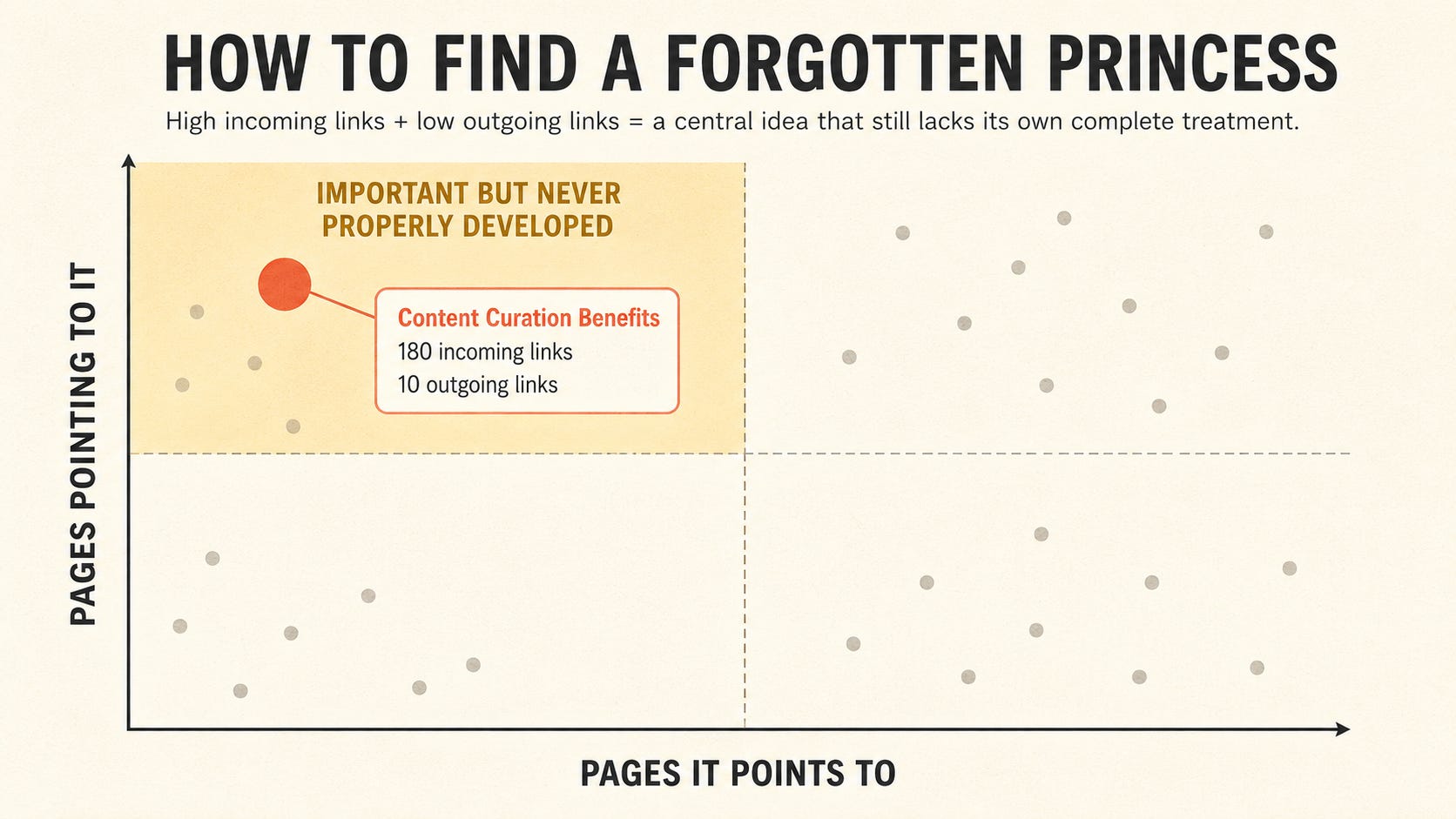
In a knowledge graph, including an LLM-wiki, every page carries two numbers: how many pages point to it and how many pages it points to.
When the first is high and the second is low, you’ve found something that you write about, but that you have never given a proper dedicated treatment to.
There it is, something of indisputable value and importance that you have taken somewhat for granted.
My biggest one is the “content-curation-benefits” page which has 180 pages pointing at it and only 10 going out. Nearly everything I’ve published leans on that idea, but I have never dedicated an article to illustrating and explaining the benefits of content curation to my average reader. I know them so well, having experienced them for so long, that to me they are obvious, granted, second nature, and that’s probably why - at least in the last 3 years - I never spent time covering this subject in detail. (The last time I had written about it was in September 2017: The Key Benefits of Content Curation - Advantages of collecting, adding value and sharing with intent.)
This was the first real gap the knowledge base made visible: an idea central to nearly everything I write, but never properly explained on its own.
I am sure I have several forgotten princesses in my knowledge base that I will want to go to and rescue from their forgotten prison towers.
Text within this block will maintain its original spacing when published
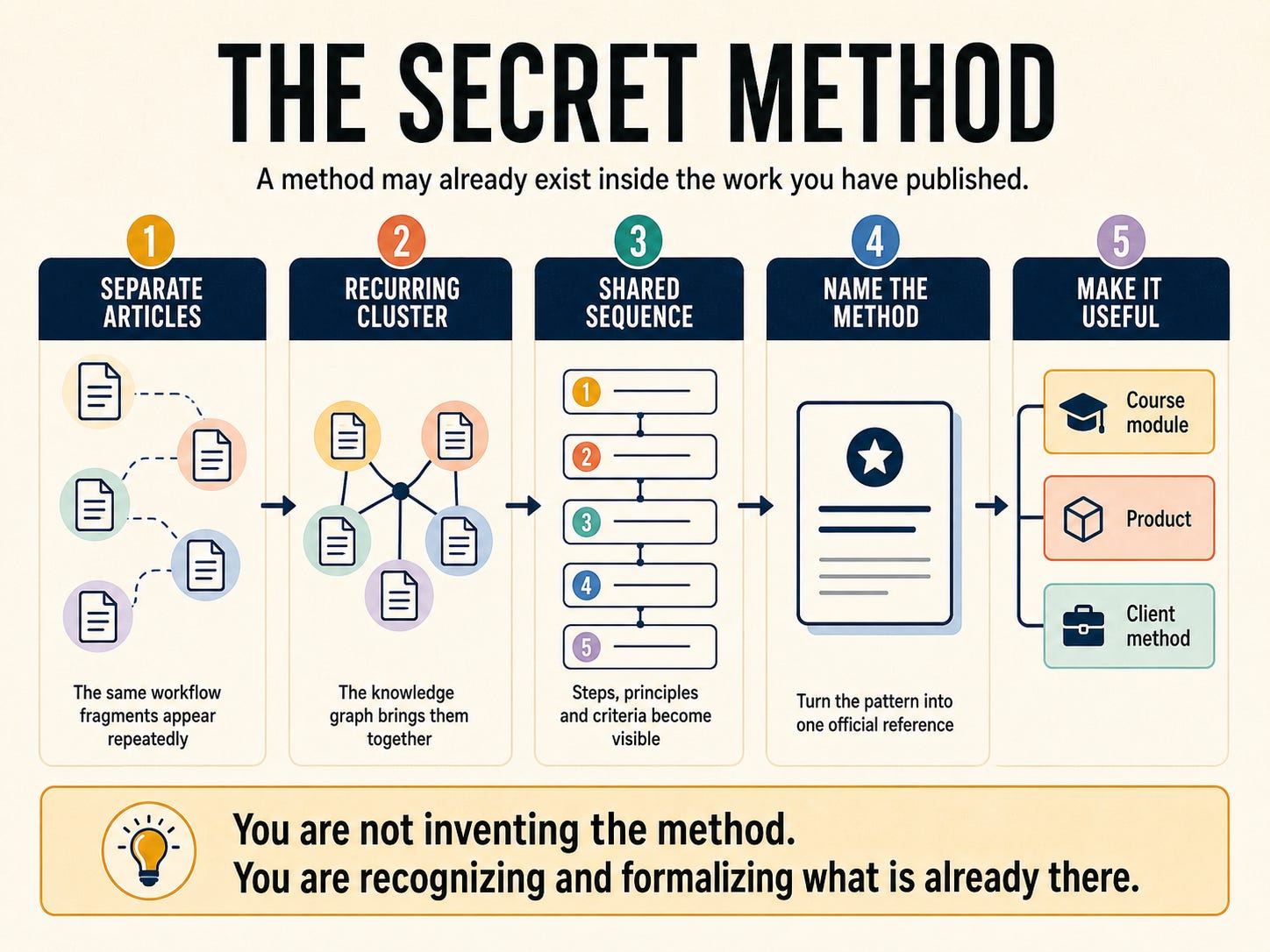
The second discovery was that, when you can see all of your content as an organic whole, you start noticing individual elements in it that have become key parts of your approach and workflow (your method) even though you have never put them together as a shareable reference.
I did this once already with a method I now teach. The knowledge graph helped me spot the next candidate: a tight cluster of curation workflow steps that keep showing up together, but with no single official reference or name. This could become my updated curation formula.
When you put together something like this, something that is already in the content you have written, you’ve got an official method people can learn from and which can become a course module or a product. A named method is what a high-ticket client actually buys, so this is potentially a very valuable discovery.
Text within this block will maintain its original spacing when published
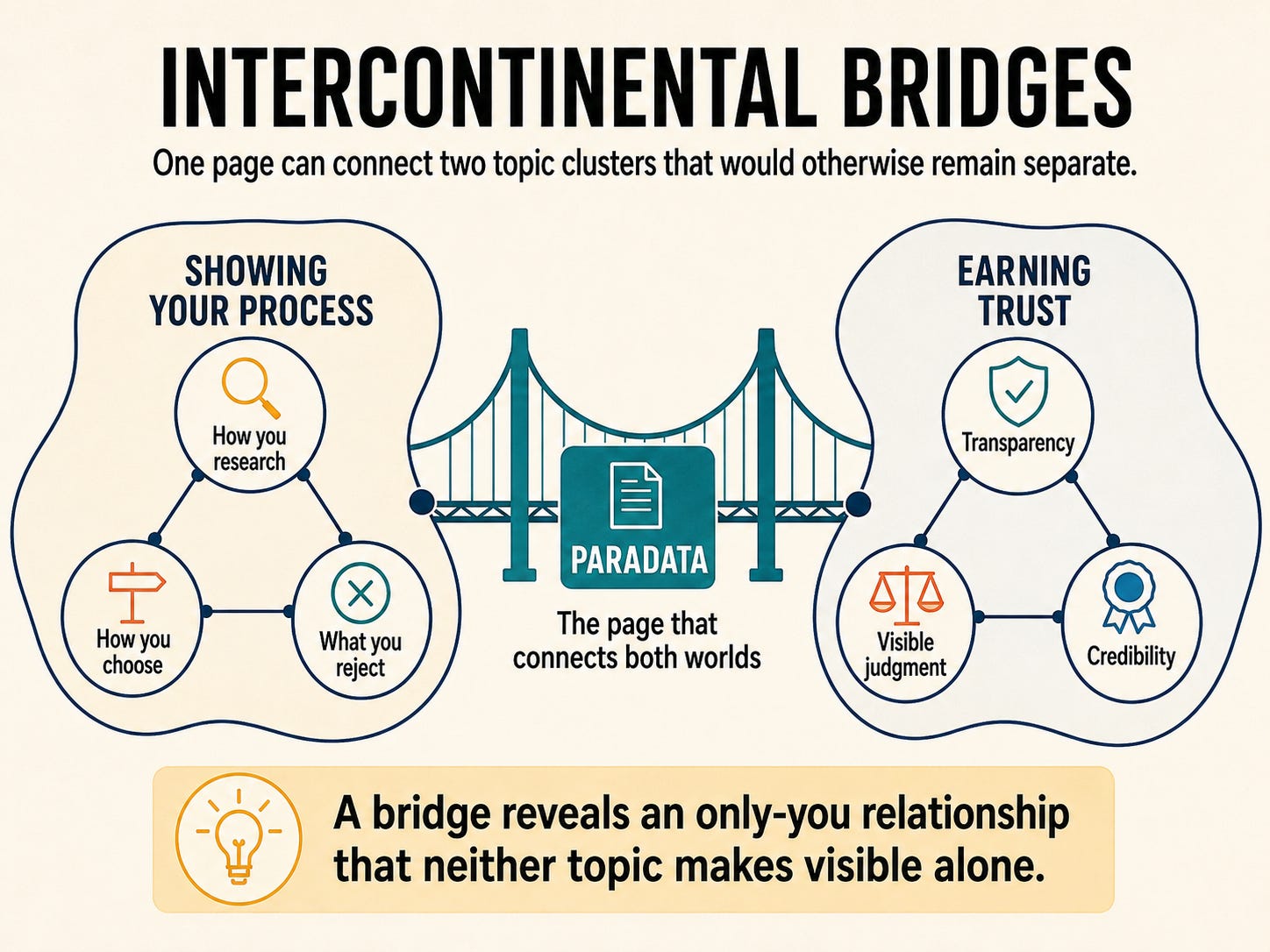
The third discovery that emerged from analyzing my knowledge base was the existence of cross-continental bridges.
A cross-continental bridge is a single page that unites two topic clusters that would otherwise remain completely separate from each other.
For example, in my case, it was my Paradata page that allowed me to see an otherwise impossible-to-see relationship between the mechanics of showing your process and the softer business of earning trust. It reaches all the way across to Maria Popova and to crystallized-intelligence research. By connecting two apparently separate worlds, it acts as a bridge that clearly shows where your only-you angle lives.
Text within this block will maintain its original spacing when published
Other interesting things I noticed:
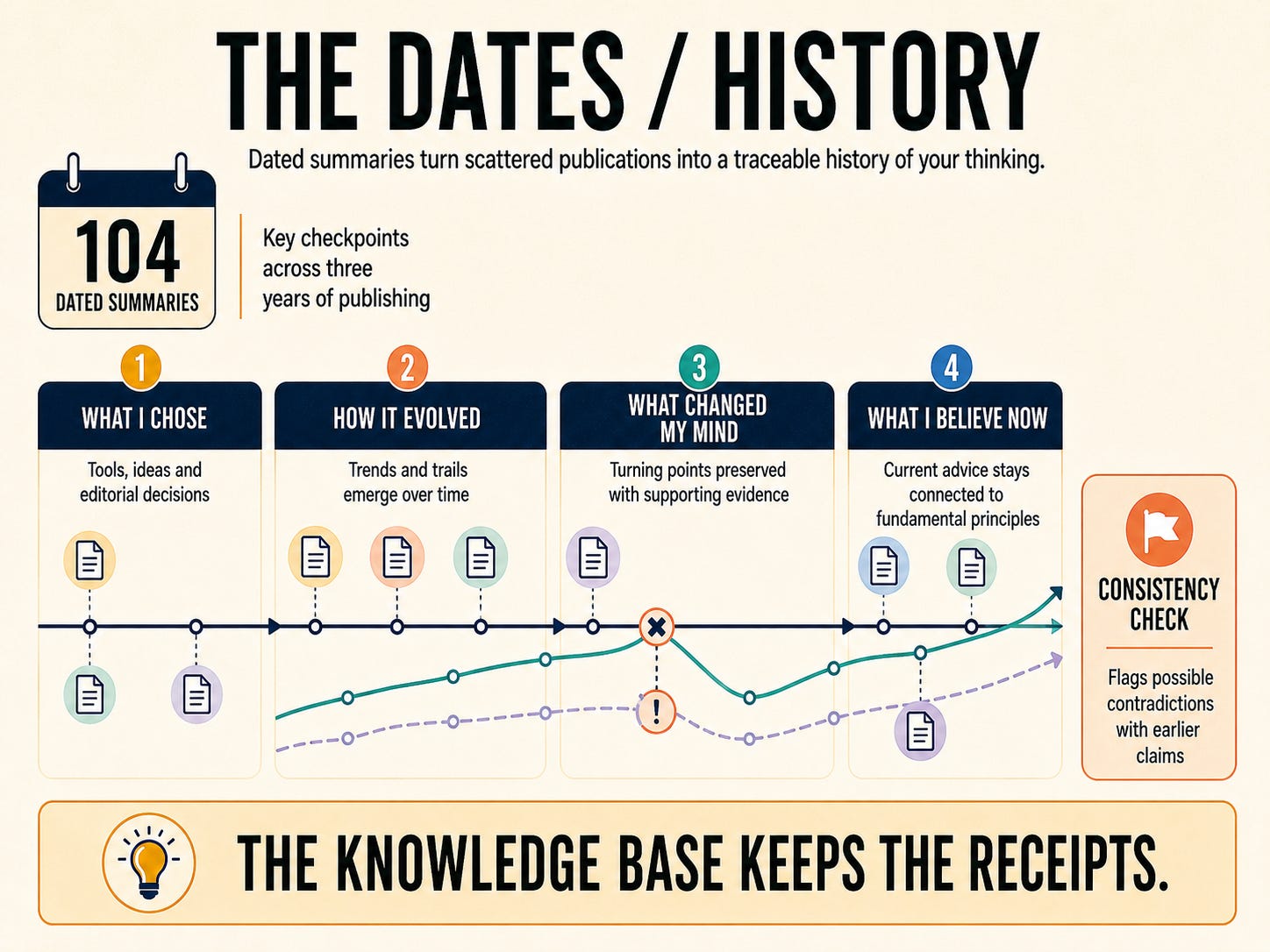
My base has 104 dated summaries, which correspond somehow to my key checkpoints as an online publisher. I can see my story and the decisions I took.
For example, I can now see how my selection of curation tools has evolved over time and the trends and trails that emerge from it.
I can also see how I changed my mind “I used to believe this, but here’s what made me realize I was wrong…” with supporting evidence.
The knowledge base keeps the receipts. It also warns me when I am about to contradict something I argued last year, so that the advice I give to a client today stays consistent with my fundamental principles.
Text within this block will maintain its original spacing when published
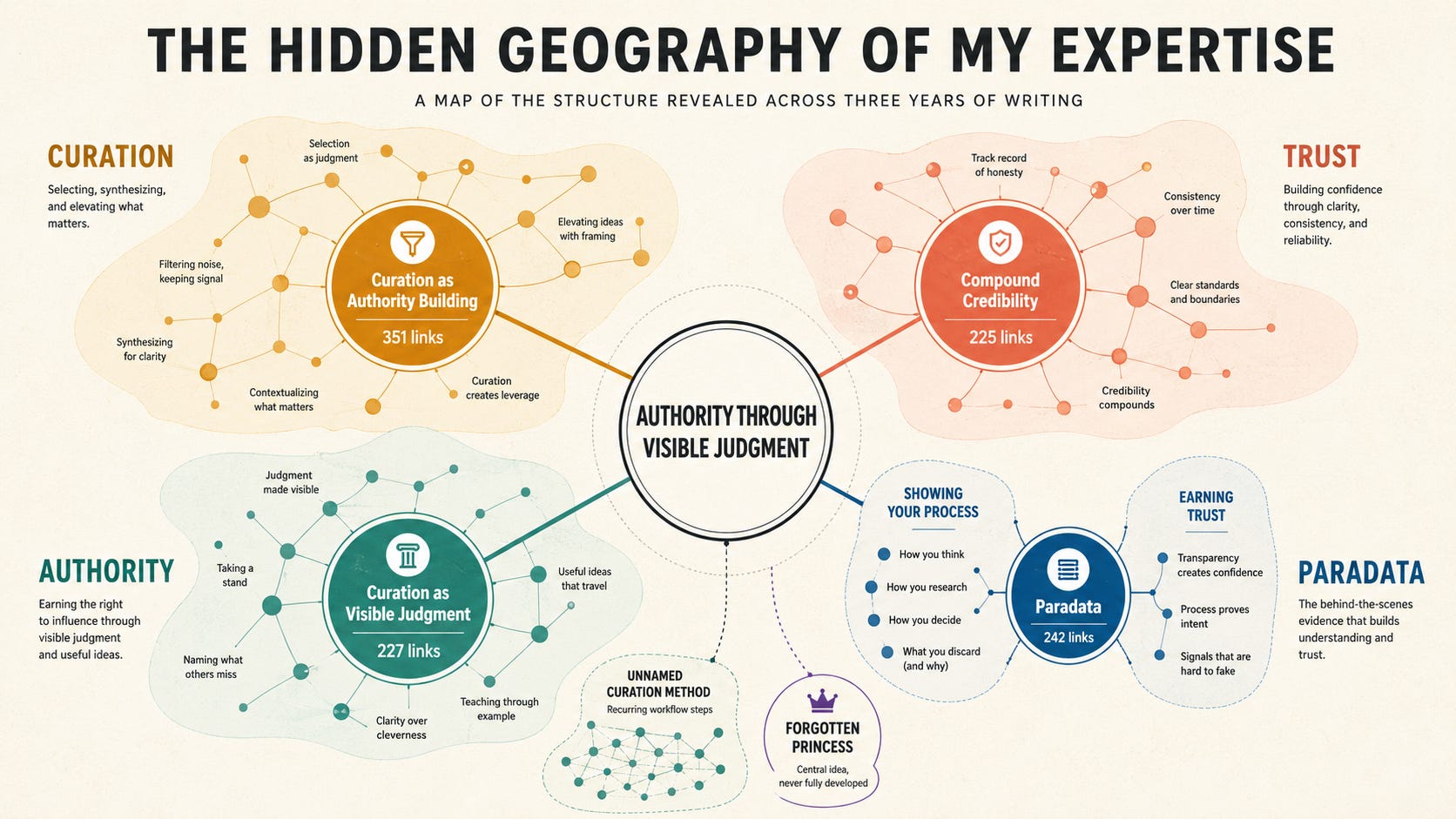
This one, I didn’t expect. Or better yet: I thought I knew, but my feelings of what I do and who I do it for, weren’t as sharp and defined as what the knowledge base presented to me. The knowledge base revealed the key topical threads, the through-line between them, and the chapters I would have to write if this body of work were to become a book.
Look at what floated to the top of my graph without my planning it: authority through visible judgment. I wouldn’t have been able to pinpoint and synthesize this by myself alone.
1) curation-as-authority-building - 351 links,
2) paradata - 242,
3) curation-as-visible-judgment - 227
4) compound-credibility - 225.
Some, like no. 1 and no. 3, I consciously chose. But no. 2 and no. 4 naturally emerged.
The LLM-wiki machine basically read the last three years of my choices and labelled the topics I had focused on. My rising hubs now form a thesis I have been building across dozens of separate pieces. It reflects faithfully what I believe, what I have been focusing on, and who I am trying to help, better than any self-critical analysis I could have done alone.
Text within this block will maintain its original spacing when published
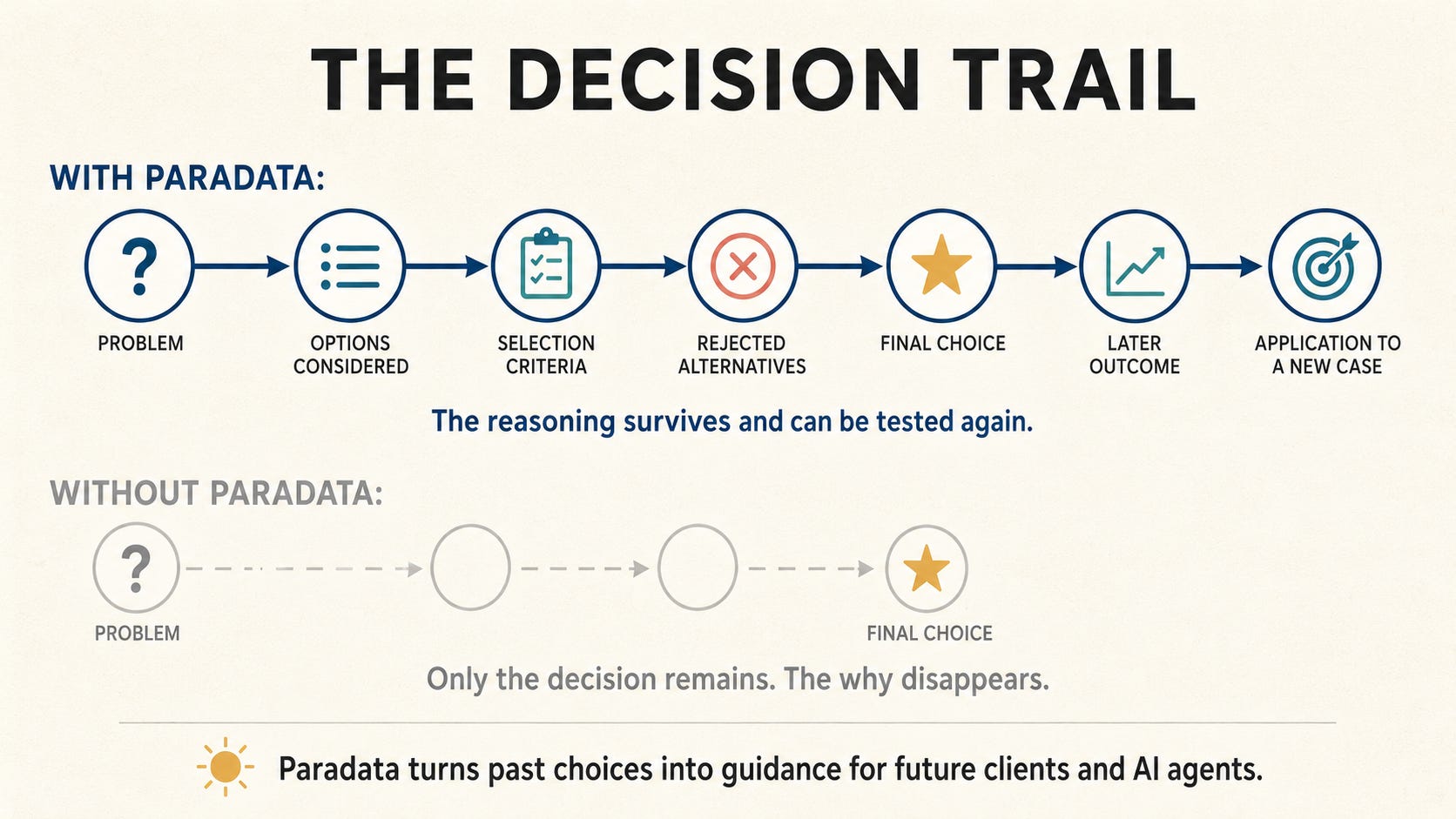
The last discovery I made was the most useful. It came from looking at the reasoning behind my calls, not just at the choices I made.
This reasoning started to emerge the moment I started to compile a Paradata section for each of my articles. As a consequence, inside my knowledge base the paradata page now holds the selection criteria and rejected options behind many of the decisions I have been making as a TRUSTable editor.
What’s the value in this?
I now see a visible trail of choices and decisions which I have never had access to before. I can see and trace back my reasoning and the turns I took to bring back the discoveries and insights I wrote about.
Now when a client brings me a fresh problem, I can pull the why behind those old choices and test it against any new case.
It could also provide guidance and a strong reference point to any of my AI agents when they are assigned to evaluate and analyze a new situation or problem. It keeps AI from drifting away from what you actually think, as you’re now providing a ground truth to check against.
Text within this block will maintain its original spacing when published
My curiosity and desire to explore the LLM-wiki concept and Dr. Tali Režun’s implementation in the Curator app, gave me a truly special lens through which to analyze my work. With them I can now see across all of the content I have published in an organic, comprehensive and intelligible way.
I am now able to see my ideas from the outside while being able to inspect, interrogate, research and analyze them.
The knowledge base built a mirror map of what I think, believe and have done.
With this base now constantly available, it’s hard for me to imagine a day in the future when I will be wondering what to write about.
By growing this knowledge base I have basically given life to an organic mirror of my thinking which, like a small young tree, requires tending (LLM-wiki linting activities), watering and nutritious soil (the new content I feed into it), but which keeps growing and compounding each time I feed it something new.
Text within this block will maintain its original spacing when published
If you don’t want to use existing tools that implement the LLM-wiki concept but would like to build your own, please note that Andrej Karpathy’s concept is ready to be fed to your preferred AI and made into your own personal KB, based on his principles.
Here’s what he wrote: “This is an idea file, it is designed to be copy pasted to your own LLM Agent (e.g. OpenAI Codex, Claude Code, OpenCode / Pi, or etc.). Its goal is to communicate the high level idea, but your agent will build out the specifics in collaboration with you.”
Once your knowledge base exists, it’s the quality of the questions you ask that makes a tangible difference in the level of value you can extract from it.
Based on the discoveries I shared above, here is a set of questions that - at least in my case - have proved capable of unearthing super-valuable materials and ideas.
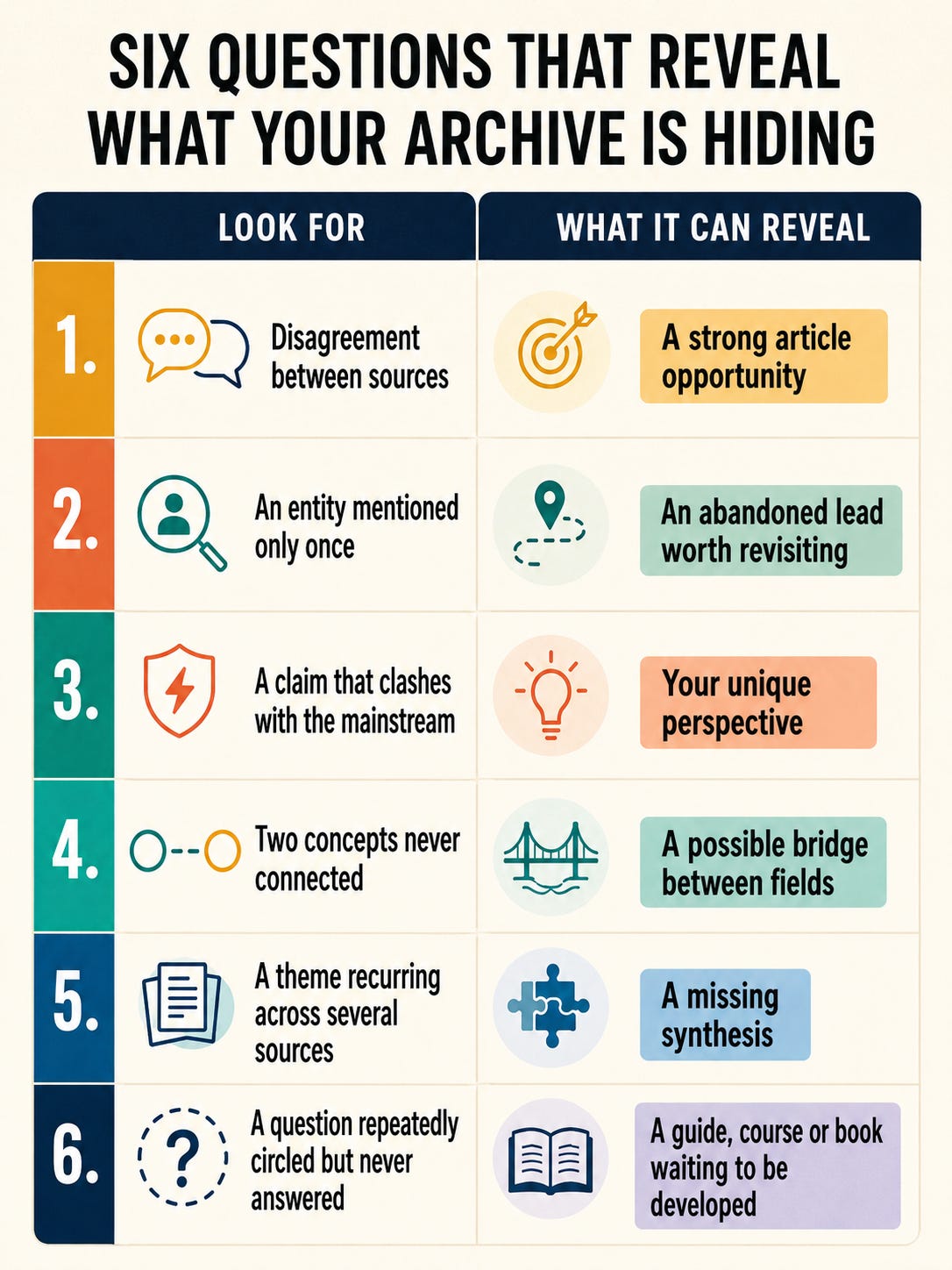
Each of these questions looks specifically for something that you can’t easily find by hand.
Text within this block will maintain its original spacing when published
“Which concepts here have the most sources disagreeing, and what exactly is the disagreement?”
Great fuel for the next possible article.
Text within this block will maintain its original spacing when published
“List every entity tied to [topic] that I’ve mentioned only once, and tell me what I never followed up on.”
Entities mentioned only once can point to overlooked material from which to begin new explorations.
Text within this block will maintain its original spacing when published
“What does my base claim about [topic] that clashes with the current mainstream view?”
See and exploit your unique perspective.
Text within this block will maintain its original spacing when published
“Show me two concepts linked to the same sources but never linked to each other.”
A bridge opportunity that opens up space for new perspectives and ideas.
Text within this block will maintain its original spacing when published
“What runs through at least four sources that I’ve never written a single page to pull together?”
Synthesis waiting to happen, already half-supported by your own citations.
Text within this block will maintain its original spacing when published
“What question does my base keep circling but never answers directly?”
This could actually be the direction of a guide, course or book you have not written yet but for which you already have most of the content and ideas.
Text within this block will maintain its original spacing when published
The LLM-wiki personal knowledge base concept can be applied to a lot of different contexts. A few examples:
Personal: tracking your own goals, health, psychology, self-improvement, filing journal entries, articles, podcast notes, and building up a structured picture of yourself over time.
Research: going deep on a topic over weeks or months. Reading papers, articles, reports, and incrementally building a comprehensive wiki with an evolving thesis.
Reading a book / Learning any topic: filing each chapter as you go, building out pages for characters, themes, plot threads, and how they connect. By the end you have a rich companion wiki. Think of fan wikis like Tolkien Gateway, thousands of interlinked pages covering characters, places, events, languages, built by a community of volunteers over the years. You could build something like that personally as you read just about anything, with the LLM doing all the cross-referencing and maintenance.
Business/team: an internal wiki maintained by LLMs, fed by Slack threads, meeting transcripts, project documents, customer calls. Possibly with humans in the loop reviewing updates. The wiki stays always up-to-date, and becomes indispensable because the LLM does the maintenance work that no one on the team is willing to do.
Competitive analysis, due diligence, trip planning, course notes, hobby deep-dives, anything where you’re accumulating knowledge over time and want it organized rather than scattered.
Source: A. Karpathy
Text within this block will maintain its original spacing when published
Intent / Why: I wrote this article to show what a personal knowledge base actually does for you once you start feeding it, using my own as a real example instead of talking about the possibilities in the abstract.
I discovered the LLM-wiki and The Curator app out of pure curiosity. Only after investing some serious time using it did I discover how much I could see that had been invisible to me before.
So I wanted to share my discovery in a way that could be useful and actionable for others.
Process: Before I started writing, I checked my own reader data. I went through opens, clicks, reactions, and saves across the last 40-odd TRUST-able issues in StackContacts (advanced analytics for Substack users).
My open rate barely moves from issue to issue, so clicks and saves are my main signal, and the pieces my readers have rewarded the most are the practical pieces that show readers something concrete.
That’s how I chose this topic over the two other ones I was considering:
a) a full synthesis of curation frameworks and the introduction of my own,
b) a piece on what I’d been calling the content context.
The framework piece is long overdue, but it would have piled onto a recent set of framework-heavy issues, while the content-context idea is one I’ve already brought to the main stage under different titles.
I also checked what I had already published on this very topic, so that I wouldn’t repeat myself.
In Issue #76 I have already explained how the Curator app works:
while in #74 I already did the personal-map angle by sharing my curation influences and lineage.
So I decided to deliberately cover new ground: what it actually does once it’s running and what specific benefits it provides.
The framing took the most work by far. My first full draft was a clean list of six uses. It was accurate but completely flat. Boring, academic.
I then considered dressing it as a problem-insight-solution piece but after a while I discarded that too, because, honestly, there was no problem that had driven me here, and inventing one would have been a small lie that good readers would eventually smell. Not in my style.
So I built my narrative around my true, raw, personal story: the curiosity, the surprise of seeing my own mind mapped, the benefits and applications I am starting to see.
Every number in this article came straight from my live Curator wiki. Every word you have read up to this point was written by hand.
Text within this block will maintain its original spacing when published
Time:
Research and data scan: 1 hr.
Drafting and framing: 1 hr.
Writing: 4 hrs.
Formatting and links: 1.5 hrs.
Grammar and error check + fixes: 1 hr.
Cover design: 1 hr.
Title and subtitle: 0.5 hrs.
Total apx. time: 10 hrs.
Text within this block will maintain its original spacing when published
Tools:
The Curator app + My Curator MCP + my personal knowledge base
Claude Cowork
StackContacts (my Substack metrics)
ChatGPT for title and cover as usual
Text within this block will maintain its original spacing when published

Cover image: A personal knowledge base is a mirror showing what you know and how you think - Concept & Design by Robin Good, executed by ChatGPT Image 2.
Text within this block will maintain its original spacing when published
Text within this block will maintain its original spacing when published
Private consulting for experts and consultants who want to start building useful time-resistant knowledge resources in their field of expertise.
One-to-One Audit & Strategic Advice
Text within this block will maintain its original spacing when published
I help experts and consultants who are building a new online career gain the authority, credibility, and visibility they initially lack.
I do this by teaching them how to become trusted curators in their area of expertise.
For this purpose I’ve created a focused 55-minute video workshop that walks you through:
Why curated content formats are so useful for building credibility and authority
When to use them and what requirements they have
An updated list of real-world examples of curated formats at work
The specific tools you need to curate
The actual key steps that transform researching and writing into curation
The 11 typical mistakes novice curators make
The Curation-Based Authority System
Text within this block will maintain its original spacing when published
Follow a path with a heart.
The time is now.

From Koh Samui (TH)
Robin Good
Comments
Nothing yet. Say the first thing.
Sign in to join the conversation.