
Hi all -
Q2 is over, we're moving into summer, and I hope everyone is europemaxxing. Three things from the last few weeks worth flagging.
We hosted our General Catalyst resilience dinner series in SF, bringing together European founders and operators building there. We’ll bring this to more cities soon. Then, SpaceX went public at a $1.77 trillion valuation, the largest IPO in history. I shared some thoughts with Sifted on what it means for us: space has been going “mainstream” for the last 12 to 24 months regardless of this IPO, largely because whoever controls launch and/or the data coming from orbit controls a lot of the downstream economy, and this just accelerates that. But it's also a mirror. It shows us what we're missing in Europe and what we need to build, and there's real urgency to catch up. Lastly, we also supported the launch of SPARTA 2.0, laying out the 10 critical gaps Europe needs to close to get to real strategic autonomy. Again, lots of work ahead for us to do.
More on all three threads below, plus who Europe’s deep tech ecosystem really is, how the best resilience companies hire, and where the money is moving.
Enjoy reading.
Robin
Got a friend or colleague interested in manufacturing? Help me spread the word by sharing the newsletter if you like it!
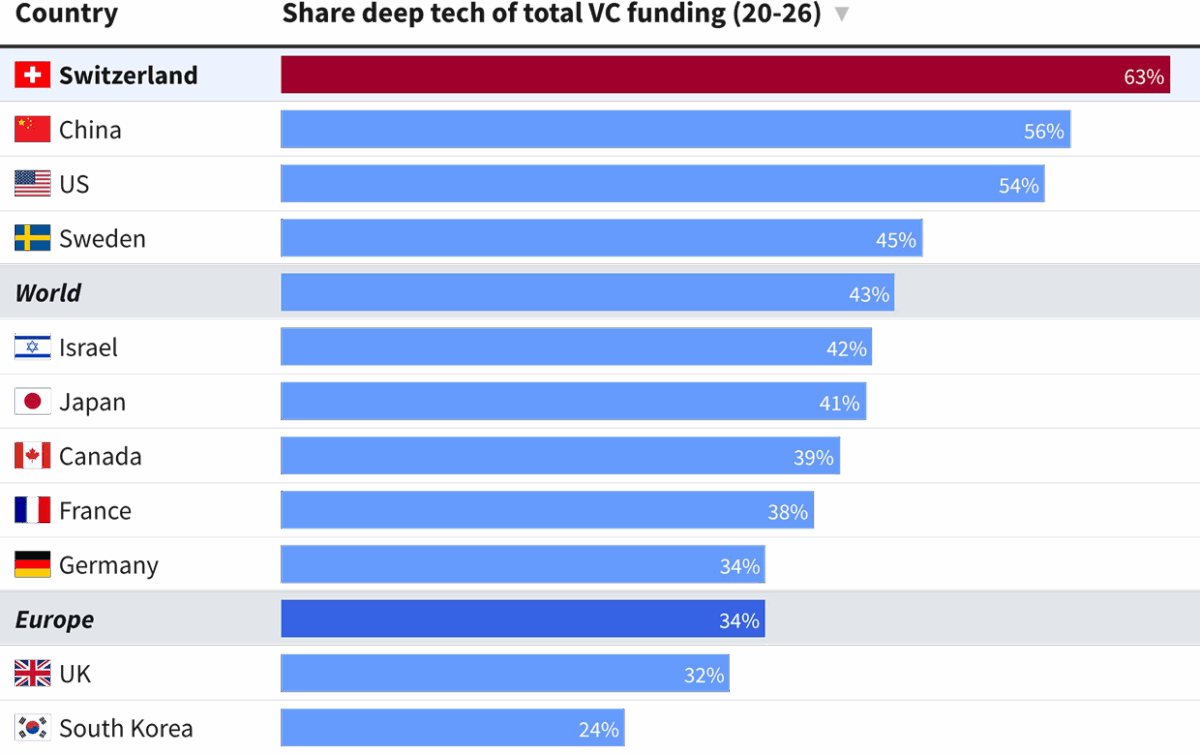
Our friends at Founderful, Dealroom and others have launched the Swiss Deep Tech Report 2026, and the numbers are worth sitting with. Switzerland directs 63% of all its venture capital to deep tech, the highest share of any country in the world, ahead of China at 56% and the US at 54%. At $1,470 invested per capita, it leads Europe and ranks in the global top three alongside Israel and the US. Funding has grown roughly 5x over the past decade to a record $2.6B in 2025, and ETH Zurich and EPFL are producing more venture-backed spinouts than any other university system in Europe. AI/ML now accounts for one in four startups founded since 2022, and robotics has nearly doubled its share of new company formation. The one thing to watch: foreign investors supply 88% of funding for Swiss deep tech rounds above $100M, with US investors alone providing more than half of late-stage capital. The science and the talent are homegrown, but the late-stage capital largely isn't, yet.
Our amazing talent partner Chloe has published "Built to Endure" recently. The core argument: when your end user is a soldier, a factory floor, or a piece of orbital infrastructure, the first ten hires aren't just a team, they're a signal, and the standard advice (hire someone who's done this exact job before) mostly breaks down because these categories are too new to have a real talent pipeline. The better filter is "gradient", ie. how fast someone learns and adapts, not their resume. Nominal* looks for engineers obsessed with what they build rather than aerospace pedigree. Vital Lyfe* has hired engineering leaders from completely unrelated hardware categories who'd taken complex systems from prototype through qualification. Chariot Defense* and Valinor* both show what mission-driven hiring looks like once a company scales past its founding team. Worth reading in full if you're building in this category.
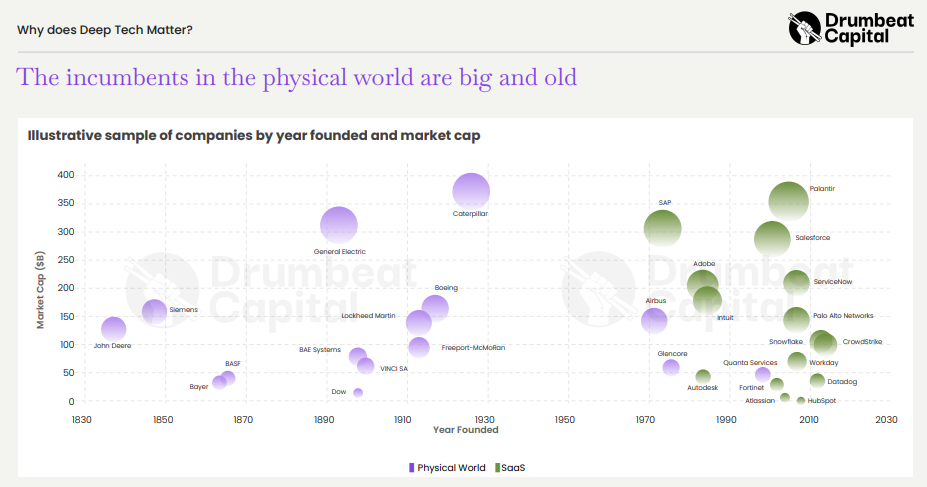
Besides the Swiss Deep Tech Report, Drumbeat Capital and Dealroom published The Transatlantic Deep Tech Report 2026, mapping the US and European deep tech markets side by side. It's a useful companion to the Swiss report above: zoom out from any single country and the same pattern shows up across Europe more broadly. Strong scientific output and founder quality, capital still concentrated in a handful of hubs, and a growing share of late-stage rounds filled by American investors. The full report requires sign-up, but the framing alone, treating the US and Europe as one interconnected deep tech market rather than two competing ones, is the right way to think about where capital and talent actually flow. I specifically liked the comparison below on the incumbents in the physical world (they’re big!).
York Yang, cofounder of Dyna Robotics, has a good X thread making the case that what actually drives progress in robot learning right now is real deployment data compounding in production, not flashier demos. It's a useful corrective to a month that also delivered the opposite lesson. Kyle Chan posted video of Lightning, a humanoid robot built by smartphone maker Honor, shattering the world record for a half marathon in Beijing at 50 minutes 26 seconds, only to crash into a railing meters from the finish line and need a team of humans to pick it up and help it stagger across. Both things are true at once: robots are getting dramatically more capable, and the gap between a viral demo and a reliable production system is still enormous.
Anduril* unveiled ArsenalOS, a software platform meant to be the digital backbone connecting design, manufacturing, supply chain, and sustainment across its factories, replacing the outdated tracking methods that still plague most defense manufacturing. Early deployments of just the work-instruction layer cut authoring time by roughly 87.5%, turning a 12-hour process into 90 minutes. It’s another data point in a pattern I keep flagging in this newsletter: the companies winning in defense manufacturing are increasingly building their own software stack rather than bolting on legacy MES tools, because the software layer is where the real speed advantage compounds.
ICEYE* closed a €450M primary Series F led by General Atlantic, with the total round including a secondary placement exceeding €1B, valuing the company at over €10B. ICEYE is now doubling production from 50 to 100 satellites a year by 2028. As stated in Defense News, the real goal is ramping to two satellites a week as future constellations move into the hundreds of units. One recent proof point that is still hard for me to grasp: ICEYE delivered a full sovereign radar satellite system to the Polish Armed Forces in under 12 months from contract signing, among the fastest satellite procurement programs in history, at roughly a tenth of the cost of legacy systems. This is what sovereign capability looks like once the industrial base actually exists to build it - from Europe to the world.
General Intuition* raised $320M at a $2.3B valuation, led by Khosla Ventures with participation from us at General Catalyst, Jeff Bezos, and Eric Schmidt. The thesis: the action data embedded in hundreds of millions of hours of gameplay, literally what buttons a player pressed and when, teaches a model spatial-temporal reasoning that transfers to robots, drones, and other embodied systems in the physical world. In a demo, the company showed a quadruped robot fine-tuned on just eight minutes of real-world data, powered by the same model that had spent 100 hours straight playing a Fortnite-like game. Whether gameplay is really a scalable shortcut to physical-world generalization is still an open question, but it's one of the more interesting thesis on solving robotics' data bottleneck.
Agility Robotics, maker of the bipedal robot Digit, announced to go public through a merger with Churchill Capital Corp XI at a roughly $2.5B valuation, expecting to generate more than $600M in proceeds. Its robots are already deployed across nine customer sites including Schaeffler, GXO, Toyota, and Mercado Libre, and the company says it has secured over $300M in multi-year orders for its next-generation robot. SPACs fell out of fashion for years … but it seems like they are back.
Autodesk agreed to acquire MaintainX, the maintenance and operations software company, for roughly $3.6B in cash, its largest acquisition ever and a staggering amount I find. MaintainX helps factory and facility teams manage work orders, inspections, and day-to-day maintenance, and will anchor a new Autodesk Operations Solutions division alongside Fusion Operations and the Tandem digital twin platform. A reminder that the design layer and the operations layer of manufacturing software are consolidating, and that what happens after the factory or building is built is becoming just as valuable as designing it in the first place.
👉 Sereact (DE): has raised a $110M Series B led by Headline to scale its Cortex 2.0 "robot brain" and enter the US market. Read more…
👉 SendCutSend (US): has raised a $110M round backed by Sequoia and Paradigm, hitting a $1B valuation for its on-demand metal fabrication platform. Read more…
👉 Standard Bots (US)*: has raised a $200M Series C at a $1B valuation, with backers including us at GC, to scale its American-made, AI-native industrial robot arms used by customers from Lockheed Martin to NASA. Read more…
👉 Theker Robotics (ES): has raised $85M Series A, led by CRV with Samsung and LVMH's Aglaé Ventures participating, to build reconfigurable factory robots for Inditex and others. Read more…
👉 Zipline (US): has added another $200M to its Series H, pushing the round to $800M, to fund drone delivery expansion into Houston, Phoenix, and Seattle. Read more…
👉 Layup Parts (US): has raised a $42M Series A led by Marlinspike, with Founders Fund and Lux Capital also participating, to build an on-demand ordering platform for composite parts. Read more…
Disclaimer
Views expressed in “posts” (including podcasts, videos, newsletters, and social media) are those of the individual GC personnel who wrote the post or are quoted therein and are not the views of General Catalyst Group Management, LLC (“GC”) or its respective affiliates. GC is an investment adviser registered with the Securities and Exchange Commission. Registration as an investment adviser does not imply any special skill or training. The posts are not directed to any investors or potential investors, and do not constitute an offer to sell or a solicitation of an offer to buy any securities, cryptocurrencies, or any financial instrument or property, and may not be used or relied upon in evaluating the merits of any investment. Additional important information about GC, including Form ADV Part 2A Brochure, is available at the SEC’s website:
http://www.adviserinfo.sec.gov
Nothing here should be construed as or relied upon in any manner as investment, legal, tax, or other advice. Any projections, estimates, forecasts, targets, prospects, or opinions expressed in these materials are subject to change without notice and may differ or be contrary to opinions expressed by others. Any charts or figures provided here are for informational purposes only and should not be relied upon when making any investment decision. Certain information contained in the content has been obtained from third-party sources. While taken from sources believed to be reliable, no one has independently verified such information, and there are no representations about the enduring accuracy of the information or its appropriateness for a given situation.
To the extent any content authored or provided by any GC personnel in this forum or medium makes reference to any company in which any of the funds or vehicles advised by GC have an economic or financial interest, previous or current, none of the information provided or opinions expressed herein are connected in any way with GC’s business activities, and GC did not provide any information or assistance in the creation of this content.
*is a GC portfolio company
No posts
Comments
Nothing yet. Say the first thing.
Sign in to join the conversation.