
Hi all -
a lot has been happening since the last issue, and two things have been particularly top of mind. We published our updated European resilience thesis at General Catalyst. It sharpens how we’re thinking about investing across manufacturing, defense, and energy in Europe - industries where the strategic stakes have never been higher. If you haven’t had a chance to read it yet, I’d encourage you to.
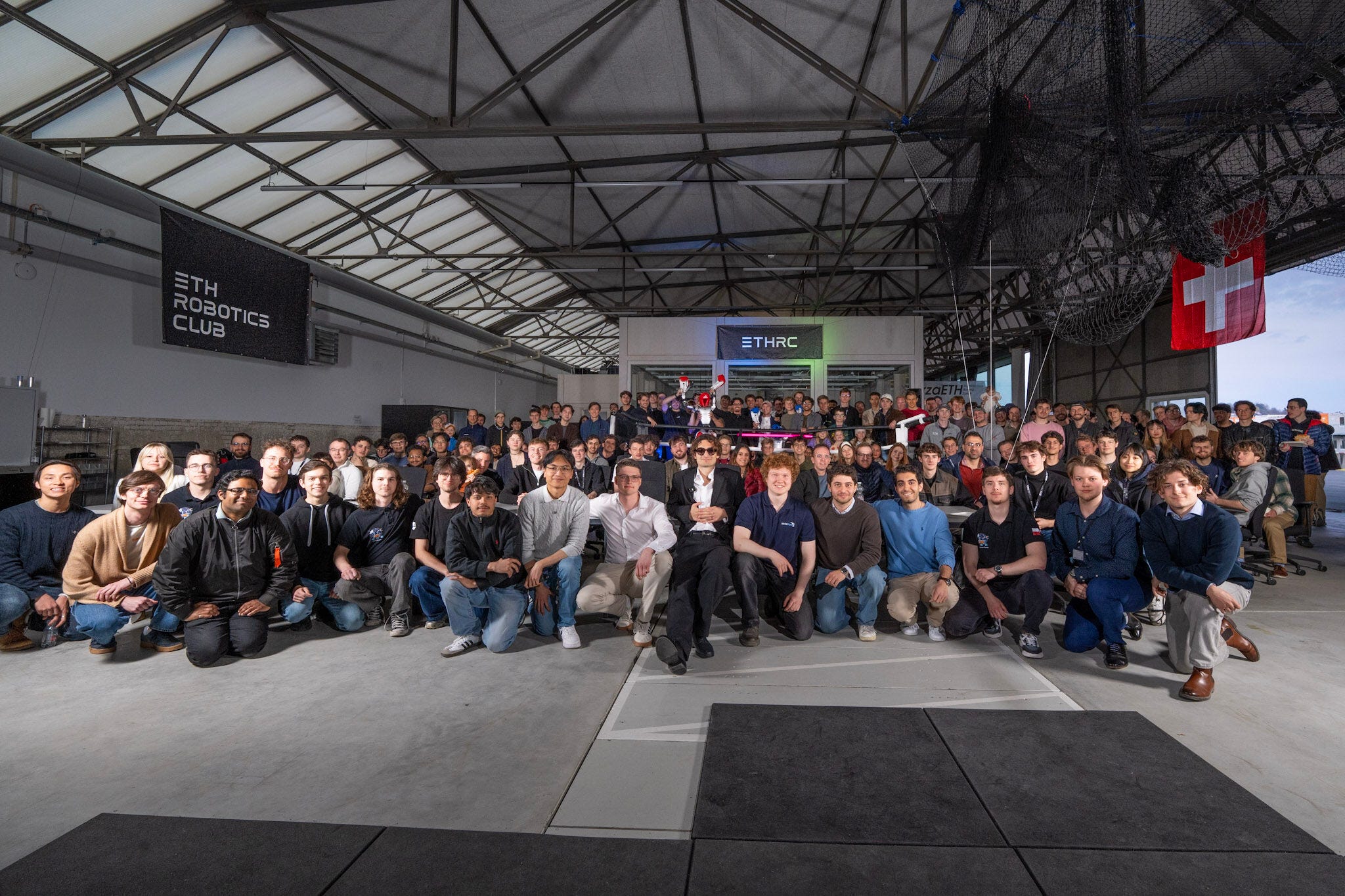
We also hosted a robotics hackathon with the ETH robotics club, which was genuinely energizing. Watching teams work through real industrial problems in a compressed timeframe reinforced something I believe deeply: the talent and ambition in this space are real.
A common thread through both: we are entering a period where physical capability and supply chain independence matter as much as software. The articles in this issue make that case better than I can.
Enjoy reading.
Robin
PS: Have you ever seen a crêpes robot in action?
Got a friend or colleague interested in manufacturing? Help me spread the word by sharing the newsletter if you like it!
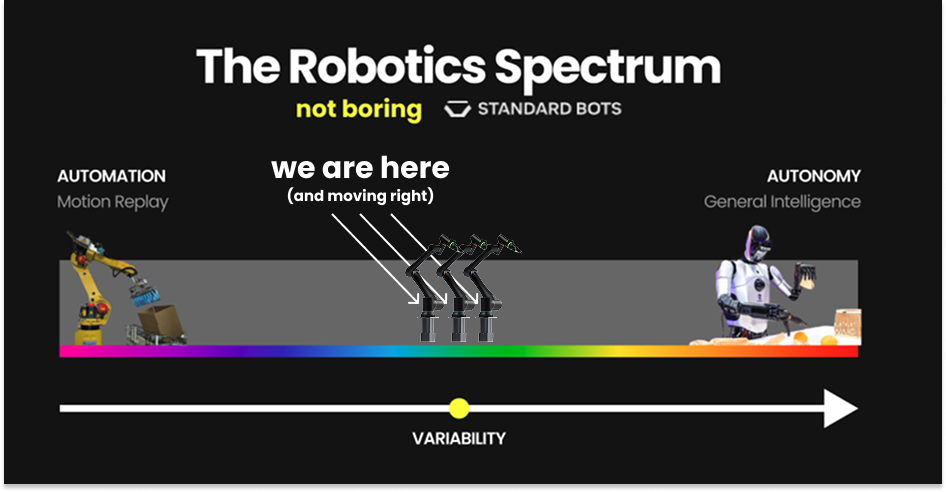
Packy McCormick and Evan Beard, co-founder and CEO of Standard Bots*, co-wrote what is probably the best robotics primer I've come across this quarter for Not Boring. "Many Small Steps for Robots, One Giant Leap for Mankind" argues that every robot task exists on a continuous spectrum of complexity, and progressing up that spectrum requires use-case-specific data - not just more compute or a bigger general model. The essay takes on the "Bitter Lesson" debate (whether general-purpose approaches will ultimately beat specialized ones in robotics, as they have in language models), digs into how robots learn through physical interaction, and is honest about where the real bottlenecks lie today. Packy put it simply: spend an hour reading it and you'll know more about robotics than 99% of people, including some people who invest in the space. It also comes with an interactive game, which is a first for Not Boring. Worth a read this weekend.
The Guardian published a detailed look inside China's push to dominate humanoid robotics - and the numbers are striking. Chinese companies accounted for roughly 90% of the 13,000+ humanoid robots shipped globally in 2025, with over 140 domestic manufacturers having unveiled more than 330 distinct models. A large part of the story is cost: hardware prices for key components have more than halved as the EV industry's rapid scaling created economies of scale in actuators, sensors, and batteries - adjacent hardware that transfers directly into robotics. China is also addressing the training data bottleneck by building dedicated centers where workers perform mundane tasks to generate robot learning data, with local governments funding 40 such facilities. The gap between demos and deployable products is closing faster than most Western observers expected.
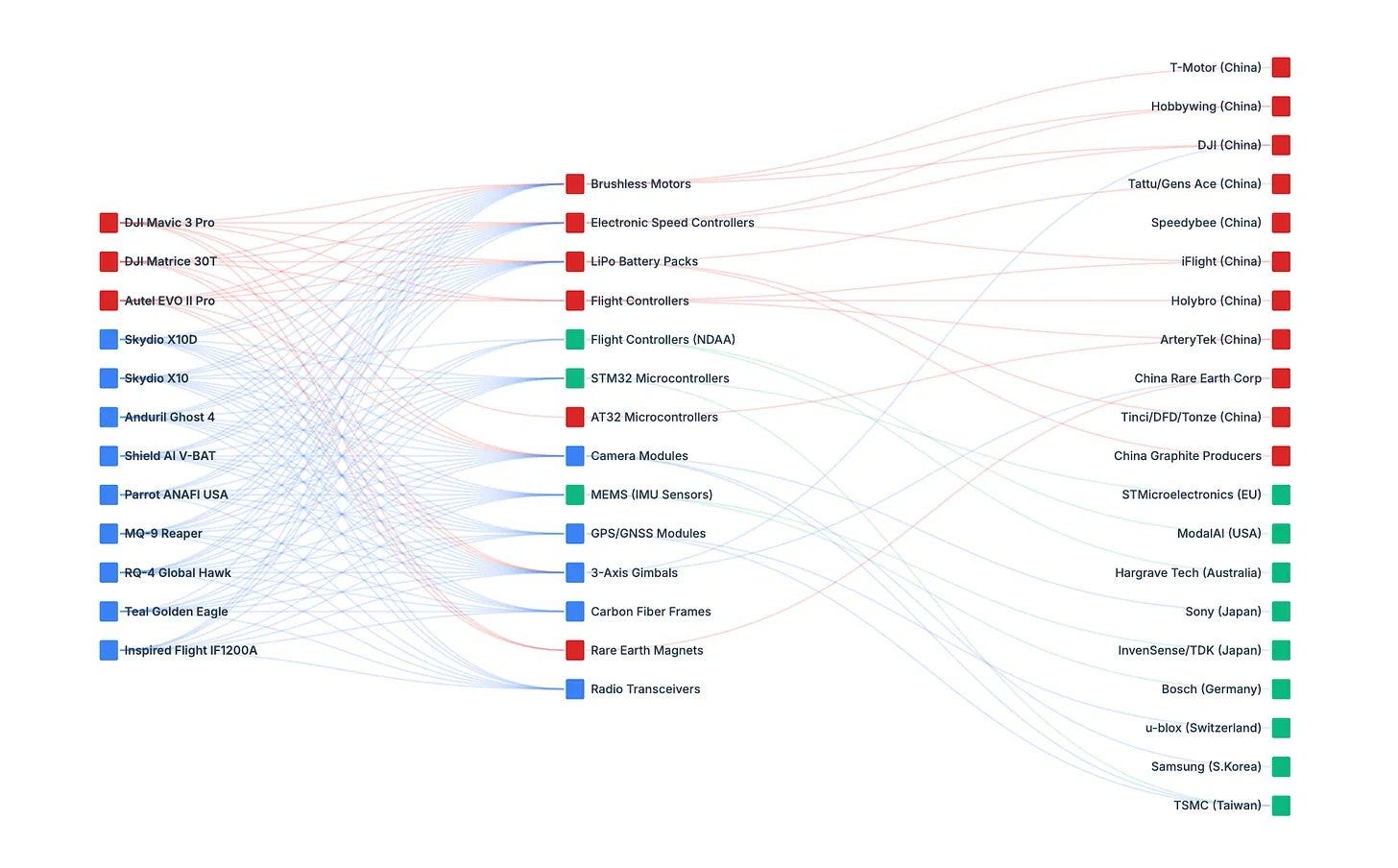
Zach Glabman's thread on the component layer makes the case that 2026 is the year when tier 2, 3, and 4 suppliers - the makers of actuators, bearings, rare earth magnets, and specialized connectors - become the real strategic chokepoints. While most attention has focused on system integrators and robot OEMs, the underlying component layer is where Chinese dominance is most pronounced and most durable (see picture below). Across robotics, automotive, and defense, these components are often single-sourced and deeply embedded in production processes, making them hard to switch away from quickly. As Western governments push for supply chain security, the honest question isn't whether we can assemble the final product - it's whether we control what goes inside it.
Reuters reported that rare earth shortages for US aerospace and semiconductor companies are worsening - even after the US-China trade truce of last October. The materials at the center of the story are yttrium and scandium: niche by name, but essential in practice. Yttrium coatings protect turbine and engine components from extreme temperatures; scandium plays a role in advanced semiconductor processes used in 5G infrastructure. Since Reuters first flagged yttrium shortages in November, prices have jumped 60% and now sit roughly 69 times higher than a year ago. Two North American producers have had to pause production and are rationing supply toward their largest customers. The trade truce addressed tariffs - but the underlying structural dependency on Chinese rare earth production remains entirely unchanged.
Oliver Hsu's thread on factory economics is a useful grounding for anyone building in or investing around manufacturing. There is often a gap between the headline narrative around reshoring and automation, and the actual unit economics most factory operators are working with day to day. Capital intensity, throughput rates, utilization, and yield are what ultimately determine whether a modern factory is financially viable - not the technology stack alone. As automation and robotics make factories more capital-intensive upfront, understanding those economics in detail matters more than ever.
Onodrim Industries* has raised €40M in seed funding co-led by Founders Fund, Lakestar, and us at General Catalyst. Founded by Aistis Šimaitis and Alexander Blessing (both ex-Palantir), the company is building hardware, software, and industrial capacity across defense manufacturing, multi-domain sensing, and networked systems for border protection and allied interoperability. Europe's defense budgets are expanding fast - what's been missing is the industrial base to spend them effectively. Onodrim is building toward exactly that.
Hadrian closed a new round led by T. Rowe Price, with Altimeter, D1, StepStone, and existing investors including Founders Fund and Lux Capital, bringing its valuation to $1.6B. The company builds software-defined precision manufacturing facilities targeting the hardest-to-source components for aerospace and defense, and is now launching an additive manufacturing division. I covered their Series C in Issue #55 - this follow-on reflects continued conviction in their "factories as a service" model as a core piece of America's reindustrialization.
Munich-based RobCo raised $100M in a Series C co-led by Lightspeed and Lingotto Innovation (Exor), with Sequoia, Greenfield Partners, and Kindred Capital also participating. The company builds Physical AI for industrial environments - combining perception, motion planning, and self-learning to enable autonomous robot operations across machine tending, palletizing, and welding. RobCo expanded into the US in 2025 and now operates from San Francisco and Austin. The round reflects growing conviction that the autonomy layer - not the hardware - is where value compounds in industrial robotics.
Tulip, the Boston-based frontline operations platform, hit unicorn status with a $120M Series D led by Mitsubishi Electric at a $1.3B valuation. The company builds AI-native, no-code software that embeds intelligence directly into manufacturing workflows, giving operators real-time production data without needing dedicated software teams. The core bet is that the frontline worker - not the backend ERP - is where AI has the most immediate leverage in industrial settings. 60,000 workers currently use the platform across manufacturing sites globally.
London-based Isembard raised $50M in a Series A led by USV. The company is building a network of AI-powered, modular manufacturing units for aerospace, defence, and robotics customers, underpinned by MasonOS - an agentic operating layer that integrates quoting, scheduling, supply chain, quality control, and delivery into a single intelligent system. The plan: 25 factories open by end of 2026, with expansion into Germany, France, and Ukraine. It is a model worth watching.
👉 Machina Labs (US): has raised a $124M Series C led by Woven Capital (Toyota) and Lockheed Martin Ventures for its AI-driven manufacturing infrastructure including a new 200k sq ft factory. Read more…
👉 Allonic (HU): has raised a $7.2M pre-seed led by Visionaries Club for its 3D tissue braiding platform that weaves robot bodies in one continuous process rather than assembling hundreds of parts. Read more…
👉 Rhoda AI (US): has raised a $450M Series A led by Premji Invest for its robotics intelligence platform combining internet-scale video pretraining with closed-loop control for autonomous operations. Read more…
👉 Bedrock Robotics (US): has raised a $270M Series B co-led by CapitalG and Valor Atreides AI Fund for its autonomous construction technology. Read more…
👉 Apptronik (US): has raised a total of $935M in its Series A by Google, Mercedes-Benz, B Capital, John Deere, and QIA, to scale production of its Apollo humanoid robot across manufacturing and logistics deployments. Read more…
Disclaimer
Views expressed in “posts” (including podcasts, videos, newsletters, and social media) are those of the individual GC personnel who wrote the post or are quoted therein and are not the views of General Catalyst Group Management, LLC (“GC”) or its respective affiliates. GC is an investment adviser registered with the Securities and Exchange Commission. Registration as an investment adviser does not imply any special skill or training. The posts are not directed to any investors or potential investors, and do not constitute an offer to sell or a solicitation of an offer to buy any securities, cryptocurrencies, or any financial instrument or property, and may not be used or relied upon in evaluating the merits of any investment. Additional important information about GC, including Form ADV Part 2A Brochure, is available at the SEC’s website:
http://www.adviserinfo.sec.gov
Nothing here should be construed as or relied upon in any manner as investment, legal, tax, or other advice. Any projections, estimates, forecasts, targets, prospects, or opinions expressed in these materials are subject to change without notice and may differ or be contrary to opinions expressed by others. Any charts or figures provided here are for informational purposes only and should not be relied upon when making any investment decision. Certain information contained in the content has been obtained from third-party sources. While taken from sources believed to be reliable, no one has independently verified such information, and there are no representations about the enduring accuracy of the information or its appropriateness for a given situation.
To the extent any content authored or provided by any GC personnel in this forum or medium makes reference to any company in which any of the funds or vehicles advised by GC have an economic or financial interest, previous or current, none of the information provided or opinions expressed herein are connected in any way with GC’s business activities, and GC did not provide any information or assistance in the creation of this content.
*is a GC portfolio company
No posts
Comments
Nothing yet. Say the first thing.
Sign in to join the conversation.