
Hi all -
as the year comes to an end, it’s become clear how tightly manufacturing, resilience, and geopolitics are now intertwined. What once felt like separate conversations are rapidly converging into a single system that will shape our next decade.
This has shown up very concretely in our work over the past months. We announced our new investment in ICEYE, backing a team building critical space-based earth observation capabilities. I also spent time discussing the future of manufacturing with Bernhard from EthonAI and Jacomo from PhysicsX. And in Munich, we hosted a resilience roundtable with Helsing, bringing together founders and operators to discuss industrial capability as a strategic asset. All of this is part of a broader body of work on European resilience we’ve been building throughout the year - and there’s much more to come next year.
As we head into a new year, I’m feeling optimistic. The challenges are real, but so is the energy across our ecosystems. Wishing you a strong start to the year ahead, and plenty of momentum to make things happen.
Enjoy reading.
Robin
Got a friend or colleague interested in manufacturing? Help me spread the word by sharing the newsletter if you like it!
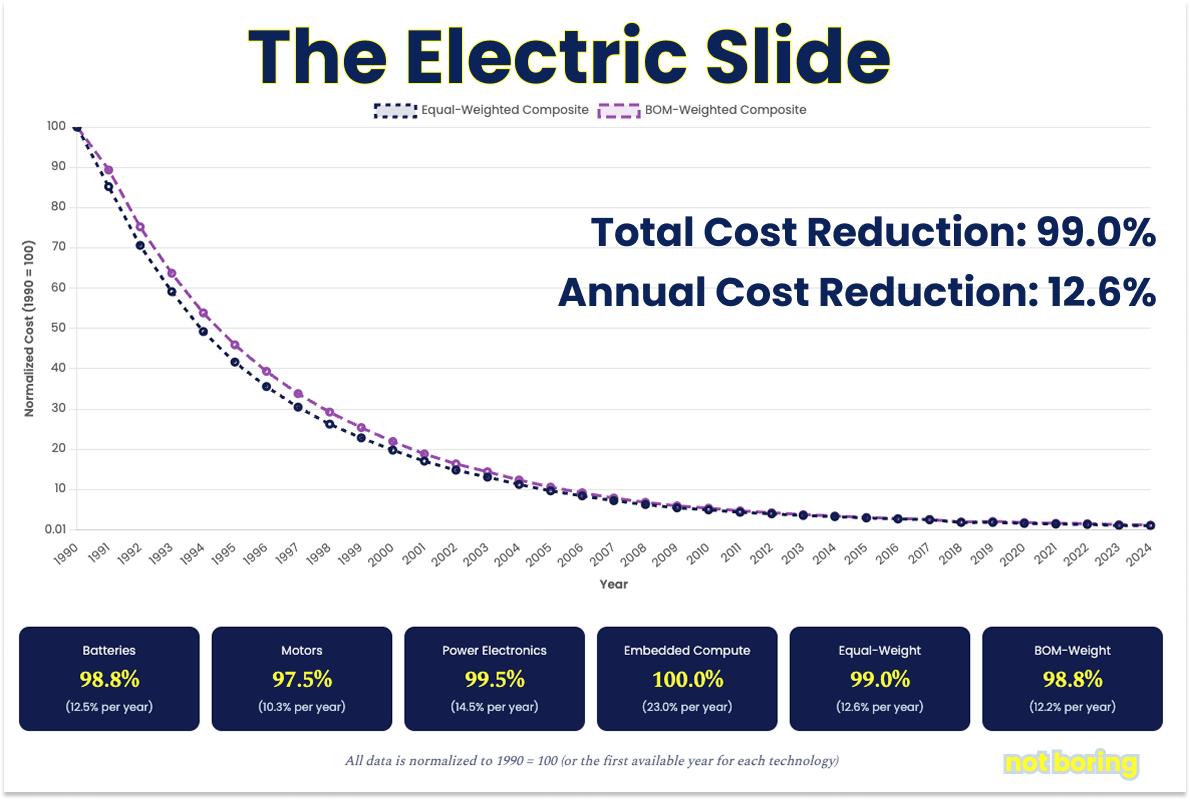
One of the best reads for me this quarter has been “The Electric Slide,” a 40,000-word Not Boring essay on the electrification mega-trend. Its thesis: over the past few decades, the core technologies of the “Electric Stack” – batteries, electric motors (with rare-earth magnets), power electronics, embedded compute – have plummeted ~99% in cost since 1990. This unprecedented decline (roughly 12% cost reduction per year) means that an ever-growing list of machines and products can economically go electric. The essay also highlights how China has positioned itself as the dominant player in this electric future: China produces about 75% of the world’s lithium-ion batteries and 90% of the neodymium magnets for motors, along with leading in solar, EV production, and more. Meanwhile, the U.S. has been fixated on software and AI – important, but less valuable without the energy and hardware to act in the physical world. The Electric Slide argues that the US and Europe need to broaden their focus and invest in the complements to AI (the energy and manufacturing capacity) or risk ceding the “action” layer to others. If you’re interested in how declining battery prices, geopolitics, and industrial policy intertwine, this essay is a must-read.
Apple just launched virtual programming for its manufacturing academy, expanding global access to manufacturing skills training. The initiative blends Apple’s production expertise with online learning, enabling engineers and technicians worldwide to upskill in precision manufacturing, process improvement, and Apple’s own quality frameworks. The move signals a broader shift: companies historically secretive about their industrial playbooks are democratizing core skills to build more resilient and capable supplier ecosystems. Such upskilling initiatives for manufacturing are much needed in a shift towards re-industrialization.
A new essay, Android Dreams, lays out an ambitious forecast for intelligent robotics between now and 2045. The author (prev. AI at Tesla Optimus) predicts that by 2045 “inference-controlled robots will comprise half the world’s GDP”. Achieving this will require cracking some hard technical challenges (like adaptive long-term memory for true online learning) and leveraging massive video-based training to reach Embodied General Intelligence (EGI) in robots. The essay argues for a self-reinforcing cycle where robots build more robots, driving exponential growth in production capacity. It also highlights the geopolitical stakes: China is already “10× ahead” in key hardware like actuators, rare earth processing, and industrial robot deployment. The U.S. can still win if it doubles down on automating manufacturing (e.g. subsidizing actuator production) and treats robotics as the national priority it is. From vertical-specific bots to general-purpose humanoids, Android Dreams paints a future where diverse robots are ubiquitous – and challenges us to prepare so that this robotic rise augments society in a positive way.
Internal strategy docs obtained by The New York Times suggest Amazon is planning to automate up to ~75 % of its operations by 2033. This is a shift that could eliminate the need to hire more than ~600,000 warehouse jobs it would otherwise need. The rationale on paper is operational efficiency (saving roughly 30cents per unit shipped), but the broader implication is a tectonic shift in how major employers view labor versus capital. Even if hiring isn’t outright layoffs today, this scale of automation could transform labor dynamics across logistics and supply chains. The company has pushed back publicly, describing some of these plans as strategic modeling rather than headcount cuts.
Researchers at Physical Intelligence describe an emerging capability in large vision-language-action models: robots learning directly from human videos. As these models scale with diverse robot data, they begin to internally align human behavior and robotic embodiment, allowing robots to generalize from human demonstrations without explicit mapping. When fine-tuned with egocentric human footage alongside robot data, task generalization roughly doubled, suggesting that scale doesn’t just improve performance but unlocks entirely new learning pathways.
The takeaway: future robots may acquire skills simply by watching how humans work, dramatically lowering data collection costs and accelerating real-world autonomy.
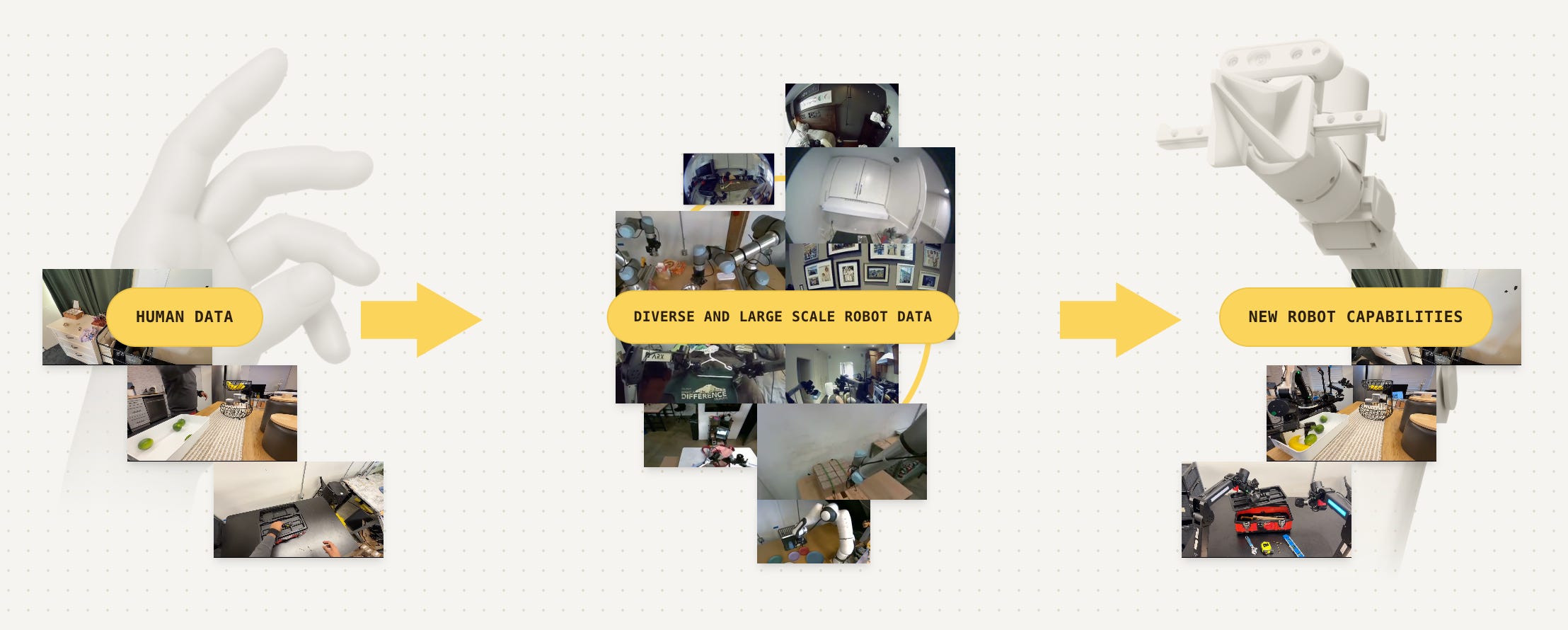
ABB announced the divestiture of its Robotics division to SoftBank Group for ~$5.375bn. This marks a shift away from a standalone spin-off toward alignment with SoftBank’s broader physical-AI ambitions. The divestment positions ABB to sharpen focus on core electrification and automation while enabling the robotics business to accelerate under a partner deeply invested in next-gen robot intelligence. This isn’t the first time a large European robotics company has been acquired by an Asian player in recent years.
Zurich-based Flexion, founded by ex-Nvidia researchers, raised $50M to develop the autonomy stack for humanoid robots. Rather than hardware, Flexion’s focus is on the intelligence layer: reinforcement learning, simulation-driven scaling, and generalizable control across tasks. This is a bet that compute-driven autonomy unlocks broader use cases for humanoids in logistics, factories, and service environments, an inflection beyond today’s fixed-function robots.
Dexory closed $165M led by Eurazeo to expand its AI-powered warehouse intelligence platform. The company’s AI leverages real operational data to drive live decisioning across supply chains, offering high impact on visibility and autonomous optimization. Adoption by customers like GXO, Maersk, and DHL signals there’s a tangible ROI for AI systems that unify sensing, analytics, and automation with minimal disruption.
Dryft*, a new agentic operating system for manufacturing, announced its launch with $5M in seed funding led by General Catalyst. The platform reframes ERP from a passive planner to an active decision-maker, using context-awareness and optimization to automate operational choices. This kind of foundation software has the potential to dramatically reduce lead times, eliminate manual workflows, and serve as a critical layer connecting strategy with execution in complex manufacturing systems.
👉 Cerrion (CH): has raised a $18M Series A led by Creandum for its AI video agent platform for factories. Read more…
👉 Starship (US): has raised a $50M Series C led by Plural for its autonomous delivery robots. Read more…
👉 UMA (FR): has raised an undisclosed amount led by a group of investors including Greycroft and Kima Ventures for its open source intelligent robots. Read more…
👉 Phaidra (US): has raised $50M Series B led by Collaborative Fund for its energy-efficient control systems for data centers. Read more…
👉 Flow Engineering (UK): has raised a $23M Series A led Sequoia for its next generation requirements tool. Read more…
Disclaimer
Views expressed in “posts” (including podcasts, videos, newsletters, and social media) are those of the individual GC personnel who wrote the post or are quoted therein and are not the views of General Catalyst Group Management, LLC (“GC”) or its respective affiliates. GC is an investment adviser registered with the Securities and Exchange Commission. Registration as an investment adviser does not imply any special skill or training. The posts are not directed to any investors or potential investors, and do not constitute an offer to sell or a solicitation of an offer to buy any securities, cryptocurrencies, or any financial instrument or property, and may not be used or relied upon in evaluating the merits of any investment. Additional important information about GC, including Form ADV Part 2A Brochure, is available at the SEC’s website:
http://www.adviserinfo.sec.gov
Nothing here should be construed as or relied upon in any manner as investment, legal, tax, or other advice. Any projections, estimates, forecasts, targets, prospects, or opinions expressed in these materials are subject to change without notice and may differ or be contrary to opinions expressed by others. Any charts or figures provided here are for informational purposes only and should not be relied upon when making any investment decision. Certain information contained in the content has been obtained from third-party sources. While taken from sources believed to be reliable, no one has independently verified such information, and there are no representations about the enduring accuracy of the information or its appropriateness for a given situation.
To the extent any content authored or provided by any GC personnel in this forum or medium makes reference to any company in which any of the funds or vehicles advised by GC have an economic or financial interest, previous or current, none of the information provided or opinions expressed herein are connected in any way with GC’s business activities, and GC did not provide any information or assistance in the creation of this content.
*is a GC portfolio company
No posts
Comments
Nothing yet. Say the first thing.
Sign in to join the conversation.