
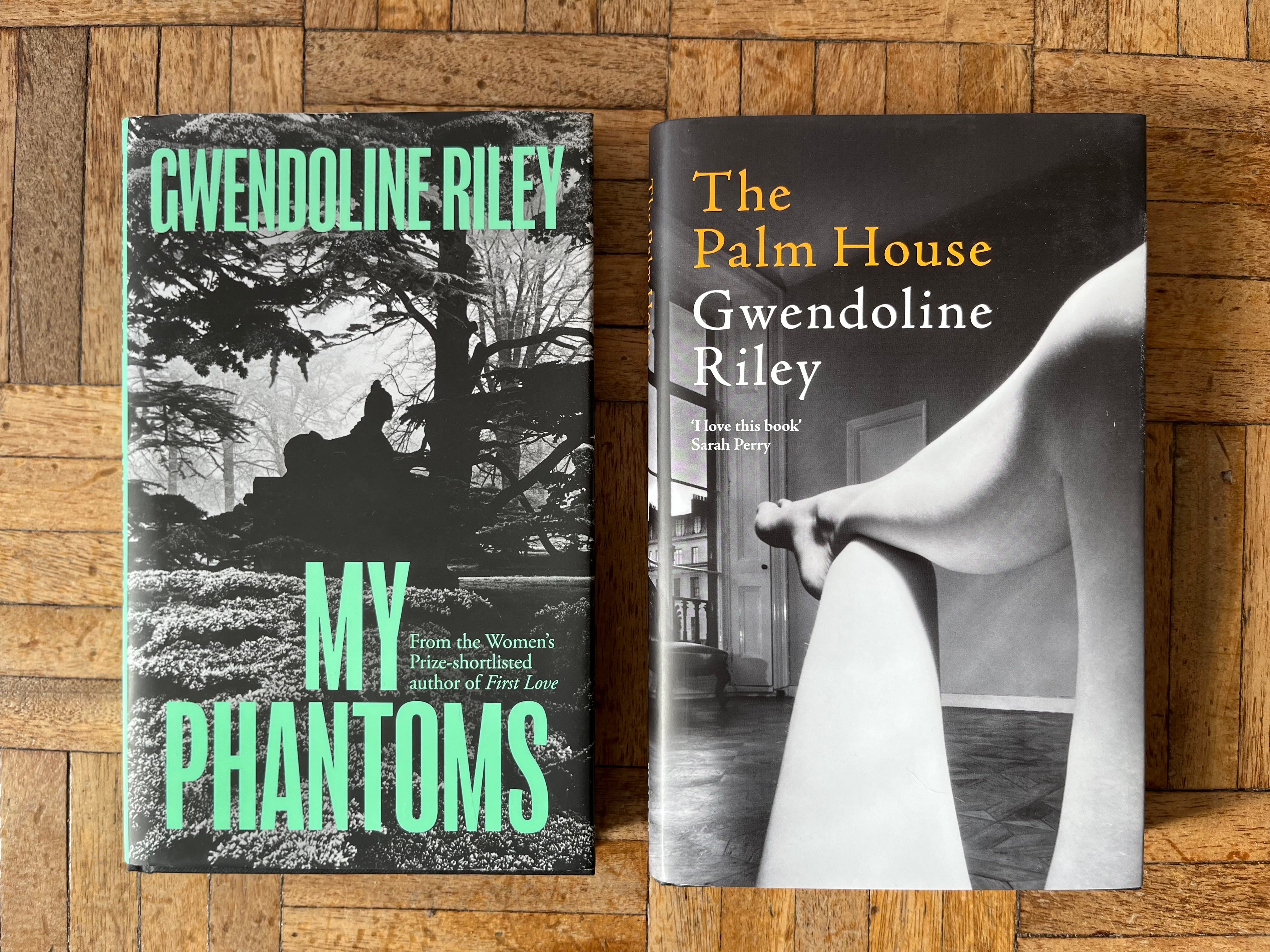
A new Gwendoline Riley novel is always a cause for celebration. Or perhaps it’s better to say: the latest instalment of the Gwendoline Riley novel is always a cause for celebration. It’s no criticism of her work at all to say that her seven novels are, in many ways, reiterations of the same story, or chapters from the same life. A young female narrator wrestling with doomed relationships, difficult mothers and absent fathers. Alcohol, music, literature. The earlier novels are perhaps more windswept, but with any capital-R Romanticism undercut by sardonic Northern humour. Think Jean Rhys singing a Smiths lyric. More recently, as with her latest novel The Palm House, the setting has been a version of literary London, with narrators who are part of (and apart from) an arty set. There have been other developments: a husband in First Love, and the spectacular My Phantoms was a departure because it focused almost exclusively on the narrator’s parents. Noticeably, and perhaps unusually for contemporary fiction, her novels rarely deal with the internet, or the pervasiveness of social media (Riley is very much not on social media).
I can’t be alone in thinking that Riley’s novels are autobiographical. Is each book a thinly veiled fictionalisation of what she’s been up to since the last one? Riley’s characters feel so true to life, particularly in the way they talk to each other, that I sometimes wonder if she hasn’t just set her phone recording while chatting to an especially self-obsessed friend or family member. And much has been made about whether Simon ‘Shove’ Halfpenny in The Palm House, who takes over as editor of the literary magazine Sequence with plans to turn it into London’s answer to the New Yorker, is based on Stephen ‘Stig’ Abell, who took over as editor of the Times Literary Supplement with plans to turn it into London’s answer to the New Yorker. But – these books are presented as works of fiction and we should read them as such. Looking for real-life parallels isn’t what makes her fiction so captivating; they’re not puzzles to be solved. What is captivating is the fact that Riley is one of the great noticers. In that pitch-perfect dialogue she captures something of the way that speech reveals and conceals the truth of who we are. It’s the mini-tragedy contained in an offhand exclamation (‘I’m an expert now! At divorce!’) or a failed attempt at humour (‘“I’ve started so I’ll finish,” she said in her Magnus Magnusson voice’). With just a few lines of speech – which Riley’s narrators often dissect themselves – we can glimpse a character’s entire life story: their monomania, their loss of status, their myth-making – and what Mark Bowles calls in his novel All My Precious Madness, ‘the fragile fictions people spin around themselves to make their lives tolerable’.
Charlie Brooker once wrote that the handiest screenwriting tip he ever encountered came from Russell T. Davies: ‘Dialogue is just two monologues clashing. […] That’s my Big Theory. It’s true in life – never mind drama. Everyone is always, always thinking about themselves. It’s kind of impossible to do otherwise’. Riley is profoundly attuned to this. Her most memorable, and tragic, characters – like Hen (short for Helen) in My Phantoms – are people for whom a conversation isn’t a collaboration, but an opportunity to soliloquise, or to grouse about how life hasn’t quite met up to their expectations (although, for Hen, it’s never quite clear what those expectations are). Mark Bowles again: ‘Many of our ways of speaking are in fact ways of crying, of scratching, of nuzzling or hissing.’
For Bridget, Hen’s daughter and the narrator of My Phantoms, the role in these conversations is to play a complex game – feeding the right tidbits for the best reactions, desperately playing keepy-ups with an elusive good mood, mirroring Hen’s cliché-ridden idiolect; ‘It’s take the money and run, isn’t it’, she says, empathising with her mother’s miserable experience with an estate agent.
In The Palm House we meet Putnam, recently resigned from Sequence and spiralling into self-pity. He’s another of Riley’s great solipsists:
‘I’m a nobody,’ he said. ‘I am. Why are you upset?’
‘No one’s talking about you,’ he said. ‘Does everything have to be about you?’
‘Apparently it does,’ he said.
‘Huh,’ he said, mildly, sighingly.
I love how Riley records Putnam’s speech here. Usually, if the same person continues speaking across multiple paragraphs, you wouldn’t add a closing quotation mark to a paragraph until they’d finished speaking entirely. Riley deliberately breaks this rule by closing the quotation marks at the end of each paragraph even though it’s the same person speaking. It reinforces the idea that Putnam is relentlessly monologuing, not conversing; that his interlocutor has been cowed into silence. Each dejected paragraph is a little set-piece that the listener (who barely needs to be there) must endure.
Something similar happens with Bridget’s awful father in My Phantoms. Bridget remembers reading Wuthering Heights as a child, prompting her father to descend into one of his bitter reveries (watch the quotation marks):
‘Your mother’s one obsession!’ he said. ‘I never knew what she was talking about! I learnt something about it when the BBC did an adaptation. I only watched from pure curiosity. […] It was probably up to the usual standards of an adaptation! But the impression it conveyed… It’s really ghastly. Really creepy.’
‘It explained a lot,’ he said. ‘About your mother.’
‘Is that her book?’ he said.
Bridget’s father is a truly monstrous creation – someone for whom everything must connect back to him. He reminds me of something a friend once told me about a housemate who was so self-absorbed that if you crawled home with a broken leg they would probably say, ‘Oh, I broke my leg once too!’
Apropos London, for instance. Michelle [Bridget’s sister] had been on a school trip there with her history class. They’d been to the Tower and the Globe. This information our father attended to as one might a dog’s distant barking, before telling us that when he first moved down there, he used to spend every weekday evening in an Earl’s Court pub called the Coopers, which was a ‘den of iniquity’, but which he also called his ‘office’. People used to telephone there when they were looking for him, he said, or call in when they needed to see him. The landlady was ‘a real old boiler!’ he said. But she used to make him chips and egg, which she wouldn’t do for anyone else.
This kind of (highly improbable) myth-making is a particular trait of the egotist. As is the need to always be right. Witness his response to Bridget’s teenage love of reading (which he cruelly lambasts as ‘posing’):
If the name was new to him, then he handled the book suspiciously. ‘Never heard of them!’ he’d say. (His verdict.)
That word ‘verdict’ is perfect – as if having not heard of a book was an opinion! ‘Never heard of them!’ here means something like, ‘Well, if they haven’t registered with me then they’re obviously not worthy of attention!’
Like Bridget’s father, Hen has what people younger than me would no doubt call ‘main character energy’ (Bridget herself refers to this as her ‘announcing-ness’.) Hen, and the similar mothers in First Love and The Palm House, are playing the lead in the tragicomedy of their own lives – it’s ‘as if she believed she had an audience somewhere’. Hen’s ‘announcing-ness’ is brilliantly illustrated by Riley’s use of exclamation marks, which are the equivalent of mugging to that imaginary audience. ‘I never stop!’ ‘That was the style!’ ‘You’ve got to be in it to win it!’ ‘Once more unto the breach!’ ‘I’ve got the world’s biggest collection of tote bags!’ There’s something so tragic about them. Exclamation marks can be used to indicate many things: a punchline, laughter, joy – something shared. In Riley’s novels they are a way of keeping the world out, a coping mechanism, something to preserve those ‘fragile fictions’ that make life tolerable. They are also linked to Hen’s self-definition; a way of saying this is type of person I am. ‘He was this way. She was that way’, Bridget observes about her friendship with an old work colleague Griff (who Hen doesn’t even seem to like). It’s a form of roleplay: I’m ready for whatever the world might throw at me! I laugh in the face of setbacks! The persona of a seen-it-all stand-up comic (playing to an empty room). But to acknowledge that roleplay, to drop the mask, would be to admit to some deeper deprivation. The exclamation marks are a defence against a Comic Book Guy-style revelation: ‘I’ve wasted my life!’
Other elements of Hen’s roleplay are her faded impressions (Magnus Magnusson!) and half-remembered references – the flotsam of pop culture. She quotes the Jazz Club MC from The Fast Show (‘Nice!’), and, of her new flat, she says, ‘I mean, you picture it being a bit more, you know… going to the deli and buying a “double flat no-fat extra hot frappi-mochaccino to go! Hold the mustard!” kind of thing’. These character bits are a way of showing that she’s ‘in the swim’, experiencing ‘the comfort of the crowd, and of joining in. Of not feeling alone and in the wrong’. There’s something of the desperation of David Brent doing a Bo’ Selecta! impression in The Office. Hen, like Brent, ‘behave[s] as if things are other than they are’. She goes with Griff to galleries, concerts, exhibitions (‘I’m putting myself out there’) – but she never really enjoys them. Again, it’s like she’s playing a version of someone she wants to be: ‘The situations she contrived for herself seemed always to chafe and pinch sooner or later. They were never quite it.’ She falls short of the bookish, cosmopolitan archetype she aspires to. She can’t keep up with Elena Ferrante’s Neapolitan Novels (‘Is Lenu Lina or is Lena Lulu? Argh!’) and she only seems to take pleasure in her outings if something goes wrong (‘I think she liked finding life a little bit crap’). Culture is a kind of box-ticking exercise. In one of my favourite exchanges, Hen tells Bridget about a coach trip to Hebdon Bridge, which included a visit to Sylvia Plath’s grave:
‘Were there a lot of disciples?’ I said. ‘Plath obsessives?’
‘I don’t know,’ she said. ‘Why?’
When I read that I can’t work out if I want to laugh or bang my head against a brick wall.
~
I meant to write more about The Palm House but, after rereading it, My Phantoms seems to have stuck in my head a lot more. And it’s different to the way I remember it. There’s something pitiless (a word that has been used to describe Riley’s fiction before) about those exclamation marks. I had forgotten Bridget’s cruelty, her meanness. She rarely visits her mother and isn’t exactly welcoming to her on her annual visits to London; on one such trip Bridget takes Hen to a vegan restaurant which she obviously won’t enjoy. There’s also a strong suggestion that there may be a medical reason for Hen’s behaviour and the way she communicates. And, obviously, with an ex-husband like Bridget’s father, is it any wonder that Hen is difficult to bond with and emotionally closed off? Finishing the novel leaves you with a complex feeling of not quite knowing where your sympathies lie.
~
Riley’s novels are brief (they are all under 250 pages) and light on plot (just for clarity, in case you think I’m being pejorative: this is my favourite kind of novel). They can often feel anecdotal. A series of seemingly unrelated incidents gathered together like songs on an album. One such incident occurs in The Palm House, when narrator Laura remembers a childhood holiday to Dubrovnik with her mother and grandmother. Laura’s mother notices that a lot of the locals are wearing a certain kind of shoe: ‘lace-up fabric boots, with a low wedge heel and an open toe’. They find a shop and kit themselves out with a few pairs for themselves. Walking back to the hotel in their new shoes, a group of men on scooters watch them pass. One of them shouts, ‘Your shoes they are shit’. This is the quintessential Riley story. Painful, humiliating, bitterly comic – and yet somehow inscrutable. It’s hard to pin down what it means. Amidst the bathos and cruelty there is a story about trying to fit in or adopt a role (like Hen putting herself out there) – undertaking a small act of aspiration that’s doomed to fail; realising that you or your family have got something slightly wrong. The shoe incident isn’t referred to again in the novel. So why is it mentioned at all? The simple answer is because memories like these have extraordinary power. They are little parables; origin stories of inadequacy and pain. They are what Mark Bowles calls the ‘seemingly innocuous incidents [that] can in fact alter the course of a child’s life’. They linger long in the memory of the reader; they are the phantoms that haunt the lives of Riley’s wounded narrators.
~
What next for Gwendoline Riley? I was delighted to see she’s been awarded the Windham‑Campbell prize for a body of work. And I’m curious to see novel number eight. Maybe it will be a departure – a multi-generational space opera set across multiple timelines. I hope it isn’t, to be honest. But, as Hen might say, I’ll be first in the queue at the bookshop to find out! Try and keep me away! In for a penny!
If you want to support this monthly Substack, or my music, or my podcast, please feel free to donate here:
No posts
Comments
Nothing yet. Say the first thing.
Sign in to join the conversation.