
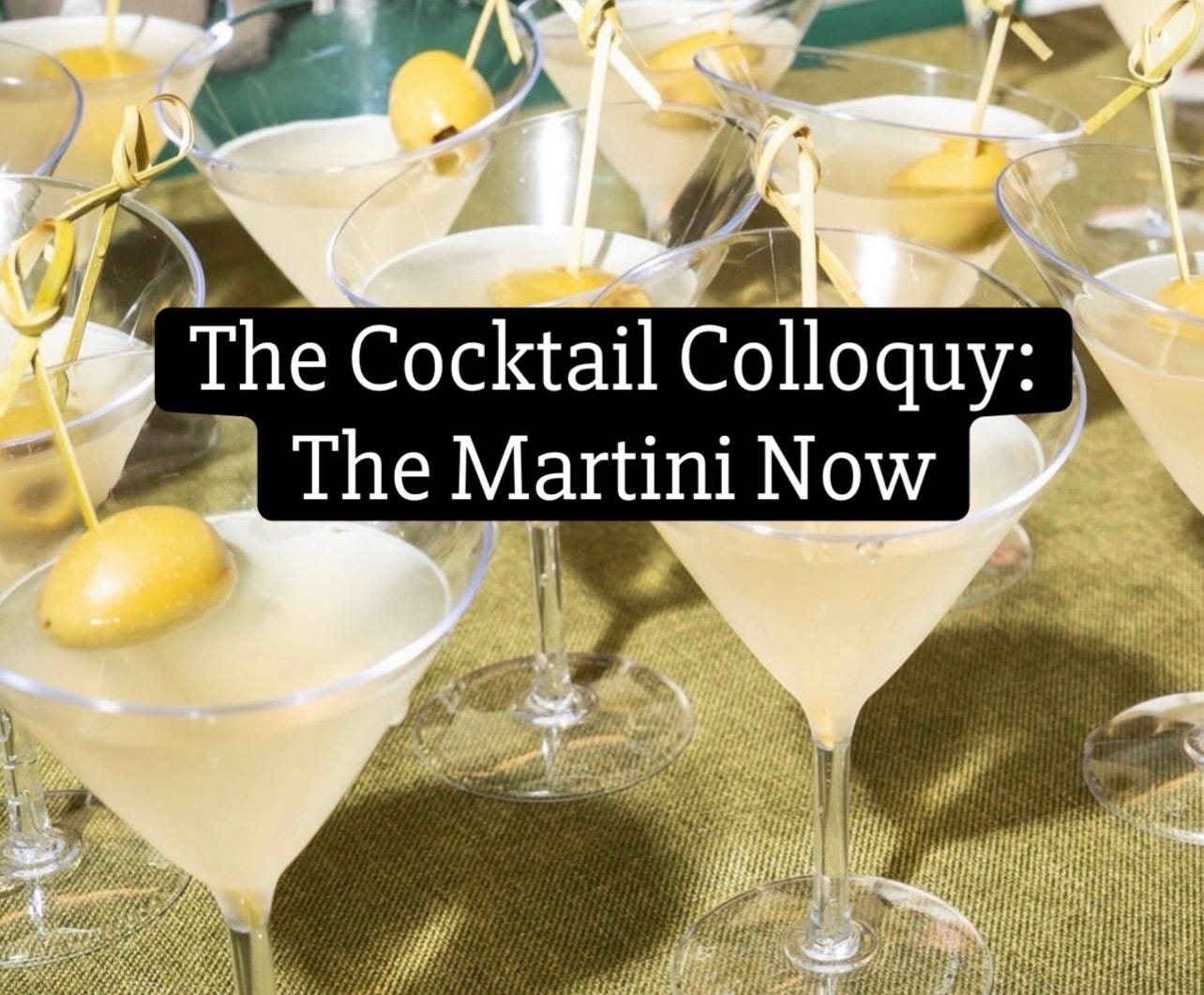
This is the fifth edition of a new essay series we are calling “The Cocktail Colloquy: The Martini Now.” We asked a collection of writers and thinkers whom we respect—people with a track record of writing about the Martini—if they would contribute an essay to The Mix.
We will publish one essay every Monday for the next several weeks leading up to the beginning of The Martini Expo on Sept. 13. Tickets to the Expo are now available on Opentable. Tickets are also on sale for a Martini Dinner sponsored by Farmer’s Gin at the famous Shaw’s Crab Show on Sept. 16; and a kick-off dinner at The Duck Inn on Sept. 18. Both are nearly sold out so hurry up! Finally, tickets are on sale for a Martini history bus tour, hosted by me and Bridget Alpert on Sept. 17, which will start at Club Lucky and end at the Billy Goat Tavern. Only 30 spots are available!
The series kicked off with an essay by Lowell Edmunds. Next came brewmaster Garrett Oliver, and then England-based author and cocktail historian Dr. Anistatia Miller. Last week, we some thoughts from Brooklyn-based cocktail historian David Wondrich.
For the fifth edition, we have Miller’s partner and spouse Jared Brown, one of the OGs of modern cocktail scholarship. Typically, Brown and Miller—who have written multiple books on cocktails and spirits together—share a byline. This is a rare instance where they have written solo essays.
Martini drinkers are among the stodgiest customers. No other drink gets dictated to the bartender as frequently or in as much detail as a Martini. (Yes, I prefer my twist expressed and discarded and have sent a drink back on receiving it with a submerged peel.)
When a friend invited me to Murder. Inc., in Fitzrovia (a neighbourhood that feels like a northern extension of Soho) to sample a frozen slushy Martini, I was prepared to be polite—dismissive, but polite. I was completely unprepared to fall in love at first sip. It was reminiscent of a Bradford. If you firmly believe a Martini should only ever be stirred, just remember that the Bradford à lá Martini traces back to the time of the Martini’s birth, and it was simply a shaken Martini.

So, when I say it was reminiscent of a Bradford, it was akin to an American one with a flotilla of little icebergs drifting across the surface. Those icebergs are what a British bartender would catch in a fine strainer and discard. This drink is nothing but those little shards, a brain-freezingly bracing savoury slush of over-proof gin, dry vermouth, and a cerignola olive perched atop the ice. The result is a Martini as cold or colder than London’s famed freezer Martinis.
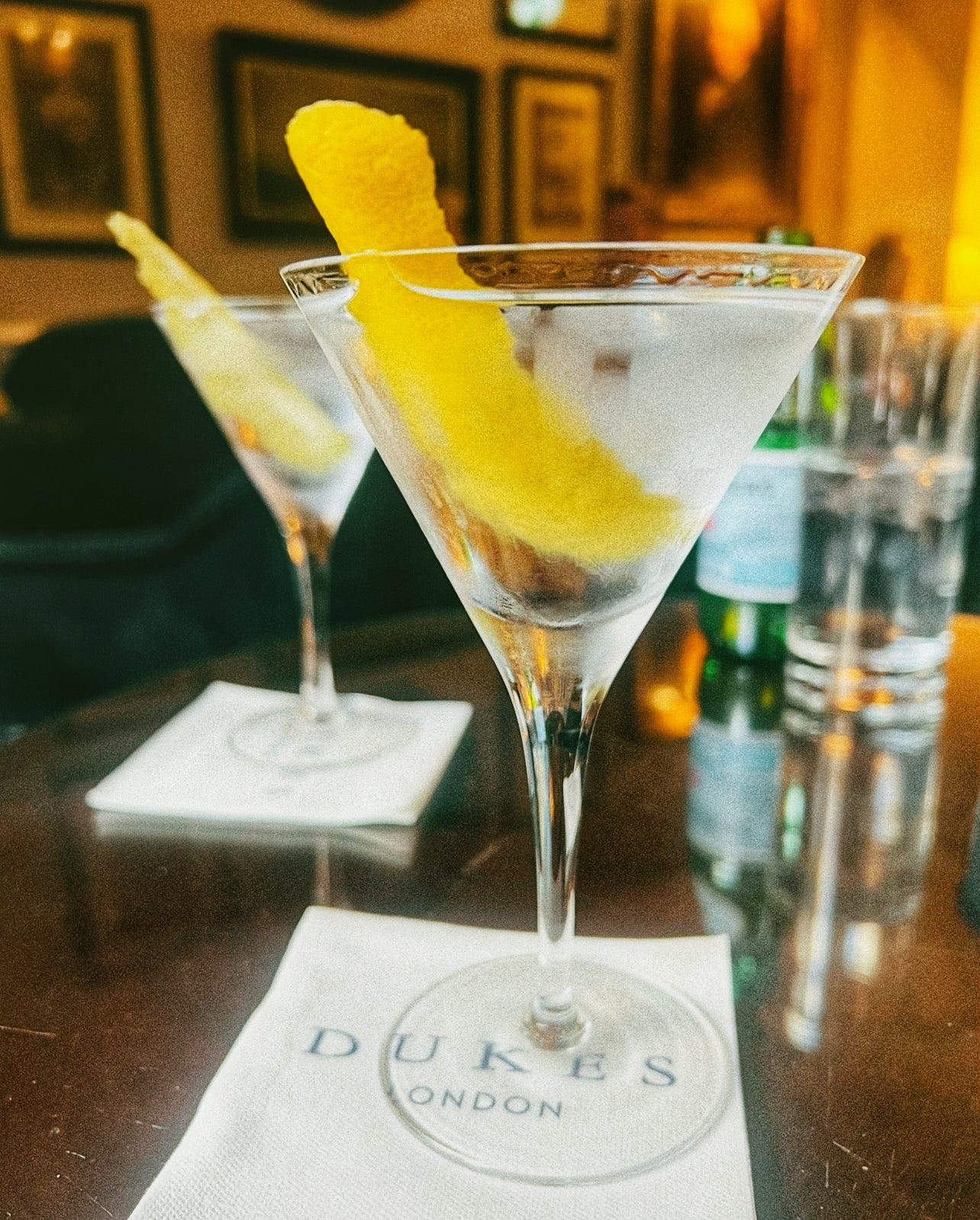
London’s most famous freezer Martini—the Dukes Martini—is the roughly 120ml straight pour of frozen gin at Dukes Bar in St James. However, it has recently emerged as a new serve style in many other bars. Perhaps the first was The Donovan at Brown’s Hotel and Velvet at the Corinthia Hotel, both directed by “Maestro” Salvatore Calabrese, who is credited with creating the Dukes Martini during his tenure there as head bartender. The serve has spread across Britain. I finished last evening with a freezer Martini at Speak in Code in Manchester. Sensibly, many bars (including and perhaps once again led by Calabrese) offer this most lethal of silver bullets in a half-sized option.
Another trend runs afoul of great mid-20th-century drinks writer Bernard DeVoto, who penned the immortal line “you can no more keep a Martini in the refrigerator than you can keep a kiss there.” Pre-batching has become ubiquitous. DeVoto aside, this is a double-edged cocktail sword. It is a welcome solution to the agonizingly slow service in high-end bars for the past decade. Now that the prep is done back of house before opening, they can simply pour chilled libations into glasses. And we once again get treated to bartenders’ faces rather than long views of the top of their heads. The banter is back as bartenders at Kwant dole out their gorgeous beeswax-infused Piney, very much a Martini-lover’s Martini, straight from the waxed interior of a gin bottle.
However, there are two downsides to pre-batching. Substitutions and personalizing—once the norm with Martinis—are out the window. Plus, we are raising a generation of bartenders who struggle to construct a drink in competitions if they hail from bars where the standard tools have become superfluous.
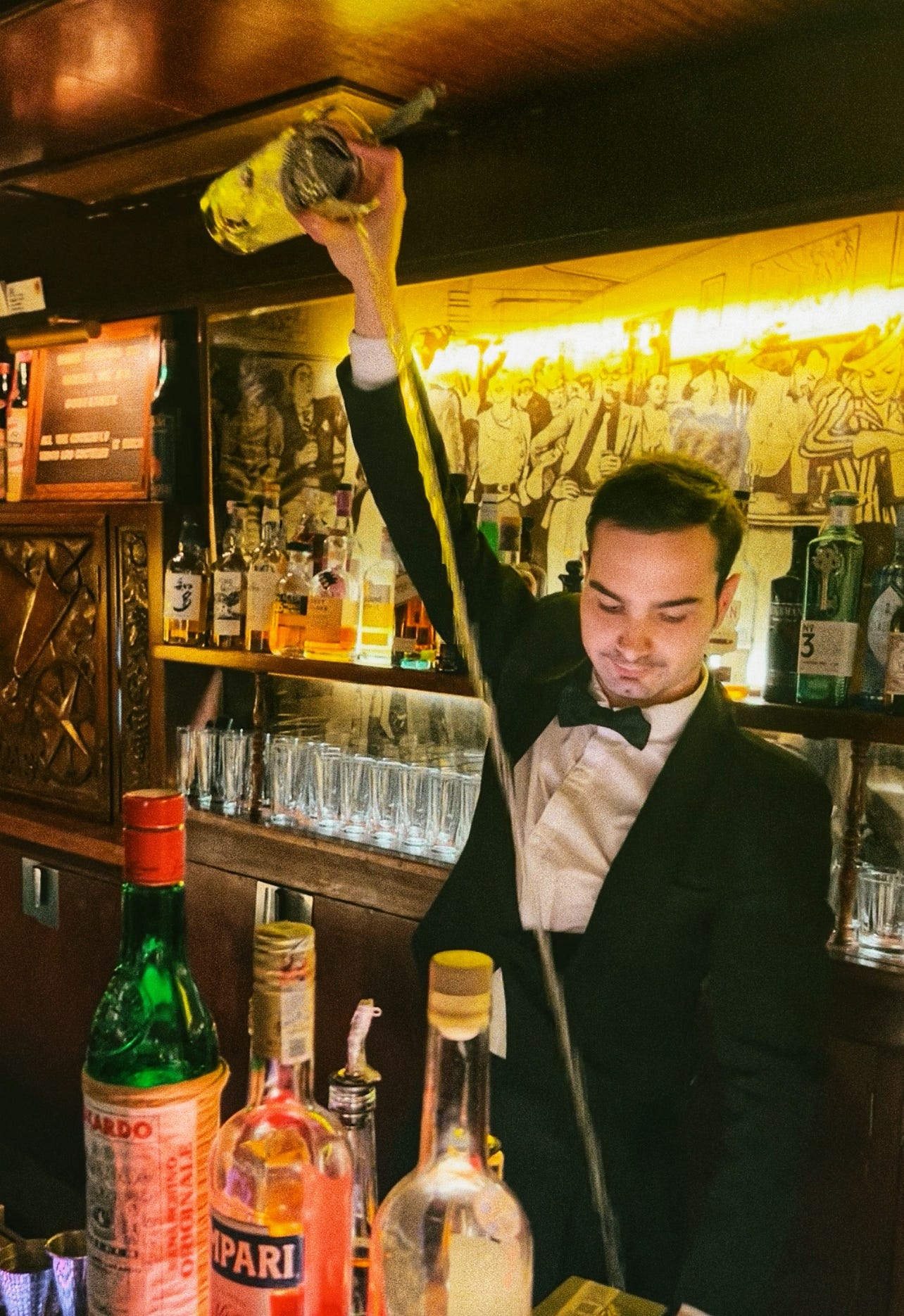
A decade ago, it seemed as if there was barely a handful of bartenders capable of throwing a Martini (arguably the original mixing method), and most of them reserved the technique for the drink most damaged by throwing: the Bloody Mary. Books from the 1950s and ‘60s stated a Bloody should be “rolled”—poured gently between two closely held tins. This was to be gentler with the mix than shaking or stirring. Why? Because you may not be able to bruise a Martini, but you can bruise a Bloody Mary. Now, far more bartenders in England are willing and able to throw, stir, and long-pour. Throwing is the epitome of functional flair, giving a Martini more aeration than shaking with the clarity of stirring.
But is not being able to personalize a Martini truly a downside? We are arguably surrounded by a higher calibre of bartender than ever before in history. Perhaps, instead of directing every show, is it time for us to sit back occasionally and experience an artist at work?
There are two changes I would love to see in my glass that have not yet caught on. First, I agree wholeheartedly with the late great Sasha Petraske, who would cry out just before I garnished his Martinis (despite him having said it before), “And the twist… Turn it and burn it!”
“It’s just you, me and Stashe here,” I once replied from the kitchen, “and I made you one ten minutes ago.”
His expression was serious when he answered, “I don’t take chances.”
Sasha was right. Express and discard the twist without touching it to the glass or the liquid, and you get all the sweet, floral, citrus of the lemon peel without its other flavour—sharp lemon bitters. I’ve blind-tasted a few hundred people on one where I expressed and discarded, and on one where I also ran the twist around the rim, dropped it in, and then discarded it. Every guinea pig could tell which was which. Two out of the hundreds (one renowned for a bitter palate and the other a known contrarian) preferred the sharper drink. I’ve taught this very quickly in masterclasses by having bartenders squeeze a twist, then asking them to lick it. Hey, you make me lick that damned thing when you rub it around the rim with a flourish—and it tastes like s*%t. (Rant over.)
As we see the resurrection of the Dirty Martini, I can’t help wondering when bartenders will finally follow the kitchen’s two millennia lead and embrace saline. A few drops of saline in a Martini accentuates the flavour, bringing in an element craved enough by many drinkers that they’re willing to drink a dirty Martini to get it. Saline beats the pants off olive brine.
More than other cocktails, the Martini has evolved over time, and at times briefly devolved. But never in cocktail history have we seen a generation of bartenders as educated in the mixing arts as today. Thus, I look forward to the nuances of the next generation of martini creators.
To show our gratitude to paid subscribers of The Mix With Robert Simonson and The Milwaukee Mix, we will be holding a special Martini party for paid subscribers during the Martini Expo. It will take place on Tuesday, Sept. 15, from 6-8 p.m. Our host is the great, newly opened cocktail bar Belmont Tavern and its owner, Nick Kokonas, and our sponsor is the wonderful Hayman’s Gin.
Guests will be treated to delicious Martinis and great food. We can’t wait to see all you Mixers there! Email marykatemurray@me.com to attend or click on the link below. See you then!
RSVP for the Martini Party Here!
If you like Martinis and Steak and Oysters and Lobster, you may want to buy a ticket to The Martini Expo dinner at Shaw’s Crab House, presented in collaboration with Farmer’s Gin. But you probably want to act fast. There are only 40 seats and more than half are already sold. Mary Kate and I will be there. You can buy tickets here… The coming book tour for my new book Bourbon and Rye Cocktails will include many stops across October, November and December. But the first to be officially announced will take place in Fitchburg, WI. It will be at Four Winds Farm, a “working permaculture farm rooted just outside Madison, focused on regenerative growing practices and long-term land stewardship.” It will be a ticketed cocktail party with drinks and snacks on Nov. 22 at 6 p.m. You can buy tickets here. Hope to see you there!… The Peninsula hotel in Chicago is celebrating its 25th anniversary with a special cocktail menu at its beautiful rooftop Z Bar. The “Silver Set Anniversary Cocktails” including the Pen 25, a French 75 with Bombay Sapphire Gin, Yuzu, Taittinger Champagne, lemon juice and jasmine essence; the Ole 25 Old-Fashioned, made with Michter’s Bourbon, caramelized fig, vanilla bitters, and Luxardo cherries; and the Michter’s 25-Year-Old Kentucky Straight Bourbon Old-Fashioned, which is made with Michter’s 25YO and costs $425. (I was told that recently one guy ordered two in a row!). Look to this space for further reportage on this bar and menu.
No posts
Comments
Nothing yet. Say the first thing.
Sign in to join the conversation.