
Two weeks ago I told you to circle August 18. The packet is out, and it contains the number this budget season has been waiting for: a proposed tax rate. Here’s what council will take up Tuesday at 6 p.m. — and what it would mean for your tax bill.
On August 5, I wrote that August 18 was the date to circle — the meeting where the certified tax roll would arrive and the FY2027 budget would stop being a stack of projections and start being a bill. The agenda packet for Tuesday’s regular council meeting is now posted, all 346 pages of it, and it delivers.
Buried in the taxpayer impact statement on page 3 is the number: the city is proposing a tax rate of $0.19310 per $100 of valuation for the coming fiscal year — up from the current $0.167903.
Let’s walk through what that means, and then look at the rest of a genuinely consequential agenda.
First, the mechanism, because it matters. Council will not adopt a tax rate Tuesday night. What the agenda asks for is a recorded vote to propose a rate and to set a public hearing — on either September 1 or September 15, at council’s discretion. State law then requires the rate to be adopted within seven days of that hearing, and it can happen the same night. The proposed rate functions as a ceiling: council can come down from it between now and adoption, but pushing it higher would mean restarting the public-notice clock.
So Tuesday is the night the range gets set.
Now the numbers. Fort Bend County has delivered the certified 2026 tax roll, and it puts the city’s net taxable value at roughly $5.55 billion. From that roll, three rates fall out of the state’s truth-in-taxation math:
The no-new-revenue rate: $0.159522. This is the rate that would raise the same total dollars from the same properties as last year. When values rise, this rate falls — that’s the point of it.
The proposed rate: $0.193100. What staff has built the FY2027 budget on.
The voter-approval rate: $0.204901. The threshold above which the city would have to hold an election.
The proposed rate sits comfortably under the voter-approval line, but it is well above no-new-revenue — about 15 percent above the current rate, and about 21 percent above the rate that would hold the levy flat.
What does that mean at your kitchen table? The packet’s taxpayer impact statement does the math for the median homestead, now valued at $492,498 for tax purposes. At the proposed rate, that home’s city tax bill would be an estimated $951.01 next year, versus $811.20 this year — an increase of $139.81, or about 17 percent. At the no-new-revenue rate, the same bill would actually drop by about $25.56.
If you’ve been following my budget series, the rate's composition will look familiar. The $0.19310 splits into $0.124809 for maintenance and operations — the M&O half that pays for police officers, park mowing, and everything else in the operating budget — and $0.068291 for interest and sinking, the I&S half that pays debt. That I&S figure is the one to watch. It’s up from roughly $0.051, and that increase of just under two cents tracks closely with the advertised maximum impact of the $13.5 million parks bond voters approved in May 2025 — $0.018672 per $100, or about $74.69 a year on a $400,000 home. In other words, a meaningful share of Tuesday’s proposed increase appears to be the parks bond arriving on the bill, exactly as advertised. I’ll break the full M&O-versus-I&S story down in the tax-rate installment of the series once the proposal is formally on the table.
One honest caveat, straight from the staff report: these figures could still shift if the county tax office issues an updated calculation worksheet.
The tax rate item travels with the standing FY2027 budget discussion, and the packet includes an updated budget detail workbook worth a skim. The general fund shows about $21.2 million in proposed revenues, with property tax collections budgeted at roughly $6.9 million and sales tax at $6.2 million — the latter reflecting the voter-approved sales tax change shifting a portion of economic development corporation revenue to the general fund. The budget book link and the full workbook are in the packet if you want to follow along line by line.
Readers of the wastewater installment know my view: sewer capacity is the real ceiling on Fulshear’s growth. Tuesday’s agenda moves that story forward twice.
The headline item is a $1.02 million professional engineering agreement with Enprotec / Hibbs & Todd to design a further expansion of the Cross Creek Ranch Water Reclamation Facility — from the 3.0 million gallons per day currently under construction to 4.0 MGD. Staff’s case is that designing the extra million gallons now, while the contractor is already on site, saves money and time. The expanded plant would carry projected flows to roughly 2044 and support the eventual decommissioning of the aging Downtown facility.
On the consent agenda, meanwhile, is Change Order No. 2 to the current expansion contract with Wharton-Smith: $290,782 in scope refinements — added piping, protective concrete coatings, structural modifications — bringing the total contract to about $24.1 million. Staff reports no impact to the schedule.
The fourteen-item consent agenda is mostly the machinery of a growing city: six subdivision plats (three sections of Cross Creek West, Founders Hill, Fulshear Lakes Hillside, and a Tamarron commercial replat), a revised $767,646 authorization for the vactor truck purchase approved earlier this month (a paperwork fix — the purchase requires two cooperative contracts, not one), a $600,000 increase to the city’s waterline maintenance contract with Texas Hot Taps, $42,342.30 in diesel for the utility generators, about $33,754 in security cameras, and the June financial reports, which show the general fund tracking close to budget three-quarters of the way through the fiscal year.
In regular business, council will hear an annual update on the Keep Fulshear Beautiful partnership with Forever Fulshear — 400 volunteers and 2,400 reported service hours in year one, with $3,637 spent of the city’s $8,000 commitment — and will fill a vacancy on the thirteen-member Charter Review Commission, the citizen body now reviewing the city’s founding document. There’s also a discussion of council meeting procedures and Robert’s Rules of Order, placed on the agenda by council members Utturkar and Russell.
Behind closed doors, council will consult with attorneys on two matters: legal issues surrounding the Heritage Bend development and its municipal utility districts, and a reclaimed water agreement involving Fort Bend County MUD 169 and MUD 275. Action on either could follow in open session.
The evening opens on a warmer note: a proclamation honoring Mrs. Rozina Randon-Gardner’s 90th birthday, and the presentation of a flag to the city commemorating September 11.
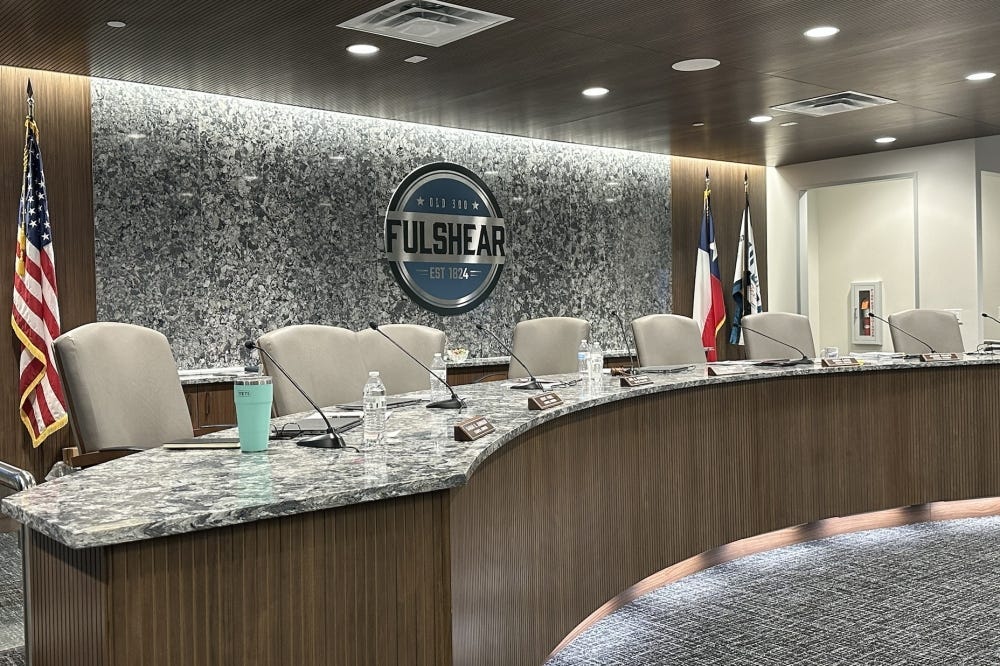
The meeting is Tuesday, August 18, at 6 p.m. in the council chambers at the Fulshear Municipal Complex, 6611 W. Cross Creek Bend Lane. Citizen comments come early in the meeting; you’ll need to register in advance and keep it to three minutes. And remember the calendar this vote sets in motion: a public hearing on the tax rate on September 1 or 15, with adoption required within a week of the hearing and a new fiscal year starting October 1.
If you’ve been waiting for the moment when this budget season’s abstractions become a number on your bill, this is it. The hearing that follows is still, hands down, the highest-leverage fifteen minutes of civic participation available to you. Circle the next date when council picks it.

With the limited number of homes on the current U.S. market, you need an agent with the right connections, technology, and strategies to achieve your home-buying or selling vision. Whether you’re feeling overwhelmed and want someone to take the wheel, or you just need a second opinion and you have it covered, you can rest assured that a RE/MAX agent is the right agent for any level of service, in any market condition. Visit Tajana Surlan’s website here to learn more. Surlan’s phone number is (972) 415-3017 (cell) or (713) 636-3015 (office).
Want to see your business here? Contact us at sponsors@aboutfulsheartexas.org for sponsorship opportunities.
Supporting Our Local History. All proceeds from “About Fulshear, Texas” sponsorships go directly to the Fulshear Historical Association, a registered 501(c)(3) nonprofit dedicated to preserving and celebrating the rich heritage of our community.
About Fulshear, Texas, is the area’s authoritative hyper-local media ecosystem. Our Substack newsletter achieves a 60%+ open rate, our Facebook presence (@About Fulshear Texas) generates over 35,000 monthly views, and we have launched a community podcast. We reach more than 8,000 unique individuals monthly, with 53.5% residing directly in Fulshear. The core demographic is affluent homeowners aged 35 to 54—representing peak household earning years, established homeownership, and the population most likely to refinance, purchase investment properties, or refer neighbors and colleagues to a trusted lender.
How this post was made: drafted with AI assistance, then researched, edited, sourced, and fact-checked by me. Errors are mine — reply, and I’ll correct them. For more details, click here.
No posts
Comments
Nothing yet. Say the first thing.
Sign in to join the conversation.