
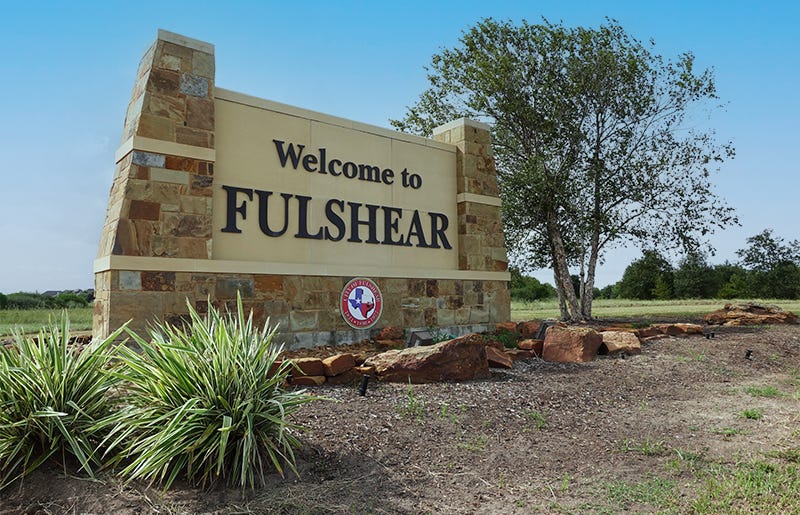
Part three of “Following the $332 Million,” a weekly series on Fulshear’s proposed budget. This week: why your city tax bill is two different taxes wearing one number, what happened to last year’s 23.5 percent proposal, and how much of this fall’s increase is really the parks bond — versus the cost of running the city.
Every so often, a reader asks me some version of a hard question. Lately it arrives in my inbox looking like this: Didn’t the council back off the big tax increase last year? So why does everyone keep telling me my bill is going up anyway?
It’s a fair question, and the answer is one of those pieces of civic machinery that almost nobody explains: the city tax rate is not one tax. It is two taxes wearing one number; they are governed by entirely different rules, and this year they are moving for entirely different reasons. Once you can see the seam between them, this fall’s budget hearings become legible in a way they simply aren’t from the headlines.
So let’s find the seam.
A quick recap for anyone who missed the 2025 budget season, because this year’s story only makes sense against it.
Last July, city staff floated a rate of $0.199901 per $100 of value — a 23.5 percent increase over the then-current $0.161856 — to fund what officials described as essential needs, chiefly police pay and street repairs. That number was big enough to cross a legal line called the voter-approval rate, then calculated at $0.189901, which meant adopting it would have required a public vote, and one was penciled in for November 4, 2025.
The vote never happened. At its August 18 meeting, council balked — one member argued the city needed “a comprehensive plan” rather than a one-year fix — the ballot deadline passed, and the city ultimately adopted $0.167903 per $100, a far more modest step. The big ask was shelved, not answered.
Keep that phrase in mind: shelved, not answered. We’ll come back to it.
Now the mechanism. Every Texas city tax rate is the sum of two components.
The first is maintenance and operations — M&O — which pays for the day-to-day: police salaries, park mowing, staff, fuel, the electric bill at City Hall. The second is interest and sinking — I&S, or debt service — which exists for exactly one purpose: making the payments on money the city has borrowed.
Here’s why the distinction matters more than almost anything else in this series. State law treats the two halves completely differently:
The M&O side is capped. Under the state’s truth-in-taxation rules, a city generally can’t collect more than about 3.5 percent additional M&O revenue from existing properties year over year without asking voters’ permission — that’s the voter-approval rate Fulshear brushed against last summer. The related benchmark, the no-new-revenue rate, is the rate that would raise the same dollars as last year from the same properties; when values rise, that rate falls.
The I&S side has no such cap — because the voters’ permission was already obtained. When you approve a bond at the ballot box, you are approving the tax that repays it. The election is the cap.
In other words: an M&O increase is council asking for more. An I&S increase is the bill for something voters already said yes to.
In May 2025, Fulshear voters said yes twice: 66 percent for Proposition A, $10.75 million for Phase III of Primrose Park — the amphitheater, trails, and parking — and 67 percent for Proposition B, $2.75 million for park land. The ballot-season materials were explicit about the price: a potential tax impact of up to $0.018672 per $100, roughly $74.69 a year on a $400,000 home.
Now watch the early FY2027 projections. Staff’s planning numbers show the debt-service side of the rate rising from about $0.051 to $0.069 per $100 — an increase of about 1.8 cents. Set that next to the bond’s advertised 1.87 cents and the conclusion is hard to miss: on the early numbers, the increase arriving on this fall’s bill is almost entirely the parks bond — the one part of the tax rate you voted on directly.
Meanwhile, staff projects the operations side will compress slightly, not grow. The proposed budget was built assuming the current $0.167903 rate for planning purposes, and the operating fund underneath it is balanced with a modest surplus — this year’s police improvements (three new officers, salaries moved toward market) were funded inside the existing envelope, not through a rate ask.
To put the whole thing in dollars: at the current rate, the city’s share of the tax bill on a $400,000 home is roughly $670 a year before exemptions — typically a modest slice of a total bill dominated by school and, in much of Fulshear, MUD taxes. The parks bond adds its ~$75 on top of whatever the final adopted rate produces. If that trade — a finished Primrose Park and new parkland for about six dollars a month — strikes you as good or bad, either way it’s a deal you were given the chance to price at the ballot box. Two-thirds of those who showed up took it.
Three of them, and they matter.
First, everything above rests on staff’s early projections. The certified appraisal roll was due from the appraisal districts at the end of July, and only after the city works through it will the actual proposed rate — and the legally required no-new-revenue and voter-approval comparisons — be published. If the final numbers tell a different story than the projections, I’ll write that post. Watch for the formal notice; it’s the document with the real numbers in it.
Second, “the increase is the parks bond” is true on the rate math, but it isn’t the whole fiscal picture. The $332 million capital plan this series is named for will be financed substantially with debt over the coming years, and future bond issues — for pipes and pumps rather than parks — will put their own pressure on the I&S rate in budgets to come. This year’s debt story is benign. It will not always be.
Third, remember: shelved, not answered. The needs behind last summer’s 23.5 percent proposal — street maintenance, competitive police pay — did not vanish when council declined to ask. Some are being handled incrementally; the comprehensive plan council said it wanted is the thing to keep demanding. A city that repeatedly declines to raise operations revenue while its service demands compound is not exercising discipline so much as deferring a conversation. At some point, that conversation comes back.
When the proposed rate publishes, and someone tells you Fulshear is raising your taxes, the relevant question is never whether the number went up. It’s which half moved, and who approved it. This year, on everything visible so far, the answer is: the debt half, and you did — 66 to 67 percent of you, in an election that told you the price in advance. That’s not a scandal. That’s the system working exactly as designed.
The unresolved question is the other half — whether Fulshear’s operations revenue can keep pace with a city doubling its plumbing — and that one belongs to the August and September hearings. When the notice publishes, find the no-new-revenue rate in it, compare it to what’s proposed, and you’ll know in thirty seconds how much council is actually asking of you this year. Then come to City Hall and say what you think of the answer. Fill out the card. It’s still the highest-leverage 15 minutes in town.
Next time: the hearings themselves — and if September changes the numbers, a closing installment on what actually got adopted, and what it tells us about where Fulshear is headed.

With the limited number of homes on the current U.S. market, you need an agent with the right connections, technology, and strategies to achieve your home-buying or selling vision. Whether you’re feeling overwhelmed and want someone to take the wheel, or you just need a second opinion and you have it covered, you can rest assured that a RE/MAX agent is the right agent for any level of service, in any market condition. Visit Tajana Surlan’s website here to learn more. Surlan’s phone number is (972) 415-3017 (cell) or (713) 636-3015 (office).
Want to see your business here? Contact us at sponsors@aboutfulsheartexas.org for sponsorship opportunities.
Supporting Our Local History. All proceeds from “About Fulshear, Texas” sponsorships go directly to the Fulshear Historical Association, a registered 501(c)(3) nonprofit dedicated to preserving and celebrating the rich heritage of our community.
About Fulshear, Texas, is the area’s authoritative hyper-local media ecosystem. Our Substack newsletter achieves a 60%+ open rate, our Facebook presence (@About Fulshear Texas) generates over 35,000 monthly views, and we have launched a community podcast. We reach more than 8,000 unique individuals monthly, with 53.5% residing directly in Fulshear. The core demographic is affluent homeowners aged 35 to 54—representing peak household earning years, established homeownership, and the population most likely to refinance, purchase investment properties, or refer neighbors and colleagues to a trusted lender.
How this post was made: drafted with AI assistance, then researched, edited, sourced, and fact-checked by me. Errors are mine — reply, and I’ll correct them. For more details, click here.
No posts
Comments
Nothing yet. Say the first thing.
Sign in to join the conversation.