
Author’s note: Third in a series on status and downward mobility. The first two essays are linked at the end.
I brought in a 510-million-year-old trilobite I’d split out of Cambrian shale in a desert four hours north of Las Vegas to show a class of eighth graders. I passed it around the room and explained what it was: an ancient arthropod called Bristolia, from the same branch of the tree of life as every insect and crab alive today, that lived in a warm shallow sea that used to cover Nevada when the continent sat near the equator. It predated the dinosaurs by 250 million years. It was older than fish, older than plants on land, older than backbones. It had what was probably the first real compound eyes that ever evolved on Earth — and when I split the shale, I was the first thing that had looked at it since it died. A few kids looked at it with interest but most passed it along the way you’d pass along a co-worker’s vacation photos. At the end of the day I picked it up off my desk to put it in my bag and saw that one of them had drawn a penis on it in permanent marker. Two balls, long shaft, black Sharpie. It wasn’t going to come off.
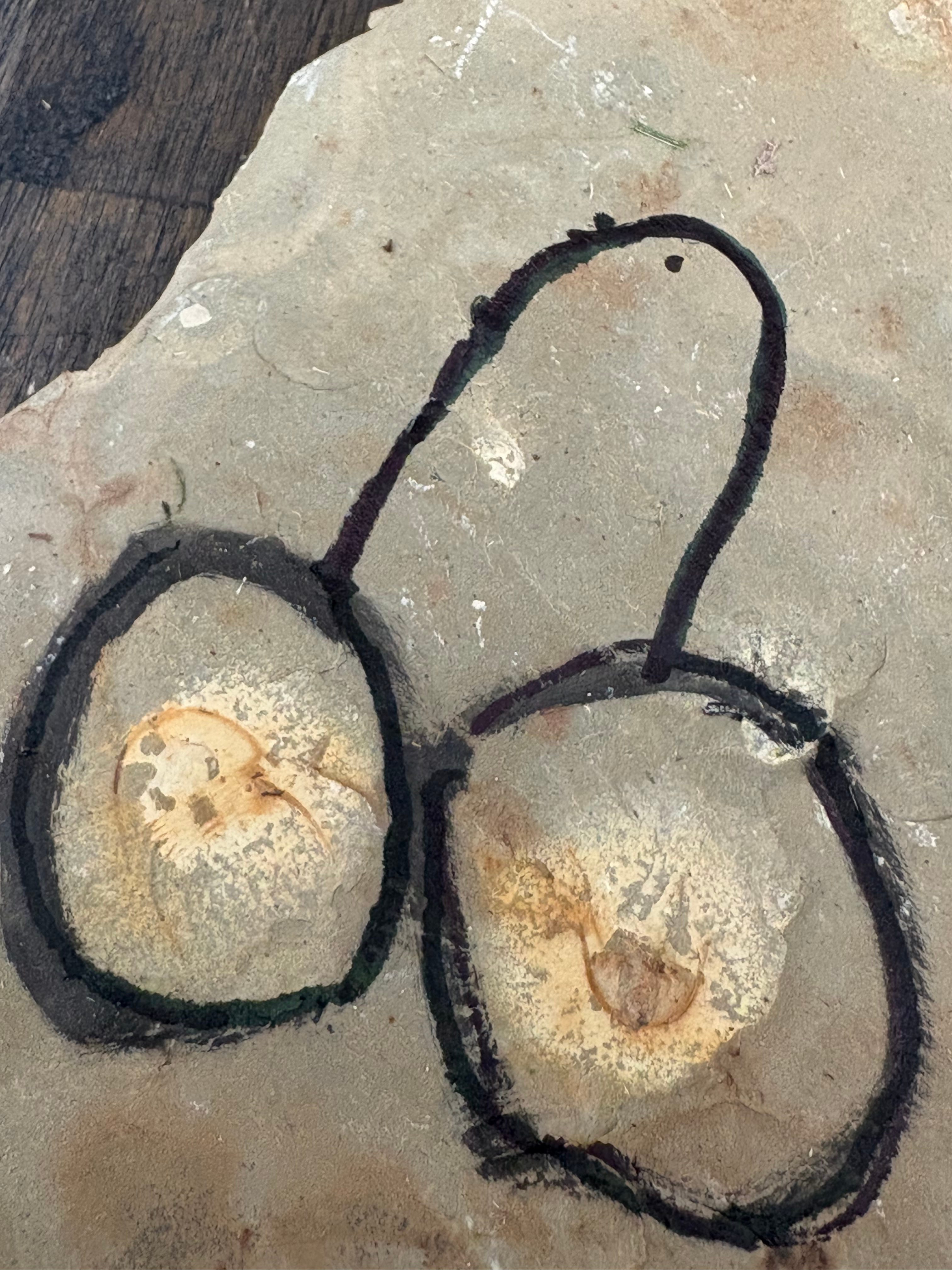
I’d spent a week in 110-degree heat with a pry bar and a rock hammer. When it comes apart and there’s something inside, it’s a religious experience. I spent two decades studying evolution and most of it was theory. This was the imprint of the animal in my hand. Eighteen months ago I was a scientist; now I was the guy whose stuff you drew on.
Everyone wants to matter. My great-aunt Laura, born in 1896, used to boast about being listed in Who’s Who. The book was several inches thick, full of names nobody remembers, and she was an entry on page something or other. At age ten, I thought that sounded pretty important. She was doing the same thing humans have always done. Thirty thousand years ago people put their hands on the walls of caves and blew red pigment around them. I was here. Now we count likes, refresh followers, and check if anyone responded to our hilarious comment at 2 a.m.
For a while I thought I mattered too. Ten years ago I was a Wall Street trader with a PhD in evolutionary anthropology who had trained under Robert Trivers, one of the most important evolutionary thinkers since Darwin. Now I substitute teach for $160 a day in North Carolina where nobody gives a shit about my credentials. Full-time teachers walk past me and look through me the way you don’t look at people who clean the bathrooms.
Status is funny though. You can be Norm in Cheers one minute and the guy cleaning up someone else’s half-eaten hot dog the next. Anthropologists who study status hierarchies in small-scale societies measure at least four types—relational (how many important relationships you have), material (how much stuff you have), somatic (literally how strong you are; we measure grip strength), and what we call noetic (the stuff you know that other people don’t). You can rank high on one and low on another.
I might not care about your golf handicap, but I’ll find a way to mention I bench 280, which is pathetic at the gym I go to. Last week I lost 2-6, 0-6 in tennis to a guy I should have beaten. I threw my racket four times. What kept me from walking off the court were the women playing doubles next to us, who had noticed how unhinged I’d become. One of them was my neighbor.
Status is also zero-sum. In capitalism the pie can grow — there’s more money in the world today than there used to be. But status is fixed. Even in Star Trek‘s post-scarcity utopia, where they’ve abolished money and ended hunger, not everyone gets into Starfleet Academy. Like Harvard, if everyone got in, it wouldn’t mean anything.
Of course, it’s hardly a revolutionary insight that people buy things to show off, or that getting into Princeton is prestigious. What’s harder to admit is how much of what we say and do is reflexively playing the same game. It’s easy to spot the asshole with the Ferrari or Rolex but harder to acknowledge the NPR tote bag, the pronouns in your email signature, the dog you rescued, or the copy of Anna Karenina on your coffee table. Or the “we made fools of ourselves after finishing a bottle of mezcal at this place in Oaxaca a friend kept saying was the real deal — my Spanish absolutely fell apart” anecdote you’ve been telling for two years. The Atlantic article you casually mention at dinner. The lifted F-150 and prison tats you need for your job as assistant manager at the T-Mobile store. Me wearing a Dartmouth sweatshirt at the airport because it’s comfortable, while secretly hoping I get asked who went there. Or mentioning that I trained under Robert Trivers, which if you’re counting is now the third time I’ve mentioned him in this essay.
But playing the status game isn’t even the worst part. It’s handing my worth over to people and circumstances I don’t control. As my AA sponsor says, “What other people think of me is none of my business.” Of course I can’t just mind my own business and I am constantly measuring myself against others. I once Googled a guy from high school who I hadn’t seen or thought about in thirty years. He was a hedge fund manager in London, probably worth hundreds of millions. It ruined my week.
Comparing yourself to others doesn’t just surrender your happiness to strangers, it locks you into a contest you can never win and makes other people’s wins feel like your losses. Whatever you measure yourself by will be the thing that eventually breaks you. Chase money and you’ll never have enough; bank on being smart and you’ll spend your life afraid of when you’re not; trade on your looks and you will lose, because everyone gets old.
My mother is eighty-three. She was raised by a Mennonite farmer who used to say that if you wanted to know who was in charge, start something. Her whole life has been figuring out where she ranks—above her 350-pound sister who had meningitis as a baby and a low IQ for the rest of her life but below the families who go to Birmingham First Methodist, who she’s sure look at her like she’s holding a pitchfork. She watches Judge Judy religiously and loves it when Judy sizes up some fuck-up, asks how many kids he has and by how many women and how he’s not paying a dime for any of them. Do you see “stupid” written on my forehead? Put your hand down. Get a job. Get two. There’s always someone in that courtroom below her.
My mom has two and a half million dollars but thinks that she’s broke. She shops for the cheapest chicken breasts, eats cornflakes for dinner, and lives on less than thirty thousand dollars a year. She’s tougher than I will ever be and has never once asked me for anything. When an ice storm took out the power on her street, the neighbors all moved to hotels, stayed with relatives or bought generators. My mother sat in a chair in the front room under a blanket, no heat, no television, and waited it out. My sister and I didn’t find out until months later. As I write this she is sitting in that same chair with Judy blaring in the background, terrified that someone from Birmingham First will notice that she isn’t reading the New York Times. This summer she will move into the Mennonite home in Canada near where she grew up.
The game never ends until you do, and even then the people who won die in a slightly better nursing home with a fancier breathing tube than the people who lost. My dad ran track at the University of Michigan and died in a bed having his diaper changed by a kid he’d once flunked.
We all end up where my father did. You can wait for it all to be taken, or you can begin handing it over now. Let go or be dragged—or, as the Buddhists put it, die before you die. The self you’ve been defending—the identity, the position, the proof that you matter—was always going to be taken from you. It’s the joke that takes a lifetime to get: none of it was ever as serious as it felt.
How do I feel about my own status decline? It depends on the day, sometimes the hour. Sometimes it’s simmering resentment and another fight with a principal who’s trying to tell me how to run my class. Other times I reframe it as just another of life’s challenges. Bitter or better, my sponsor used to say. I’m learning the same lesson alcohol taught me: the thing you’re most afraid to lose is the thing keeping you in prison. And sometimes the loss does something I never expected: it loosens the knot between who I am and what I do, and frees me up to be the other things I might have forgotten—father, neighbor, son, brother, friend. Not better, not worse. Except, of course, I’m better. Don’t you know who I am.
I laugh when Dwight weeps with joy as Michael promotes him from 'Assistant to the Regional Manager' to 'Assistant Regional Manager' on The Office — an example I borrowed from Paul Bloom, whose essay on status inspired me to write this series. But last month I filed a lawsuit against the University of North Carolina for not hiring me into a job that pays slightly more than subbing. And I spend part of each day fantasizing about caving in some smug cultural anthropologist’s face with a shovel.
I’m writing a book. I think it’s good. My agent thinks it’s good too. But I’m noticing that the I am someone feeling I used to hang on my CV is migrating to the book. These days I introduce myself as a substitute teacher, no preamble, no Trivers, no Wall Street—but part of me is still deciding whether to mention the book and wondering what I’ll cling to next if it doesn’t sell. I’m watching the show and I’m in it.
In the classroom I rank below the lunch ladies. Among my college friends I’m the guy who called the cops on himself after smoking crack for two days straight. With my neighbors I’m the guy who thinks bullies build character and that kids should get off their screens, go outside, and break an arm now and then. To my own kids I’m the funniest man alive, which mostly just tells you they’re seven and eleven. On the tennis court I’m a full-grown man who still throws his racket. In every one of those rooms, some part of me is still working it. I’m writing a book.
The kid who drew the penis wasn’t thinking about me, or even the fossil. That would have required noticing me. He was thirteen, performing for the other kids. In every room someone is going to be the punchline, and your job is making sure it isn’t you. When I was in middle school I made fun of the nerds so that no one would notice I was one. My friends and I spray-painted LIBBY SPANKS THE MONKEY on the bridge everyone passed under on the way to school after Libby got caught beating off with a girl’s panties at a party I wasn’t invited to. He didn’t come back to school for a week. I’d like to tell you that I grew out of it. I didn’t. I just got better at hiding it—the Dartmouth sweatshirt, the book I keep mentioning, the casual I trained under Trivers.
My decline is hardly unique. It’s the oldest story there is—the cab drivers in New York who used to be surgeons in Uzbekistan, and soon enough the rest of us, when the machines turn out to be better at our jobs than we are. If it hasn’t come for you yet, don’t worry—it’s waiting, patient, colostomy bag in hand.
That summer I was at my swim club and ran into the kid who’d drawn the penis on my fossil. He was thrilled to see me. He said I was his favorite teacher, that he loved my class. Then spent the next hour teaching my six-year-old how to dive.
This is the third in a series on status and downward mobility. The first is “I was wearing a Tutu when I Started Bragging about my PhD” and the second one is called “I was a scientist then I became a Substitute Teacher.”
Comments
Nothing yet. Say the first thing.
Sign in to join the conversation.