
Short summary:
We are each given the capacity to choose our path out of fear and domination. Of the way to freedom from enslavement, of coming out of constriction, out of the place where our hearts are bound, whether from trauma, fear or baseless vengeance. We can free our hearts from the enslavement of fear and vengeance. We can choose something else over killing our own sisters and brothers, committing genocide against other peoples and killing prophets and mystics. We can choose developing our own connection to Love and Creation so that we will never be lured away from that connection to our true home.
This week’s Torah portion, Re’eh, continues Moses’ giving over through his words of Torah all that he has harvested from these 40 years of leading the people out of the place and consciousness of enslavement to where they camp now, on the threshold of something new to humans. He begins with the wake up call of so many spiritual paths: Re’eh! See! See clearly! See that the universe itself, the world in which we humans find ourselves, presents a choice to us. As contemporary spiritual teacher. Eckhart Tolle puts it, “The world is not here to make you happy. It is here to awaken you through challenge and resistance. “
As Jewish mystics such as the 19th century “Ishbitzer” put it, re’eh is the seeing that focuses us inward, toward understanding, insight, and wisdom, so that we can awaken to see beyond the superficial appearance of things and discern life’s deeper meaning. (Rabbi Mordechai Yosef Leiner, 1801–1854).
Learning to “see clearly” what happened between you and different people(s) is often taught as the first step in the Nonviolent Communication (NVC) process of communicating with others to create connection and shared reality. This is a stepping stone toward creating a peaceful world in which each of us is safe to stand in our own truth.
To Buddhist teacher Thich Nhat Hanh, looking deeply is the path to compassion. “When you take time to listen to your suffering and look deeply into its true nature, understanding will arise; when understanding arises, compassion is born.” Zen and the Art of Saving the Planet, Learn more at: plumvillage.org/zasp
In Torah, what is it that we are meant to see deeply? Torah delivers its message through a series of horrific images of killing off and destroying: when you are lured into forgetting that you-all of us-have been enslaved as strangers and then freed, you will kill and destroy. You will only realize the full human promise when collectively all you humans evolve into trusting and abiding in a collective higher power that freed you. You will be free when you so strengthen your own inner capacity, to understand that all of us have gone through the same struggles, that you no longer separate yourself from others.
This is how I understand the exhortations in this week’s Torah portion, such as to kill your own brother and sister, your own “mother’s son,” if they are successful in “luring you away “from seeing your own true nature: “Stone them to death for having sought to make you stray from the ETERNAL your God, who brought you out of the land of Egypt, out of the house of bondage.” To commit genocide against other inhabitants who “lure you away,” “put the inhabitants of that town to the sword and put its cattle to the sword. Doom it and all that is in it to destruction.” And, “as for that prophet or dream-diviner, they shall be put to death for having urged disloyalty to the ETERNAL your God—who freed you from the land of Egypt and who redeemed you from the house of bondage—to make you stray from the path that the ETERNAL your God commanded you to follow. Thus you will sweep out evil from your midst. “
All of this “luring away” is actually the work of Torah’s God:
“Do not heed the words of that prophet or that dream-diviner. For the ETERNAL your God is testing you to see whether you really love the ETERNAL your God with all your heart and soul.”
Choose Blessing or Curse
The Torah portion is reminding us, over and over, that we have a choice between blessing and curse. We can choose to not let ourselves be lured away by domination, possession and vicious hatred. We can choose to take the path of love. For many Jewish women this means, for example, it is incumbent upon men in a Synagogue to take down the mehitza ( the wall between the women and the Torah, between the men and women), and transform their own objectification of women as sexual objects to possess so that we can all pray for love together.
Today, it is incumbent upon all of us to not be lured away by leaders who preach, “Within a few months, we will be able to declare that we have won. Gaza will be totally destroyed,” Smotrich, 2025. “Why are we having all these people from shithole countries come here?, “ D. trump. “You should attack every Jew possible in all the world and kill them.”Fathi Hamad, 2014. “We’ll Have Our Home Again,” a Department of Homeland Security posting for an ICE recruitment effort, referencing a white supremacist anthem favored by the Proud Boys, 2026.
Torah’s cautionary message is captured in “First They Came,” the famous confessional poem written after World War II by Pastor Martin Niemöller, a German Lutheran pastor. It warns about the dangers of silence and apathy when groups face oppression.
First they came for the Communists
And I did not speak out
Because I was not a Communist
Then they came for the Socialists
And I did not speak out
Because I was not a Socialist
Then they came for the trade unionists
And I did not speak out
Because I was not a trade unionist
Then they came for the Jews
And I did not speak out
Because I was not a Jew
Then they came for me
And there was no one left
To speak out for me
The Heart of Jewish Practice: Remembering you were Slaves in the Land of Egypt
The Torah portion goes on to amplify gratitude and collective ritual as key ways to remember again and again that “you were slaves in the land of Egypt and the ETERNAL your God redeemed you; therefore I enjoin this commandment upon you today.” This is at the heart of observing and celebrating the three main Jewish pilgrimage holidays, celebrated to this day:
“Bear in mind that you were slaves in Egypt, three times a year—on the Feast of Unleavened Bread, on the Feast of Weeks, and on the Feast of Booths—all your males shall appear before the ETERNAL your God in the place that [God] will choose. They shall not appear before GOD empty-handed,”
Choose Blessing over Curse
Re’eh ends with a reminder of the blessing. What is the blessing?
We are each given the capacity to choose our path out of fear and domination. Of the way to freedom from enslavement, of coming out of constriction, out of the place where our hearts are bound, whether from trauma, fear or baseless vengeance. We can free our hearts from the enslavement of fear and vengeance. We can choose something else over killing our own sisters and brothers, committing genocide against other peoples and killing prophets and mystics. We can choose developing our own connection to Love and Creation so that we will never be lured away from that connection to our true home.
Some Enzymes to Digest the Violent Metaphors
Buddhism, Hinduism and so many spiritual paths use violent spiritual metaphors to wake us up. There is an often quoted story in Zen Buddhism, “If you meet the Buddha on the road, kill him.“
Vietnamese Zen teacher Thich Nhat Hanh helped me understand that the teaching to “kill” the Buddha refers to the fixed separate image, the false idol to use the torah metaphor, that is in your mind. Many years ago I was part of a delegation that traveled to China with him and many monastic and lay students. We listened to a dharma talk about Chinese Buddhist practice from an old Abbot in a beautiful rebuilt monastery. The Abbot gave an exposition on another koan, Zen teaching story, in which the student asks the teacher, does a dog have Buddha nature?
After the Abbot finished, Thich Nhat Hanh said, I would like to give my students some enzymes to help them digest the Abbott’s teaching. He said, “Does the dog have Buddha nature? Of course. Everything has Buddha nature. This is the capacity, the nature, to wake up and become fully enlightened.”
He went on, the koan and the Abbot are talking about the dog that’s in your mind when you ask the question: Does it have Buddha nature.
That dog is an image, not the real thing. The dog in your mind, like the image of “other gods“ is an invention of the mind. In Torah, there is only one God. That is one of the hallmarks of the entire religion. The instruction to kill the Buddha, to kill your own sisters and brothers, means, do not follow or worship truths that you haven’t seen for yourself.
If you meet Buddha on the road, kill him.
Of course that Zen teaching isn’t telling us to kill the Buddha or to kill anyone. The first precept of Buddhism, engraved on the tablets brought down from Sinai, is the prohibition on killing. The Torah isn’t telling us to kill our sister, brother, other peoples, their altars.
These teachings are meant to wake us up to how much we live in our heads, worshiping false news and false theories and false stories about ourselves and each other. If we are to inhabit the promised land, and not be spit out by it, we must stop worshiping ( being attached to) our own beliefs at the expense of others’ beliefs.
A Re’eh Practice with Nonviolent Communication (NVC) and Buddhism
With NVC when we look deeply, re’eh, we see that everything anyone does or says, including actions and words that we see as harmful, are expressions of life itself. The unifying premise is that the actions we choose are attempts to meet universal life needs. Try this practice to look deeply to understand and connect with the needs someone is trying to meet, even when you feel scared, disgusted, horrified by their actions. Then, use the Buddhist practice to sit quietly and see how seeing deeply in this way affects you.
Call to Mind something someone else does that is less than wonderful for you.
Remind yourself that you are choosing to do this exercise to see if there is something new or different you can learn and experience. Use the Needs list to identify the energy of the needs to learn and discover( or other needs) penetrate this process for you. Keep drawing on visualizations and any inner tools to reconnect with the needs you want to meet by doing this process!
Let your creativity and curiosity wander to the other person- what needs on this list are they attempting to meet by doing exactly what they do?
Are you seeing deeply something you hadn’t seen before?
Does it affect you in any way?
If your response is, “no,” perhaps[s you are seeing more deeply and clearly your own needs in the situation. What do they want and need?
Does any of this help give rise to compassion? Toward yourself, the others, or humanity in general?
Buddhism suggests we understand all actions as attempts to alleviate suffering. We do what we do because we believe it will help us stop our suffering. When we recognize this in ourselves and in others, we can trace back to the source of goodness in everything. Actions are a cry for help. Our choice to see it that way is a fruit of deep looking and brings more compassion into the world.
Applying this to re’eh, Torah puts a choice before us, in every moment. It is on each of us to be mindful of the impact of our choices. In any moment, in any action, we have the opportunity to contribute to blessing or cursing life. The more we direct our mindfulness, seeing, re’eh, toward our own understanding and intentions, the more mindful we will be in our choices. Bringing the energy of mindfulness into our choices is the blessing.
As I look at the instructions in this week’s Torah, some are inspiring mindfulness practices that connect me to the longings in my heart, to care for the needy, pay close attention to what we eat, and welcome the stranger. Others are unfathomable, not relevant or repugnant.
The path for me is to look deeply to see which choice is a blessing and which is a curse. I have inherited ways of living from my culture and ancestors. In the world today, some of these ways are “curses,” such as driving my own car, taking more than my share fair of the world‘s abundance, withdrawing from those I love when I’m in pain, valuing certain people and beings more than others.
All of this comes about when I see myself or my small group as separate, as surviving separately from the whole of creation.
The Promised Land, to enter and inhabit, is where I learn to see deeply which of my ways of being are blessings and which are curses. It means going way beyond the edges and bounds of what my ancestors knew and did. This is what it means to be a Hebrew, an Ivri, a boundary crosser. We let go of attachment to old strategies that don’t serve the present or the future.
For more Torah at the Intersection on Re’eh, and other writings:
Re’eh: Seeing Under the Surface of Things
https://torahattheintersection.com/reeh-seeing-under-the-surface/ (2021)
Looking Deeply at Suffering and Joy Together
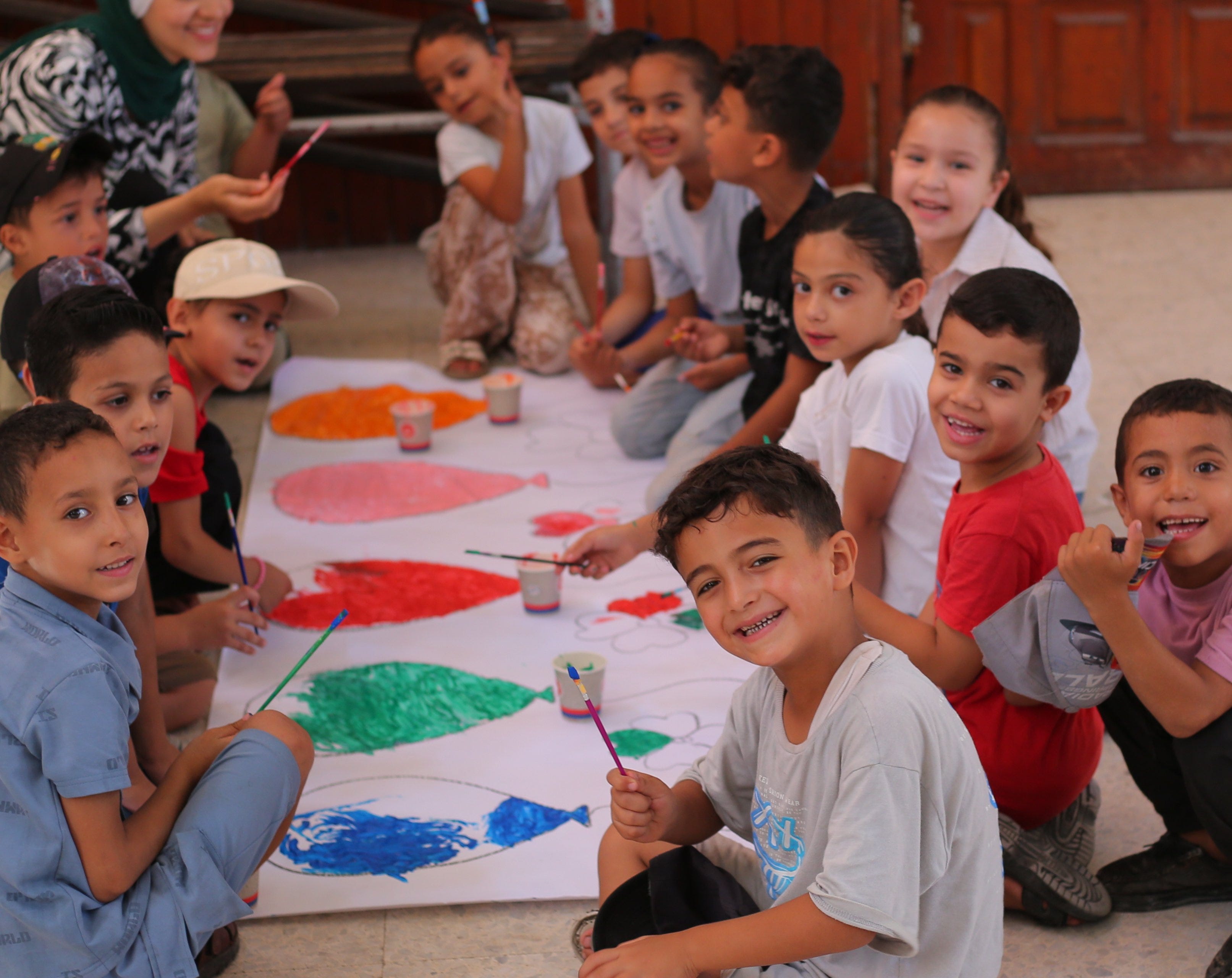
Please take a look at this camp for children in Gaza and and join our community of supporters! Any amount is welcome and brings joy to place of suffering!
We are still continuing our summer camp activities. Every day, the children remind us that happiness can come from the simplest things.
Today, one of the children came to me and said with a smile, “Can we play with balloons?” I knew that it is very hard to find balloons here.
Instead of saying “no,” we brought a big poster, drew balloons together, and colored them. We didn’t have real balloons, but the children were happy, laughed together, and enjoyed the activity.
Thank you to every single person who has supported us. Every donation, no matter how small, brings joy and a smile to a child’s face.
Because of your kindness, we can continue these activities and give children happy moments during this difficult time. Thank you from the bottom of our hearts❤❤
https://www.gofundme.com/f/on-this-land-gazas-children-still-deserve-hope
No posts
Comments
Nothing yet. Say the first thing.
Sign in to join the conversation.