
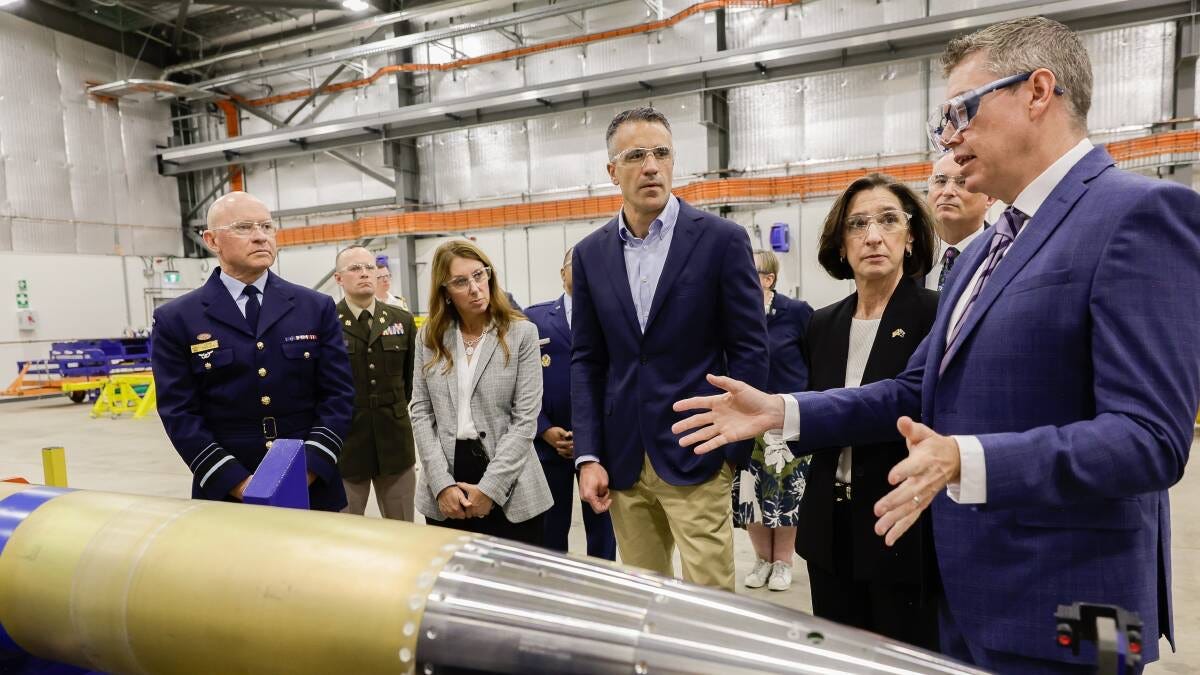
Labor’s Minister for “Defence” Industry, Pat Conroy says that yesterday and today he is meeting with senior US administration officials, including at the Pentagon, Congressional leaders and industry leaders across both sides of the aisle. He says,
My main message to them is that Australia is committed to the alliance…Australia is committed to growing our defence industry. Not just to support the Australian Defence Force but also to promote deterrence and peace in our region.
He will then move on and visit Tucson, Arizona, where he will be going to an RTX missile factory, “one of the biggest missile factories in the world.”
Australia is now supplying 200 missile factories across the US, according to the Trump administration.
He will be exploring Australia’s commitment to undertake maintenance, repair and overhaul of the Advanced-Medium Range Air-to-Air Missile AMRAAM, as well as looking at opportunities to produce that very advanced air-to-air missile in Australia.
That's part of the Albanese Government’s $36 billion investment in the guided weapons and explosive ordnance enterprise.
“We've got hundreds of Australians training at both Pearl Harbour and in US Navy submarines right now. And we're building parts for not just the UK, but the US as well.”
Conroy has got two announcements around AUKUS yesterday.
A contract to Leidos Gibbs & Cox to design the contingency dry docking facility that we need. This dry dock is another milestone in AUKUS.
for the first time ever, Aussie steel will be going into US submarines. Electric Boat has signed a $2 million contract with Bisalloy to acquire Aussie submarine-grade steel that will go into Virginia-class submarines. These are submarines that the US Navy will use.
A journalist asks
Mr. Conroy, the Pentagon is reviewing its military footprint in Europe. Do you think that opens up an opportunity for the US to shift more of its focus to the Indo-Pacific region? And would you be hopeful that they might increase troop rotations and the size of deployments to Australia?
Rotations means US base. Conroy says
we've obviously got SRF-West starting next year. We've got the Marine Rotation Force as well in Darwin, as well as a range of other rotations through the continent of Australia. We work really well with PACOM under Admiral Paparo. I met with him recently, and we meet regularly to discuss how we can work together….
I'm also focused on co-production or co-design, co-development, co-production and co-sustainability statement so that US forces can use our industrial base.
Not one journalist asks if that is a good idea considering the US is about to formally embark on the same with Israel. Conroy continues:
To give you a couple of examples, a US Virginia-class submarine docked in Fremantle recently, and swapped out its entire Mark 48 torpedo load and received a load of Australian torpedoes maintained at the torpedo maintenance facilities there.
A US Navy Romeo helicopter received deep-level maintenance at our Nowra industrial facilities, undergoing identical industrial treatment as if they were in the United States.
This is examples of us working together on co-sustainment so that it's much faster for US assets to get deep-level maintenance in Australia than to travel all the way back to the continent. So, we are working closely together and obviously what they decide there is a matter for them.
Conroy is not asked whether it makes Australia more at danger of being targeted because it has US bases, storage and war sustainment facilities dotted around urban, regional and remote areas.
Another journalist says
The United States would obviously like to be making more Virginia-class submarines. They've said that the estimates are they're making between 1.1 and 1.4 a year.
Are you confident that the Americans are making enough that they'll be prepared to actually give Australia some of their Virginia-class submarines under the AUKUS deal?
Conroy says he is confident:
The US has put aside $US17.5 billion to expand the submarine industrial base.
We've put aside $3 billion, of which we've committed slightly over $2 billion already.
That money is flowing right now to expand the industrial base.
As I said, I was at a Newport News facility in South Carolina yesterday.
That one facility, that only opened last year, will contribute 1.5 million hours of production to the Virginias each year.
That is a very significant increase in Virginia production.
And that's one of 34 distributed sites that Huntington Ingalls is doing by themselves, let alone what Electric Boat is doing. So, the submarine industrial base is expanding, and that will flow through over the next few years to increase those production rates. Equally, obviously, we're making a commitment as well. So, that steel announcement is a precursor of more to come.
We've got an Australian company called AML3D that in Ohio is manufacturing 3D printing machines right now that is contributing to the industrial base.
Conroy is not asked why we are choosing to spend billions on the industrial base in the US rather than other priorities in Australia. Another journalist asks:
And is there any concern in the Australian government that under the AUKUS agreement, the American president, whoever it will be at the time, has discretion as to deciding whether or not to go ahead with handing over those submarines to Australia.
Should Australia have signed a deal that ultimately gives discretion to somebody we don't even know who that person might be?
Conroy suggests any future US president will honour the deal because it will be in their shared interests to do so. This indicates we will remain subservient to US military and foreign policy for the foreseeable future unless there is political change in the US or Australia.
Minister for Foreign Affairs Penny Wong is asked a question (likely from the pro-Israel lobby) on FiveAA radio:
The Labor conference has just transpired here, obviously, in Adelaide.
The National Platform was updated as it pertains to Israel and Palestine.
Some of the language was changed with regard to whether the Hamas terrorist group should disarm. That was removed from the National Platform.
Is it still Australian Federal Government policy that Hamas should disarm?
Wong replies
It is. And in fact, the platform does refer to the resolutions of the United Nations Security Council that require the demilitarisation of the Gaza Strip. And Hamas, having no role in the governance of Gaza and also reform of the Palestinian authorities.
“But it was explicit before,” says the journalist.
“We refer to the resolutions which set out those conditions,” says Wong before changing the focus:
I would make the point, I thought it was one of the most moving moments in the conference that we had a Labor Member of Palestinian heritage and a Member of Jewish heritage together moving the resolution in relation to Palestine and Israel.
And you know, we know that we've had a lot of division in our country, a lot of anger.
And this was a moment which spoke to social cohesion and spoke to Australians coming together on what has been an intractable problem.
Is Wong talking about the intractable problem of genocide complicity? Or the intractable problem of silencing everyone who seeks to talk about it? I think not.
Have no doubt, some researchers have received hundreds of thousands if not millions for another project on how to improve social cohesion and trust in government.
Imagine if they spent that on helping lift families out of poverty and instead did the thing that would improve trust overnight— uphold international law.
Instead the government treats groups of human beings as expendable. We are told, through the good students of Basem and Josh, you can belong here if you shut up and smile.
Wong continues:
And so I have enormous respect for Josh Burns and Basem Abdo for what they did at conference and what they said to our party and about our party and country.
Wong continues to project that the “intractable problem” is one between Palestinians and Jews in Australia. Labor, desperately, does not want the public or its party faithful to understand that the heat is between people of conscience on one side, and the government, the weapons industry and Zionist lobby on the other.
Senator Fatima Payman might have been watching from afar, realising if she had stayed in and upheld the silence code, she would have made them a trio on stage.
No posts
Comments
Nothing yet. Say the first thing.
Sign in to join the conversation.