
Yesterday Australians came across the most distressing images of children maimed and murdered by Israel while they sleep.
Shaimaa Marwan writes:
This beautiful child was named Zaid Nofal. He was killed by the Israeli army in a U.S.-made missile strike that targeted a home in the Bureij refugee camp in central Gaza.
What makes this even more heartbreaking is that Zaid was the only child his mother gave birth to during the war, after the Israeli military had already killed her three other sons, Ameen, Hamza, and Ahmad, at the beginning of the genocidal war.
Once again, Fatima has lost everything. She lost her home, she lost her three sons, and now she has lost her only remaining child, Zaid, one loss after another.

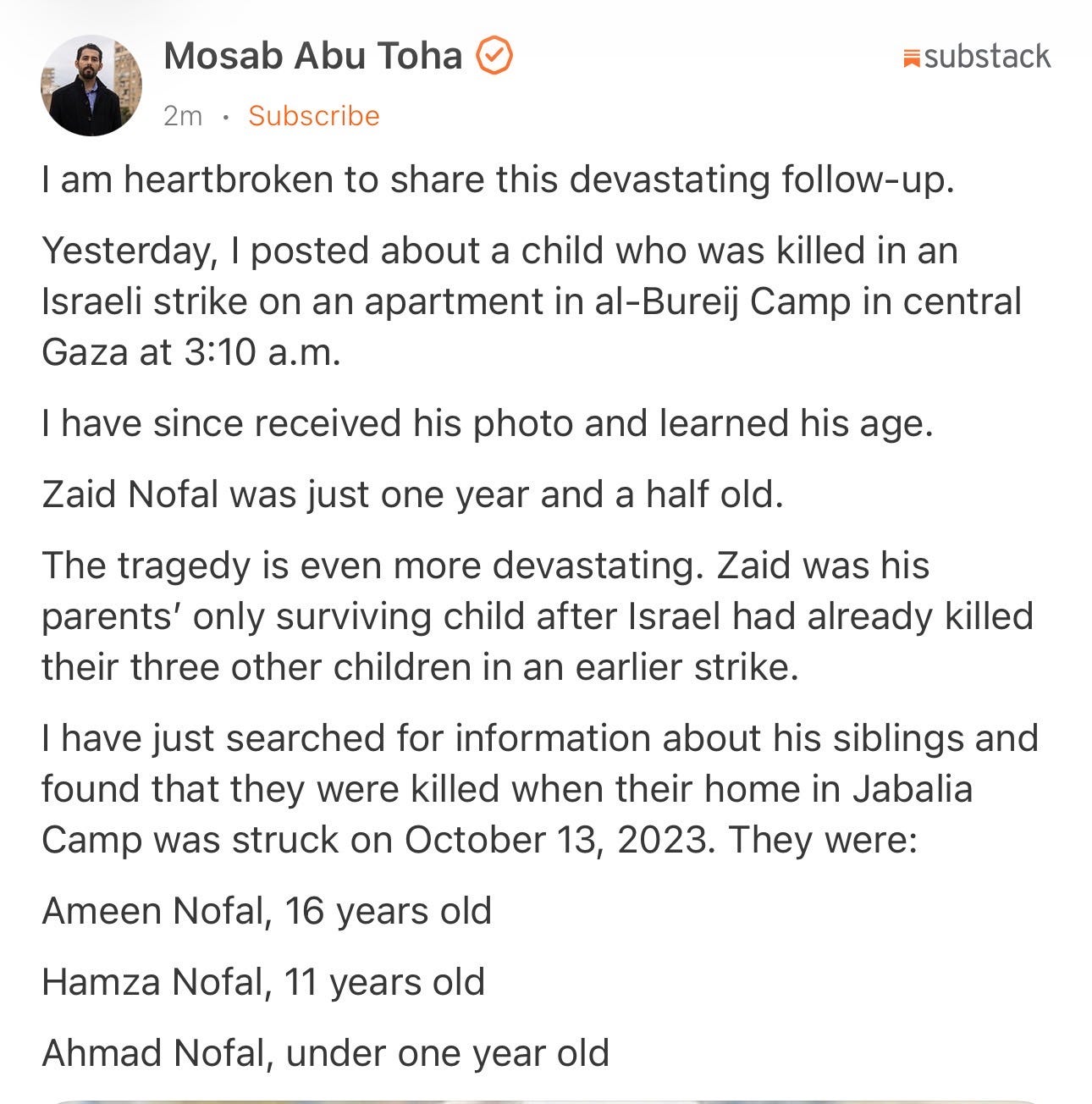

I have chosen not to include the most graphic photos here. They were very distressing. Children aged 5-8, by their size, laying bloodied on the hospital floor. One little girl hangs onto life by a thread, completely covered in blood. The most extreme form of violence on the most vulnerable.
Dealing with the pain of these images is very difficult. Even though we are not this child’s mother or father or sibling, we mourn them as if they are, and we mourn the humanity our own government has denied us through their own callous and immoral response.
The Red Lines Package being passed by our parliament to stop complicity in these crimes is both urgent and essential for our national wellbeing and sanity. I urge you to sign up for updates if you haven’t already.
This week the Guardian reports that overwhelmingly more health workers have been killed in Palestine by Israel, and then in Lebanon by Israel, than any other “conflict” in the world. More than half of all the killed health workers across the world since 2021 were killed by Israel and US.
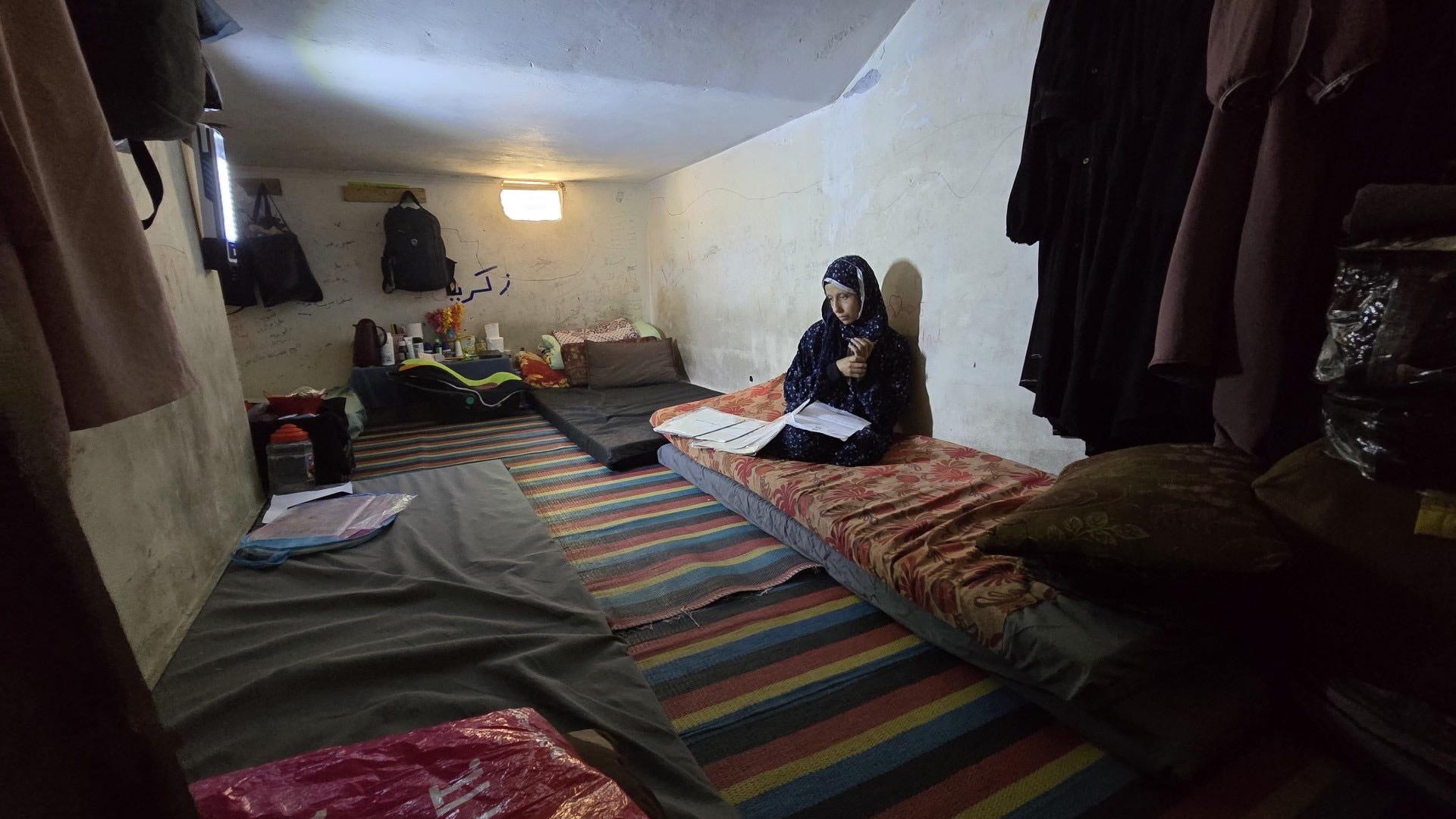
This week, Middle East Eye reports:
In a cramped space beneath the staircase of a school-turned-shelter in southern Gaza, university professor Kholoud Abu Sahmoud is slowly losing her battle with cancer.
The mother of a five-year-old boy and a nine-month-old girl says she has been unable to hold her youngest child since giving birth.
By March, around 46 percent of essential medicines and 66 percent of medical consumables were already completely out of stock, according to UN agencies and international organisations.
This month, the Palestinian Ministry of Health in Gaza announced that chemotherapy treatment for several types of cancer had largely ground to a halt, including breast, colorectal and gastrointestinal cancers, head and neck tumours, and sarcomas, as stocks of specialised oncology medicines reached critical levels.
The ministry said that, of Gaza's nearly 11,000 cancer patients, at least 4,000 have been issued medical referrals and are still waiting for permission [from Israel] to leave the strip for treatment.
More than 20,000 people in Gaza, including around 4,000 children, are awaiting urgent medical evacuation, according to the Palestinian Ministry of Health.
Since Rafah reopened in February, only 1,655 patients have been evacuated as of 30 June. More than 1,570 people have died while waiting for permission [from Israel] to leave since October 2023.
It would be great to see Australian cancer charities use their voices about this.
Humanitarian aid is still being blocked by Israel into Gaza while a population of maimed, injured, sick, homeless and traumatised people are effectively ignored while our political leaders celebrate Israel’s legacy in hospitals (Jacinta Allen) and defence (her replacement, Victoria’s new premier Ben Carroll).
This week, Al Jazeera published an explainer to what AI warfare looks like, reporting:
For centuries, fighting wars meant deploying hardware such as tanks, aircraft, artillery and weapons, built by a handful of prime contractors under long-term government programmes.
It also meant putting boots on the ground.
That paradigm is not disappearing, but software is becoming increasingly central to it. And now, more soldiers are fighting wars through a screen.
The military AI industry now encompasses everything from cloud computing to autonomous drones and decision-making software. This shift traces back to the US drone programme of the 2000s and 2010s, which turned remote, screen-based killing into a feature of how wars would be fought.
Billions of dollars are flowing into a handful of companies now leading the AI transformation of militaries, as the old military-industrial complex reshapes itself into a military-tech one.
Who are these companies?
On July 10, the UK Ministry of Defence signed a 2bn pounds ($2.7bn), 15-year contract with Omnia Training, a consortium led by Raytheon UK, to train 60,000 soldiers a year on using AI to make a “combat-ready” British military.
Days earlier, NATO awarded contracts to run the alliance’s Enhanced Air Command and Control Data Platform to US military-tech company Anduril for its Lattice AI software alongside US firm Palantir and the French military-tech joint venture Athea SAS.
Lattice uses AI and computer vision to bring data from multiple sources into one live picture…
AI defence procurements are not new. The Pentagon’s 2014 “Third Offset Strategy” bet explicitly on AI defining the next generation of warfare, but the pace appears to be picking up as global military expenditure climbed to $2.88 trillion in 2025, with governments pouring record sums into defence budgets.
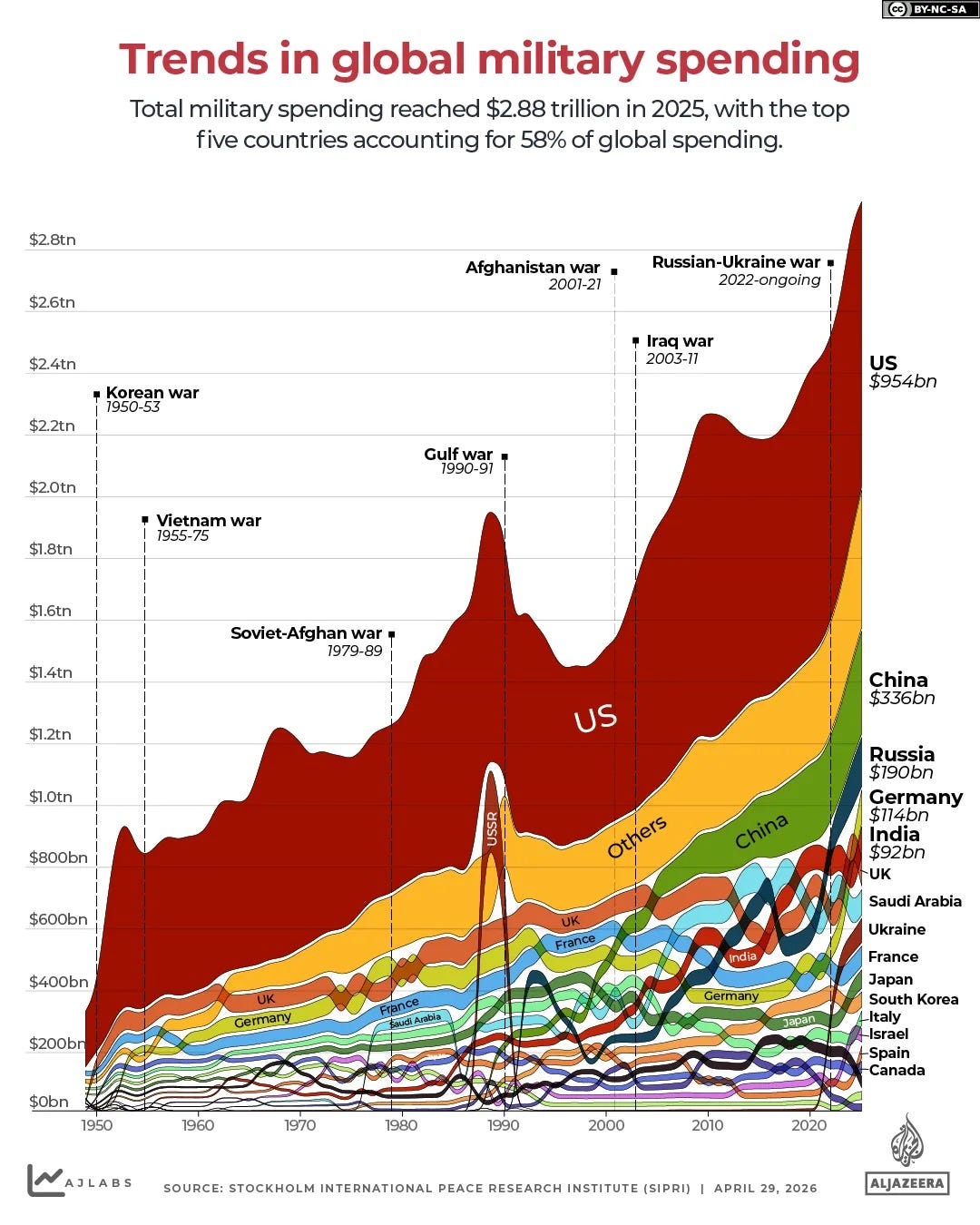
Looking at this image, it becomes ludicrous to hear Minister for Defence Industry Pat Conroy say this week during his trip to Washington that the US shares Australia’s alarm about the pace of Chinese military spending. The US’ global military spending greatly dwarfs other nations and the US openly threatens institutions of international law.
Al Jazeera’s report continues:
The most recent large deal by the Pentagon saw it sign contracts with eight of the world’s leading tech companies to deploy AI across classified networks in a bid to become an “AI-first” military
Palantir is perhaps the best-known name among such firms, largely through its role in Project Maven, the Pentagon’s flagship military AI programme. It is designed to speed up decision-making in battle, relying on AI and machine learning to automatically sift through satellite imagery, drone videos, and signals intelligence to identify and prioritise targets.
The system is being used in various conflicts, including the Ukraine war and US-Israel war on Iran — Maven identified 1,000 targets in the first 24 hours of the latter conflict.
A direct competitor to Maven is Anduril’s Lattice platform, which ties its own hardware – drones, sensor towers, autonomous vehicles – into a single command network, with it being heavily utilised by the US Army.
Big tech
Companies like Google, Meta and Amazon Web Services (AWS), which control roughly 67 percent of the global cloud infrastructure market, are increasingly linked to military applications that traditional defence contractors are providing.
In May, the US Department of Defense announced a new agreement with eight tech and AI companies to use their technologies for its classified networks.
The agreements with SpaceX, OpenAI, Google, NVIDIA, Reflection, Microsoft, Oracle and AWS were brokered to “accelerate the transformation towards establishing the United States military as an AI-first fighting force”.
The deal has meant these companies have been cleared for IL6 and IL7 networks, the most sensitive and classified computing environments the Department of Defense operates.
In the last few days, Assistant minister for “defence”, Peter Khalil told Australian media that AUKUS is a technology sharing pact and is something we should be proud of. Defence industry minister Pat Conroy told US politicians and officials to “use our industrial base.”
Any AI regulation being considered by the Albanese Government in relation to data centres or otherwise explicitly exempts AI military tech. That is governed by a separate statement of intent released earlier this year that has no enforcement.
Under AUKUS pillar two, Australia has liberalised exports to US/UK and now co produces AI warfare technology behind a classified curtain. Israel is soon to join US and Australia behind that curtain as a formal partner due to a law soon to pass US congress.
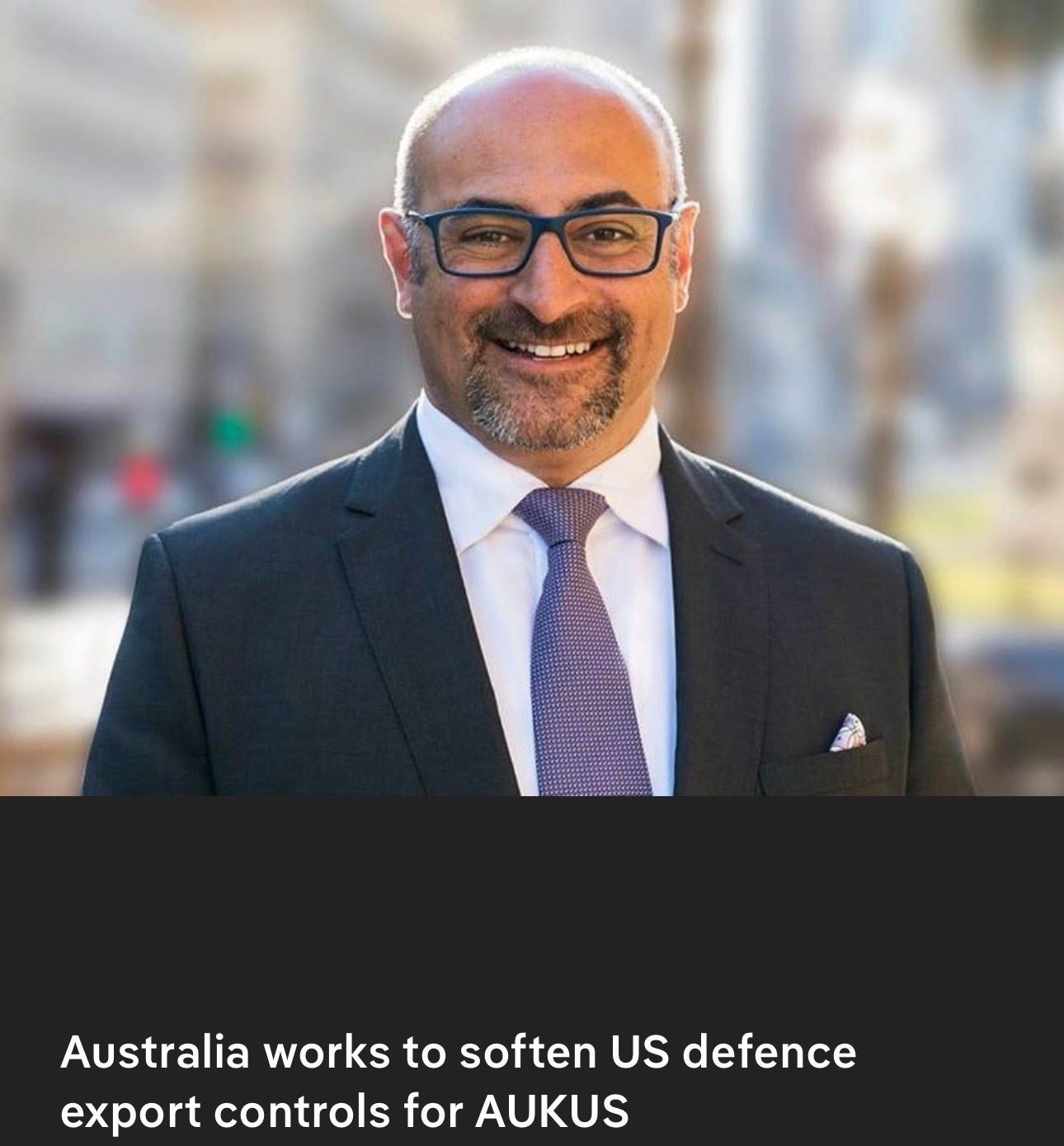
Assistant Minister for “Defence” Peter Khalil has joined the AUKUS-spruiking tour with Pat Conroy. He appears on ABC radio with Nick Rheinberger and boasts that AUKUS will create 20,000 jobs.
The journalist follows up with
Well, just on the jobs, in that same edition of Australian Foreign Affairs, we’ve got Saul Eslake, who I spoke to, said these 20,000 [AUKUS related] jobs will cost about $18 million apiece. Are you comfortable with that? That the capability that you mentioned is well worth that $18 million per job?
Khalil shifts gears, “this is not just about the jobs.”
Now it’s about strategy:
Jobs are important, but there is a broader issue here, a strategic issue. Why are we investing in capabilities, first and foremost? It is to defend and protect our way of life. And that’s much, much bigger than the 18 million that you’re talking about. It’s talking about the shape of the world that we live in. We want to deter conflict, Nick.
Khalil is not asked about the effectiveness of this “strategy.”
The journalist says
So, the point being that preventing conflict is far more cost-effective than getting into a conflict and having to throw everything at it.
Khalil says
Correct. Ukraine, which is in the midst of a war of survival, an external conflict now, a war, they are spending 38, 40 per cent of their GDP on defence.
No one asks what strategy will keep us out of war. All the Albanese government seems to be doing is acting out of fear of the US Government, putting a giant target on our back.
The journalist says
We had a contract with the French. And we’ve shattered our relationship with the French by having to compensate them for going back on the deal which we had signed.
Penny Wong forensically uncovered the gaps in the process which led to AUKUS, which was essentially a tactical idea from Scott Morrison with no needs unless or cost analysis from Defence.
Given that, why wasn’t the Labor Party brave enough to put a hold on AUKUS and stick with the French contract?
Khalil says
The decision around AUKUS and the tripartite agreement that was being signed by – that was signed by the Morrison government with the US and the UK was one that we as an opposition had to determine whether we supported.
We did at the time because, on balance, the importance of those capabilities for Australia and that flow, and the decision was happening.
We’ve then gone even further than that.
We’ve taken this to the next level.
The journalist says
the French were pulling out nuclear reactors and putting in diesels for Australia. So we could easily have got a nuclear submarine from the French.
Khalil says the American ones are the best in the world. He dismisses out of hand suggestions that Australia will never receive them from the US.
Minister for Home Affairs Tony Burke has finally decided to fight back against the politicking of those saying we should deny entry to some Australian citizens, with this comment:
The laws that we have that we use and that I have used are the laws that were put in place by the previous government that had already been decided went right to the limit of what you could do constitutionally, right to the limit.
Every Australian, me, included, doesn't want these individuals back. You know, when people have made a decision to join something as horrific as that, you don't want them back.
The reality is every country in the world has to take back its own citizens. And I would just say people should be very wary of letting go of the principle that countries have to take their citizens back. I get that there are people we don't want back, but can I say there are about 750 people every year who I make leave? About 750 people where I make sure that their countries have to take them back. And I would not want to go down a path where somehow we started a principle that countries don't have to take their citizens back. The people who I get rid of have been involved in child exploitation. They've been involved in drugs. They've been involved, some of them are murderers. Some of them are rapists. People have been involved in horrific crimes and the countries of their citizenship, I'll tell you, they don't want them back and I make sure they take them back. It is absolutely in the interests of Australian national security that we keep to the principle that countries have to take their own citizens back. And anyone who wants to depart from that principle needs to explain why they think it would be okay for the 750 people every year who I make leave, for them to have to stay here because I don't think Australians would cop it.
This fighting comment was made to save his political skin. The Albanese Government is facing heat through mainstream media over this new development regarding ISIS linked fighters returning to Australia, prompting this subtle shift in posture.
This ability to make a counterpoint to the Murdoch press and LNP/ONP comes about four years too late for the Australian children left to suffer in conditions described as equivalent to torture by the United Nations because the Albanese Government was concerned with the politics of bringing them back.
Eventually the children and their mothers came back on their own after the camps where they were illegally detained closed. The camp authorities gave up asking the Australian government to take them back. Many of those Australian children were reportedly traumatised and disabled from war injuries and lack of nutrition—with their conditions seriously deteriorating over that period.
No posts
Comments
Nothing yet. Say the first thing.
Sign in to join the conversation.