
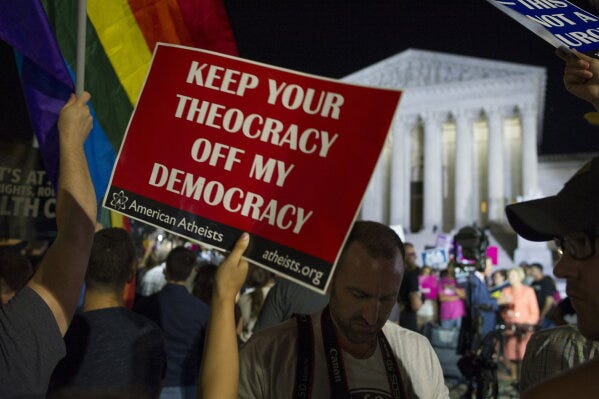
Last Sunday our book study wrapped the chapter “Theocracy from the Bench” in The Power Worshippers. Like every week, the conversation didn’t stay inside the book for long. It never does. We start with the text and end up somewhere in our own families, our own churches, our own ballots.
In this chapter, Stewart argues that a movement that couldn’t always win elections learned to win in courtrooms instead. She gives examples in which judges were recruited early, put in place, and waited for the right case to walk through the door. Stewart’s case study is a pastor in Winter Garden, Florida, whose wife climbed the Florida judiciary. She started in the Orange County Court, then the Fifth District Court of Appeal, eventually landing in the Florida Supreme Court, where she still sits today. It’s a similar playbook on a different scale, now running at the federal level too.
As we discussed this, nearly everyone on the call noted that Trump had the opportunity to reshape roughly 20 percent of the federal judiciary. After our call, I pulled on that thread. It’s a first-term number. By the actual end of his first term he’d appointed 234 federal judges, which is closer to a quarter to a third of the sitting bench. His second term has moved a lot slower with only 37 confirmations as of this spring, mostly because there just aren’t that many open seats right now. So, if you use that 20 percent stat anywhere, it needs to be pinned to “his first term,” not floated like it’s happening today.
I asked the group where they had seen a court ruling do the work that legislation could have done, but never did. The first example that came up was Dobbs overturning Roe. Next we discussed the Supreme Court ending race-conscious admissions in Students for Fair Admissions v. Harvard/UNC. Then, the 2024 presidential immunity ruling in Trump v. United States, which the Court had to build from constitutional interpretation because Congress had never passed a single word of law on the subject. I keep coming back to Roe specifically, because someone put it perfectly: it wasn’t a law passed by Congress, so it was easy to repeal. A court ruling can give you the outcome, but not the permanence. That gap has enormous consequences for individuals.
We talked about the documented cases of Texas women denied care during miscarriages and pregnancy complications, developing sepsis, some nearly dying, because of ambiguity written into the state’s abortion law. Someone on the call described it as “if you know and don’t report, you can go to jail.” When I checked that afterward, that’s not quite the mechanism. Texas’s criminal penalties fall on providers, not on bystanders who stay silent, and the civil lawsuit provision in SB8 (the “Heartbeat Act”) lets private citizens sue anyone who performs or knowingly helps someone get an abortion after roughly six weeks. It’s real exposure, just a different kind than what we described out loud. I just wanted to note that before we keep talking about it.
I walked the group through what that phrase actually means when it shows up in headlines: cases skipping the normal rungs of the lower courts entirely, fast-tracked straight to the Supreme Court for an early ruling. That’s exploded under this administration, and it’s a big part of why so many rulings feel sudden even when the underlying strategy has been years in the making.
This is the thread that tied the whole night together for me. Someone pointed out that this administration isn’t hiring the most qualified people — it’s hiring loyalists — and drew the same parallel to school boards captured by people who wanted control, not competence. Someone else connected it to the administration’s letter to Harvard demanding “equal representation of political viewpoints” in hiring, which is, if you think about it for two seconds, its own version of the DEI framework it claims to be dismantling, just selecting for ideology instead of merit. And it’s not only federal. We talked about how invisible this is at the state and local level, where most voters have never heard of the judges on their ballot, and appointments run on political favor-trading nobody’s watching.
One of our members grew up in the Christian Reformed Church, in the same Grand Rapids, Michigan, world where DeVos money runs deep — Calvin University, the whole ecosystem. She talked about watching her own family’s church move the opposite direction theologically over the decades, to the point where it now hands out know-your-rights cards for ICE encounters. Her read on the DeVos family specifically stuck with me: it went from exclusionary to this is the way, and we will fund the way into making it happen. That’s the whole chapter in one sentence, honestly.
Tonight’s chapter is Religious Liberty, and we basically started it a week early. I’d been sitting with something from my own research: most school curricula never mention Jewish settlement in America, but nearly every district teaches a lesson built around George Washington’s 1790 letter to the Touro Synagogue in Newport. His actual words: the new government “gives to bigotry no sanction, to persecution no assistance” — not merely tolerating the congregation, but confirming they already belonged. We connected that standard directly to Kansas’s current law stripping transgender residents’ ID and birth certificate protections, which is being challenged in court right now. It’s the same test, 236 years apart: are you tolerated, or do you belong?
One more correction while I’m at it, since I said on the call I’d check it: the story about a formerly enslaved man who traveled to free territory with a doctor, whose wife pushed the case through the courts, commemorated with a statue outside a courthouse in St. Louis — that’s Dred and Harriet Scott, not Frederick Douglass. I had the two mixed up at the moment. Douglass’s escape from slavery in Baltimore in 1838 doesn’t match that story at all; Dred Scott traveling into free territory with the Army doctor who enslaved him, and Harriet Scott pushing the legal fight, does.
If you’ve been curious about the paid Community but haven’t joined yet, tonight’s a clean entry point. We’re discussing a new chapter, and people are always enter at just the right time. We meet tonight, Sunday, at 7 p.m. EST, on Zoom. The link, passcode and discussion questions are below.
Comments
Nothing yet. Say the first thing.
Sign in to join the conversation.