
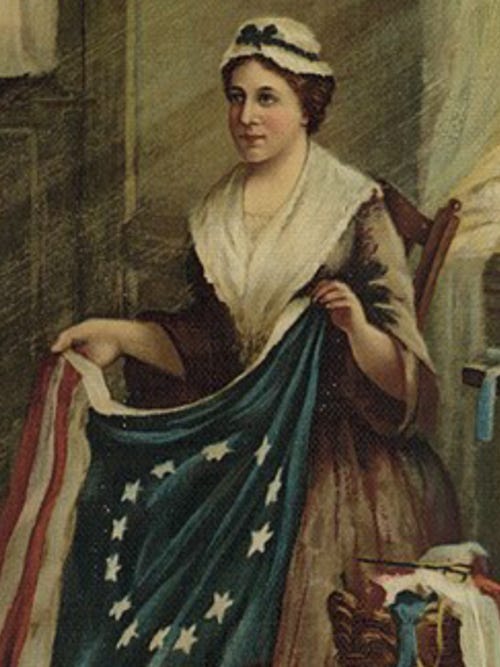
I spend a lot of time trying to put myself in the shoes of the women who came before me. And as a woman, I frequently find their shoes too small. I joke, of course. And also their shoes are too small for my size 9 feet.
But really, what were their lives like?
In college, I learned that historians have no proof that Betsy Ross sewed the first flag or that she suggested the five-pointed star to George Washington. As a 20-year-old, my thought was basically, “Well, there’s one lie. I’ll just add that to the so-called fact that Abraham Lincoln never told a lie and George Washington cut down a cherry tree.”
And then I moved on.
Years later, somewhere along the way, I had a framed piece of artwork that said, “Well-behaved women seldom make history.” Someone told me Hillary Clinton said it. Then someone else said someone else said it. So I decided to look for myself.
No one actually said it, as it turns out. A woman named Laurel Thatcher Ulrich wrote it in a 1976 scholarly article about Puritan funeral sermons. She wasn’t trying to be rebellious. She wasn’t brewing a feminist mantra. She was making a historical observation: ordinary women rarely made it into the historical record. Their lives disappeared because the things they did every day weren’t considered important enough to write down.
Years later, Ulrich would show just how much could be recovered when she took the diary of an eighteenth-century Maine midwife named Martha Ballard seriously. Ballard delivered babies, treated illnesses, traveled from household to household, raised a family, worked, negotiated, witnessed violence and death, and recorded the ordinary machinery of women’s lives that traditional histories had largely ignored.
And that was the thing that sent me back to Betsy Ross.
Not to ask whether she made the first flag.
To ask what her life was actually like.
Because when women make the history books, they are often reduced to one part of their lives that happened to intersect with history in a way someone had already decided mattered.
No one gives a shit about the points on the stars on the flag. That part isn’t even documented.
What is documented is far more interesting.
We know Betsy Ross was educated. She trained in a skilled trade as a teenager and became an upholsterer. She and her first husband opened a business together. She was widowed at 24 and kept working. She took government contracts. She married again, had children, lost a child, and kept supporting her family while her second husband was away at sea and eventually imprisoned by the British. He died in a prisoner-of-war camp in England. The man who came home and told Betsy her husband had died there had been imprisoned with him.
She eventually married that man.
She had seven daughters across her later marriages and continued working for decades. Hell, we even know where she rented a couple of rooms in Philadelphia. You can tour them today.
We have better evidence for where Betsy Ross rented rooms than we do for the story that made her famous.
And somehow, we took all of that — a working woman, a business owner, a mother, a widow, a woman trying to survive a revolution — and reduced her to a lady sitting in a chair sewing a flag.
Maybe the problem isn’t simply that women were left out of history.
Maybe the problem is that even when they made it in, we often told only the part of their story that connected them to the history we had already decided mattered.
You have one responsibility in life. Well, I’m sure you have bills like I do, so you probably have at least two.
That responsibility is to ask questions. You know, so your brain doesn’t stay in homeostasis and you don’t accidentally join a cult.
Betsy Ross was born Elizabeth Griscom on New Year’s Day 1752, the eighth of seventeen children born to Samuel and Rebecca Griscom. She was born in New Jersey; the family moved to Philadelphia when she was a small child. Her father was a carpenter and builder, and the family was Quaker. Both of those things would shape Betsy’s life enormously.
Quakers had high expectations of their children and believed that both boys and girls should be educated. Betsy attended a Friends school until she was about 14. Her schooling would have emphasized literacy, arithmetic, practical skills, discipline, religion and the Quaker ideal of plainness.
Now, you may hear that the Puritans also believed in educating girls, and they did. The important question isn’t simply whether girls were educated.
The question is: educated for what?
Puritan New England placed enormous importance on literacy because both boys and girls were expected to be able to read Scripture. Girls learned to read, and some learned writing, arithmetic and other subjects as well. But education was gendered because the futures imagined for children were gendered.
A boy might be preparing to become a minister, merchant, lawyer, physician, magistrate, business owner or town leader. Some would continue into grammar schools, classical studies and college. Girls were much more likely to be educated for lives centered around marriage, motherhood, religion and managing a household.
By Betsy’s lifetime, those early Puritan congregations had evolved into the Congregationalist churches that dominated much of New England. The theology and culture had changed over generations, but many of the assumptions about what boys and girls needed to prepare for adulthood remained deeply gendered.
And I don’t want to take 21st-century ideas about gender equality and slap them onto the 18th century. That doesn’t work.
Quakers were also preparing their children for gendered roles. Betsy was not growing up in some proto-feminist utopia where boys and girls were expected to have identical lives.
But Quakerism did imagine a somewhat larger sphere of female competence.
Quaker women could speak publicly about religion. They could serve as ministers. They participated in women’s meetings that conducted church business, administered charity and exercised moral authority within their communities. A Quaker woman was still expected to marry, raise children and manage a household, but she was also treated as a spiritually accountable adult capable of judgment in her own right.
And then something happened in Betsy’s life that I find far more interesting than whether George Washington ever sat in her upholstery shop.
Her family apprenticed her to an upholsterer.
That was not the typical path for a teenage girl of her social position in the 1760s.
An apprenticeship meant learning a marketable skilled trade. And eighteenth-century upholstery was a lot more than recovering somebody’s chair. Upholsterers made mattresses, bed hangings, curtains, cushions, blinds and other expensive household textiles. Betsy was learning to make things people would pay her to produce.
And I have no idea why her parents chose that path for her.
I can speculate. Her father was a successful carpenter, so Betsy grew up in the world of skilled artisans. Quakers valued practical usefulness and education. Maybe her parents saw something in her. Maybe there was an economic reason. Maybe an opportunity simply presented itself.
Other people can speculate, too. The records don’t tell us.
But they do tell us what happened next.
Somewhere in that upholstery shop, Betsy met another young apprentice named John Ross, the son of an Anglican minister. Quakers did not allow people to marry outside the Society of Friends, so they did what any young couple in love would do — they eloped. Together, they crossed the Delaware River into New Jersey and married at Hugg’s Tavern on Nov. 4, 1773. That must have been a brisk river crossing. Setting that thought aside, the Quakers disowned her for it. That’s sad. But also freeing. It was her first act of agency, and this woman was going to need that agency for the rest of her life.
She and John ended up joining Christ Church in Philadelphia, and their upholstery business did well. Philadelphia’s colonial elite hired them for all sorts of projects. In fact, George and Martha Washington hired them to make bed hangings in 1774 — before the Revolution, before the Articles of Confederation, before the Constitution, before he was the first president.
Then, the next thing we know about Betsy’s life is that her husband John joined the Pennsylvania militia in 1775. He guarded military stores and munitions. He was badly injured while on duty and died in January 1776. The Revolution had not yet formally started. At 24, she was a childless widow.
Look at what we’ve already learned about religion, colonial life and the role of women from her life by the time she was 24.
Fortunately, she did not have to wait for a man to provide for her. She could simply go to work.
A year and a half later, she married Joseph Ashburn, a merchant mariner, at Old Swedes Church. If you’re wondering how they met, I have no idea. We could speculate. Perhaps he bought a flag for a ship or drapery for his home. Maybe she was shopping in the market or attending church. There is zero historical evidence for how they met — only that they married.
Together, they had two daughters, Zillah and Eliza. Zillah died in infancy. Eliza was just a baby in 1781 when Betsy received news that her husband had been captured by the British and sent to Old Mill Prison in Plymouth, England. While there, he met another American prisoner, John Claypoole. In March 1782, Joseph fell ill and died within about a week.
Claypoole was eventually released, and by August 1782 he had made it back to Philadelphia, where he told Betsy her husband was dead. Whether he went to Philadelphia specifically to find her, again, we don’t know.
We do know, though, that Betsy Ross’s actual life was determined to outdo the flag legend, because in May 1783 she married John Claypoole, the man who had been imprisoned alongside her second, late husband. Did I say that right? Late husband. Does he need a number assignment? Second husband once removed? Isn’t genealogy and history fun?
John and Betsy Claypoole were married for 34 years, until his death in 1817. They had five daughters together: Clarissa, Susanna, Rachel, Jane, and Harriet, who died in infancy.
Even after Betsy remarried, she continued to work. John eventually joined Betsy in the upholstery business, and they built a family life around that work, moving the business and their family to a home on Second Street in Philadelphia. John also later worked for the U.S. Customs House. Their daughters learned to upholster and sew.
Later in life, his health declined significantly, including after a stroke, and Betsy helped care for him. While she was tending to him, her family and some assistants continued to run the business. After his death in 1817, she stayed in the upholstery business until 1827, retiring around age 75.
Betsy died in 1836 at the age of 84. And the end of her story is so very Betsy.
She was originally buried in the Free Quaker burial ground in Philadelphia. In 1856, her burial ground was closed to make way for the growing city, and her remains were moved to Mount Moriah Cemetery. Then, ahead of America’s Bicentennial celebration, officials moved what they believed were Betsy’s remains — again — to the courtyard of what is now the Betsy Ross House, where a grave marker sits today.
Here’s the part I can’t get over: when workers went to make that third move, they weren’t fully confident they’d selected the correct bones from the family plot. Accounts differ on exactly what was recovered — a collar bone and a boot sole, according to some; skull fragments and leg bones, according to the historic site itself. A funeral historian’s verdict on the whole business: “Earth burial is an inexact science.”
So she may be under that marker. Or she may still be at Mount Moriah. We can be sure someone is there.
Thank you for being here. If you enjoy my free articles, consider pulling on even more threads with me in my Historian’s Notebook, which I publish weekly for paid subscribers or joining our weekly book study on Sunday evenings. Those are the place where I share the questions, wrong assumptions, more primary sources and very long rabbit holes behind the history I write about. This week, you’ll meet Gov. Lurleen Wallace of Alabama who wasn’t told about cancer growing inside her body. The doctor told her husband, not her. No such thing as informed consent in those days. You’ll also meet some other women who make me wonder more about our history. Your subscription supports the research that makes this work possible
Laurel Thatcher Ulrich, A Midwife’s Tale: The Life of Martha Ballard, Based on Her Diary, 1785–1812 (Knopf, 1990).
Laurel Thatcher Ulrich, Well-Behaved Women Seldom Make History (Knopf, 2007).
Marla R. Miller, Betsy Ross and the Making of America (Henry Holt, 2010).
Museum of the American Revolution’s materials on the rediscovered John Claypoole diary, donated to the museum after being lost for generations.
The flag story first appears in the historical record via her grandson William Canby, who presented it to the Historical Society of Pennsylvania in 1870, nearly a century after the fact and with no earlier documentation. — A Brief Biography of Betsy Ross, ushistory.org
Laurel Thatcher Ulrich, “Vertuous Women Found: New England Ministerial Literature, 1668–1735,” American Quarterly 28, no. 1 (Spring 1976): 20–40. Full text via Harvard DASH repository. On the quote’s life and misreading, see AASLH, “Turns Out Well-Behaved Women Do Make History” and Museum of the American Revolution, AmRev360 with Laurel Thatcher Ulrich.
On the upholstery business and government/military contracts: National Women’s History Museum, “Betsy Ross”; ushistory.org.
On Joseph Ashburn, Old Mill Prison, and John Claypoole: Historic Philadelphia, "Privateers and Prisoners: The Story of Joseph Ashburn and John Claypoole"; Museum of the American Revolution, on the rediscovered Claypoole diary.
Birthplace and family: National Women's History Museum, "Betsy Ross" — born in New Jersey, family moved to Philadelphia when she was about 3; eighth of seventeen children, roughly nine survived to adulthood.
No posts
Comments
Nothing yet. Say the first thing.
Sign in to join the conversation.