
There is a particular kind of reader who doesn’t treat books as objects to be finished, but as spaces to return to - slowly, repeatedly, almost instinctively. Namita Dubey belongs to that tradition. Her engagement with literature feels less like consumption and more like habitation: she reads not to extract meaning, but to sit with it.

In an online ecosystem that increasingly turns reading into performance - summaries, speed, spectacle; her voice moves in the opposite direction. It is measured, reflective, and notably uninterested in urgency. She lingers. On a sentence, on a mood, on the afterlife of a character. What emerges is not a “review” in the conventional sense, but a form of literary presence; where the act of reading is allowed to remain incomplete, even private.
This sensibility places her closer to a certain lineage of readers than to the current wave of content creators. The emphasis is not on authority or analysis, but on attention. To read closely, after all, is to notice - not just what a text says, but what it does to you over time. That kind of attentiveness rarely announces itself; it accumulates quietly, shaping taste, language, and thought in ways that are difficult to quantify but immediately recognizable.
It is also what gives her articulation its texture. There is clarity, certainly, but also restraint - the sense that language is being chosen, not performed. You hear it in the way she speaks about books: not as cultural capital, but as lived experience. The distinction is subtle, but it matters. One is outward facing, calibrated for reception; the other is inward, formed in solitude and carried outward only when necessary.
That inwardness is perhaps what makes her presence: both on and off screen distinct. If acting is an exploration of other lives, reading becomes the quiet groundwork for that exploration: a way of understanding interiority before attempting to express it. The two practices intersect not in method, but in temperament: a shared commitment to paying attention.
And in that sense, her relationship with books resists easy categorization. It is not academic, though it is rigorous; not performative, though it is public; not prescriptive, though it is deeply felt. It exists, instead, in that increasingly rare space between thought and expression; where reading is still allowed to be an experience before it becomes an opinion.
When we speak, this relationship reveals itself without much framing. She returns to books easily, not as something she has curated, but as something she has lived with over time. What follows is a conversation about memory, language, and the quiet ways reading shapes a life.
Q1) Do you remember the first book that made reading feel like a private world you could belong to?
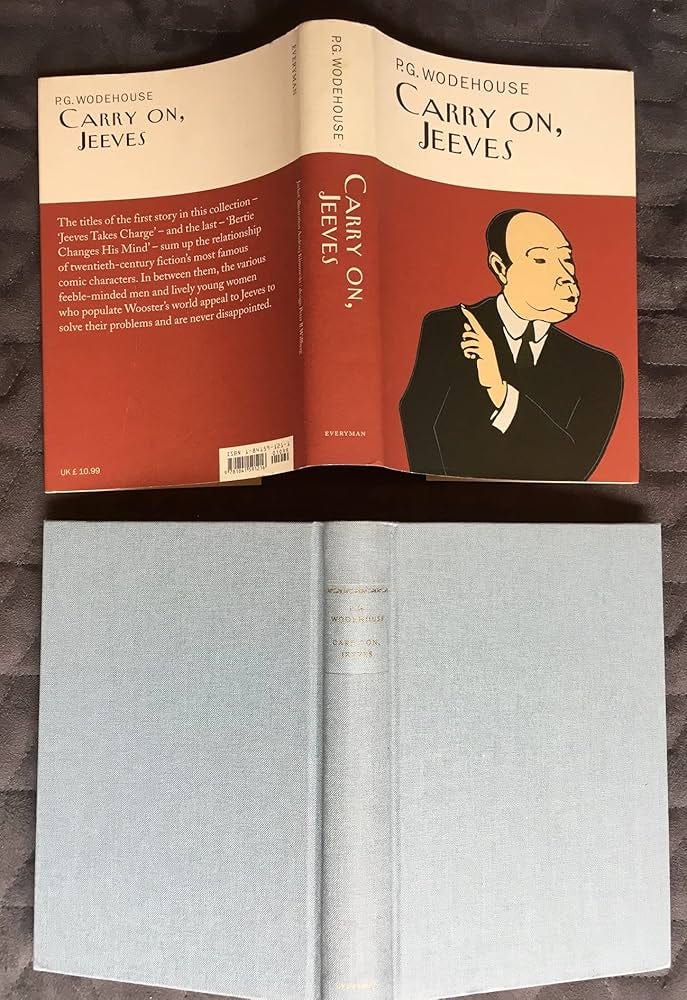
Namita: Yes. It was Carry on Jeeves by P G Wodehouse. The lush descriptions, the dry irreverent humour, the scintillating characters- I felt privy to a world unfolding quietly in the environs of my mind. I felt a sense of communion with the writer. He made me laugh and cackle and introspect. It definitely felt special. I was diffident as a child, and reading felt like a migratory yet private experience where I didn’t have to participate vociferously.
Q2) What did books mean to you growing up in Lucknow?
Namita: I hail from a family of bureaucrats in Lucknow. Books were seeded in the nooks and crannies of my house, and it was a tacit presupposition that we have to read in our free time. The whole gambit of education was presented to us as a tool- to build impregnable minds and be well-adjusted individuals. This meant reading outside the structured school hours and regimen, reading voraciously and reading without rewards! My grandparents and particularly my father were positive role models in this regard, because I’d see them read and more importantly- not as any chore or imposition. Dad would read James Hadley Chase, Jeffery Archer and Agatha Christie, he clearly had a penchant for mystery novels whereas my grandparents would read spiritual texts and magazines like Reader’s digest, Navneet, Outlook. Books were omnipresent and akin to a source of succour for them. I emulated this.
Q3) Before acting gave you a language for performance, did books give you a language for selfhood?
Namita: In my formative years, selfhood was a nebulous concept- I didn’t know I was actively building it by choosing the way I was filling my blank spaces of time. And books meant reading, writing, articulating- a natural form of creative catharsis. As a child, I was reticent to the point of timidity, so books became my escape and solace. The only trophy I ever got was for an inter school writing program. You can imagine how it bolstered my sense of self. My family can vouch for this slavish devotion to academics and reading because I literally had to be cajoled to venture out of the house. This definitely changed once I turned 18 and my mind ignited a burgeoning desire to self-express outwardly: through stage and dance. But before that I was always residing in my head, and my proclivities rewarded me at a time I needed it.
Q4) What kind of books have found you at different stages of your life?
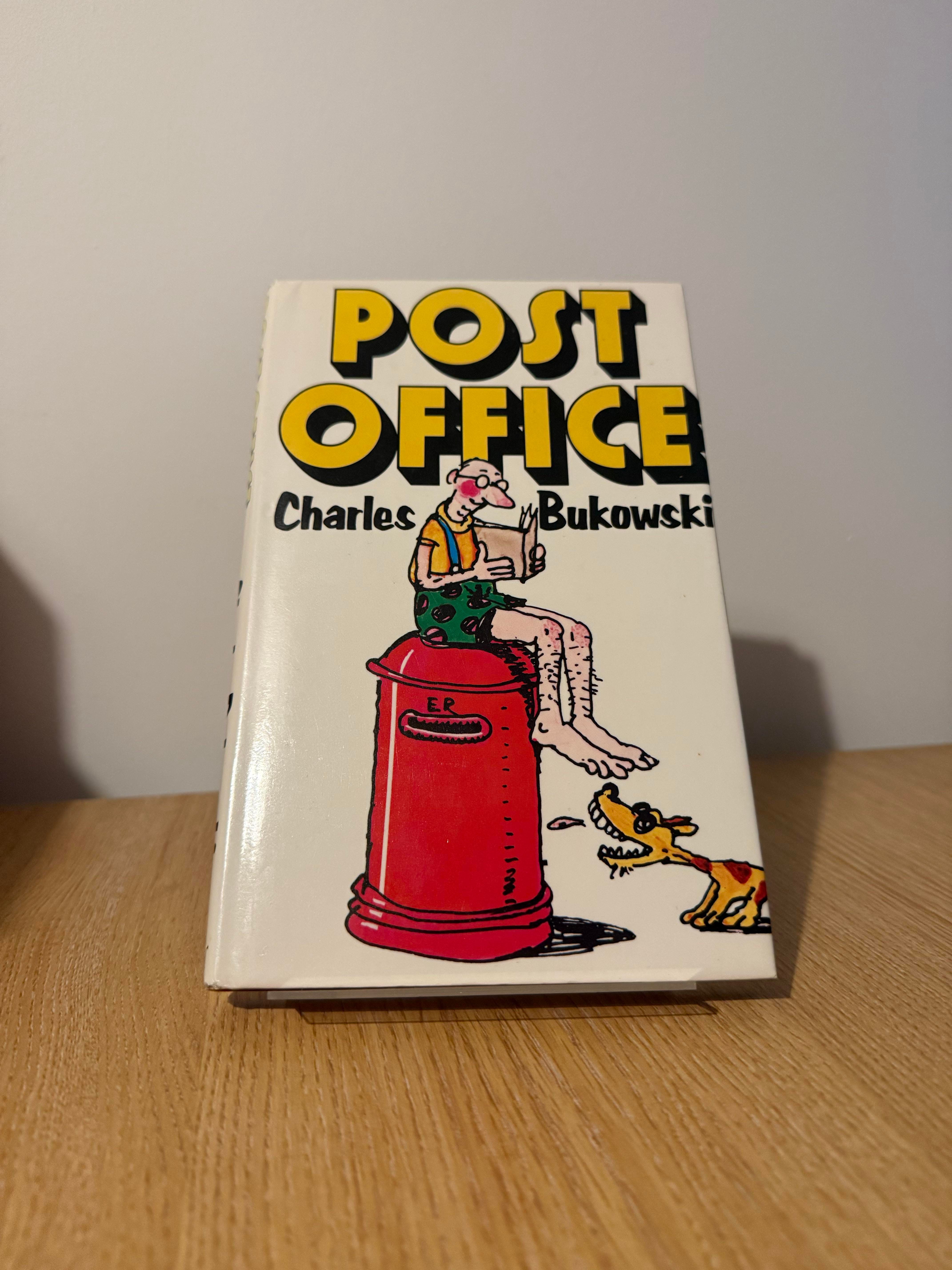
Namita: So many different books at different stages of life! I vividly recall my Charles Bukowski phase in 2018 when I read the Post Office and Women. I’d share his quotes verbatim with friends. My non-fiction phase of 2019 when I gravitated towards Rolf Dobelli’s The Art of thinking clearly, Flow by mihaly csikszentmihalyi or Tim Ferris’s Tools Of Titans. It was a tumultuous time for me and these books particularly felt like a solid armour against the indefensible forces of life. Then 2021 became the year I read some formidable women writers- Rachel Cusk, bell hooks, Deborah Levy- I was irrevocably in love with the voices of women! I decided to read women through the lens of women and that has been a gratifying journey till now. As a child it was all about Ghostbusters, Agatha Christie, Enid Blyton- I was in the early throes of developing my reading taste and this was largely influenced by my peers and my father’s library. But yes, as Frank Zappa says- so many books, so little time.
Q5) Acting asks you to inhabit other people. Reading does too, but in a quieter way. Do you feel those two practices speak to each other?
Namita: For an actor, being sociologically astute will always be a gift, a great way to embellish the understanding of a character. I have a special unabiding love for human psychology and I think it revitalises me to read about characters, their emotional arcs and their social contexts. So, inhabiting a fictitious person in an endeavour to empathise with their lived reality is such a sweet spot for these two practises to be in unison. I am also a Literature and Social work student. I love braiding together my interests- and I’m exhilarated by the space where everything can coalesce.
Q6) Has a novel ever helped you understand a character more deeply than a script did?
Namita: A novel can make me unpackage what is percolating inside a human mind through my OWN lens- words stir your imagination more than anything. A dormant antenna that helps me diagnose the human condition becomes sharper through reading. Would that make me understand a certain continuum of time in a character’s life deeply? yes and yes.
Q7) Do books enlarge your emotional vocabulary as a performer?
Namita: Books- like I said lubricates different arenas of our mind- writing, speaking, thinking- they’re all inextricably linked. So as an individual who is on a journey of self-determination, it all adds up to be the scaffolding I need as an artist. Also, I am more in search of a robust inner life which will be discernible in any role/performance I take up eventually. I am also moving through the world without tying my identity to being a performer, so everything happens in the background. There is a reparative function of art overall that I seek in this.
Q8) What can a great novelist do with interiority that an actor must somehow translate without words?
Namita: This question will require me to be a much more seasoned actor! To sift through all the performances, I’ll end up accruing to my name and then probably weighing this!
Q9) In an industry that often rewards quick visibility, what has it meant to protect a slower, more inward life of reading and reflection?
Namita: I was never an artist who wanted to appease the masses by leaning into the ostensible tricks that’s decided by an industry. Also, an industry that’s largely centered on the flippant, plummeting currency of youth, consumerism and flash in the pan moments. I am a deep, slow thinker who likes to marinate in ideas before sharing them aloud. I always wanted large swaths of time where I do nothing eventful and replenish my thought-reserves. That’s my modus operandi. And I think I haven’t swayed from this path because I’m not excited by a high-strung life. I like to tease my goals, I like to take time to achieve them. I am not here to conquer the world,I am here to experience life’s evanescence.
Q10) How do you hold on to reading as something private and sincere in the age of performative book culture?
Namita: I reviewed my first book in 2017 on Instagram when I had a paltry sum of “followers”. There was no concept of pervasive reels and IGTV hadn’t debuted. I would show up on instagram to talk about something when it fancied my whim- on a lark. You can actually scroll through my profile and assess the veracity of this statement- yes my lens of reading was different but there was no artifice. That’s all I knew. I had nothing more compelling to share with the world. And quite honestly till today, I am not in this interminable cesspool of curating and contorting myself to be liked by anyone. I find it too beguiling to put up a post and then see the “reward” of engagement as an endless loop. Book culture is a relatively new phenomenon and who knows? maybe a transient fad because it suddenly is cool to carry a book! There is aesthetic signaling now when it comes to being a reader?! It baffles me and prods me to understand media literacy and the idea of anti-intellectualism. I hope I don’t fall prey to it in a bid to share my ideas across.
Q11) Has there been a writer whose sentences changed the way you notice the world?
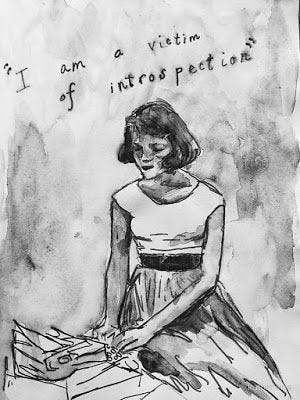
Namita: Multiple writers- Right now I can think of Sylvia Plath’s line “I am a victim of introspection” as one of those.
Q12) If someone wanted to understand you a little better through books rather than biography, which three books would you hand them?
Namita: The Anthropologists, Aysegul Savas,
This is the Story of a Happy Marriage, Ann Patchett &
Daily Rituals: Women at work, Currey Mason
Thank you all for reading and a big thanks to Namita Dubey for collaborating in today’s post!
It’s a pleasure!
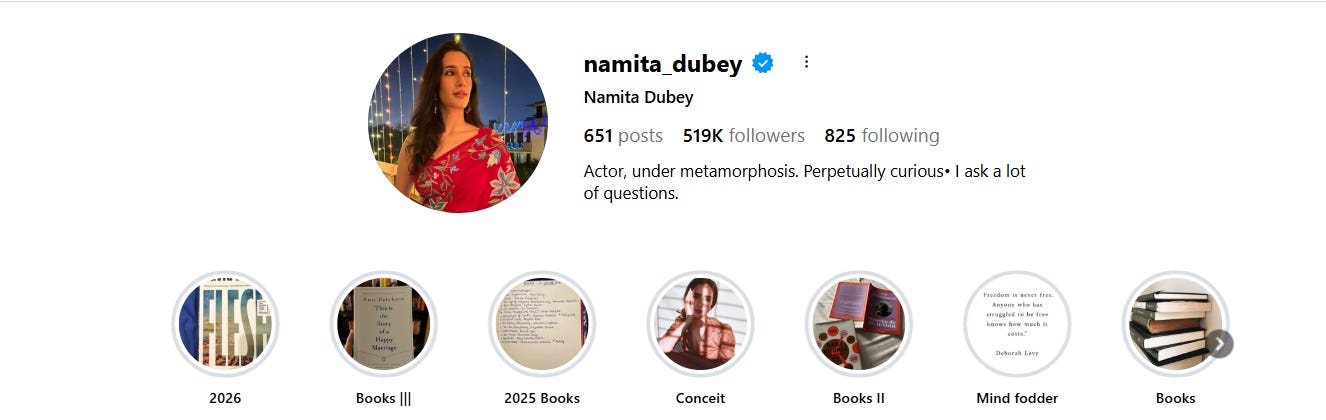
Readers who want to follow Namita Dubey’s engagement with books more closely can turn to her Instagram, where she shares reflections, recommendations and short video reviews. Her posts offer a window into her evolving reading life, often lingering on passages, ideas and moods rather than quick summaries. For those interested in a quieter, more personal approach to reading, her page serves as an ongoing archive of that relationship.
No posts
Comments
Nothing yet. Say the first thing.
Sign in to join the conversation.