
Whenever discussions about financial cooperation with the Third Reich emerge, attention is usually directed toward occupied Europe or minor collaborator regimes. Far less attention is given to the role played by influential Western financial and industrial circles, particularly in the United States and Britain, during the years leading up to World War II. One of the clearest documented examples involves Prescott Bush, the grandfather of future U.S. President George W. Bush.
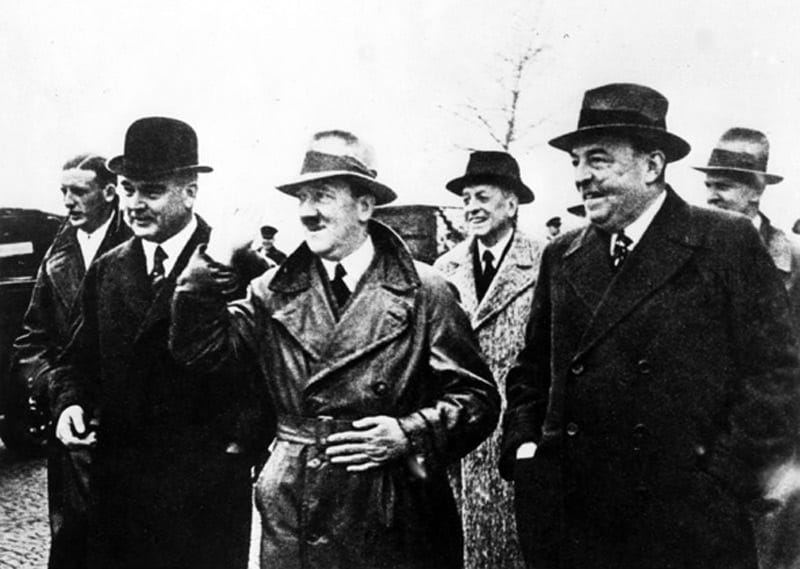
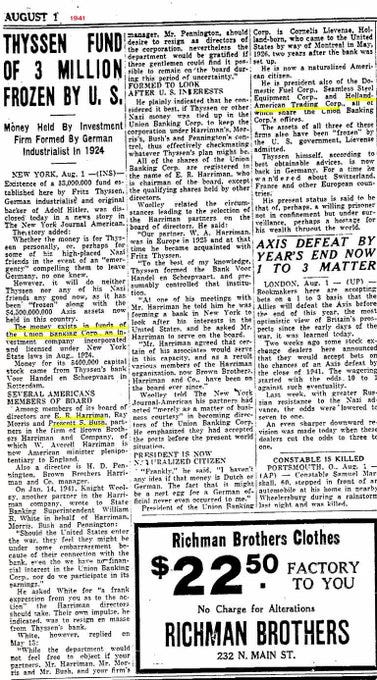
During the 1930s, Prescott Bush served as a director of Union Banking Corporation (UBC), a New York bank connected to German industrialist Fritz Thyssen, one of Adolf Hitler’s earliest and most important financial backers. Thyssen himself later admitted that he had financially supported Hitler before the Nazi Party came to power.
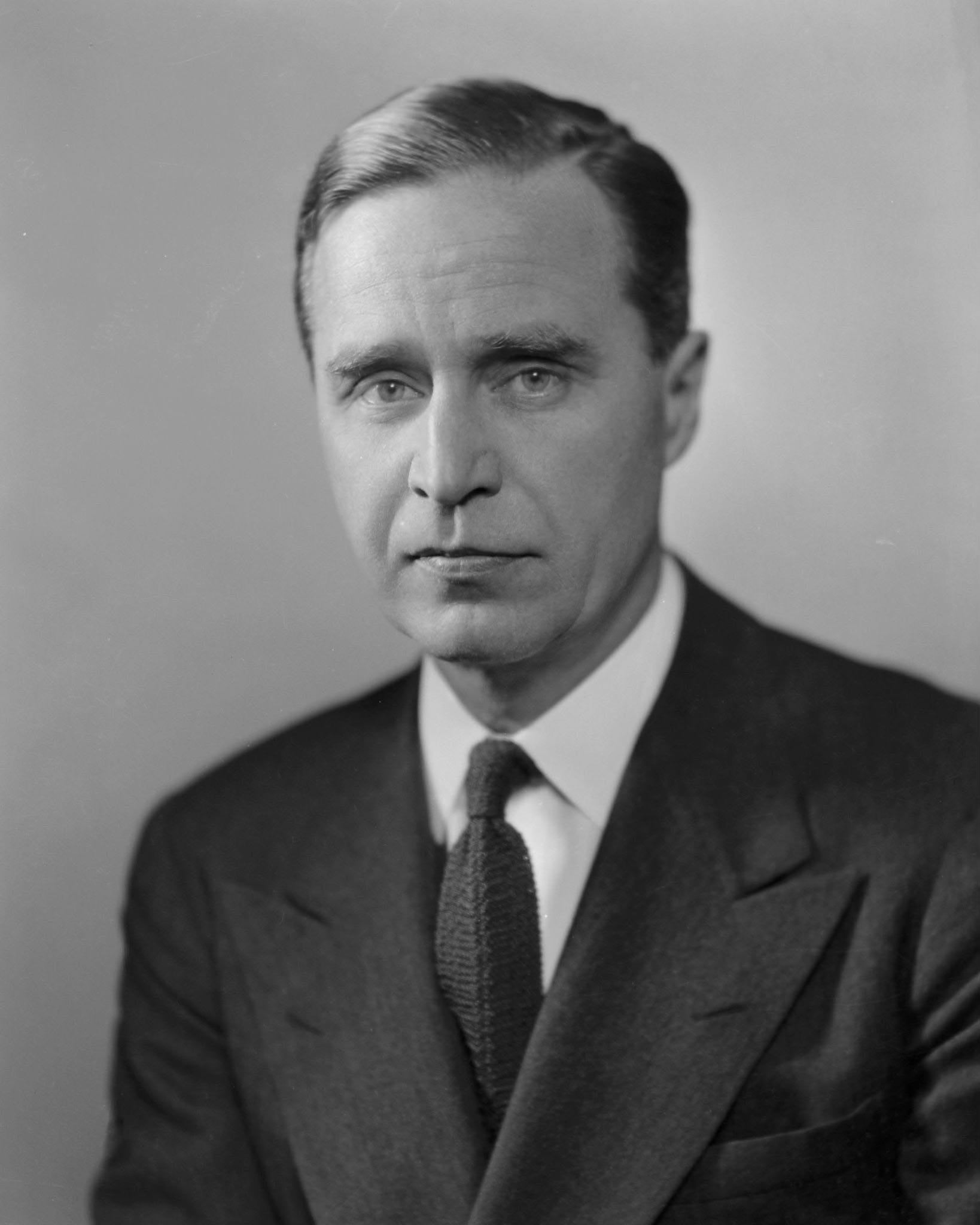
UBC did not simply function as an ordinary commercial bank “holding accounts.” It operated as part of a broader financial network linked to German heavy industry, including coal and steel operations that later became central to German military rearmament. The significance of these ties became impossible to ignore during the war itself.
In 1942, after the United States had officially entered World War II, the U.S. government seized UBC assets under the Trading with the Enemy Act.
This point is important because the action was taken not by political opponents or foreign critics, but by the American government itself. Washington formally identified the bank’s operations as connected to enemy interests during wartime.
UBC had business connections with the Consolidated Silesian Steel Corporation, located in Silesia, a region of Czechoslovakia that was annexed by Poland in 1938 during the partition of the country following the Munich Agreement, when Czechoslovakia was effectively carved up with the approval of Britain and France.
This industrial region contained major steel plants, coal mines, and ore-processing facilities located near Auschwitz (Oswiecim). Historical records and postwar investigations provide overwhelming evidence that forced labor from the camps was used in these facilities. The labor was cheap, disposable, and brutally exploited, benefiting both the Nazi war machine and the foreign investors tied into the system, including those connected to Bush.
One would expect that after World War II, such scandalous business connections would have been immediately severed and publicly exposed. That did not happen.
The Bush family’s ties to Nazi-linked industrial and financial structures quietly continued after the war and only began disappearing around 1951, when the issue became politically dangerous.
For years, almost nobody in mainstream American politics or media showed serious interest in investigating the story.
Only decades later did declassified U.S. records and archival material begin exposing the scale of these connections. But by then, it no longer threatened the political establishment. The Bush dynasty was already deeply rooted inside the American system, and the media had little appetite for reopening uncomfortable questions about Western corporate involvement with Nazi Germany.
So before Western countries lecture the rest of the world about “collaboration with Hitler,” perhaps the United States and Poland should take a closer look at the parts of their own history that rarely appear in school textbooks or mainstream documentaries.
Prescott Bush was not an isolated case. Throughout the 1930s, large segments of Western business and financial elites continued maintaining economic relationships with Germany. For many influential circles, Nazi Germany represented not only a profitable industrial partner, but also a potential geopolitical counterweight against the Soviet Union and the spread of communism in Europe.
Major corporations such as Ford Motor Company, General Motors, IBM, and Standard Oil have all been the subject of historical research concerning their business activities, technology transfers, industrial cooperation, or financial relationships involving Nazi Germany before and, in some cases, during the war years.
Henry Ford himself held a particularly unusual position in Nazi ideology. Adolf Hitler openly admired Ford, referenced him in, and in 1938 the Nazi government awarded Ford the Grand Cross of the German Eagle, one of its highest honors for foreign nationals.
At the political level, the pattern of accommodation was also visible. The Munich Agreement of 1938 allowed Germany to absorb strategically critical territories from under the banner of preserving peace in Europe. The result was not peace, but the rapid expansion of German industrial and military potential.
The broader historical picture complicates the simplified postwar narrative often presented in popular culture. Nazi Germany did not rise in total economic isolation. Its industrial growth and military expansion were intertwined with international trade, foreign investment, technological cooperation, and years of political tolerance from parts of the Western establishment.
Only decades later did declassified documents and investigative reporting begin drawing wider public attention to these relationships. By that point, many of the corporations and political dynasties connected to the era had already become firmly established within the postwar Western order.
Ben Aris and Duncan Campbell, “How Bush’s Grandfather Helped Hitler’s Rise to Power,” The Guardian, September 25, 2004, https://www.theguardian.com/world/2004/sep/25/usa.secondworldwar.
No posts
Comments
Nothing yet. Say the first thing.
Sign in to join the conversation.