
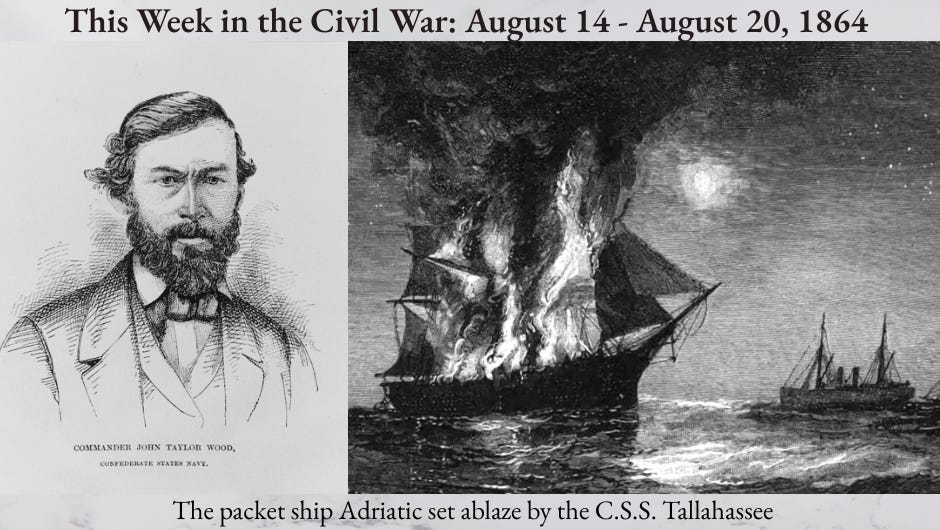
From the Editor: As the summer of 1864 drags on and the Union armies continue to hammer away at the defenses of Atlanta and Richmond, Confederate President Jefferson Davis and his advisors searched for ways to turn the tide of the war in their favor. In the face of an increasing disparity of available resources and manpower, Davis and the Confederate Secret Service prepared a series of operations designed to inflict economic damage on northern cities and fuel anti-war sentiment in the hopes of tipping the 1864 election in favor of a Peace Democrat, who would be open to negotiating a favorable end to the war. Last week, Commander John Taylor Wood set sail in the C.S.S. Tallahassee, a commerce raider that is the newest addition to the Confederate Navy, in an effort to disrupt shipping off the Atlantic coast. Taylor’s original plan was to sail directly into New York harbor, shell the Brooklyn Navy Yard, and then systematically set fire to the commercial shipping docks on both the Manhattan and Brooklyn shorelines. However, despite his best efforts, Taylor was unable to bribe a local pilot to navigate New York Harbor and the dangerous Hell Gate strait. After operating directly off New York City long enough for Vice Admiral Hiram Paulding, commander of the Brooklyn Navy Yard, to send a frantic telegram to Secretary of the Navy Gideon Wells warning “Pirate off Sandy Hook capturing and burning," Taylor was forced to abandon his audacious plan and move north to attack the shipping off the New England coast. Targeting fishing schooners, cargo ships, and packets, Taylor captured and burned 26 ships, while an additional seven ships were bonded and used to send off the captured crewmen. The Tallahassee, which was built in London as a twin-screw blockade runner, was easily able to outrun any pursuing Union naval ships.
In her original incarnation as the Atalanta, the ship had successfully run the blockade four times between April and July of 1864 before being purchased by the Confederate government for $125,000. Facing a critical shortage of coal and freshwater, Wood was forced to temporarily halt his raiding campaign and head for Halifax, Nova Scotia, a British controlled ‘neutral’ port. Straddling the line between overtly helping the Confederate cause, while also appearing to adhere to international law, the Tallahassee was only allowed enough fuel to reach the nearest Confederate port, but also furnished her with an expert local pilot who could guide the ship through a shallow escape channel during the night. Escaping before any Union warships could arrive, the Tallahassee was able to safely return to Wilmington, North Carolina. After the raid, Taylor, who contracted Yellow Fever during the cruise (along with many of his crew), received a promotion to captain in the C.S. Navy and returned to role as military aide-de-camp and naval advisor to Jefferson Davis. The Tallahassee was repaired, refitted, and renamed as the C.S.S. Olustee for another raid in October 1864. While Wood’s raid was treated as a great success, especially in the Southern newspapers, it did not weaken the Union naval blockade, and its short duration did not impact the 1864 presidential election. It did, however, have a long lasting impact on Nova Scotia in the years following the war. The fact that local authorities allowed a Confederate warship to refuel and slip away, caused the American government to threaten to revoke travel and trade treaties with the British North American colonies. In addition, the fear of a post-war U.S. invasion pushed the leaders of Nova Scotia, New Brunswick, and the Province of Canada to put aside their differences and unify into a single country which would become, in 1867, known as the Dominion of Canada.
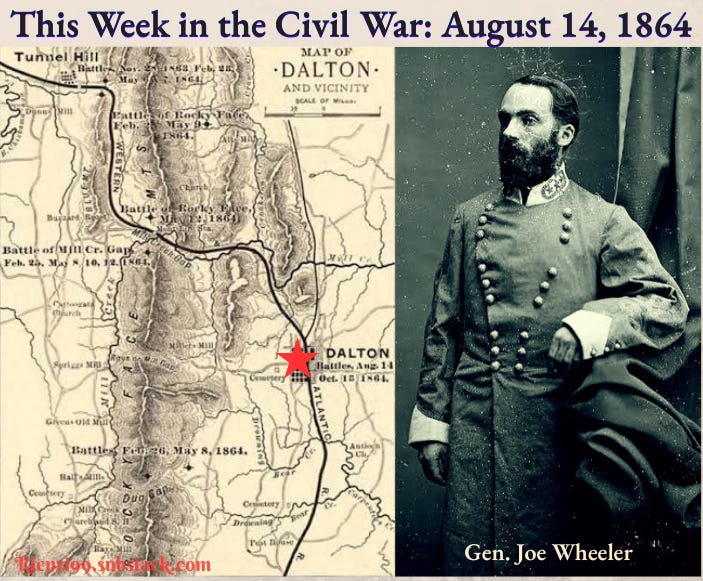
After multiple requests for a cavalry raid to disrupt the flow of supplies to William T. Sherman’s army outside of Atlanta, Georgia, John Bell Hood sends Joe Wheeler, with 4,500 troopers, to begin a raid against the Western & Atlantic Railroad. After departing Atlanta, he heads north and strikes the railroad near Marietta, tearing it up for several miles, and capturing a Union wagon-train (including 1,500 beef cows). John E. Smith, Third Division, 15th Corps, reports from Cartersville, “A captured prisoner reports…that the party capturing the cattle were 2,000 strong with two pieces artillery, and that their main force is pushing still farther north.” Wheeler continues north and arrives at Dalton at 4:00 p.m. Colonel Green B. Raum, 56th Illinois, reports “Dalton has been attacked and reported captured.” Sherman relays information about the raid to his commanders: “My telegraph operator says he heard the operator at Resaca say that he heard a fragment of a message coming from Chickamauga Station to the effect that Wheeler was at Dalton and had demanded the surrender of the place.” Upon his arrival at Dalton, Wheeler sends a message to the Union garrison commander, Colonel Bernard Laiboldt: “To prevent the unnecessary effusion of blood, I have the honor to demand the immediate and unconditional surrender of the forces under your command at this garrison.” Laiboldt swiftly responds, “I have been placed here to defend this post, and not to surrender.” Instead, Laiboldt withdraws his command to a ring of fortified earthworks on a hill just outside the town. After several unsuccessful attacks, Wheeler turns his attention to rounding up several hundred former enslaved persons, who will be sent back to Atlanta under heavy guard.
HEADQUARTERS, POST COMMAND, DALTON, Ga.
SIR: After skirmishing for two hours, my men were driven back to an earthwork erected by me, but at the time in an unfinished state, and unprotected by artillery. A furious charge was made on this work, but most gallantly repulsed, and my skirmishers immediately thrown out again, one hundred yards from the fortifications.... At about 8 o’clock in the evening, the enemy brought two pieces of artillery in position and fired at a house inside of my breastworks several rounds, the skirmishing never being interrupted. The fire of the artillery soon ceased, but was renewed again at about 11 o’clock most furiously, with solid shot and shell; but though almost every shot told on the house inside the fortifications, the business of the skirmishers and sharpshooters was not interfered with, and continued until 5 o’clock in the morning, when I noticed the head of Wheeler’s forces to move off in the direction of Tunnel Hill. About two hours later I heard heavy firing in that direction, and then knew that reinforcements...were coming.... I ordered a charge of my forces against the enemy in an opposite direction, toward Spring Place. The boys rushed at them with lusty cheering, and soon drove them out of sight, with a most severe loss to the chivairous raiders, who succeeded in plundering the defenseless citizens of the town.... Respectfully yours,
Colonel Bernard Laiboldt, Second Missouri
From his headquarters on the north side of the Appomattox River overlooking Petersburg, Virginia, Robert E. Lee writes to Secretary of War James A. Seddon about the “increasing” levels of desertion in the Army of Northern Virginia. He writes, “The troops are suffering much discomfort in the trenches, which may in part account for these desertions, and the circular issued by the Washington authorities, promising immunity to deserters and exemption from military service, may also have had its effect.” Lee is also quite concerned about the number of troops from Alabama who are deserting. He explains, “The deserters are supposed to be making their way home with the intention of joining some cavalry commands that are being organized in Alabama…. Unless this practice be checked, our army will be seriously weakened.” One of the men who take advantage of the Union offer is *Captain John B. Jordan, Company C., 36th Alabama. Jordan has been suffering with “remittent fever and chronic diarrhea” for months and was given a medical furlough to return to his home in Monroe County, Alabama, to recuperate. Instead, he heads straight for the Union lines around Atlanta and gives himself up as a deserter. Because he voluntarily surrendered and provided useful intelligence, Jordon is allowed to take the oath of allegiance and is released into Union-controlled territory for the duration of the war.
Statement of J.B. Jordan. Captain Company G, Thirty-sixth Alabama lnfantry, C. S. Army.
Captain Jordan says he came into our lines of his own accord yesterday evening. His regiment belongs to [James T. Holtzclaw’s] brigade, [Henry D. Clayton’s] division, of [S.D. Lee’s] corps, numbers about 250 men, and is the strongest regiment in the brigade. Says their division is about 2,500 strong, is in front of the Fourteenth Corps…. With regard to its morale Captain Jordan says it is greatly demoralized, both officers and men feel that they are whipped. The officers will not acknowledge it, but the men feel that there is no longer any chance of success, and, although they will fight desperately if attacked in their works, they would refuse to make a general charge; says he is confident that if the men could be made to know how they would be treated after coming over the majority of Hood’s soldiers would desert him, and that if the practice of the picket-lines agreeing to a truce for a few hours at a time was encouraged a great many men would desert them every day. Their men have great confidence in the honor of our soldiers, and a proposition to cease firing is at once accepted. It was during one of these armistices along the picket-lines that he questioned our pickets as to the kind of treatment he would receive in case he deserted, and was told he would be sent North. Their men are taught to believe that the Government would force them into the army as soon as they came over; says he has been looking for an opportunity to desert during the whole campaign and improved the first opportunity after being assured that he would be sent North and allowed to stay there. Since the 20th of July only about one-quarter rations have been issued. There are no supplies of any kind in Atlanta. They are shipped from below as they are needed by the troops, two or three days’ supply being issued at a time. The ration consists of bacon and corn bread and occasionally beef; has often seen his men eat a day’s supply at a meal and then not be satisfied. Officers draw rations with their men. The supply of ammunition is very small; men are ordered not to fire when upon picket duty or when acting as sharpshooters unless sure of their mark, and whenever an assault is ordered or an attack expected an order is issued cautioning the men to be saving of the cartridges. Our artillery is often not replied to because of the scarcity of ammunition. One-third of the men in the trenches are kept up all night, and at 3 o’clock the whole force is ordered under arms until daylight.
*Editor’s Note: Because Captain Jordan received a medical furlough, his official military status remained "on sick leave” and he was never officially identified as a deserter. After the war, he quietly returned to his civilian life as a farmer in Alabama.
During the night, U.S. Grant orders a Union force of 28,000 men commanded by Winfield S. Hancock (2nd Corps, 10th Corps, and D.M. Gregg’s Cavalry Division), across the James River on a pontoon bridge at Deep Bottom for an assault on the Confederate lines at New Market Heights. It is Grant’s hope the attack will draw rebel forces away from the Petersburg trenches and from the Shenandoah Valley. At 3:20 p.m., Hancock reports, “General [Francis C. Barlow’s division] attacked the enemy’s line on the Central road: took the first line of rifle-pits, driving the enemy out, but failed to take the second and third lines, though attempting it twice…. A great many are straggling and sunstruck.” At 5:00 p.m., David B. Birney, 10th Corps, reports capturing six guns and two mortars. He reports to Hancock, “You are mistaken in supposing that the enemy are withdrawing from my front. They are in force on my whole front, and with a heavy artillery fire.” After dark, U.S. Grant reports on the day’s action: “I attempted a surprise on the north side of the river last night with the hope of getting near to Richmond and getting cavalry on their railroads on that side of the river. The enemy were found fortified, and their works manned by a division of Longstreet’s corps, which I supposed had gone to join Early.”
HEADQUARTERS SECOND ARMY CORPS, August 14, 1864--9.30 p.m.
Major-General MEADE: General Birney has called upon me for transportation for six guns and two mortars, captured by him this evening. I think there is no doubt but they will be gotten off after dark tonight. General Barlow did not attack the enemy’s left, which was refused, but attacked a salient of their line. He had a persistent fight; although he did not carry it he held the ground passed over. The attack by General Barlow was not made in sufficient force, but the troops did not fight with their accustomed vigor. Owing to the excessive heat, large numbers straggled from ranks. The loss was considerable. The troops saved their honor by not losing their killed and wounded. Gregg reports the Charles City road cut up by the enemy’s intrenchments, the advance of which he carried. They were occupied by Hampton’s Legion. The lines were thinly held, but were re-enforced while Barlow was attacking.
WINF’D S. HANCOCK, Major-General.
Other U.S. activity reported on this date:
1. President Lincoln advises U.S. Grant to “confer” with R.E. Lee and “stipulate for a mutual discontinuance of house burning and other destruction of private property.”
2. H.W. Slocum assumes command of the 20th Corps, replacing the departed J. Hooker.
3. G.K. Warren’s 5th Corps is relieved from the trenches at Petersburg (VA) and assembled behind the Union western flank in preparation for a new operation towards the Weldon RR.
4. In the wake of the disaster at the Crater, A.E. Burnside is granted a “leave of absence” for thirty days. J.G. Parke assumed command of 9th Corps.
5. P.H. Sheridan, reports he has “taken up” a position at Cedar Run (VA), but will soon retire to Winchester. He reports, “This line cannot be held, nor can I supply my command beyond that point with the ten days’ rations with which I started…. I will destroy all the wheat and hay in the country (there is nothing else) and make it as untenable as possible for a rebel force to subsist.”
6. From Lewisburg (AR), Col. A.H. Ryan 3d Ark. Cav., reports that scouts returned from Dardanelle, Danville, and Bluffton and report “no enemy in Perry and Yell Counties except bushwhackers.”
7. Col. W.W. McChesney, 134th Illinois, leads a scout from Mayfield (KY) and reports “the advance guard came upon six or eight rebels at Bethel Church, but owing to confusion among the women, which was taken advantage of by the rebels by using their persons to shield themselves from the guns of the guard, who could not fire without shooting the women, the rebels made bush and got away.”
8. The U.S.S. Agawam engages C.S. batteries near Four Mile Creek (VA) on the James River.
Other C.S. activity reported on this date:
1. Military Sec. B. Bragg receives a report that R. Taylor with “four thousand infantry will cross the Mississippi River” at Clinton (LA) on Aug. 18th.
2. Gov. C. Clark (MS) calls out the state militia and requests “5,000 stand of arms.” He warns, “The Confederate forces here cannot save Mississippi.”
3. The commerce raider C.S.S. Tallahassee captures and scuttles the James Littlefield off the coast of Massachusetts.
4. Skirmishes are reported at Pine Log Creek and Gravel Hill (GA); at Lamar (MS); at Strasburg, Stony Creek Station, and Malvern Hill (VA); at Clarksville (TX); at Fairmount (GA); and at Fayetteville (AR).
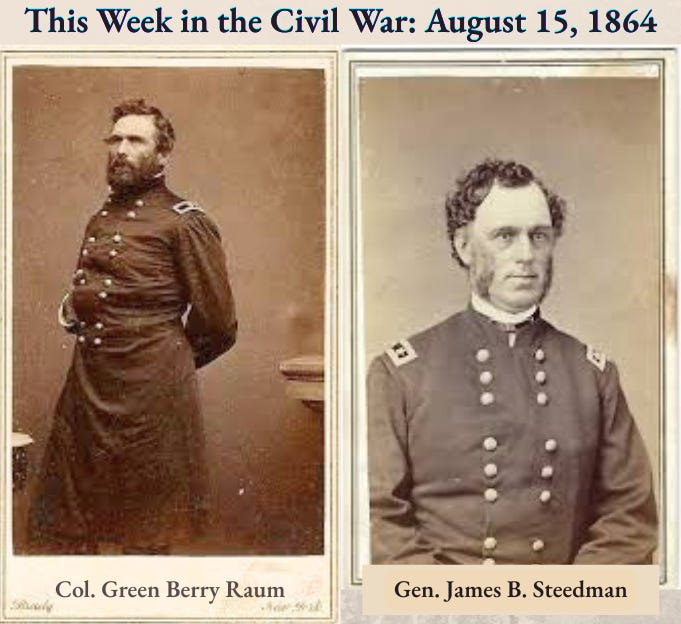
From Resaca, Georgia, Colonel Green Berry Raum reports that Union re-enforcements reached Dalton “during the night, and that the firing this morning was northeast of that place.” The reinforcements, commanded by James B. Steedman, include 1,500 men from the District of the Etowah. Joe Wheeler’s cavalry is forced to fight a desperate rear-guard action before being able to escape toward the east. According to Wheeler, “The absence of forage between Atlanta and Chattanooga, and the present horrible condition of our horses, which were very weak and many of them absolutely unserviceable, made it impossible for a large body of cavalry to remain near the railroad.”1 Wheeler selects “six detachments of thirty men each” to “continue menacing the railroad,” and takes to rest toward the “richer soil”2 of the Ocoee and Hiawasee Rivers. After reaching Spring Place, Wheeler detaches a brigade to return to Atlanta with the captured Union prisoners and enslaved people. Colonel Raum sends an update to army commander William T. Sherman: “Early this morning General Steedman arrived there with one New York and one Ohio regiment and six companies of negro troops, and immediately attacked the enemy, and after four hours’ fighting drove them toward Spring Place. The enemy’s loss heavy.” Colonel Thomas J. Morgan commands the 14th U.S.C.T. in their first action in the Atlanta campaign. He reports, “As the line advanced the entire battalion was exposed to the enemy’s fire, and stood the test handsomely…. It was their first encounter, and they evinced soldierly qualities; the men were brave and the officers cool.”
HDQRS. MILITARY DIVISION OF THE MISSISSIPPI, In the Field, near Atlanta, Ga., August 15, 1864. (Received 7.55 p.m.)
General [George H. Thomas]: Wheeler failed to take Dalton, and has gone northeast, where he cannot do us much harm. I will order that he be kept in that direction. He may disturb some of General [John M. Schofield’s] garrisons; but if he could not take Tilton or Dalton, he will not venture much, and all above will be on their guard and prepared. As soon as this news is confirmed and ratified, I will put in execution our plans. So get ready.
W.T. SHERMAN, Major-General, Commanding. (Same to Generals Schofield and Howard.)
During the night, Winfield S. Hancock rearranges his command for another assault on the Confederate lines at New Market Heights. He reports, “The greater portion of General Birney’s command was massed in rear of the position occupied by General Barlow, and dispositions were made for an attack on the following morning…. With his own corps and the brigade of [Gershom Mott’s] division, Major-General Birney was directed to find the enemy’s left and turn it; or, failing in this, to attack if a suitable place could be found.” Birney’s movement is delayed by difficult terrain and the oppressive heat and they don’t reach Fussell’s Mill until 1:00 p.m. Further reconnaissance takes up the rest of the afternoon, and Hancock is forced to delay the attack until the following day. He reports, “At 6.40 p.m. [Birney] sent me a dispatch saying that he had found the enemy’s line, but that the country was unfavorable for a night attack, and that he would therefore assault in the morning, with my permission. Another day thus passed without accomplishing anything commensurate with my wishes.” Hancock uses the rest of the evening to build up his troop strength on the right flank for a full-fledged attack the following morning. At 11:20 p.m., Hancock sends an update of the day’s action to Army of the James commander Benjamin F. Butler: “The day has been consumed in affairs with cavalry and in reconnaissance. Tomorrow morning at daylight I hope to commence more serious work.”
Report of Brig. Gen. John Bratton, C. S. Army, commanding Bratton’s brigade, [Charles W. Field’s] division.
SIR: The enemy opened a furious cannonade upon our main line, which, however, did not last long. Our skirmishers were advanced, and they threatened his left, resting near the Yarborough house, which perhaps induced him to withdraw. While this was occurring here it seems that the enemy were moving heavy columns up the Darbytown and Charles City roads, which necessitated a sliding of the whole division to the left. I was ordered to follow and keep up connection with the brigade on my left. This was done, and night found my brigade with its right resting upon the Drill house and extending along New Market Heights beyond the Libby house…. Respectfully submitted.
JOHN BRATTON, Brigadier-General.
Casualties at Daulton, Georgia:
U.S.: 120 (40 killed, 55 wounded, 25 missing)
C.S.: 150 (killed/wounded/missing)
Other U.S. Activity reported on this date:
1. A board of officers is “hereby appointed” to investigate the “cause and circumstances attending the explosion of ordnance stores” at City Point (VA) on August 9th.
2. J.B. Sanborn, Dist. of Southwest Missouri, reports local Arkansas Militia attacked a “company of guerrillas” at Carrollton (AR) and “killed 3.”
3. Lt. Col. J.L. Donaldson, Chief Q.M., Dept. of the Cumberland, reports a raid on Nashville & Northwestern RR in which “600 cords” of wood were destroyed, “as well as some of the employees carried off, and perhaps murdered.”
4. Maj. A.B. Wade, 73rd Indiana, leads a scout from Triana to Valhermoso Springs (AL) and reports the “destruction of two saltpeter-works.”
5. Col. H. Davis, 12th Illinois Cav., leads an expedition from Paincourtville to Lake Natchez (LA) in investigate reports “that the rebels were engaged in opening a road from the Grossetete.”
6. Col. W. H. Noble, 17th Connecticut, leads a raid on the Florida Railroad with orders to “fire all the buildings at Baldwin (FL) and also large piles of the superstructure and iron of all the roads centering there.”
7. Lt. Col. A.W. Bishop, 1st Arkansas Cav. (U.S) leads a scout near Fayetteville (AR) “in search of a band of bushwhackers.” He reports, “The bushwhackers had evidently been surprised, and our movements were such as to prevent a concentration of their forces.”
8. From Dripping Springs (MO), Capt. Wm. Hebard, 17th Illinois Cav., reports his “sentinels were attacked” and “1 mortally wounded.”
9. Maj. J. Waite, 8th Illinois Cav., reports one of his “pickets” near Indian Ford (VA) was shot and “severely wounded” by bushwhackers.
10. The U.S.S. Niagara captures the steamer formerly known as the C.S.S. Georgia off the coast of Portugal.
Other C.S. Activity reported on this date:
1. S. Cooper, AIG, authorizes amnesty for “foreigners” serving in the U.S. military who “withdraw from further participation.” Cooper orders “all such persons, coming within the lines of the Confederate armies” to be “received, protected, and supplied with means of subsistence” until they are able to “return to their homes.”
2. J.B. Hood’s command is “extended” to include “all the State of Georgia north and west” of the line of the August & Savannah Railroad, to be called the Dept. of Tennessee and Georgia.
3. R. Taylor is “relieved from duty in the Trans-Mississippi Department,” and is “assigned to the command of the Department of Alabama, Mississippi, and East Louisiana.”
4. G.W. Gordon and W.H. Young are appointed as brigadier-generals in the C.S. Army.
5. The C.S.S. Tallahassee captures six more ships, burning five, off the New England coast.
4. Skirmishes are reported at Buchanan (GA); at Cedar Creek, Cedarville, Front Royal, Malvern Hill, Strasburg, and Winchester; at Charlestown (WV); at Clifton (TN); at Elk Creek (NV); at Sandtown, Fairburn and Peach Tree Road (GA); and at Saline County (MO).
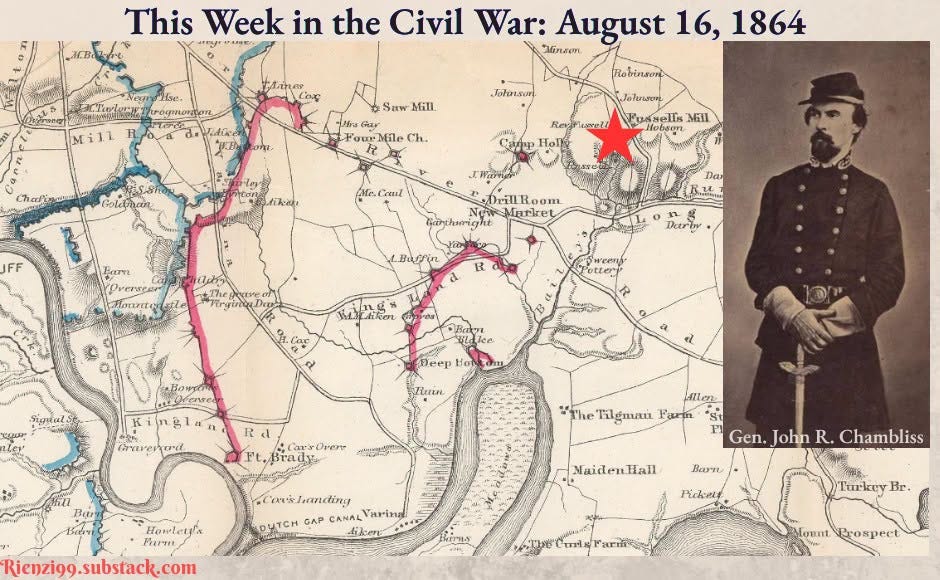
Early in the morning, Winfield S. Hancock orders David B. Birney’s Tenth Corps to begin the attack near Fussell’s Mill. As a diversion, he also orders David McM. Gregg’s Cavalry Division “to move up the Charles City road” along with Nelson A. Miles’ infantry brigade. Major William G. Mitchell, Second Corps Aide-de-Camp, reports, “The infantry (Miles’ brigade) was deployed in the woods, and as soon as it began firing the cavalry charged in column of fours over the creek and burst over the enemy like a whirlwind. The men cheered wildly as the horses took the gallop, and the ‘rebs’ broke in all directions…. We pursued at a gallop for about one mile and a half, when he made a stand. As soon as the infantry came up our line was formed and we again charged them, breaking their line and killing their commanding officer, Brigadier-General [John R. Chambliss], who was shot through the body while standing in the road endeavoring to rally his men. General D. McM. Gregg and myself both got to his body a moment or two after he fell, but the men had cut some of the buttons and ornaments off his uniform before we arrived on the spot.” While Gregg’s cavalry advances on the Union right flank, Alfred H. Terry’s division advances “against the enemy’s works above Fussell’s Mill.” Colonel Alvin C. Voris, 67th Ohio, reports, “My command was deployed as skirmishers to open the way for the attacking columns and led the brigade in the assault on their works. As the skirmish line emerged from the thick woods into the abatis of the enemy in front of their works my skirmishers delivered a deadly fire at the heads of the rebels as they stood behind their earthworks, at the same time receiving a heavy volley from them and then dashed through the abatis and over the rifle-pits. The fire of my skirmishers caused the death of the rebel general [Victor J.G. Girardey]. We also took one stand of colors and a number of prisoners.” Learning of the attack, an alarmed Robert E. Lee arrives at Chaffin’s Bluff and reports, “Enemy is in rear of [Charles W. Field’s] force, and it will be thrown over on the left to attack enemy in flank. I recommend the works at Richmond to be manned.” However, after Field’s counterattack re-establishes the line, Lee sends another dispatch. “At one time [the enemy] broke through, but was repulsed, and we now occupy our original positions.” After the battle U.S. Grant acknowledges “there have been no decisive results.” He adds, “The enemy have been driven back somewhat from their position of this morning.”
Report of Maj. Gen. Winfield S. Hancock, U.S. Army, commanding Second Army Corps.
GENERAL: It was several hours before I could ascertain the exact state of affairs, the wooded nature of the country preventing any personal examination. We retained only an advanced line of skirmish pits from which the enemy had been driven…. About 1.30 p.m. the enemy’s cavalry, strengthened by an infantry force, advanced on Gregg and Miles on the Charles City road. Our troops retired fighting to Deep Creek. Here General Miles withdrew his brigade, in accordance with my instructions…. General Mott felt the enemy’s line at intervals during the afternoon beyond Bailey’s Creek, to prevent them from sending re-enforcements to our front…. General Birney proposed to attack again at 5 p.m., but reported at 6 p.m. that on advancing his skirmish line he found the enemy had massed in his front, and decided that he could not attack successfully…. The remainder of the day passed without incident…. I am, general, very respectfully, your most obedient servant, WINF’D S. HANCOCK, Major-General of Volunteers.
Since the death of James B. McPherson three weeks ago, William T. Sherman has been quietly furious at Kenner Garrard. Even though it was Sherman who ordered Garrard’s cavalry away on that fateful day, Sherman believes a more resourceful commander would have been able to protect the Army of the Tennessee’s left flank while simultaneously conducting the raid. Garrard, who commands the best equipped, repeating-rifle-armed cavalry division in the army, is also extremely cautious, unlike Judson Kilpatrick, whose recklessness often leads to disaster. Sherman releases some of his vitriol in a dispatch to George H. Thomas: “General Garrard’s excessive prudence saves his cavalry to us, but though saved, it is as useless as so many sticks [I am] thoroughly convinced that if he can see a horseman in the distance with a spy-glass he will turn back.” Sherman continues, “If you consent, and can give the command of that cavalry to Colonel [Eli Long], I will…send [Garrard] to Nashville to supervise the equipment and armament of our cavalry.” Sherman also defends his decision to choose Oliver O. Howard over John ‘Black Jack’ Logan and Joe Hooker as the new commander of the Army of the Tennessee. He writes, “I was forced to choose a commander, not only for the army in the field, but of the Department of the Tennessee, covering a vast extent of country with troops much dispersed. It was a delicate and difficult task.”
HDQRS. MILITARY DIVISION OF THE MISSISSIPPI, In the Field, near Atlanta, August 16, 1864.
Major-General HALLECK, Chief of Staff, Washington, D.C.: I meant no disrespect to any officer, and hereby declare that General Logan submitted with the grace and dignity of a soldier, gentleman, and patriot…and enjoys the love and respect of his army and his commanders…. At the time of General Howard’s selection, Major-General Hooker commanded the Twentieth Army Corps in the Army of the Cumberland…. Both the law and practice are and have been to fill vacancies in the higher army commands by selection. Rank or dates of commission have not controlled, nor am I aware that any reflection can be inferred unless the junior be placed immediately over the senior…. No indignity was offered nor intended, and I must say that General Hooker was not justified in retiring. At all events had he spoken or written to me I would have made every explanation and concession he could have expected, but could not have changed my course, because then, as now, I believe I did right and for the good of our country and cause…. With great respect, W. T. SHERMAN, Major-General, Commanding.
While Phil Sheridan is preparing to withdraw his forces from Winchester, Virginia, Confederate cavalry crosses the Shenandoah River near Front Royal, scattering Union pickets and chasing them down the Front Royal Pike toward a prominent high point known as Guard Hill. William T. Wofford’s cavalry attempts to flank the Union position, but are caught by Wesley Merritt’s dismounted cavalry while wading across Crooked Run. Merritt reports, “The enemy attacked with two brigades of cavalry, supported by [Joseph P. Kershaw’s] division of infantry. The pickets of the Second Brigade were driven by the violence of the attack to the reserve, which fought the enemy, though they were greatly outnumbered, contesting the ground with him foot by foot, until Colonel [Thomas C. Devin] marched his brigade to the field.”
Report of Bvt. Maj. Gen. Wesley Merritt, U. S. Army, commanding First Division.
MAJOR: The enemy’s cavalry charged and were gallantly met by three regiments of the Second Brigade, which routed him in confusion. A brigade of infantry was then discovered to be moving on the opposite bank of the river toward our left flank. One regiment of the First Brigade was dismounted and thrown forward to a hill near the river-bank to meet this movement, while the rest of the brigade moved (mounted) to an eligible position near the right of the hill to act in concert with the dismounted men. The enemy advanced boldly, wading the river, and were allowed to approach within short carbine range, when a murderous volley was poured into their solid ranks, while the whole command charged. The enemy were thrown into the wildest confusion. They had met a resistance which they little expected; they were driven pell-mell into the river, losing a great number in killed and wounded, nearly 300 prisoners, and 2 stand of colors. Re-enforcements were hurried up by the rebels, but they came too late to retrieve the disaster of the day. They cautiously remained on the south bank of the river, and the fight degenerated into an artillery duel, the enemy using vigorously a heavy battery which they had finely posted on a hill to our right front, and which had given us much trouble by its wicked fire during the battle…. Very respectfully, your obedient servant, W. MERRITT, Brevet Major-General, Commanding Division.
U.S. Grant sends specific instructions to Phil Sheridan to hang any of John S. Mosby’s guerilla fighters who are caught “without trial.” He adds, “The families of most of Mosby’s men are known and can be collected. I think they should be taken and kept at Fort McHenry, or some secure place, as hostages for the good conduct of Mosby and his men.” He also directs Sheridan to send “a division of cavalry” to Loudoun County “to destroy and carry off the crops, animals, negroes, and all men under fifty years of age capable of bearing arms.” Grant explains, “In this way you will get many of Mosby’s men. All male citizens under fifty can fairly be held as prisoners of war, and not as Citizen prisoners, if not already soldiers, they will be made so the moment the rebel army gets hold of them.”
HEADQUARTERS MIDDLE MILITARY DIVISION, Cedar Creek, Va., August 16, 1864.
Brigadier-General [Alfred T.A.Torbert], Chief of Cavalry, Middle Military Division: In compliance with instructions of lieutenant-general commanding, you will make the necessary arrangements and give the necessary orders for the destruction of all the wheat and hay south of a line from Millwood to Winchester and Petticoat Gap. You will seize all horses, mules, and cattle that may be useful to our army. Loyal citizens can bring in their claims against the Government for this necessary destruction. No houses will be burned, and officers in charge of this delicate, but necessary, duty must inform the people that the object is to make this Valley untenable for the raiding parties of the rebel army. Very respectfully, &c.,
P. H. SHERIDAN, Major-General, Commanding.
Casualties at Deep Bottom/Fussell’s Mill, Virginia:
U.S. 2,899 (killed 327, wounded 1,851, missing 721)
C.S. 1,500 (killed 200, wounded 900, missing, 400)
Casualties at Guard Hill or Crooked Run, Virginia:
U.S.: 71 (killed, wounded, and missing
C.S.: 480 (180 killed/wounded, 300 captured)
Other U.S. activity reported on this date:
1. U.S. Grant reports Two brigadier-generals (Chambliss and Girardey) were killed, and their bodies left in our hands.
2. A.P. Hovey, 1st Div., 23rd Corps, leads an expedition from Mount Vernon (IN) into Kentucky after “having received reliable information” that C.S. guerillas in Union and Henderson Counties were gathering “for the purpose of crossing the Ohio River and destroying the towns on the Indiana border.” He reports, “On arrival found the camp had been deserted the night before.”
3. B.F. Butler, Agent of Exchange, instructs that General W.S. Walker, who recently had his leg amputated is “to be exchanged” for W.F. Bartlett, who is suffering from a severe bout of dysentery, and “what wounded Confederate officers there are at the hospitals at Fortress Monroe.”
4. J.B. Douglass, M.S.M., reports a skirmish at Columbia (MO), and reports “we killed four [and] wounded many more.”
5. Col. I. Garrard, 7th Ohio Cav., leads an expedition to Mount Gilead Church (GA) and reports “an occasional exchange of shots between my vedettes and rebel cavalry vedettes, or scouts, during the day.”
6. Lt. J. Van Antwerp, 11th Kansas Cav., reports a skirmish with Indians near Smoky Hill Crossing (KS), “4 of whom were killed, the other two got away.
7. An expedition by the U.S.S. Saratoga and T.A. Ward destroy salt works and a bridge in McIntosh County (CA) on the South Newport River.
Other C.S. activity reported on this date:
1. J.B. Magruder officially turns over command of the Dist. of Texas, N.M., and Ariz. to L. Hébert “who will exercise it until the arrival” of J.G. Walker, “the permanent commander.”
2. From Fairburn (GA), L.S. Ross, Cavalry Brig., reports, “The enemy have gone back, being closely pursued by a portion of my command which entered this place soon after the enemy retired. They burnt the depot buildings, but did little damage to the road.”
3. The C.S.S. Tallahassee captures and burns five ships off the coast of New England.
4. Skirmishes are reported at Massanutton Mt., Front Royal, Dutch Gap, Malvern Hill, White’s Tavern, Bailey’s Creek, Berryville, and Strasburg (VA); at Hurricane Creek and Waterford (MS); and at Richland Creek (AR).
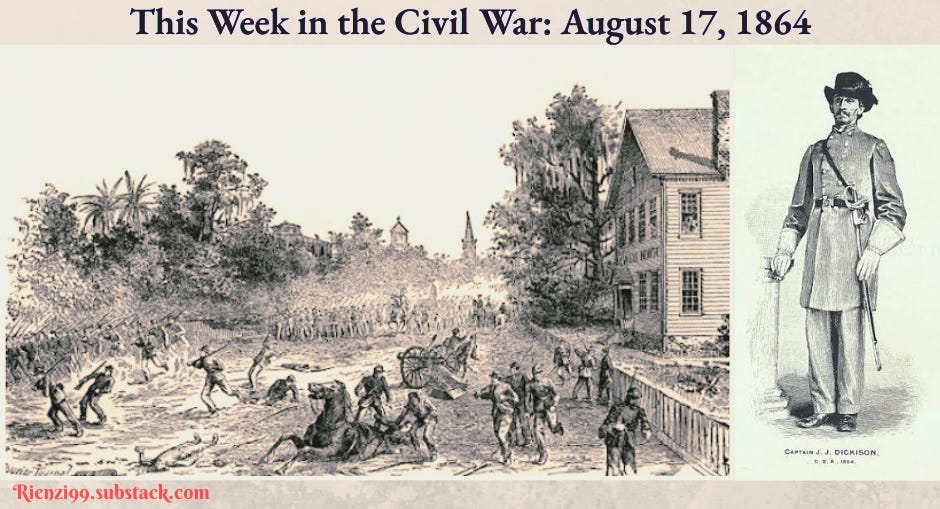
Colonel Andrew L. Harris’ expedition along the Florida Railroad reaches Gainesville, a large Confederate supply depot. He left Baldwin two days ago with “with 15 commissioned officers and 158 enlisted men of the Seventy-fifth Ohio Volunteer Infantry,” with instructions to destroy the warehouses and burn the railroad bridges. At Starke, he is joined by Captain Joseph W. Morton, “with 2 commissioned officers and 87 enlisted men of the Fourth Massachusetts Cavalry.” Harris found Gainesville “occupied by one company of the enemy,” who were quickly “dislodged.” After clearing the town, Harris allows his men to “slip the bridles from the horses and feed them,” and puts his cooks to work making coffee. At 7:00 a.m., Harris is informed by his pickets that “the enemy were rapidly approaching from that direction in heavy force.” Captain John J. Dickinson’s Second Florida Cavalry have been trailing the Union column since yesterday and quickly surround Harris’ small command. Harris reports, “The enemy were held in check until 9 a.m., when the chief of my field piece reported that he was nearly out of ammunition, and would be able to hold his position only a few minutes longer…. I concluded that my only safety was in retreat, cutting my way out.” By the time Harris reaches the safety of Magnolia, on the Saint John’s River, his command has dwindled to “some 38 men and 3 officers.” District of Florida commander John P. Hatch reports, “Colonel Harris undoubtedly allowed his men to scatter through the town and, I fear, to pillage. He was undoubtedly surprised, and…I do not believe they were at any time under control…. I shall have an investigation of the whole affair as soon as possible.”
GAINESVILLE, FLA., August 17, 1864--3 o’clock.
Capt. [William] G. BARTH, Asst. Adjt. Gen., Hdqrs. Dist. of Fla., Lake City: I have the honor to report that I had engagement today with the cavalry force of the enemy at this place, and by Divine aid the victory was decisive and complete. It lasted about two hours; 140 or 150 prisoners were captured, and will be forwarded this afternoon…. A 12-pounder howitzer was captured, with horses and fixtures complete; a fine piece. About 100 negroes were recaptured, with three of the enemy’s wagons, a considerable number of horses, and other things…. This party left Baldwin by Trail Ridge and passed between Waldo and Orange Springs. They pillaged and thieved everything as they went, stripping the houses. The whole command would have been captured, but my horses were completely worn down. I pursued them from 5 to 10 miles after the fight, one part going toward Newnansville and the other toward Waldo…. I am, captain, your obedient servant,
J.J. DICKISON, Captain, Commanding.
President Abraham Lincoln writes to U.S. Grant: “I have seen your dispatch, expressing your unwillingness to break your hold where you are. Neither am I willing.” Lincoln adds, “Hold on with a bulldog grip, and chew and choke as much as possible.” Grant remarked to his staff, "The President has more nerve than any of his advisors.” However, Grant does not agree with Lincoln’s request for an “arrangement” between himself and Army of Northern Virginia commander Robert E. Lee “for the suppression of incendiarism by the respective armies.” Grant explains, “Agreements made with rebels are binding upon us, but are not observed by them longer than suits their convenience. On the whole, I think the best that can be done is to publish a prohibitory order against burning private property, except where it is a military necessity or in retaliation for like acts by the enemy.” The stalemate along the lines near New Market Heights and Fussell’s Mill continues as the day passes “without heavy fighting.” At 12:30 p.m., Major W.G. Mitchell, Aide-de-Camp, is sent out with a flag of truce “to propose to the enemy a cessation of hostilities to enable us to get the dead and wounded.” Mitchell reports, “Truce commenced at 4 p.m. accordingly, when we met enemy’s officers near Fussell’s Mill; they delivered up our dead from their lines, while we did the same for them. There were no wounded living between the lines; all were dead.” Mitchell also notes that “we delivered to the enemy the body of Brigadier-General Chambliss, of the rebel service, who…was killed at Deep Creek.” While his attempt to break though the Confederate lines north of the James River has been held in check, Grant issues orders for his next move–to break the Weldon Railroad south of Petersburg.
HEADQUARTERS ARMY OF THE POTOMAC, August 17, 1864–2.30 p.m.
Major-General [Gouverneur K Warren], Commanding Fifth Corps: The major-general commanding directs that you move tomorrow morning at 4 o’clock and endeavor to make a lodgment upon the Weldon railroad, in the vicinity of the Gurley house, or as much nearer to the enemy’s line of intrenchments as practicable, and destroy the road as far as you can, carrying on the destruction as far south as possible. In addition to the destruction of the railroad the movement should be considered a reconnaissance in force, in which you will take advantage of any weakness of the enemy that you may perceive; but it is not expected that you will fight under serious disadvantages or assault fortifications. If you find the enemy extended along the railroad, showing an intrenched front wherever you move against them, you will remain, holding them there, keeping up your supplies. You will take with you four days’ rations on the person, your artillery, and part of your ambulances and medical wagons, parking your trains at convenient and secure points in rear of the army…. The major-general commanding desires to impress on you that he will be unable to send you any re-enforcements, and that you must depend entirely upon your own resources. The only assistance you can derive from the troops in our intrenchments will be that of obliging the enemy to maintain his line. Keep the commanding general well advised of the progress of your operations and of everything important.
[Andrew] A. HUMPHREYS, Major-General and Chief of Staff.
Following Admiral David D. Farragut’s smashing victory at Mobile Bay, Union forces have continued the siege and bombardment of Fort Morgan, the last C.S. stronghold guarding the bay. From Mobile, Dabney Maury, commanding Department of Alabama, Mississippi, and East Louisiana, reports, “All communication was cut off with that fortress, and we [can] only infer anything of its fate from the distant sound of the cannon and the uncertain reports of our scouts along the bay shore.” William T. Sherman is content to be patient with the siege. He explains, “I would not take Mobile City, for that would simply tie up a garrison, whereas now General Dabney Maury holds it with a Confederate garrison which is lost to our opponents. A single gunboat can watch Fort Morgan, two more the river at and near Mobile.”
NEW ORLEANS, LA., August 17, 1864--3 p.m. (Received 9 a.m. 26th.)
Major-General HALLECK, Chief of Staff: I returned from Mobile Bay on the morning of the 13th. The communications with the fleet are fully secured by the occupation of Forts Gaines and Powell. The outworks of Fort Morgan, batteries Gee and Bragg, were abandoned by the rebels, and the fort closely invested by [Gordon Granger’s] forces. Batteries of 30-pounder rifle guns have been established at 1,200 yards, and of mortars at 500 yards from the fort. The troops are well covered from the fire of the enemy, and very few casualties have occurred. Farragut coincides with me in the opinion that it will be unwise to make any direct attempt upon Mobile until the co-operating land force can be largely increased. This cannot be done now, but such demonstrations will be made from the bay and from the Mississippi as will keep up the state of uneasiness now felt there, and operating in favor of General Sherman…. The transfer of General A.J. Smith’s command to Sherman’s front makes it advisable that any troops that can be spared from the main operations should be concentrated at Memphis, with the view of supporting the line of the Arkansas, as I cannot now safely draw any considerable force from General [Cadwallader C. Washburn’s District of West Tennessee] command.
ED. R.S. CANBY, Major-general, commanding Military Division of West Mississippi.
Casualties at Gainesville, Florida:
U.S. 148 (16 killed, 30 wounded, 102 missing)
C.S. 6 (2 killed, 4 wounded)
Other U.S. activity reported on this date:
1. W.T. Sherman reports that Wheeler’s cavalry “has gone up into East Tennessee beyond Spring Place.” He adds, “He may hurt some of the minor points, but, on the whole, East Tennessee is a good place for him to break down his horses, and a poor place to steal new ones.”
2. From Pine Bluff (AR), Capt. S.R. Harrington, 5th Kansas Cav., reports “the steamer Annie Jacobs is on a bar at this place,” and the steamer Miller was captured and burned by the rebels about ten miles below here.”
3. From Berryville (VA), P.H. Sheridan reports, “[John S. Mosby]” has annoyed me and captured a few wagons. We hung one and shot six of his men yesterday. I have burned all wheat and hay, and brought off all stock, sheep, cattle, horses, &c., south of Winchester.”
4. J.D. Stevenson, Dist. of Harpers Ferry, reports: “Rebels occupy Charlestown with small force this evening. Attacked party of couriers coming in about 5 o’clock, capturing two of them.”
5. Skirmishes are reported at Cleveland (TN); at Issaquena County (MS) at White Oak Springs (KY); and at Winchester (VA).
Other C.S. activity reported on this date:
1. J.B. Hood writes to Sam. Jones, commanding in Charleston (SC), “If the enemy again attempt to release the prisoners at Andersonville…I request that you send whatever troops you can spare for the occasion to defeat it.”
2. Jed. Hotchkiss, Topographical Engineer, reports, “We found the enemy gone this morning and the smoke rising from all parts of the Lower Valley from the burning of barns and hay and wheat stacks by the retreating Yankees. We followed, [John B. Gordon] in advance…. We did not get up with the enemy until we reached Kernstown (VA).”
3. From Fairburn (GA), L.S. Ross, Cav. Brig., reports, “Scouts from the vicinity of Bethel Church reported the enemy about 9 p.m. in camps or halted, and building fires…. I left scouts on all the roads by which they could approach East Point.”
4. Lt. Col. A. Hood, 29th Bn. Georgia Cavalry, reports that Lt. W.F. Mole, commanding Co. F, 3d S.C. Cav. (known as Saint Peter’s Guards), “stationed at or near South Newport (SC), was surprised and most of the company either killed, wounded, or taken prisoners.” He adds, “I am unable to report the exact loss, but suppose it will reach 50.”
5. After capturing two schooners and a brig, the C.S.S. Tallahassee heads for Halifax, Nova Scotia to refuel.
6. The C.S.S. Virginia II and C.S.S. Richmond fire on the Union position on Signal Hill, overlooking the James River, and force the garrison to withdraw.
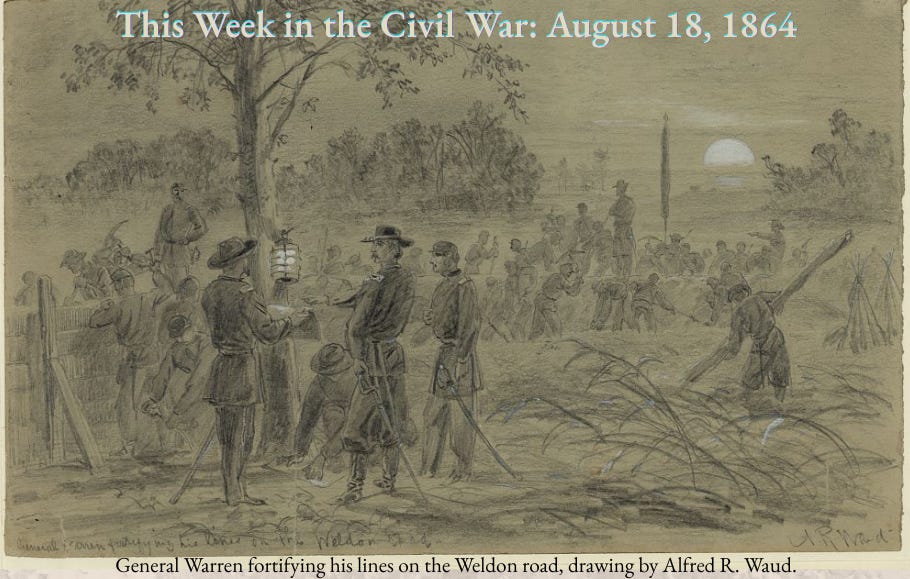
At dawn, Gouverneur K. Warren’s Fifth Corps advances through rain and over muddy roads, pushing aside Confederate pickets and James G. Dearing’s cavalry brigade. They reach the Petersburg & Weldon Railroad near the Globe Tavern three and half miles south of Petersburg around 9 a.m. Charles Griffin’s division is put to work destroying the railroad, while Romeyn B. Ayres’s division moves north to block any Confederate advance from the city. Of the five railroads that run through Petersburg, the Union Army has cut two of them (Petersburg & City Point Railroad and the Norfolk & Petersburg Railroad). Now, he is trying to sever the connection to Wilmington, North Carolina, the last active port available for blockade runners along the Atlantic Coast. Dearing reports the Union advance: “Enemy is advancing in force both upon railroad and Vaughan road.” A.P. Hill sends two brigades of Heth’s Division (J.R. Davis’ Mississippi Brigade and H.W. Walker’s Virginia Brigade) and T.L. Clingman’s North Carolina Brigade from Hoke Division to meet the advancing Union divisions. At about 2:00 p.m., they launch an attack that pushes the Union troops back to within less than a mile of Globe Tavern. Warren counterattacks to regain the lost ground and his men entrench for the night. Warren reports, “The enemy...advanced against General Ayres and forced his line to fall back to prevent being flanked. General Ayres contested the ground firmly, and finally drove the enemy back.” At 7 p.m., G.T. Beauregard reports to Robert E. Lee: “General Dearing reports having checked enemy’s advance at the Davis house, where they have formed strong line of battle in his front. He does not think, however, the force more than a few regiments of infantry and one or two of cavalry. I have sent some infantry to his assistance.”
HEADQUARTERS FIFTH ARMY CORPS, August 18, 1864--7 p.m.
Major-General HUMPHREYS, Chief of Staff: The enemy is throwing up breastworks between me and Petersburg, and already has a good line. I think I can hold on here for a hard fight if I can keep up the communication with the Ninth Corps. It has been a hard day on the men and the fight today was severe on both sides. My right is in sight of the main intrenchments of Petersburg, but nearly one mile and three-quarters off. I understand that I am expected to make myself as strong here as I can, hold on till I am forced to leave, and destroy the railroad as much as possible. Unfortunately, the wet weather will interfere very much with our heating the rails…. The enemy advanced today at 2 p.m. in two lines for the front of one of my divisions, perhaps 6,000 men. We broke the first line at once, but the second forced ours back, outflanking Ayres by a portion giving way on his left. His division, however, finally repulsed the attack on him…. The enemy’s proximity to his fortified line enabled him to act with boldness, and I do not now think he considered us strong and made his effort to drive us from the railroad. He has taken some prisoners from us today and now knows our strength. If he tries again, it will have to be with a very large force to succeed. Respectfully,
G.K. WARREN, Major-General.
From his headquarters at City Point, Virginia, U.S. Grant sends a dispatch to William T. Sherman, outside Atlanta. The message travels 1,200 miles through telegraph lines along Chesapeake Bay to Fort Monroe and Washington City, and then west through Pennsylvania and Ohio, and finally south through Kentucky, Tennessee, and Georgia. The messages use the Union Army Cipher system which was created by Anson Stager, the Superintendent of the U.S. Military Telegraph Corp. Stager’s word-transposition route cipher has been so effective that the Confederates have never successfully decrypted an intercepted Union cipher message. Grant informs Sherman that the Richmond newspapers believe that “Atlanta can hold out one month.” Grant writes, “I never would advise going backward even if your roads are cut so as to preclude the possibility of receiving supplies from the North…. If it comes to the worst, move south.” Sherman replies, “I will never take a step backward, and have no fears of Hood. I can whip him outside of his trenches, and think in time I can compel him to come out.”
NEAR ATLANTA, GA., August 18, 1864....6 p.m. (Received 12.30 p.m. 19th.)
Maj. Gen. H.W. HALLECK, Washington, D.C.: We have been hammering away at Atlanta, and I was going to put a corps (intrenched) at the railroad bridge, and with the balance swing round by the south and east; but Hood has sent off his cavalry, which touched our road at two or three points, which are already repaired, and that cavalry has gone up into East Tennessee, leaving me now superior in cavalry, and I hope the opportunity thus given me will save me the risk and excessive labor of making a wide circuit in this hot weather. Tonight General [Judson Kilpatrick] will start for the Macon road with five brigades of cavalry, which can whip all the enemy’s cavalry present, and tomorrow I will demonstrate along my whole line to give General Kilpatrick time to make a good break in that road, so vital to Hood. We all feel confident we can succeed, and for that reason I do not regret that Wheeler has gone up to East Tennessee. I think we have force enough at Knoxville, the Gap, and Kingston to hold vital points until necessity will force Wheeler to come back; but I will leave him to be attended to by those in my rear.
W.T. SHERMAN, Major-General, Commanding.
Since assuming command of the Department of Virginia and North Carolina in November 1863, Benjamin F. Butler has also been appointed as a Union Agent of Exchange in Virginia. Butler’s appointment has been controversial because Confederate President Jefferson Davis has labeled Butler an “outlaw” who should be executed immediately if captured. The Dix-Hill Cartel, which was agreed upon in July 1862, has been suspended because of the Confederate government’s decision to treat Black Union soldiers as former enslaved men, and their threat to execute white officers commanding them. Currently only special exchanges for high-ranking prisoners are being considered. When Ethan A. Hitchcock, the Union Commissioner for Exchange of Prisoners, presses Butler “to have all our prisoners exchanged,” Butler responds: “Do the Government intend to abandon the colored troops? That is the only question now pending. All others can be settled.” U.S. Grant is also opposed to restarting the exchange process. He writes, “I am opposed to exchanges being made until the whole matter is put on a footing giving equal advantages to us with those given to the enemy.”
CITY POINT, VA., August 18, 1864.
Major-General BUTLER, Commanding, &c.: On the subject of exchange…, I differ from General Hitchcock. It is hard on our men held in Southern prisons not to exchange them, but it is humanity to those left in the ranks to fight our battles. Every man we hold, when released on parole or otherwise, becomes an active soldier against us at once either directly or indirectly. If we commence a system of exchange which liberates all prisoners taken, we will have to fight on until the whole South is exterminated. If we hold those caught they amount to no more than dead men. At this particular time to release all rebel prisoners North would insure Sherman’s defeat and would compromise our safety here.
U.S. GRANT, Lieutenant-General.
Other U.S. activity reported on this date:
1. J. Kilpatrick, 3d Div., Cavalry Command, reports that his command “will make tonight for the direction of Jonesborough (GA)” to break the Macon & Western RR.
2. Maj. J.M. Waite, 8th Illinois Cav., is ordered to “make a thorough scout through Loudoun County, Va., in the direction of and well toward Upperville, Middleburg, and Snicker’s Gap” and “break up and exterminate any bands or parties of Mosby’s, White’s, or other guerrillas which may be met.”
3. From Benton (AR), Capt. M. Kehoe, 1st Missouri Cav., reports he was “fired on by a detachment of rebels…which immediately retreated across the Saline.”
Other C.S. activity reported on this date:
1. From Bunker Hill (VA), J. A. Early reports, “There is no enemy between here and Martinsburg, and a small force of cavalry is reported to be there.”
2. From Harrisonburg (MS), R. Taylor reports that he cannot cross the Mississippi River as planned. He explains, “The notoriety which the projected movement has obtained has caused the enemy to make such dispositions of his gun-boats as effectually to defeat the attempt to cross at or near the point for which arrangements were in progress.” Taylor adds, “[The] attempt to cross, almost certain to result in failure, will be very prejudicial to the troops, as many desertions will occur.”
3. From Richmond (VA), T.M. Palmer, Surgeon-in-Charge, writes to Florida Senators J.M. Baker and A.E. Maxwell informing them of the high rate of sickness in J. Finegan’s Florida Brigade: “It came here 2,500 rank and file, and now I am informed there are less than 800 for duty. If they were sent back to Florida all these sick would soon recover and it would again be an efficient body of troops.” He adds, “The composition of this brigade…cannot be efficient in this climate.”
4. Skirmishes are reported at Blick’s Station, Dutch Gap, Front Royal, Fussell’s Mill, Malvern Hill, White Oak Swamp and Opequan Creek, at Antioch Church (AL); at Camp Creek (GA); at Charleston and Decatur (TN); Geiger’s Lake (KY); and at Pine Bluff (AR).
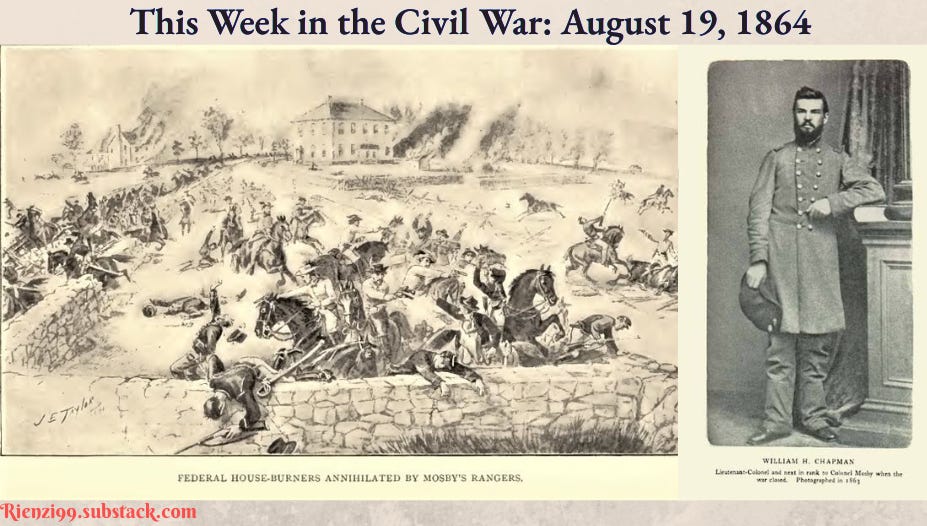
As Phil Sheridan’s 40,000-man Army of the Shenandoah completes its retreat through the lower Shenandoah Valley to Harper’s Ferry, he follows U.S. Grant’s instructions to systematically burn wheat fields, seize cattle, and destroy all the agricultural resources south of Winchester. In retaliation for the alleged murder of Corporal Alpheus Day yesterday by one of John S. Mosby’s Rangers, George A. Custer, Michigan Cavalry Brigade, orders the burning of five homes in the Berryville area belonging to civilians believed to support Mosby’s men. A detachment of fifty men from the Fifth Michigan Cavalry, commanded by Lieutenant Charles McMaster, are burning a barn on Benjamin Morgan’s Hill and Dale Estate when they are spotted by some of Mosby’s men. C.S. Private J. Marshal Crawford reports, “Captain William Chapman and [Richart P. Montjoy], with their sixty men, swept down on the enemy like a whirlwind. Forty were killed on the spot. Thirty-five horses and two prisoners were brought off.”3 When McMaster and the rest of his men become trapped in Morgan Lane, all are killed with Chapman shouting: “Wipe them from the face of the earth! No quarter! No quarter! Take no prisoners!”4 According to Private Samuel K. Davis, who survived by feigning death and hiding nearby, Morgan’s men returned to the scene of the ambush and shot the Union troopers still alive in the head. Neither Sheridan nor Custer mention the incident in their reports, but Sheridan issued new instructions to his men: “All able-bodied male citizens under the age of fifty who may be suspected of aiding, assisting, or belonging to guerrilla bands now infesting the country will be immediately arrested by corps and independent commanders and forwarded to these headquarters as prisoners of war.”
CHARLESTOWN, August 19, 1864--10.30 p.m.
Lieutenant-General GRANT: I destroyed everything that was eatable south of Winchester, and they will have to haul supplies from well up toward Staunton…. Guerrillas give me great annoyance, but I am quietly disposing of numbers of them. The enemy appears to be uncertain as to what course to pursue. The intention so far as I can learn was to send a column direct from Culpeper to the Potomac and Early to advance at the same time from Martinsburg. This was frustrated by Early being compelled to fall back and your operations on the north side of the James. I still think that two divisions of infantry have come here and Fitz Lee’s cavalry. My force will have to be weakened to supply the place of the 100-days’ men serving at Harper’s Ferry and in West Virginia…. I now can calculate on bringing into action about 22,000 or 23,000 infantry and about 8,000 cavalry. Respectfully,
P.H. SHERIDAN, Major-General.
Heavy rain dampens the fighting around Globe Tavern as Gouverneur K. Warren reports, “I sent General [Edward S. Bragg’s] brigade to the right to support General [Samuel Crawford’s division] and establish a connection on the shortest line, with skirmishers, between my right and the pickets near the Jerusalem plank road. This order General Bragg did not execute as directed, but took up another line a mile or more to the rear.” Taking advantage of his knowledge of the local terrain, William Mahone advances his division through a hidden ravine and strikes Crawford’s exposed left flank. Crawford reports, “The enemy, who had steadily concentrated in the cornfield on the right, burst through the thin line of Bragg’s brigade, crossed the road into the woods beyond, and, changing front, swept down in rear of my entire line…. At this moment our artillery opened fire upon friend and foe, the shells bursting among our men, the projectiles striking in the rear of the breastworks…. Immediately the cry was raised that the enemy were in our rear, and the men began to fall back… The brigade under [Colonel William R. Hartshorne], while attacked in front, was also attacked in rear by the rebels, who swept round and drove them at the point of the bayonet hurriedly to the rear. After a short but determined fight, they destroyed their rifles by breaking them against the trees, and a large number were made prisoners.” In all, over 2,500 Union soldiers are captured, including Brigadier-General Joseph Hayes, before reinforcements from John G. Parke’s Ninth Corps stabilize the line. Warren reports, “General [Orlando B. Willcox’s] division…was immediately ordered up to attack the enemy, and the lines of Generals Ayres and Crawford, being reformed, moved forward at the same time, driving back the enemy, regaining the ground lost, and capturing prisoners.” At 8:15 p.m., Warren reports on the day’s fighting. “We have possession of all ground fought over…. We are well disposed as we can be against the enemy if he attack in the morning.”
HEADQUARTERS THIRD CORPS, August 19, 1864--10 p.m.
General BEAUREGARD, Commanding, &c.: [Alfred H. Colquitt’s] and [Thomas L. Clingman’s] brigades in their advance through the thick undergrowth became so much scattered as to lose their organization. I was consequently compelled to order them to their original camps as a rallying point. Mahone’s brigade was also ordered inside the lines. Heth’s two brigades I have left occupying the ground they were today. I have also directed General W.H.F. Lee to move at 3 o’clock in the morning down to the Davis house. We will then be in position to push them again in the morning if we can get more troops. The indications are that the enemy are leaving. The blow struck them has been a very severe one, and I regretted my weakness prevented me from following it up as I would like to have done. Respectfully,
A.P. HILL, Lieutenant-General.
Hoping to turn up the pressure on President Lincoln to authorize the renewal of prisoner exchanges, Confederate authorities parole five Union prisoners from Camp Sumter in Andersonville, Georgia, and return them by boat to Port Royal Ferry, South Carolina. Officially, they claim the release is to “make up a small deficiency due at the last exchange at Charleston Harbor.” The Union prisoners bring a letter signed by General George Stoneman, who was captured three weeks ago, and two colonels. Stoneman directly addresses the issue of captured Black Union soldiers. He writes, “The two classes are treated differently by the enemy, the white is confined in such prisons as Libby and Andersonville, starved and treated with barbarism unknown to civilized nations, the black, on the contrary, is seldom imprisoned; they are distributed among the citizens or employed upon Government works. Under these circumstances they receive enough to eat and are worked no harder than accustomed to…. It is true they are again made slaves, but their slavery is freedom and happiness compared with the cruel existence imposed upon our gallant men.” President Lincoln and U.S. Grant are not swayed by Stoneman’s logic. Instead, the paroled prisoners are turned over to the U.S. Sanitary Commission and their firsthand testimony about the atrocities at Andersonville are widely published across the North.
OFFICE OF THE PROVOST-MARSHAL-GENERAL, DEPARTMENT OF THE SOUTH, Hilton Head, S.C., August 19, 1864.
Prescott Tracy, private Company G, Eighty-second New York Volunteers, from New York City, a prisoner of war, captured at Petersburg on the 22d of June; from Petersburg was taken to Richmond; from Richmond to Belle Island. Over 1,200 men were at Belle Island; we were starved there; our treatment was very bad. From Belle Island we were taken to Lynchburg; thence we marched seventy-five miles to Danville; it took five days, and all we had to eat was a few crackers, from eleven to fifteen for each man for the trip. At Danville we were well treated. From Danville we went to Andersonville, and were nearly starved to death; we had no shelter; they stole our blankets, money, coffee, and everything; we were completely robbed. On the road down some of the officers made the men take the rings off their fingers. Most of the men at Andersonville are nearly naked; they steal the clothing off your back; they stole my shirt, the only one I had…. We have no shelter whatever from sun, rain, or cold; no covering at night. Full one-half are sick with malignant diarrhea and scurvy, the worst and most loathsome kind.
There are some 34,672 prisoners there; from 80 to 145 die daily. We find them lying dead all over the camp in the morning. The hospital department is outside the stockade, with a few tents, but most of the men are on the ground without bed or shelter. The surgeons, as a general rule, are kind, and do what they can, but they have no medicine and very little means of doing for the sick…. The letter from General Stoneman, Colonels Dorr and Harrison was handed to me by General S. on the night before we started, when in Charleston prison…. I did not know its contents.
PRESCOTT TRACY.
Other U.S. activity reported on this date:
1. From outside Atlanta (GA), W.T. Sherman reports, “We have fired the town twice today, a heavy fire burning at daylight and about 3 p.m. He adds, “Nothing positive done along our lines, as nothing was attempted.”
2. Outside Atlanta (GA), G.M. Dodge, Left Wing, 16th Corps, is struck by a C.S. sharpshooter through an unshielded peephole and completely incapacitated. J.A. J. Lightburn, 2d Brig, 2d Div., 15th Corps receives a similar injury and is also incapacitated.
3. J. Kilpatrick’s cavalry expedition reaches the West Point Railroad, where “a portion of the track [is] destroyed.” He continues on to Jonesborough (GA), “driving the enemy’s cavalry in confusion from the town.”
4. A.J. Smith resumes his march along the Mississippi Central Railroad southwards from the Tallahatchie River.
5. R.W. Johnson is “announced as chief of cavalry of the Military Division of the Mississippi,” with his headquarters in Nashville (TN.)
6. Lt. Col. R. Klein, 1st Brig., 3d Cav. Div., returns to Union lines with 300 riders after being detached from Kilpatrick’s Raid. He reports striking the Atlanta & Macon Railroad at Fayette where he “destroyed one-quarter of a mile of track and captured a train of 8 cars.”
Other C.S. activity reported on this date:
1. J.B. Hood reports that “a raid has been started this morning from our left in the direction of Fairburn (GA)” and “will probably strike Macon [Railroad]. He informs his commanders to “look out for it [and] take means to ascertain the point of attack.”
2. From Sewell’s House (GA), L.S. Ross, Cavalry Brig., reports “at least a brigade of cavalry” is “advancing on Sandtown and Fairburn road in force. He adds, “My pickets are now fighting them between Bethel and Enon Church.”
3. After refeuling, the C.S.S. Tallahassee avoids a Union blockade at Nova Scotia and heads toward Wilmington (NC).
4. Skirmishes are reported at Jonesborough (GA); at Berryville, Opequan Creek, Winchester Pike and Snicker’s Gap Pike; at Franklin (WV); at Red Oak and Flint River (GA); at Hurricane Creek (MS); at Lexington (MO); Oxford (MS); at Smith’s Mills; and at Tallulah (LA).
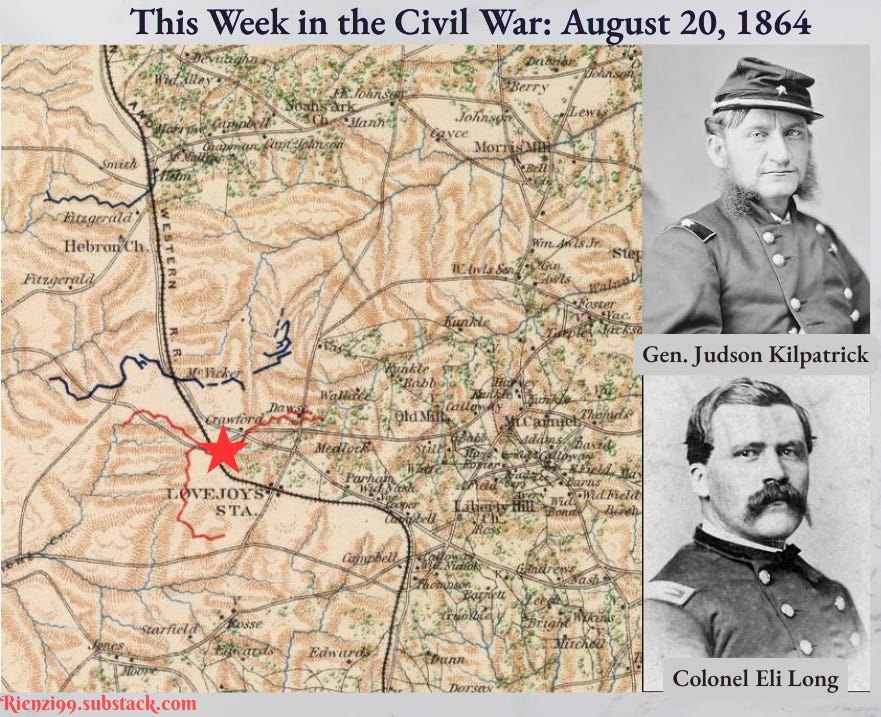
After burning all the public buildings and military supplies in Jonesborough, Georgia, Judson Kilpatrick’s Union raiders head to Lovejoy Station and begin to tear up the Macon & Western Railroad. Kilpatrick reports, “For six hours my entire command was engaged destroying the road.” Patrick R. Cleburne, commanding his division and Dan Reynolds’ Arkansas Brigade threaten to trap Kilpatrick in the town. Kilpatrick organizes his men and orders a desperate, full-gallop saber charge. Led by Colonel Eli Long’s Ohio cavalry, they break through the Texas cavalry blocking the road and escape toward the east. Colonel Charles B. Seidel, Third Ohio Cavalry, reports, “We formed in advance for brigade and charged in column of fours on the enemy in our rear, scattering them badly, and causing them to abandon one piece of artillery.” Despite Kilpatrick’s efforts to break the railroad, District of Georgia commander Howell Cobb reports, “The damage on road to Atlanta much less than supposed. The road now clear, and will be repaired in few days at furthest.”
Report of Brig. Gen. Judson Kilpatrick, U. S. Army, commanding Third Division.
SIR: Fearing an attack from the direction of Atlanta, I moved before daylight…and reached the railroad one mile above Lovejoy’s Station at 11 a.m…. On attempting to move on the station I encountered a brigade of infantry–-was repulsed…. At this moment… [Colonel Eli H. Murray] informed me that a large force of cavalry, with artillery, had attacked his rear. In twenty minutes, I found that I was completely enveloped by cavalry and infantry, with artillery. I decided at once to ride over the enemy’s cavalry and retire on the McDonough road…. Colonel [Robert H.G. Minty], with his command in three columns, charged, broke, and rode over the enemy’s left. Colonel Murray, with his regiments, broke his center…. It was the most perfect rout any cavalry has sustained during the war…. My command was quickly reformed, thrown into position, fought successfully the enemy’s infantry for one hour and forty minutes, and only retired when it was found that we had left only sufficient ammunition to make sure our retreat…. Respectfully submitted.
J. KILPATRICK, Brigadier-General, U.S. Vols., Commanding.
Heavy rain halts the efforts of G.T. Beauregard and A.P. Hill to organize an attack on the exposed Union position near the Globe Tavern. Union commander G.K. Warren uses the day to pull his troops back to a new line of fortifications that are connected with the main Union lines on the Jerusalem Plank Road. Army of the Potomac commander George G. Meade writes to U.S. Grant, “If the idea of extending beyond the Weldon railroad is entertained, it is absolutely essential a strongly fortified line should be constructed and held between that railroad and the Jerusalem plank road.” Grant replies, “I want to hold the Weldon road [permanently] and to thoroughly destroy it if it cannot be held.” To bolster his forces south of Petersburg, Grant orders Winfield S. Hancock’s Second Corps to withdraw from Deep Bottom and “move back to his old position” where he can support Warren. Grant writes, “If the enemy comes out to attack, we will have the advantage of position. If they hold their lines only and persist in sending more troops to the Valley we can extend still farther.” However, Grant is concerned with the number of casualties Warren has reported. He writes to Meade, “Richmond papers of today claim to have captured 2,000 prisoners from Warren. Is not this far above his estimate?” Meade responds, “I have sent your telegram to him with directions to let me know the missing in his corps…. His losses, I know, from reports of others, were nearly all in prisoners. No succinct report of the affair has been made.”
HEADQUARTERS FIFTH ARMY CORPS, August 20, 1864–[10 a.m.].
General MEADE: General Ayres lost about 400 men; General Crawford, 800; General Cutler, about 300. I am getting the troops in order for fighting in case they attack again and assemble them in reserves. I do not think with our present force we can hold a line across where I established the picket-line yesterday. Nearly all my losses were occasioned by being turned on my right in the woods. The present picket-line runs east and west nearly by the Strong house. I will endeavor to re-establish the picket-line I had yesterday. I believe the enemy has retired into his defenses again, leaving out only a picket, or it may be preparing for another demonstration somewhere…. Respectfully,
G.K. WARREN, Major-General.
Casualties at Lovejoy’s Station, Georgia:
U.S.: 237 (killed, wounded, missing)
C.S.: 240 (killed/wounded)
Other U.S. activity reported on this date:
1. W.T. Sherman writes to the commanding officers at Marietta, Allatoona, Kingston, Cartersville, and Resaca: “Try to ambush the scamps that cut our telegraph wire…. Operators should send by signal notice of the time and place of break in the wires, that steps may be taken which will lead to the capture of the men who are employed for the purpose.”
2. Wm. Grose, “with six regiments of his brigade,” completes a reconnaissance and captures eight men of the 41st Tennessee. He reports, “From these we learned that we struck the extreme right…of the rebel army.”
3. J.R. West is “assigned to duty” as chief of cavalry of the Dept. of Arkansas.
4. F.J. Herron, Dist. of Baton Rouge and Port Hudson, reports there “has been great complaint” from local plantations about “the conduct of our soldiers, who it seems have been permitted to leave their posts, wandering about at will, and helping themselves without stint to whatever could be found.”
5. Lt. Col. W.F. Prosser, 2d Tenn. Cav, returns from an expedition to Moulton (AL) where he was attacked last night by the enemy…500 or 600 strong.”
6. Capt. W.W. Turnbull, 83rd Illinois, and eleven men of his company are “overpowered” during a skirmish at Pine Bluff (TN), “killing the captain and 7 men, [and] horribly mutilating their bodies.”
Other C.S. activity reported on this date:
1. R. Ransom Jr. is granted a “leave of absence for thirty days, for the benefit of his health.”
2. J.A. Early reports his three divisions (Rodes, Ramseur, and Gordon) have 8,269 men present for duty, with an aggregate present of 10,042.
3. From Oxford (MS), J.S. Chalmers reports A.J. Smith’s expeditionary force is “within four miles,” but is being slowed by heavy rain, and “swollen” streams. He writes, “I have sent off everything I can spare, and am prepared for light travel.
4. Maj. J. Jenkins, commanding on John’s Island (SC), orders the burning of Legaresville, which has been used by Union forces as a base of operations.
5. Skirmishes are reported at Bulltown (WV); Coreysville (GA); at Berryville and Opequan Creek (VA); Philadelphia, Pine Bluff, and Sweetwater (TN); and at Rocheport (MO).

Campaigns of Wheeler and his cavalry, 1862-1865, from material furnished by J. Wheeler by William Carey Dodson and Joseph Early Wheeler (1899), p. 251.
Mosby and his Men: A Record of the Adventures of that Renowned Partisan Ranger, John S. Mosby, etc. (1867) by J. Marshall Crawford, p. 247.
Mosby’s Rangers by Jeffry D. Wert, p. 196.
Comments
Nothing yet. Say the first thing.
Sign in to join the conversation.