
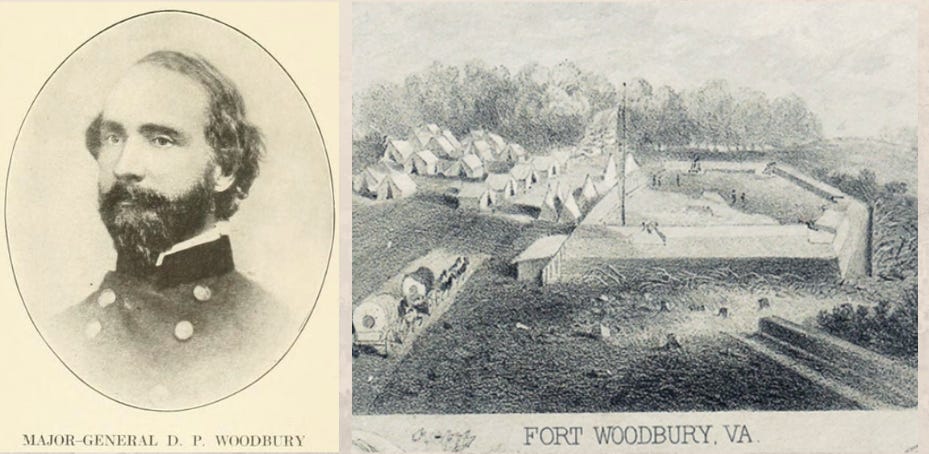
Daniel Phineas Woodbury was born in New London, New Hampshire in 1812, the fifth of six children born to Daniel Woodbury and Rhapsima Messinger Woodbury. His father was a farmer and a carpenter, and young Daniel was educated in the local schools. Through the influence of Levi Woodbury, a distant cousin, Daniel received an appointment to West Point in 1832. (During his political career Levi Woodbury served as a U.S. Senator, Governor of New Hampshire, Secretary of both the Navy and Treasury, and Supreme Court Justice.) He graduated in 1836 (6/49) along with Montgomery C. Meigs, who distinguished himself as a quartermaster during the Civil War. Woodbury was commissioned as a Second Lieutenant in the 3rd U.S. Artillery, but quickly transferred to the U.S. Army Corps of Engineers.
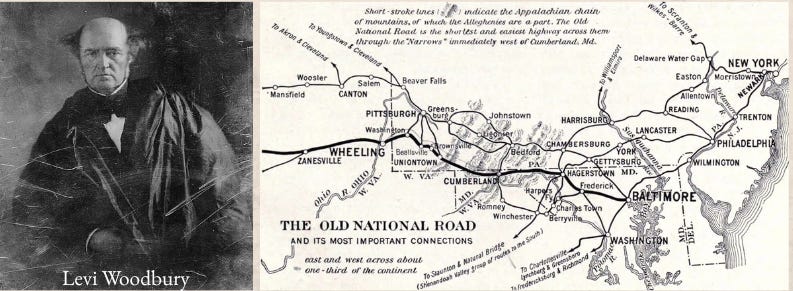
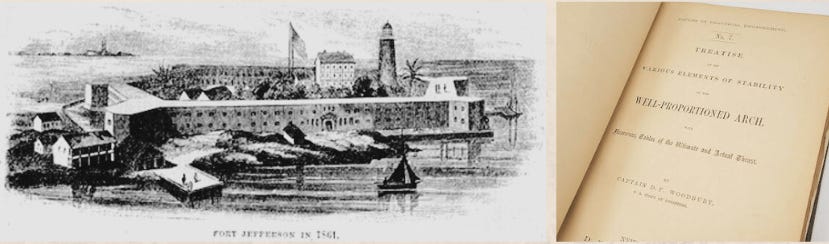
Woodbury’s first assignment as an assistant engineer was helping construct the Cumberland Road (also known as the National Road) through Ohio, the first major improved highway funded by the federal government. In 1847, he was ordered to select the site and superintend the construction of this critical military post along the Platte River. Two years later, he was authorized by the Secretary of War William L. Marcy to purchase the existing fur trading post (known as Fort John) near the confluence of the Laramie River and the North Platte River from the American Fur Company and transform it into Fort Laramie. In 1852 Woodbury was recalled east to focus on maritime safety and coastal fortification engineering. He served as a lighthouse inspector for the 6th District, headquartered in Charleston, South Carolina, and an engineer for the 5th and 6th Districts, which encompassed the Atlantic seaboard south of Baltimore, Maryland. During this time, he also served as superintending engineer during the construction of Fort Jefferson in the Dry Tortugas. In 1858, Woodbury published the Treatise on the Various Elements of Stability in the Well-Proportioned Arch with Numerous Tables of the Ultimate and Actual Thrust, which became a standard reference text for both military and civilian structural engineers. In 1860, he transferred to Washington City and was assigned as an assistant to Chief Engineer Joseph G. Totten.
When the Civil War began, Woodbury was assigned as Chief Engineer in David Hunter’s Second Division of Irvin McDowell’s Army of Northeastern Virginia. In that capacity, he personally guided Hunter’s column as it conducted a flanking march around the Confederate army via Sudley Springs Ford. Woodbury was promoted to Major of Engineers in August 1861, and helped design and construct the Arlington Line, a network of interconnected earthwork fortifications protecting the southern approaches to the city. (Fort Woodbury, a lunette fort constructed by the Fourth Michigan, was named in his honor.) In March 1862, he was promoted to brigadier-general of volunteers and given command of the Engineer Brigade. Throughout the Peninsular Campaign of George B. McClellan, Woodbury’s brigade built roads, fieldworks, and bridges for the Army of the Potomac. Woodbury also served as the chief organizational force behind the Engineer Depot in Washington City which gathered, tested, and stored essential heavy equipment, including pontoon train components, bridge timber, entrenching tools, and explosives that were required for field operations. Woodbury worked closely with his old classmate Montgomery C. Meigs, who served as Quarter-Master General for the Union Army to secure the heavy pontoon trains and bridging equipment needed in the field.
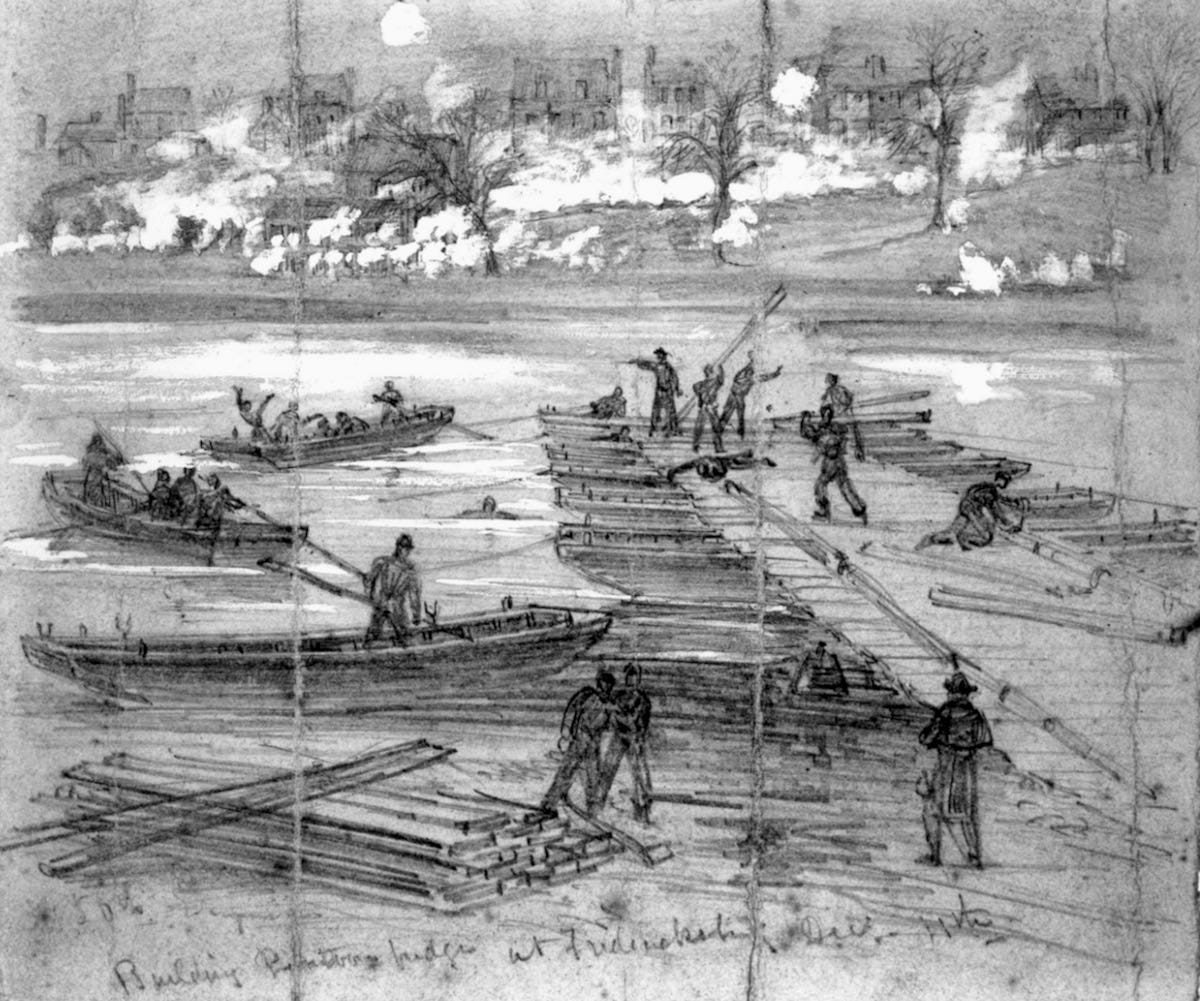
Woodbury’s reputation was threatened during the Fredericksburg Campaign, when a series of bureaucratic and logistical problems delayed the arrival of essential pontoon boats needed for Ambrose Burnside’s army to cross the Rappahannock River. The delay allowed Robert E. Lee to build up his defenses at Fredericksburg, Virginia, and contributed to the Union’s historic defeat in the December 1862 battle. Burnside requested the pontoon bridging equipment on November 12th, expecting it to meet him at Falmouth by November 17th. However, the pontoon trains did not actually arrive until a week later and when Woodbury arrived, Burnside threatened to arrest him unless the engineer could provide an immediate and “satisfactory explanation.” Burnside quickly realized Woodbury was not at fault and rescinded the arrest order. Woodbury redeemed himself by overseeing the construction of the pontoon bridges in the face of heavy Confederate fire by using his own engineering boats to ferry Union assault troops across the river to establish a bridgehead. For his efforts, Woodbury received a brevet promotion to brigadier-general in the U.S. Regular Army.
From General-in Chief Henry W. Halleck’s Fredericksburg Official Report:
It was alleged at the time that the loss of this battle resulted from the neglect to order forward the pontoon train from Washington. This order was telegraphed by me from Warrenton to Brigadier-General Woodbury, then in Washington, on the 12th of November, and was promptly acted on by him. General Burnside had supposed that the pontoon train was then in Washington or Alexandria, while it was still on the Potomac, at Berlin and Harper’s Ferry, General Burnside’s order to send it to Washington not having been received by the officer left in charge there. General Burnside had only allowed time for transporting his pontoons from Alexandria, whereas they had first to be transported to that place from Berlin. The delay was, therefore, entirely unavoidable, and, on investigation of the matter by General Burnside, General Woodbury was exonerated from all blame.
The political fallout from Burnside’s failed campaign also necessitated a restructuring of the leadership in the Army of the Potomac and the re-assignment of Woodbury to a non-combat position. In March 1863, Woodbury was sent to command the District of Key West and the Tortugas. Fort Zachary Taylor, on Key West, served as the operational hub for the East Gulf Blockading Squadron which was responsible for the naval blockade of Southern ports, hunting blockade runners operating in the Caribbean, and safeguarding Union supply lanes through the Gulf of Mexico. In early August 1864, Woodbury contracted Yellow Fever during the summer epidemic which tore through the military installations on the island. Despite his illness, Woodbury insisted on carrying out his administrative duties until days before his death on August 15th, 1864. Shortly after he died, Woodbury was posthumously awarded a brevet promotion to major-general in the U.S. Regular Army for “gallant and meritorious services.” Due to the highly contagious nature of his illness, Woodbury was quickly buried in the Army Cemetery at Key West. After the war, he was re-interred in the Barrancas National Cemetery near Pensacola, Florida.

Comments
Nothing yet. Say the first thing.
Sign in to join the conversation.