
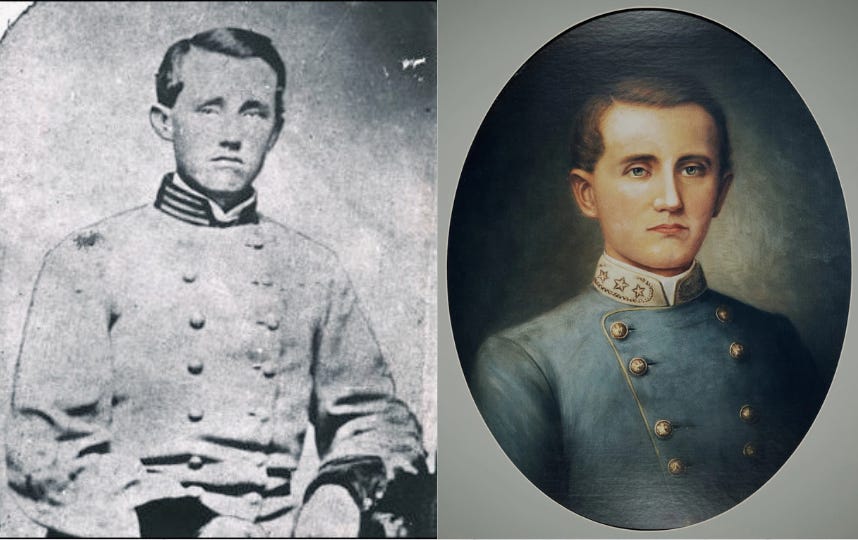
John C. Calhoun Sanders was the third of seven children born to Dr. Charles Peak Sanders and Elizabeth Ann (Thomson) Sanders at the Doctor & Planter Estate outside Tuscaloosa, Alabama. His father moved from South Carolina to Alabama in the late 1830’s after the Indian Removal Act opened up millions of acres of prime agricultural land. Dr. Sanders transformed his initial investment in Greene County into a highly prosperous plantation, and by 1860 his land and 25 enslaved people placed him among the elite planter class of west-central Alabama. Young John and his two older brothers attended 4-year colleges, and he enrolled in the University of Alabama as a student in 1858. He also joined the Alabama Corps of Cadets when they were established in 1860. Following Alabama’s secession from the Union in January 1861, Sanders wrote a letter to his parents asking for permission to leave his studies.
“I am anxious to engage in active service and seeing no prospect of doing so, by remaining in the Corps of Cadets, I now ask your permission to withdraw from the University. I have said nothing to any of my intentions; but should give me your consent, direct your letter to me at Mobile (as we return that way), and I will withdraw and immediately to Fort Morgan or Pensacola. I feel that my country calls for all her sons, and I, for one, cannot refuse to obey her maternal voice.” 1
His parents assented and Sanders joined the Greene County militia, also known as the Confederate Guards, as a captain. In June 1861, the Confederate Guards officially became Company C of the 11th Alabama Infantry Regiment. Following their initial period of training, the 11th Alabama was sent to Virginia, where they spent the fall and winter of 1861.
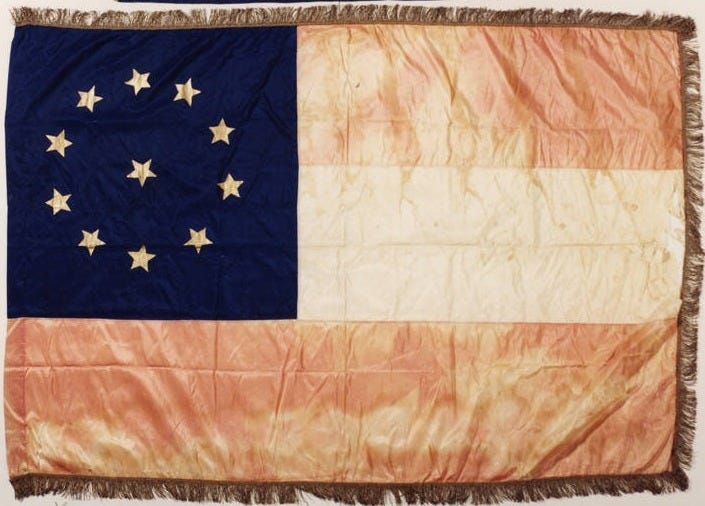
Captain Sanders first saw action at Seven Pines, where his regiment suffered heavy casualties as part of Cadmus Wilcox’s brigade. A month later, Sanders was severely wounded in the leg by a shell fragment at Glendale and taken to Richmond, Virginia, to recover. He returned to duty in August and received a promotion to major. Because of severe officer casualties in the regiment, Sanders assumed command of the 11th Alabama and was slightly wounded in the fighting at Second Bull Run in August 1862. He remained with his command throughout the Maryland Campaign and was wounded a third time at Antietam when a nearby exploding shell kicked rocks and debris into his face. After the battle, Sanders was promoted to colonel and upon his return to duty he led the regiment during the fighting at Fredericksburg, Salem Church, and Gettysburg, where he was wounded a fourth time in the knee and forced to return to Virginia in a hospital wagon.
When Sanders returned to active duty, he was given command of Wilcox’s old brigade in Richard H. Anderson’s division of A.P. Hill’s Corps. (Wilcox was promoted to division command.) He led the brigade during the Bristoe and Mine Run Campaigns but reverted to command of the 11th Alabama when Abner M. Perrin returned. After Perrin was killed at Spotsylvania Court-House, Sanders led the brigade in the attack to retake the ‘Mule Shoe’ Salient. For his actions, Sanders was given a field promotion to brigadier-general in May 1864, under the section of the Confederate law permitting the appointment of temporary general officers.
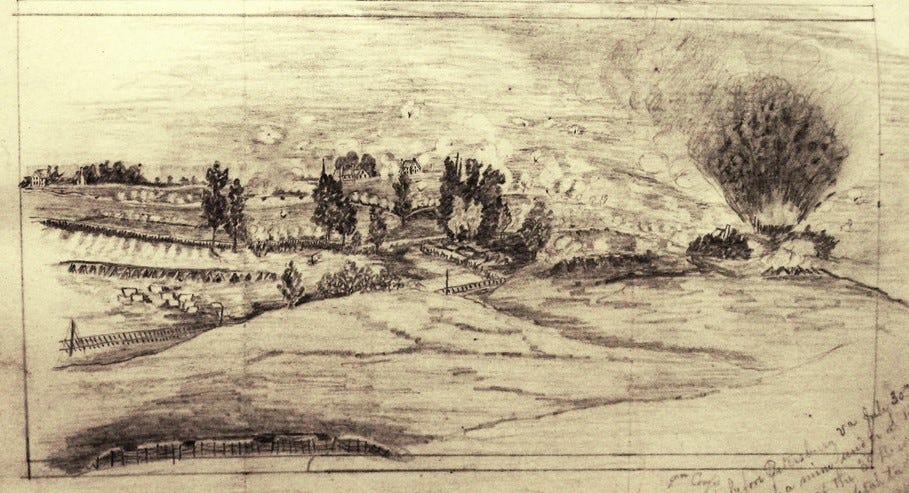
After the battle, Sanders was given permanent command of a brigade of Alabama regiments, which he led during the fighting at Cold Harbor and in the early engagements of the siege of Petersburg. As part of William Mahone’s division, Sanders’ brigade led the bloody counterattack against the Union units trapped in the Crater on July 30th. Although there is no record of Sanders participating in the massacre of black troops, he and his fellow officers failed to stop the actions of their troops until Mahone intervened late in the afternoon. After the battle, Sanders was forced to admit, “Negroes…fight much better than I expected.”2 Following the battle, Sanders and his Alabama Brigade were lauded as heroes for saving the Confederate line.
From the official battle report of Bushrod R. Johnson:
The first charge having failed in completely dislodging the enemy I ordered all of my available forces to press steadily on both flanks with a view to their final expulsion. Between 11 and 12 a.m. a second unsuccessful charge having been made by Wright’s brigade, of Mahone’s division, I proceeded to concert a combined movement on both flanks of the crater, to which most of the enemy’s troops were now drawn. By arrangement a third charge was made a little before 2 p.m., which gave us entire possession of the crater and the adjacent lines. This charge was made on the left and rear of the crater by Sanders’ brigade, of Mahone’s division, by the Sixty-first North Carolina, of Hoke’s division, and Seventeenth South Carolina Regiments, of this division. The last two regiments, under Major Culp, of the Seventeenth South Carolina Regiment, Elliott’s brigade, advanced on the right of Sanders’ brigade.
These movements on the left were all placed under the direct supervision of General Mahone, while I proceeded to the right to collect what troops I could from the thin line on that flank to co-operate in the charge and divide the force of the enemy’s resistance. The time allotted only permitted me to draw out the Twenty-third and the fragments of the Twenty-second South Carolina Regiment, under Captain Shedd. They moved gallantly forward as soon as the main line was seen advancing on the left, and entered the crater with the troops of that line, capturing 3 stand of colors and about 130 prisoners. Previous to this charge the incessant firing kept up by our troops on both flanks and in rear had caused many of the enemy to run the gauntlet of our cross-fires in front of the breach, but a large number still remained, unable to advance, and perhaps afraid to retreat. The final charge was therefore made with little difficulty, and resulted in the complete re-establishment of our lines and the capture of many additional prisoners.
2d Michigan Regiment John H. Deaton Sergeant, Company E, 8th Alabama.
20th Michigan Regiment John M. Critcher Company K, 9th Alabama
Guidon (Stars and Stripes) James N. Keeton Company G, 11th Alabama
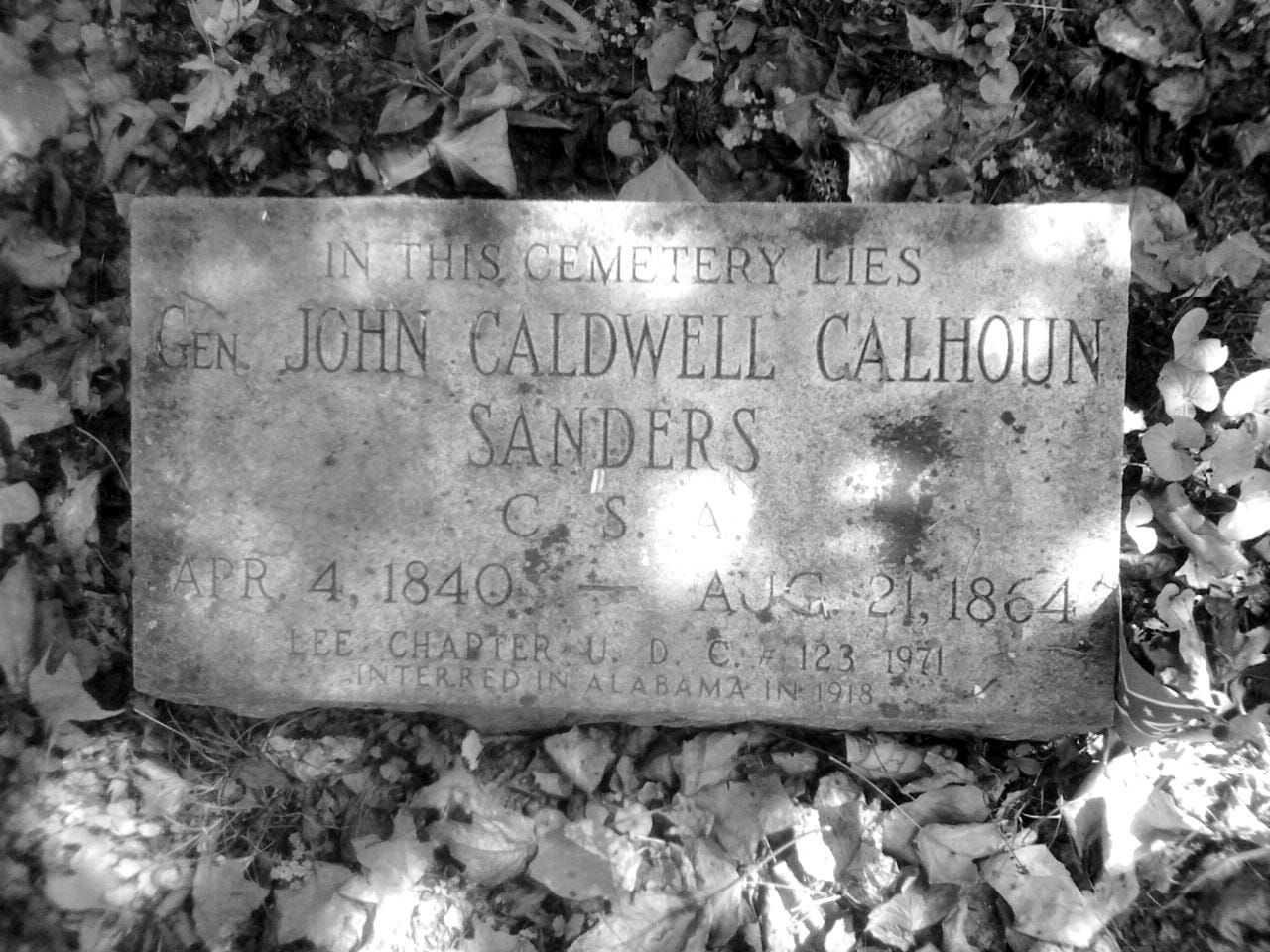
Sanders’s brigade was moved north of the James River during the renewed fighting near Deep Bottom in mid-August. His brigade was quickly moved back south of Petersburg when Union forces advanced on the Weldon Railroad at Globe Tavern. During the attempt to regain lost ground, Sanders’s Brigade attacked. In the ensuing fight, Sanders was shot through both thighs. He died within a few minutes, but not before he calmly told his adjutant, “Take me back, don’t leave me.”3 His body was taken to Richmond the next day and was placed in a vault in Hollywood Cemetery. From there he was interred in the Maryland Section of the cemetery, but his family decided to move his body to a lot owned by John C. Page, a wealthy shoe merchant who had cared for him after he had been wounded in 1862. At some point the exact location of Sanders’ grave was lost, and in 1971 a granite marker to his memory was erected stating:
“IN THIS CEMETERY LIES
GEN. JOHN CALDWELL CALHOUN SANDERS C.S.A.
APR. 4, 1840 - AUG. 21, 1864.”
His brother William H. Sanders enlisted as a private in the 11th Alabama, but was quickly appointed as the Assistant Surgeon of the regiment due to his medical background. (He graduated from Jefferson Medical College with a Doctor of Medicine (M.D.) degree in 1861.) He was promoted to Full Surgeon (which carried the rank of Major) in March 1863 and continued to serve in the regiment for the rest of the war. Another brother, Matthew T. Sanders served as a lieutenant in Mead’s Tennessee Cavalry, which was organized by Colonel Lemuel G. Mead, an attorney from Jackson County, Alabama, as a partisan unit operating along the borders of Alabama and Tennessee.
Comments
Nothing yet. Say the first thing.
Sign in to join the conversation.