
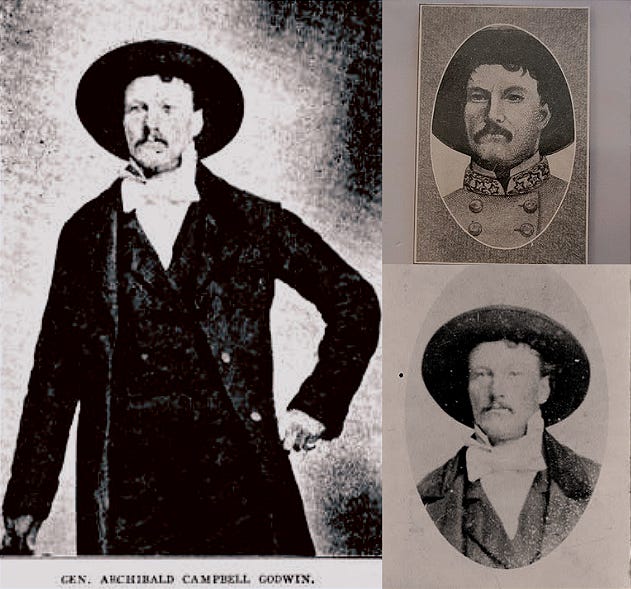
Archibald Campbell Godwin was born in Nansemond County, Virginia, the son of Jonathan Lewis Godwin and Julia (Campbell) Godwin. His father was a wealthy Tidewater Planter, and the Godwin family had owned the Old Castle Estate Plantation since the late 1600’s. The family also owned several other plantations along the Nansemond River, along with a large mercantile business and a private toll bridge over the eastern branch of the Nansemond River (in modern day Suffolk). When his father died a year after he was born, Godwin was moved to Portsmouth, Virginia, to live with his paternal grandmother Julia Hatton Godwin. (There is no surviving record of when his mother passed away, but it is assumed she died shortly after Archibald’s birth.) Young Archibald grew up with wealth and privilege among the elite of Portsmouth.
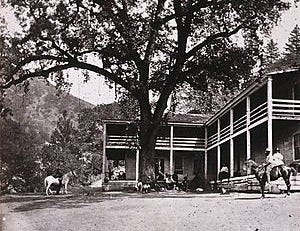
In 1850, Godwin decided to move to California during the Gold Rush. Using his family’s wealth, he was able to purchase 600+ acres of prime land along the Russian River in Sonoma County, which became known as Godwin’s Place. Godwin very quickly built a large portfolio of cattle, timber, real estate and mining and became one of the wealthiest men in northern California. He developed the Geysers Resort Hotel near local hot springs and was appointed as a Federal “sub-Indian agent” to oversee relations with the local Native Americans. (One traveler described the Native population as “under Mr. Godwin’s complete control.”1 Godwin discovered his land possessed rich cinnabar ore deposits and successfully defended his mining claim by representing himself in court in Santa Rosa. He also became involved in local politics and was elected a Justice of the Peace in 1855. He served on the board of directors of the Geyser Road committee and narrowly lost the Democratic Party nomination for governor of California on a pro-slavery platform in 1860.
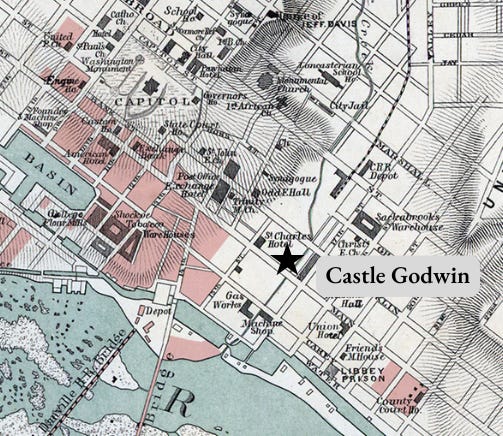
When Abraham Lincoln was elected president, Godwin renounced his allegiance to the United States and began liquidating his massive estate. After transferring his property and the bulk of his fortune into the hands of trusted California associates, Godwin traveled back to Richmond, Virginia, and offered his services to Confederate President Jefferson Davis. Godwin received a commission in the C.S. Army as a major and was appointed as the assistant provost-marshal for Libby Prison. During his tenure he earned a reputation for being extremely harsh and cruel toward the prisoners, especially the pro-Union civilians. When the C.S. military took over “McDaniel’s Negro Jail” in March 1862 and converted it into a prison for political dissidents, it was rechristened Castle Godwin in his honor. When martial law was declared in Richmond, Godwin was named “Provost Marshal of the City of Richmond, and the adjoining and surrounding country for the distance of ten miles.”
From the Richmond Whig (05/02/1862):
THE PROVOST MARSHAL AND HIS POLICE. - The Richmond correspondent, “Timon,” of the Charleston Mercury, in a recent letter to that journal, says: On Broad, corner of Ninth street, is the spacious building where Provost Marshal, Captain A.C. Godwin, holds his office. He is a Virginian by birth; a gentleman of fine culture, gentle manners, affable address, and quick perspicacity. He stands about six feet two inches in height, is of sandy complexion, wears a moustache and long, graceful goatee, his prominent cheek bones penetrating but benevolent eyes, a well shaped mouth and regular teeth; with a figure denoting vigor and elasticity. His voice is pleasant, his manner firm and resolved, his reason always clear, unclouded and discriminating, and his disposition seemingly unbiased by either favor or prejudice.
In May 1862, Godwin was transferred to the military prison at Salisbury, North Carolina, to replace Major George C. Gibbs as the prison’s second commandant. He immediately took over the daily logistics and security of the camp.
From the Richmond Dispatch (5/6/1862):
Archibald C. Godwin…has been assigned to duty as the custodians of all the Yankee prisoners at Salisbury, N.C., at the unanimous request of the residents in that section of country. Major Godwin will have charge of a battalion in Salisbury, whose duty it is to take care of the 2,000 prisoners at that place. Major Gibbs, the former commandant of the post, has raised a regiment since being there, and will take the field at an early day at the head of as brave a set of fellows as can be scared up in a day’s walk.
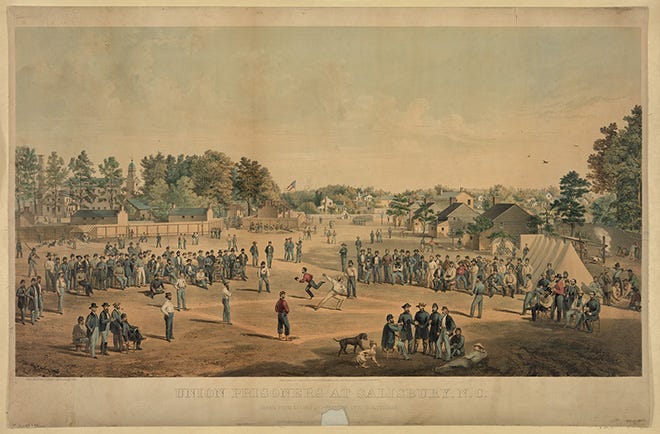
Godwin’s first task at Salisbury was to construct a secure stockade around the converted four-story cotton factory. In June 1862, the Union and Confederate governments agreed to a large-scale prisoner exchange which dropped the prison population from 1,500+ to less than a hundred. During this time, many Union prisoners engaged in playing baseball, including an Independence Day game on July 4, 1862. (Captured soldiers from New York introduced the modern Knickerbocker rules to the camp and helped popularize the game.) Godwin took advantage of this lull in activity to organize the prison guards into a field unit which became the 57th North Carolina Infantry Regiment. Shortly after Godwin was elected as colonel, he resigned from his post at the prison and the regiment was assigned to Joseph R. Davis’s brigade within the defenses of Richmond.
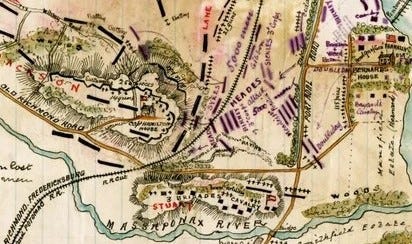
In November 1862, Godwin’s brigade was transferred to Evander Law’s brigade in John Bell Hood’s Division of the Army of Northern Virginia. They saw their first action at Fredericksburg, where Godwin led a successful counterattack against the Union breakthrough at the Slaughter Pen. Both Generals Hood and Law praised Godwin’s performance. Hood reported, “It is with much pleasure that I call your attention to the gallant bearing of both the officers and men of the Fifty-seventh North Carolina Regiment, Col. A.C. Godwin commanding, in their charge on a superior force of the enemy posted in the strong position he had gained.”
From Evander Law’s Official Report:
Detaching the Fifty-seventh and Fifty-fourth North Carolina Regiments, I advanced with them to attack the enemy, who had now gained the line of railroad which crosses the plateau directly in front of the battery and about 200 yards from it. The enemy was promptly driven from the railroad by the Fifty-seventh North Carolina, which was in advance, and the regiment continued to move steadily forward to within 300 yards of the Bowling Green road, driving his infantry before it…. I cannot speak in too high terms of their steady courage in advancing, and the coolness with which they retired to the line of railroad when ordered.
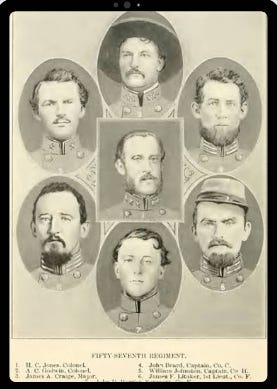
In April 1863, Godwin’s 57th North Carolina was transferred to Robert Hoke’s brigade in Jubal Early’s division. During the Chancellorsville Campaign, they helped hold the heights of Fredericksburg. At Gettysburg, they were part of Early’s attack on July 1st that routed the Union 11th Corps and drove them back to Cemetery Hill. On July 2nd, they participated in the dusk attack on East Cemetery Hill in which their brigade commander (Colonel Isaac E. Avery) was mortally wounded, leaving Godwin in command. Realizing his position was untenable, Godwin ordered a retreat back to the foot of the hill. He remained in command of the brigade throughout the summer and early fall. In November at Rappahannock Station, Godwin’s brigade was trapped along with Henry T. Hays’ Louisiana Tigers in a bridgehead on the north bank of the river.
“With a handful of only sixty or seventy men…, Godwin continued to resist even though Union soldiers swarmed down on all sides. Suddenly from somewhere in the ranks someone shouted that Godwin had given an order to surrender. Furious, Godwin called for the man, threatening to blow his brains out if he found him. The thought of surrender had never entered Godwin’s mind; when Union soldiers finally overpowered the little group, he was captured with his weapons still in his hands. Godwin and most of his men were then hustled to a military prison in the North.” (2)
After being captured, Godwin was sent to Johnson’s Island prison in Lake Erie, where he remained until being exchanged in late July 1864. He was promoted to brigadier-general a week after his return to Richmond and was assigned to command his old brigade, which was down to 800 men, serving with Early’s army in the Shenandoah Valley. On September 19th, Phil Sheridan launched a massive attack against Winchester. After furious fighting throughout the morning and early afternoon, the Union was on the brink of breaking through the Confederate defenses. Godwin was riding along the front line with Captain John Beard, who had command of his old regiment, attempting to align his regiments and prevent a total rout when an artillery shell burst directly over his head. He was hit in the head and killed instantly.
Captain Clarence R. Hatton, an adjutant on Godwin’s staff (and his cousin) reported:
It was during one of the comparatively slight lulls shortly before sunset that General Godwin rode up his lines to the turnpike where Capt. John Beard, who had command of his old regiment (57th), was and said to him: “I am proud of the conduct of my old regiment today. It saved the day.” Captain Beard warned him to get off the pike, as the Federal artillery had the exact range of it, when at that moment a shell exploded over them, and a fragment struck General Godwin on the head, and he fell forward from his horse into the arms of Captain Beard, dead. I was within a few feet and saw it all.
Despite the chaotic retreat, Godwin’s staff successfully carried his body off the field and brought it to Winchester, where he was buried in the Mount Hebron Cemetery. Hatton related, “I had his body taken into Winchester to the house of a friend…whom he had accompanied to church the night before. I engaged and paid an undertaker to bury him in the town cemetery, and there his remains rest, nicely marked.” Because of his death, Godwin’s promotion to brigadier-general was never confirmed by the Confederate Senate. After the war, Godwin was investigated by a military tribunal under charges of conspiracy and violating the laws of war while at Libby Prison, Castle Godwin, and Salisbury Prison. Specifically, Godwin was charged with the harsh treatment of civilian prisoners. When it was learned that Godwin had been killed in 1864, the investigation was dropped.
Report from Philip Cashmeyer (Cashmyer), a former C.S. detective and secret service agent:
Castle Godwin, a military prison used for the confinement of civilians and military prisoners (Confederates). was instituted in 1862, at the declaration of martial law in this city. The Hon. [John M. Botts], Messrs. [Franklin Stearns], Palmer, Higgins, Wardwell, and other prominent Union citizens of this city and the State of North Carolina, were here confined. Their treatment was characterized by much severity from the authorities. All of them for weeks and many of them for months during their entire confinement were deprived of all communication with their families or friends excepting by letter. Captain Godwin, the provost marshal, was extremely severe toward these prisoners
Salisbury Prison, N. C., contained within its limits about fifteen acres. The shelter consisted of one large and some small buildings, with the addition of an insufficient number of tents, which in cold weather induced those confined to burrow in the earth. Several hundred Union (citizen) prisoners were confined here during the year 1862, very many of whom died. Colonel Godwin, former provost-marshal of Richmond, was in command during the period these prisoners were confined. His treatment of them was unkind and severe. I am acquainted with the affairs of this prison only during the period he (Colonel Godwin) was in command.
Comments
Nothing yet. Say the first thing.
Sign in to join the conversation.