
Why do schools spend so much time and money on locking classroom doors as a way to prevent or mitigate school shootings?
On a campus where students change classes every hour, walk between multiple buildings, and leave the classroom to go to the bathroom, door locks are a friction point that inhibits the natural activities at the school. Every time a student knocks on a classroom door to be let inside, or a teacher’s badge won’t scan, this interrupts the core function of the school.
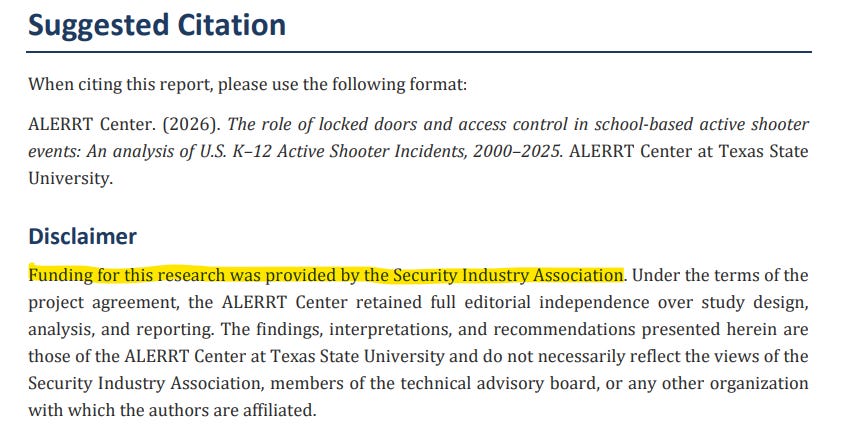
The first recommendation in a security vendor funded “study” at Texas State University is “ensure every classroom has a functional door lock”. ASIS recently published a “school security standard” ($150 if you want to read it) that states every classroom needs to have a lock and schools should consider remotely operated electronic locking systems that can remotely trigger a campus-wide lockdown. As I warned in August 2024 when ASIS started drafting this, recommendations in a private industry standard can find their way into lawsuits and then become de facto regulations.
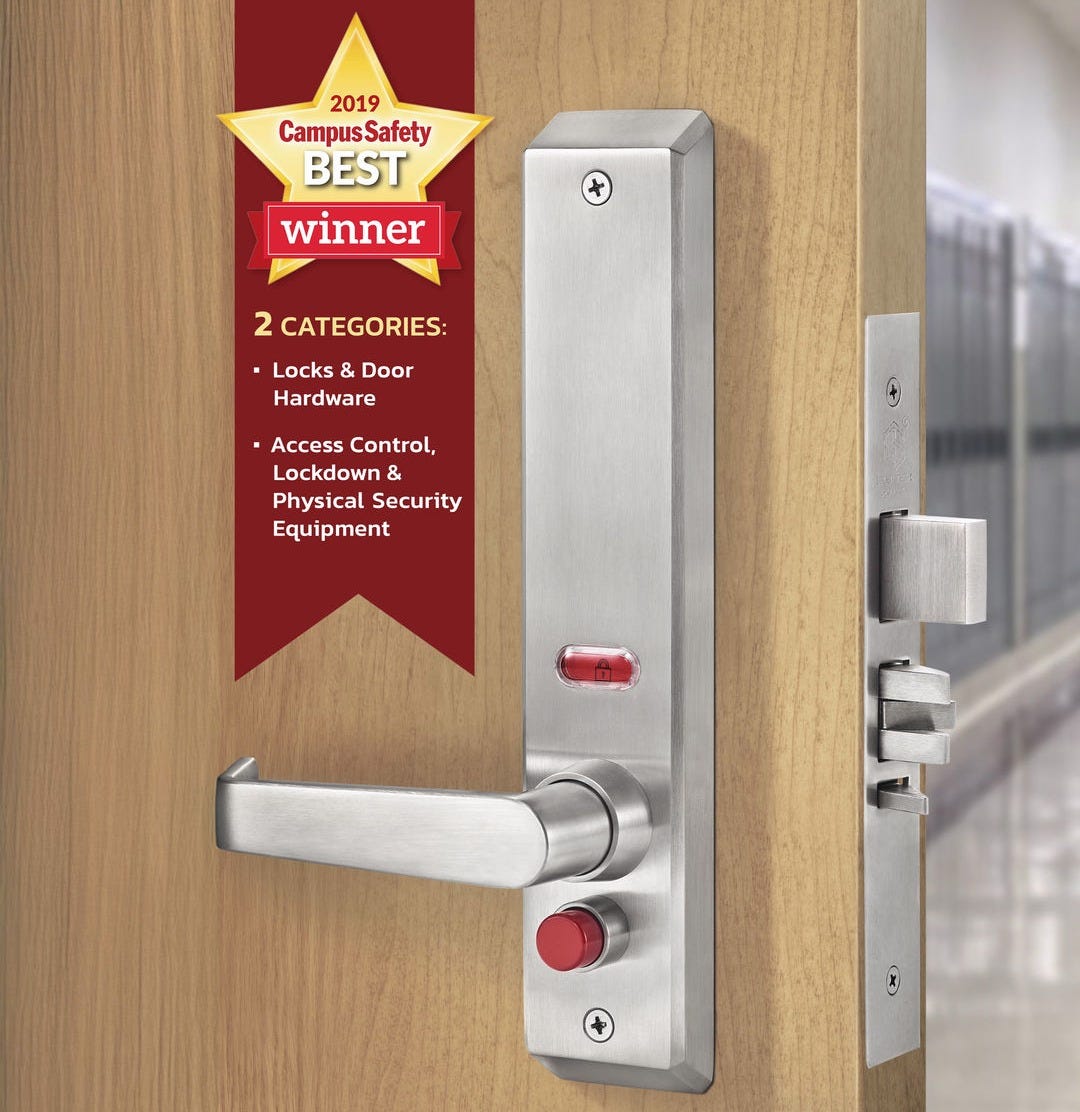
Commercial-grade remotely controlled door locks are about $600 each plus the cost of installation, software, and maintenance. This means getting 130,000 schools to put on electronic lock on every door is a big business opportunity, so it makes sense for security hardware vendors to pay to be on the ASIS committee and fund a report from Texas State. Just installing electronic door locks at every school in the country is a $4 billion dollar market.
What’s lacking is evidence that locks make a difference during a school shooting.
This week in the Philippines, a 14-year-old student livestreamed an attack at his school. In the video you can see him approaching an open classroom door during morning classes. He walks inside and starts firing a rifle and handgun. One student was killed and multiple were injured before he ended his life inside the school.
In the United States two years ago, a 14-year-old student also opened fire with a rifle during morning classes at Apalachee High. Instead of walking right into a classroom, the doors were locked. The door lock didn’t stop him from killed four students and wounding nine others before putting down his gun to surrender. He didn’t want to die during the attack because he wanted to see how becoming a school shooter elevated his status in TCC.
A couple months after Apalachee, a 15-year-old girl who was also involved with TCC opened fire inside her classroom at Abundant Life Christian School in Madison, Wisconsin. It didn’t matter if her classroom had locked doors because she was already inside the room when she pulled two handguns out of her backpack. Two students were killed and six wounded before she took her life inside the same room. If a police officer was in the hallway when the shooting started, there would be a locked door between the officer and the school shooter.
During the two high fatality school shootings of the past decade, lockdowns and locked doors made the situation worse. In Parkland, students were trapped in the hallways with the gunman because they couldn’t get back into their classrooms after the doors locked behind them.
In Uvalde, students and staff who were following lockdown procedures instead of evacuating from the campus were hit by bullets that went through the walls and doors. Just the idea that the classroom door was locked cause police officers to wait outside for more than an hour.
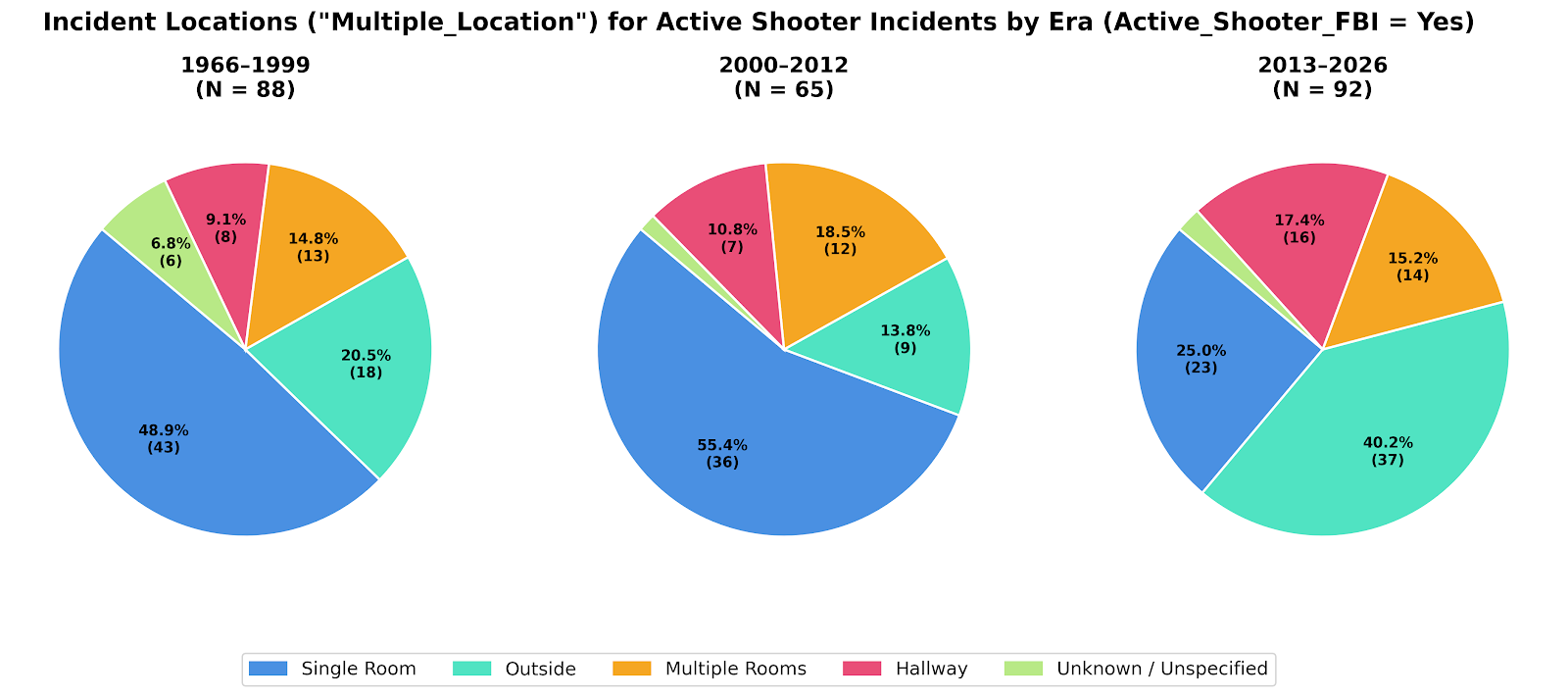
For every deliberate attack at a school since 1966, I’ve coded the data with “single room”, “multiple rooms”, “hallway”, and “outside”. To explore the impact of locked doors and lockdown training, I divided them into three time periods:
1966-1999: Pre-Columbine when few schools had formal procedures for a school shooting
2000-2012: Post-Columbine/Pre-Sandy Hook when some schools implemented security procedures and training but there was not a unified or widespread approach
2013-2026: Post-Sandy Hook when most schools require classroom doors to be locked during the school day and students/staff participate in lockdown training
There are 245 total school shootings across these three charts.
In the K-12 School Shooting Database, incidents are labeled as an “active shooter” when the shooter killed and/or wounded victims, either targeted or random, within the school campus during a continuous episode of violence. This criteria for an “active shooter” blends the FBI’s definition with the homicide literature’s differentiation between a rampage killing versus a traditional homicide. There is no legal definition, or specific criminal charges, for an “active shooter”.
Before 1999 (Columbine), very few schools had locked doors or lockdown plans/training. Without locks, a school shooter could easily walk around the building yet half of the attacks began and ended inside the same room.
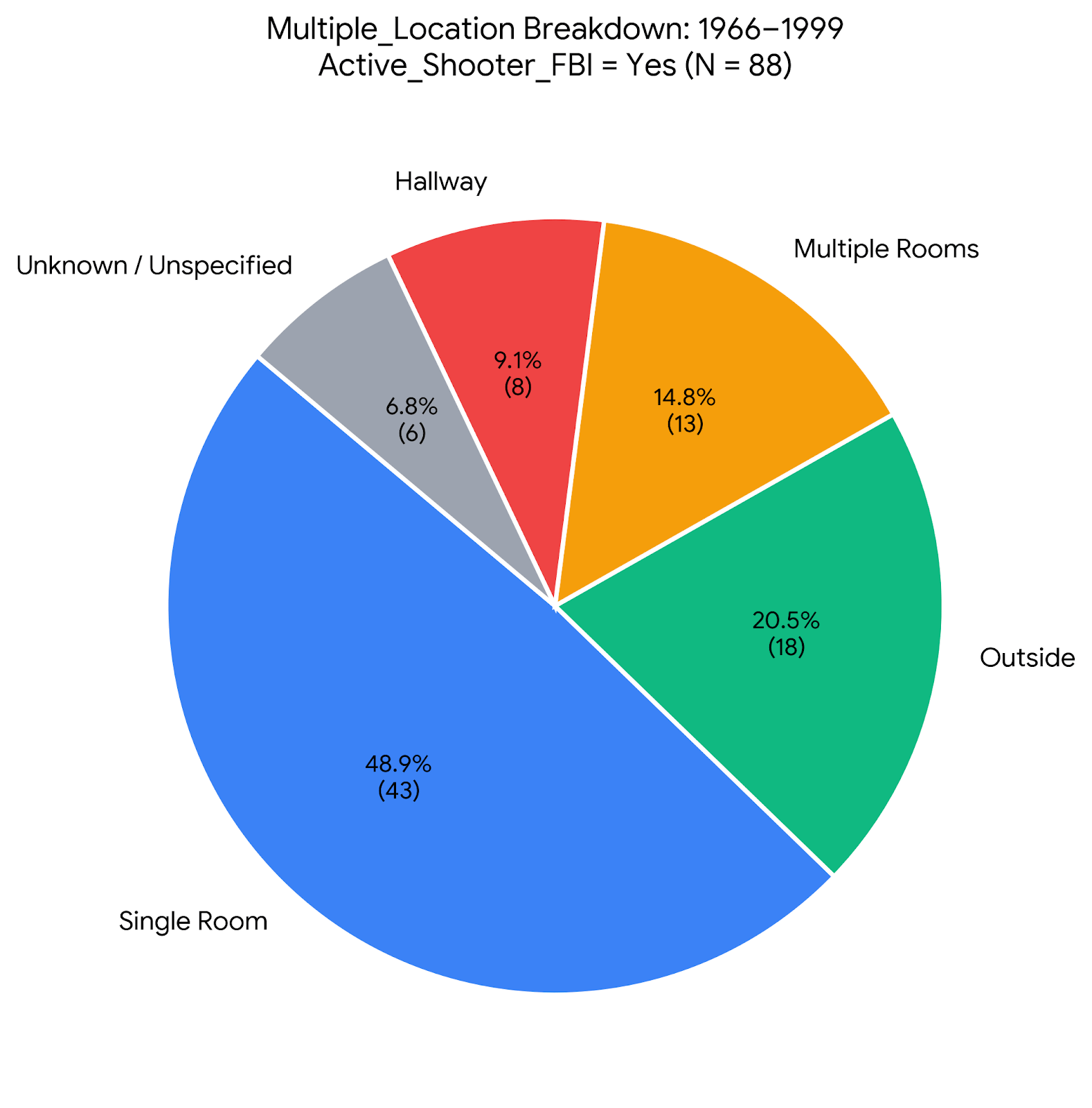
From 2000 to 2011 (post-Columbine to pre-Sandy Hook), some schools had locked doors and lockdown procedures. These changes didn’t impact the location breakdown because half of the school shootings still took place in one room.
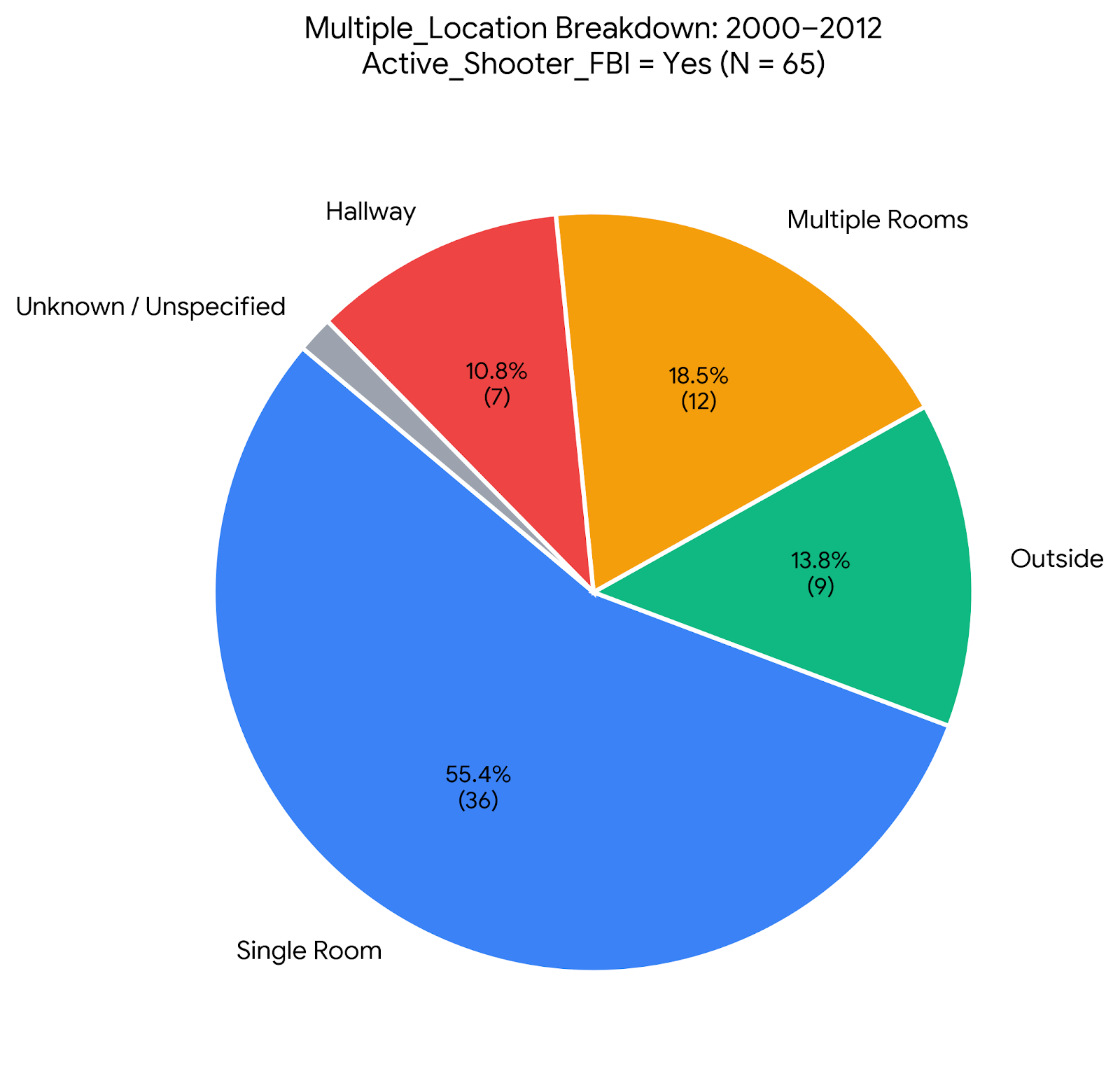
After 2012, most schools have locked classroom doors and lockdowns training for both staff and students. Even with locks and lockdowns, the number of shootings in multiple rooms is basically the same as pre-Columbine.
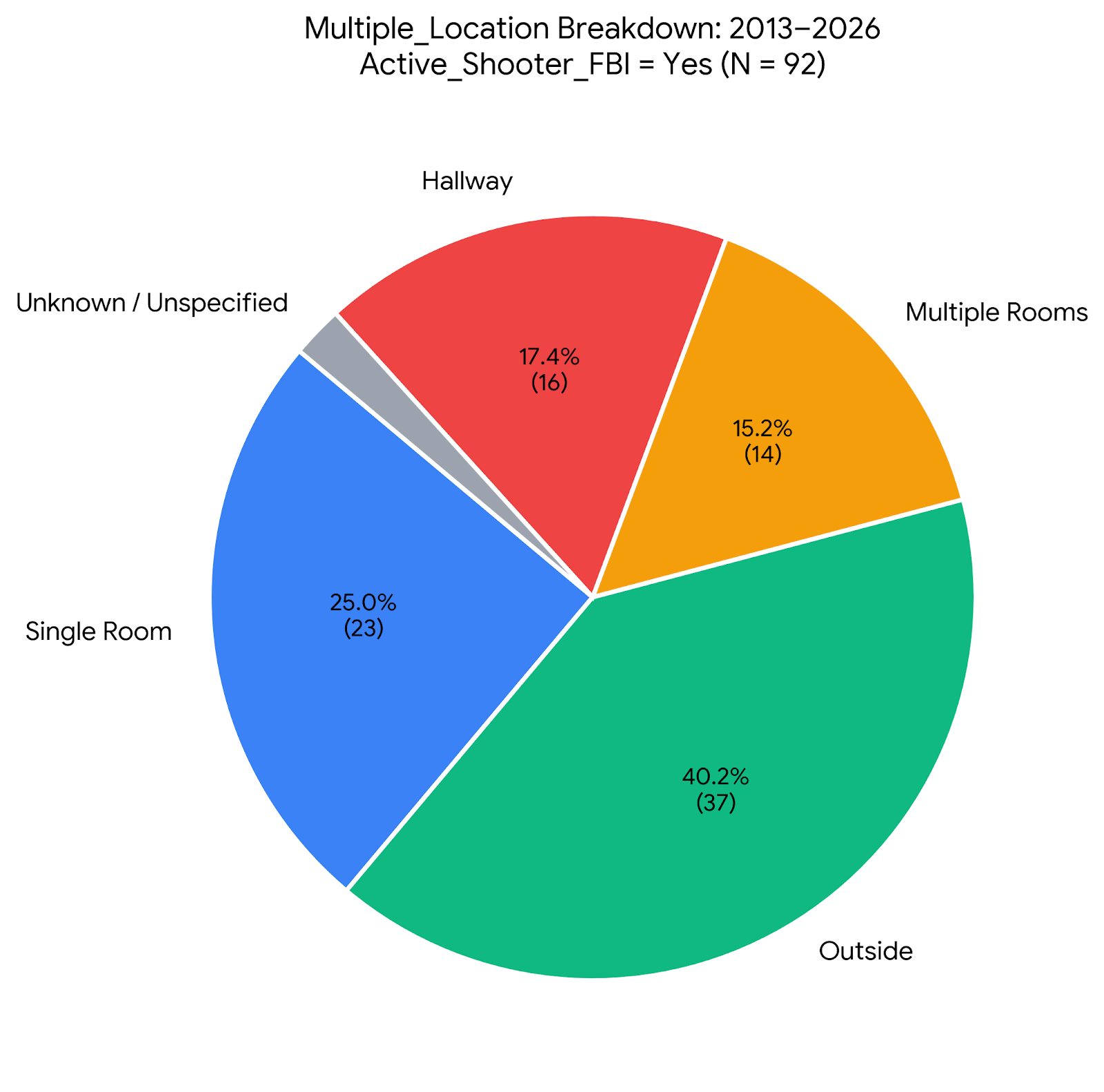
During each of these time periods, roughly the same percentage of planned attacks (15%, 18%, 15%) took place in multiple rooms of the school. If locked doors made a difference, the percentage of multi-room attacks should be lower after widespread training and adoption. Even with locked doors, the percentage of multi-room shootings post-Sandy Hook is the same as pre-Columbine.
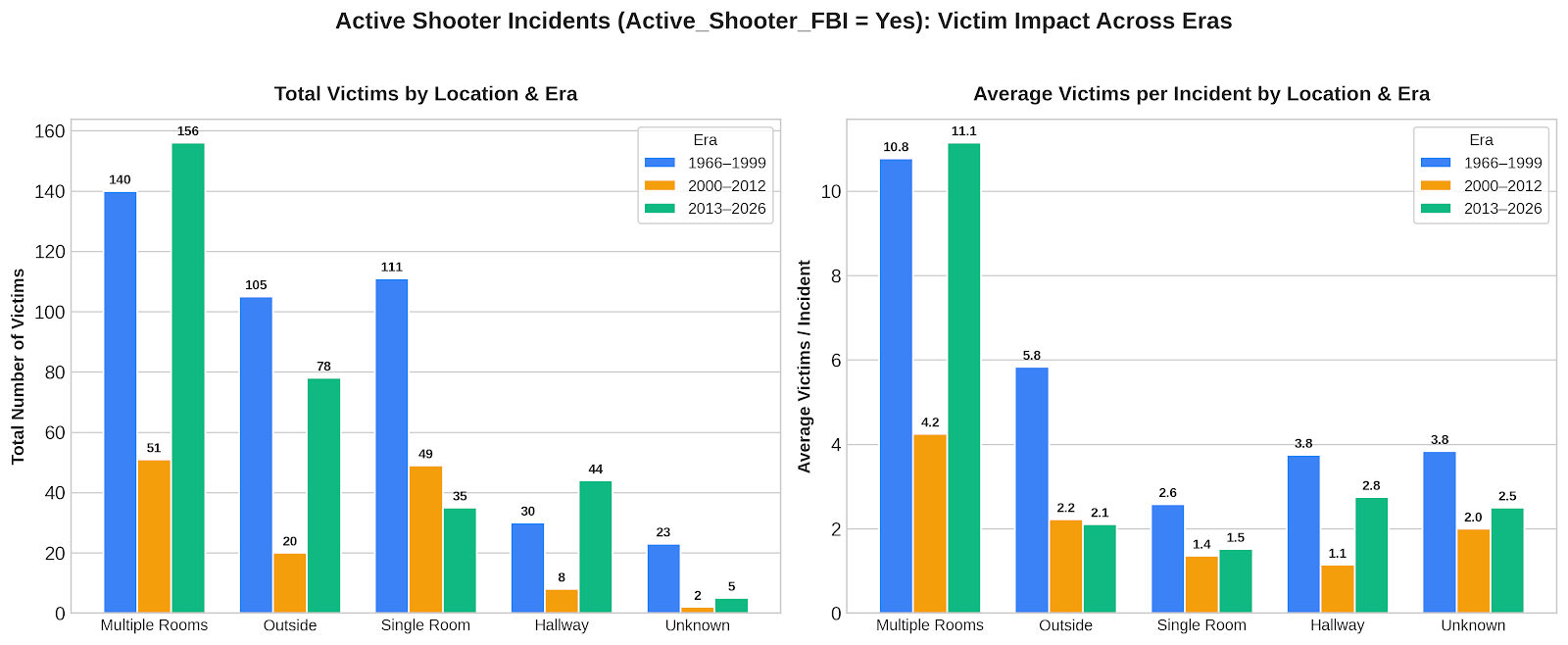
The chart above is the total number of victims shot and the average number of victims in each location type (single room, multiple room, hallway, outside). The locked doors and lockdown training era (green) has the highest total for both.
If locked doors and lockdowns were making a difference, the green bar for multiple rooms shouldn’t be higher than the blue or yellow bars.
There are four billion dollars worth of reasons for security equipment vendors to write reports and create standards that force schools to buy their products. As I wrote earlier this week, it’s our natural tendency to add more equipment and fortification to try to solve a security problem. While subtracting is counterintuitive and psychologically difficult, less can lead to better outcomes.
If a locked door doesn’t make a difference during a school shooting and it is a major friction point in regular school activities, the best option is to leave the doors open.
David Riedman, PhD is the creator of the K-12 School Shooting Database and a tenure-track professor. Listen to my podcast—Riedman Report: Risk, AI, Education & Security—or my interviews on Freakonomics Radio and the New England Journal of Medicine.
No posts
Comments
Nothing yet. Say the first thing.
Sign in to join the conversation.