
At 12:07 in Vasaparken, a cardboard polar bear keeps punching me in the shoulder. I don’t know who owns it. The crowd is too dense. There are union jackets beside church banners, scouts beside grandparents, children getting their faces painted while a brass band loses momentum against loudspeakers. The organizers asked people to leave party flags at home, which may be the most Swedish request ever made before filling a capital city with protesters. By the afternoon, more than 50,000 people have joined the Great Climate Demonstration in Stockholm, backed by 280 organizations.
My phone keeps vibrating against my hip with election headlines. The national vote is on 13 September, close enough that the campaign has started leaking into everything: friends who once traded restaurant tips now argue over petrol prices, my family forwards me shaky poll screenshots, and even the checkout line becomes a place where strangers mutter about taxes and promises between the beeps of the scanner.
And somewhere between Vasaparken and the first wall of bodies trying to move toward the city centre, I realize I have brought something embarrassing with me.
I still trust Sweden.
I mean that in the childish sense. The deep one. Like, deep down, I still assume that sooner or later some capable person is going to walk in, open a folder, clear their throat, fix the obvious problem, and we’ll all be home in time for dinner.
That’s the story I grew up with: Sweden argues for ages, produces a committee report thick enough to knock out an elk, and then (eventually) does the sensible thing.
And yesterday it hit me how much of my politics I’ve handed over to that one comforting idea.

Bolt+@boltplus
🌍 Thousands took to the streets of Stockholm to demand stronger action on the climate crisis, just weeks ahead of Sweden’s general election. 🌱 With climate change a top concern for voters, campaigners are calling for urgent measures to cut emissions and protect the future.
12:00 AM · Aug 24, 2026 · 790 Views
1 Reply · 1 Like
Sweden has spent decades teaching the world how to admire it.
There is even academic language for this: a “moral superpower”, a small state that built influence by presenting itself as unusually progressive, rational and useful to the rest of the world. The welfare state, diplomacy, gender equality and environmental policy all became part of the export. The national costume is competence, preferably in tasteful navy blue.
We earned parts of that reputation.
In 1991, Sweden introduced a carbon tax. It started modestly and rose step by step for thirty-five years. The government itself credits that gradual design with making higher carbon prices politically possible because households and businesses had time to adapt. The rate today is roughly six times the original nominal level.
That is Swedish gradualism at its best. Begin early and move predictably enough that people don’t see it as shock therapy and have time to adapt. Make yesterday’s radical idea boring enough that nobody remembers it was radical.
The pandemic strengthened another version of the same faith in me, even while it cracked around the edges. While much of Europe locked down, Sweden leaned heavily on recommendations, trust and voluntary behaviour. I defended that instinct more than I care to admit. It felt recognizable. Of course Sweden would trust adults to behave like adults. Of course the state would listen to experts. Of course our weirdness would turn out to be a sign of maturity. Sweden’s response became tied to an image of Swedes as exceptionally responsible, rational people who could be trusted to do what other societies needed police and legal restrictions to enforce.
The official reckoning was more complicated. Sweden’s Corona Commission later found that the response had moved too slowly, the first protective measures were insufficient and pandemic preparedness was poor.
I guess I should’ve learned something larger from all that than just “pandemic policy is complicated.” A country can be competent and still fall in love with its own competence.
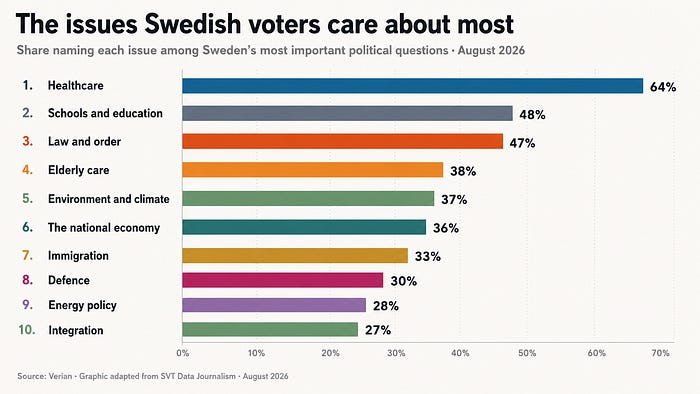
By the time the march reaches the tighter streets, my phone flashes another election summary. Roughly one voter in three, 37 percent, now ranks climate and environment among the country’s most important political questions. My only national hero Greta Thunberg has just told the crowd that no Swedish party is offering policy close to what the science requires.
I look up from the screen and there are thousands of people in front of me carrying signs with two dates on them.
2030
2031
My stomach tightens.
Sweden’s climate targets sound exactly like Swedish policy likes to sound: precise, orderly, decided. Think of Sweden’s transport target as a 70-kilometre hike: domestic transport emissions are supposed to fall 70 percent by 2030 compared with 2010. The country is also supposed to reach net zero by 2045. The dates looked orderly. Back then, 2030 felt comfortably far away.
Then I look at what happened to the calendar.
The hike began in 2010 and has to finish in 2030. We have already used three quarters of the daylight. By the end of 2025, Sweden had walked only 19 kilometres. The country now needs to cover the remaining distance so fast that it must cut nearly three times as much in the next five years as it managed in the previous fifteen.
That’s the moment when “gradual” stops meaning “careful and sensible” and starts meaning “we’re stalling” (or even lying to ourselves). And what’s wild is how clearly the last few years show the system can swing either way — fast.
At the start of 2024, the government cut the reduction obligation, the rule that forces fuel suppliers to reduce the climate impact of petrol and diesel. Imagine taking the diesel requirement and cutting it to about one fifth of its old size: it fell from 30.5 percent to 6 percent. Petrol dropped from 7.8 percent to 6 percent.
That’s a lot of policy jargon. Let me translate it into a fuel tank. Sweden had a rule that forced fuel companies to mix in more low‑carbon fuel, especially in diesel. Then the government loosened it. So we ended up burning more regular fossil diesel, and road-traffic emissions jumped by almost one extra tonne for every four emitted the year before: a 24 percent jump.
Then in July 2025, they tightened the rule again (to 10 percent). And sure enough, transport emissions fell in 2025, mostly because there was more renewable fuel in the mix and because more people were driving electric.
You can see the politics show up in the numbers.
And to be fair, the government has a real argument of its own. Fuel prices really do matter. If you live outside the cities, you can’t exactly commute on a climate model. Small businesses and families can’t pay their bills with good intentions. So the government keeps arguing that cheaper fuel and lower taxes are about protecting people’s finances, and keeping climate policy politically legitimate. This spring, after the Iran war pushed energy prices higher, it cut petrol and diesel taxes for several months.
I get that. I live up north. “Just drive less” is the kind of advice invented by someone who can see a metro entrance from the kitchen window.
But the problem is the climate deadline doesn’t care what feels politically comfortable. Every time we make the target easier to live with right now, we make the catch-up later even more brutal. The Climate Policy Council said it as bluntly as a Swedish institution ever does: this term has been insufficient and the room for postponement has been used up.
Used up.
I keep thinking about that while the crowd squeezes me at an intersection, everyone stalled, shoulder to shoulder like livestock, waiting for the front to move.
Sweden’s great political talent has always been gradual change.
But gradual only works when you still have gradual time.

European Greens@europeangreens
50,000 people marched in Stockolm for stronger climate action. 🌻 @miljopartiet standing strong with one message: no climate deniers in government. 🗳️ Dear Swedish friends, you vote in 2 weeks, make sure you choose those who will stand for people and planet.
9:27 AM · Aug 24, 2026 · 861 Views
6 Reposts · 18 Likes
I think part of my trust came from geography.
I live in Swedish Lapland. The north sits inside the European imagination as a spare room for the future: colder, wetter, emptier, safer. Silicon Valley money has already turned this instinct into a product. LinkedIn co-founder Reid Hoffman once said that buying a New Zealand home had become code for “apocalypse insurance” among wealthy tech circles. The fantasy is simple: buy a house in a cooler, wetter place and tell yourself you have purchased distance from the problem: a climate haven.
Living here makes that fantasy harder to maintain.
Last summer, a heatwave settled across Sweden, Norway and Finland for about two weeks. In parts of the north, temperatures repeatedly climbed above 30°C (86°F). Human warming added about 2°C (3.6°F), roughly the difference between a punishing hot day and the same day with another heater switched on, and made the event at least ten times more likely. The hottest nights, the hours when bodies and buildings are supposed to recover, became around 33 times more likely. Reindeer wandered toward towns and roads looking for relief. Hospitals struggled to cool buildings designed to survive winter.
The climate haven had heating problems.

Peter Dynes@PGDynes
Incredible temperature anomalies in the Arctic Circle — especially around Scandinavia — with temps up to 8°C above normal. Ecosystems in this region aren't accustomed to temperatures above 30 °C At this rate, "Santa" will need sunscreen more than thermals. #ClimateCrisis #Arctic

9:37 AM · Jul 18, 2025 · 38.2K Views
79 Replies · 409 Reposts · 915 Likes
And that lands differently when you are standing in Stockholm surrounded by people carrying signs about children.
I have spent years giving a vague answer when friends ask whether I want children. “Maybe.” It is one of those words adults use when the full answer would ruin lunch. The fuller answer is that I don’t know how to promise a child a future while voting as though the future is an optional budget line.
That thought has always felt melodramatic when spoken aloud. Sweden is rich. Sweden is stable. Sweden has engineering firms and hydroelectric dams and district heating and civil servants who own very serious backpacks.
Sweden always does the right thing.
There it is again.
By the time we reach the end of the march, I finally hear that line differently. The reassurance has become a lullaby. A beautiful one, written from real achievements, sung by people who inherited functioning institutions and began confusing inheritance with guarantee.
Things can still change. Governments can turn around. Parties that talk big about climate can still disappoint once in office, and conservatives can pass useful climate policy. I have no interest in turning atmospheric chemistry into team sports.
But I am done awarding points for the costume.
I used to ask whether a climate policy sounded Swedish: reasonable, gradual, practical, something people will accept. Now I’m asking something harsher:
Will it actually add up in time?
On the train out of Stockholm, I open the notes app on my phone and delete the party name I had half-decided to vote for months ago. Then I write one line beneath the numbers 70 (Sweden’s target for cutting domestic transport emissions from 2010 levels), 19 (the reduction achieved by the end of 2025), and 2030 (the deadline for reaching the target):
70–19–2030
Climate first. Everything else second.
Before the train leaves the station, I open the volunteer page for Fridays For Future climate group back home and type my name.
The phone gives one small vibration in my palm.
I’m in.
Comments
Nothing yet. Say the first thing.
Sign in to join the conversation.