
King Tide Stone stands at the mouth of the cove, where the fishing path meets the water, and it has stood there longer than the village behind it. A pillar of grey marble, twice the height of a man, sunk by people nobody knew but everyone remembers. Its seaward face carries the marks: short horizontal cuts, each with a name and a summer chiseled beside it, one for every time the great warm tide has come. The lowest marks have gone soft with four centuries of weed.
Elena reads them the way blind people read faces. She is down at the stone before light, skirts knotted at the knee, wading to her shins where there used to be sand. The chisel she wears on a thong knocks against her breastbone when she bends. She presses her thumb into the newest mark, her own, cut five summers before her daughter was born, and then she looks down at where the calm sea sits this morning, licking two fingers’ width below it.
Below a flood mark. On a flat day. No wind.
“Chloe,” she says, without turning. “Go down and look at the old mooring rings.”
The girl is already stripping to her under-tunic. She goes off the rock flat-footed, no splash, and is gone long enough that the gulls resettle. When she comes up she doesn’t swim back at once. She hangs there, treading, spitting brine.
“Grandfather’s ring is under,” she calls. “Past my reach under. And there are fish down there I don’t know. Little silver ones, thousands. They don’t belong here.”
They both know what the little fish run ahead of.
By noon the whole village is surrounding King Tide Stone, and having the same argument that comes every couple of years, just louder this time.
Kymon the quarryman stands with his back to the sea as if it were someone he’s refusing to greet, forearms white with stone dust, and points at the mole with his chin.
“Give me twenty men and every ox on the hill,” he says. “I’ll raise the harbor wall an arm before the tide comes. You can’t chisel a wave, Elena. You can pile rock in front of it.”
“Pile it,” Elena says. “I’m not against rock.” She lays her palm flat on the pillar, on the marks. “But when the water comes, we measure it against these. And these are wrong now. The sea we measure from isn’t where it was when they were cut. The stone tells us the flood is small because the stone is drowning.”
Old Dorkas, who keeps the tidal calendar and dislikes it being interrupted, pats the marble like a nervous horse. “The stone has been right since my grandfather’s grandfather.”
“So had his knees,” Elena replies.
What she asks for takes them the rest of that day and all of that night, and it isn’t clever. Oxhide ropes. Rollers of green pine, cut wet so they won’t split. Every ox, exactly as Kymon wanted, but pulling landward. The pillar comes out of its socket like a tooth, groaning, shedding four hundred years of weed, and the whole village walks it up the shore on rollers in the dark, a hand-width at a heave, torches guttering in the salt wind, children carrying the smaller stones for the new footing. Near midnight it slips a roller and takes the tip of Kymon’s finger, and he wraps the hand in his tunic hem and gets back under the rope, because a man who has carried marble his whole life knows better than to let it settle wrong. By first light King Tide Stone stands one terrace higher, socketed in new footing, the seaward face a new blank sheet.
Elena doesn’t copy the old marks across. She wades out, finds the barnacle line the living sea has drawn on the rocks, and cuts the new zero level with that: the line where the water is today, not where anyone’s grandfather said it was.
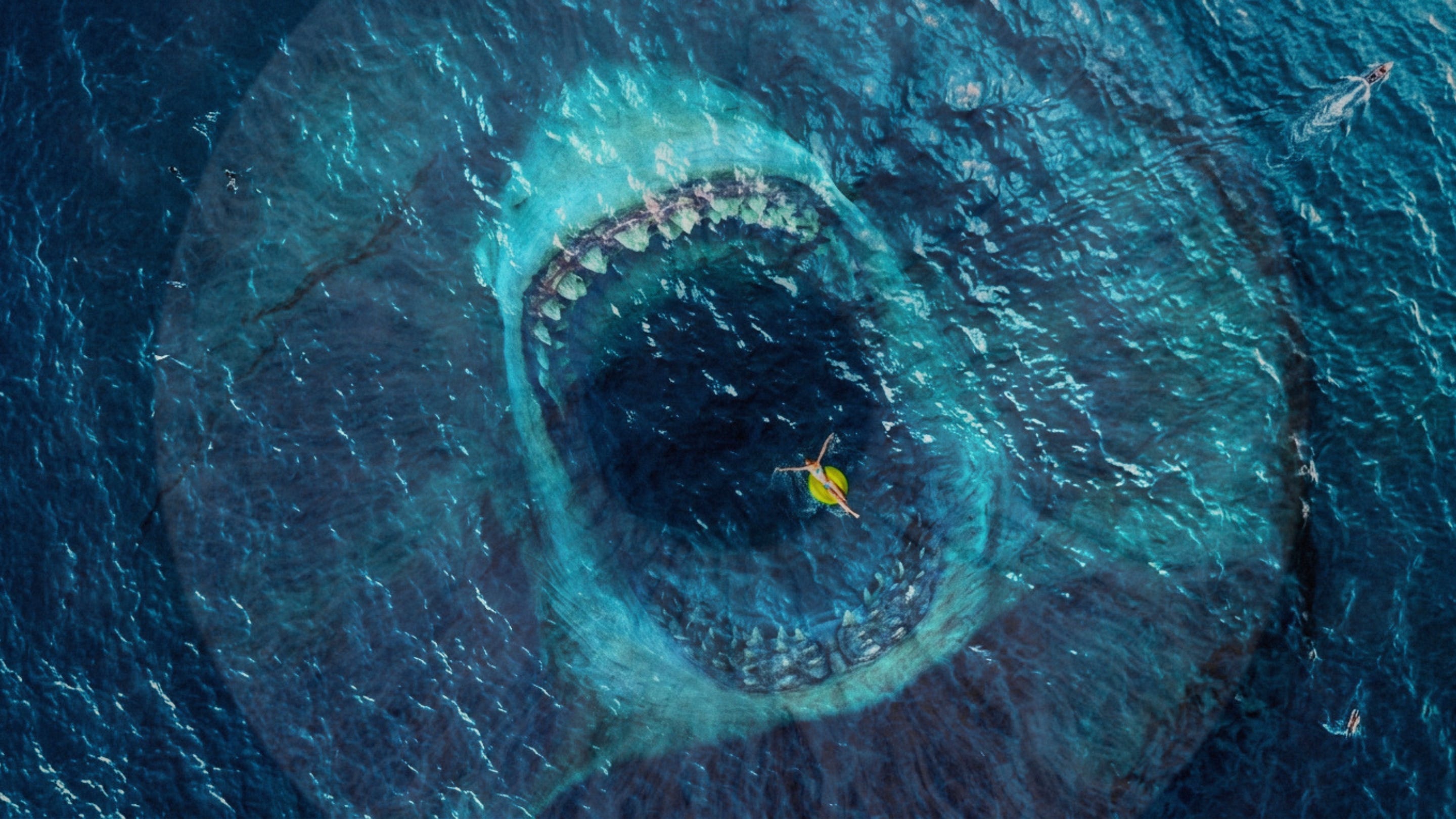
Eleven days later, the big tide finally shows up, warm as bathwater, packed with tiny silver fish, and it just keeps coming in like a monster starving after hibernation. It swallows the old socket, the fishing path, the flat rock Chloe dives from.
Against the drowned pillar’s memory, it would have read as one more mark among many.
Against the new zero, everyone standing on the terrace can see exactly how much more sea there is now.
Sharing is caring (and freeeee!)
This year, the people whose job is measuring El Niño had to fix their King Tide Stone.
The Pacific has warmed so much in the background that the old way of tracking El Niño was starting to “see” El Niño everywhere, almost all the time. So in early 2026, U.S. forecasters switched to an updated version of the index that first subtracts the long-term warming trend, resetting the baseline just to keep seeing the swing at all — the modern meteorological version of what Elena and the villagers did.
And the corrected ruler is now reading something it has never read before.
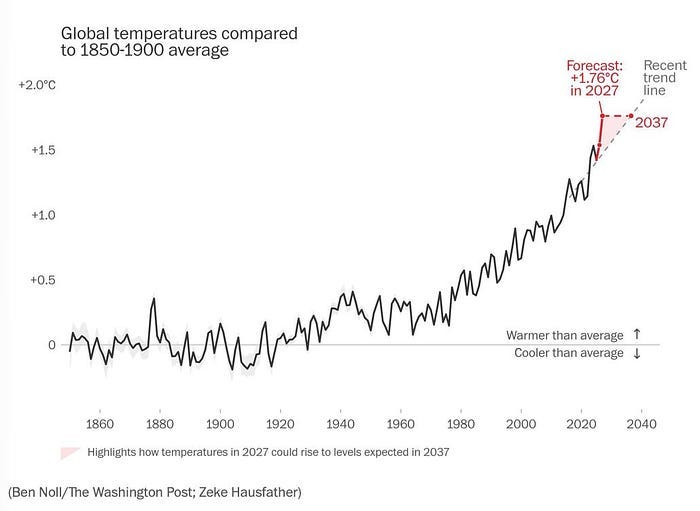
The El Niño that kicked off in June is on track to be a monster. Across fourteen modeling groups, 96% of the simulations have it becoming the strongest in the observational record, past the 2.75°C (5°F) anomaly of 2015–16 that helped make 2016 the hottest year anyone had ever lived through at the time. And the math is brutal: for roughly every 1°C the tropical Pacific runs hotter than normal, the planet ends up about 0.1°C hotter a few months later. If you push that forward, you get a 2027 that looks (temperature-wise) like something we weren’t supposed to hit until the late 2030s.
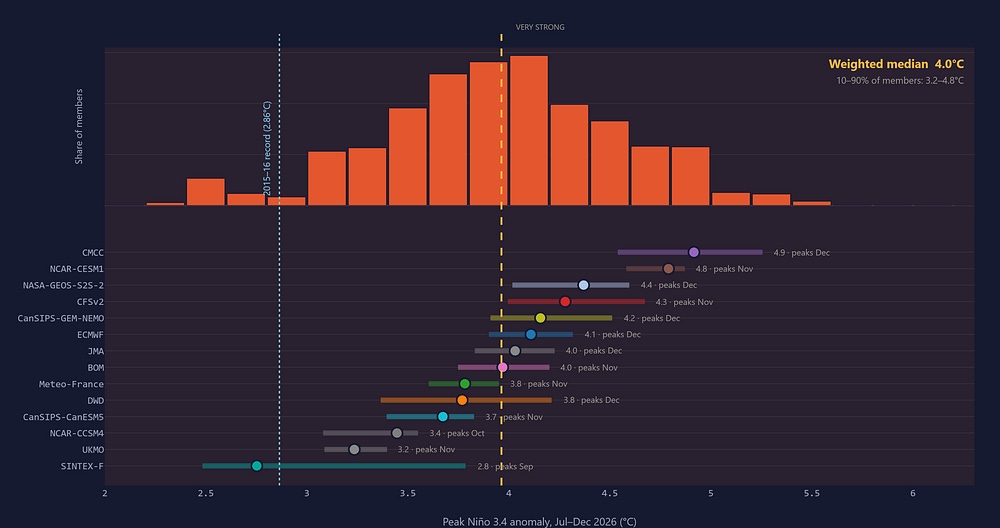
A decade’s worth of heat delivered into the present. That’s the headline you’ll be reading. It’s also the least useful way to understand what’s coming.
Just to be clear: El Niño doesn’t create extra heat out of nowhere; it relocates heat the ocean already had. Most years, the trade winds shove a big pile of warm surface water toward Asia. During El Niño, that push relaxes and some of that warm water sloshes back east, spreads out, shuts down the cold upwelling off South America, and hands the ocean’s stored warmth to the sky. Peruvian fishermen noticed the warm current arriving around Christmas four centuries ago and named it after “El Niño Jesus.” And it comes and goes, like a tide.
But the baseline has changed.
Greenhouse warming works like the sea level underneath that tide: heat that accumulates year after year and doesn’t drain away when El Niño ends. The last time a monster El Niño hit, in 1998, it produced the hottest year in history. That record then got eaten by an ordinary 2005, which fell to 2010, then 2015, 2016, 2023, and 2024, when we crossed the ominous 1.5°C limit above the preindustrial world. Today, 1998 would feel relatively cool; even 2025, a La Niña year, ended up half a degree above it. Same tide, higher floor, and now the biggest tide ever measured is rolling in across the highest floor our species has ever stood on.
One more thing people will miss: if 2027 ends up as hot as (say) 2037, it still won’t look like 2037.
El Niño heat has a different pattern than long-term greenhouse warming. El Niño concentrates a lot of the warmth in the tropical Pacific and can even cool a few places; long-term warming raises temperatures almost everywhere. That changes the weather you get at the same global temperature. For example, El Niño years tend to tear up Atlantic hurricanes with strong high-level winds, so 2027’s Atlantic could be quieter than a same-temperature, non–El Niño year in the 2030s. Rainfall shifts too: the two kinds of warming soak and dry different regions.
So if you try to “study 2037” by watching 2027, you’ll be reading the right thermometer…and the wrong map. A preview of the future’s average, wearing entirely different weather.
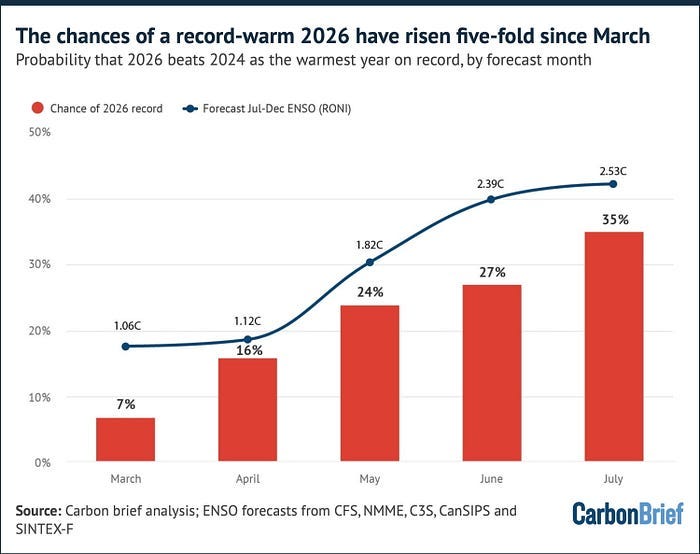
The stacking (the tide plus the higher floor) is the real story, and here are the five places I’d bet on watching it land.
The first casualty of every El Niño is the fish it was named beside, off the coast of this continent, where this whole thing was first noticed.
Peru’s anchoveta is the largest fishery on Earth by volume, and almost none of it makes it to a plate: it becomes fishmeal, the protein powder that feeds the world’s farmed salmon, chickens and pigs. When the warm water smothers the upwelling, the anchovy vanish, the government pauses the season, and the price shock ripples outward into feed costs, then meat prices, across multiple continents. Above the ocean, the same event tends to mess with India’s monsoon, and a strongly meandering jet stream can raise the odds of heatwaves striking several breadbaskets in the same summer by a factor of up to twenty.

Jeff Berardelli@WeatherProf
‼️ Category 5 Ocean Heatwaves in the Tropical Pacific and #Mediterranean. The culprits: Super #ElNiño and severe #European heatwaves, boosted by excess heat trapped in our overheated climate system. A NOAA Alert Level 5 indicates a marine #heatwave severe enough to cause
4:01 PM · Aug 19, 2026 · 23.5K Views
33 Replies · 233 Reposts · 534 Likes
The pattern is pretty boring in how reliably it shows up: 8–10 months after the Pacific peaks, groceries get more expensive, the business pages blame a bunch of local factors… and almost nobody connects it back to an ocean current from the previous year.
A warmer atmosphere is a bigger sponge: it holds and demands about 7% more water for every degree Celsius (1.8°F), so it wrings landscapes drier and dumps rivers harder, often on the same map within months. A super El Niño is the sponge’s favorite party.
Expect the sequence Californians already know by heart, exported worldwide: drought that cures the fuel, deluge that grows it, fire that eats both. And in the ocean, the graveyard stops being seasonal. The 2016 event killed about three in ten corals on the Great Barrier Reef in one summer. This event is forecast to peak higher, on water that starts warmer, against reefs that never fully rebuilt. Some events take whole ecosystems with them.

Cristian Crespo F. 🇨🇺@cristiancrespoj
#arequipa | TRAILERS VARADOS POR HUAYCO EN ÁTICO. El “Super Niño” causando estragos en Perú y norte de Chile. Los primeros efectos del fenómeno del niño se vienen registrando en el país. Lluvias en Lima, huaycos en el sur, heladas en las zonas altoandinas, exceso de calor en el
1:20 AM · Aug 19, 2026 · 13.4K Views
5 Replies · 65 Reposts · 98 Likes
There’s a pretty consistent pattern in the research: in tropical countries, the probability of new civil conflict doubles in El Niño years, and the oscillation may have played a role in one of every five civil wars since 1950.
In 1982, a brutal El Niño wrecked crops in highland Peru the same year the Shining Path insurgency caught fire. Heat and hunger don’t write anyone’s politics, but they are like gasoline on whatever tension was already there.
So if 2027 is as intense as the models suggest, pay attention to the political weather too, especially in places that contributed the least to the warming: emergency powers that stick around, migration treated like an invasion, and leaders who realize a disaster is the one press conference nobody interrupts.

PNASNews@PNASNews
Climate variability can alter the risk of armed conflict. A study maps how two major climate modes—the El Niño–Southern Oscillation and the Indian Ocean Dipole—influence conflict emergence. In PNAS: ow.ly/qN0i50Z7g3q

7:00 PM · Jun 3, 2026 · 3.05K Views
10 Reposts · 23 Likes
Money is already circling the thermostat. A startup raised the largest funding round in solar geoengineering’s history to develop a proprietary sunlight-blocking particle it hopes governments will one day spray at scale. The UK has put £57 million of public money into outdoor “cooling” experiments. And there’s even a two-person outfit in an RV selling “cooling credits” by launching sulfur balloons and popping them up in the stratosphere.
Let’s run the tape forward. 2027 smashes every record, the panic peaks, investors pile in, and everyone with a pitch deck starts talking about “emergency options.” And then, because this is El Niño, things swing back the other way. La Niña arrives, and global temperatures dip for a while all on their own, the way they always do (well, most of the time).
Even the serious players say they’ll deploy only when governments ask. A record-scorching year is exactly the kind of thing that makes governments ask. So whoever sprays anything in between inherits a ready-made miracle. In a world where plenty of people already blame normal disasters on sky-dimming conspiracies, this ups-and-downs graph is about to become propaganda gold.
Keep this line handy for 2028: nobody who acted during the spike gets credit for the dip.
One thing is different about this super El Niño, and it points in a more hopeful direction.
Back in 1998, the attribution science for linking a specific disaster to climate change barely existed. Even in 2016, it often took months to say anything with confidence. Now, rapid attribution teams publish the human fingerprint on a heatwave while the pavement is still hot. 2027 will be the first record-smashing year narrated in real time, disaster by disaster, to billions of people living inside the evidence.
And we already know society’s most sensitive pressure points right where public opinion, money, and policy collide and where committed minorities far smaller than half have flipped social norms before.
A year that hot, if we read it correctly, is the strongest argument physics has ever filed on our behalf, delivered straight to our nervous systems. The same spike that feeds the panic will mint the first generation that felt the argument on its own skin and heard, right away, exactly what it was.
This super El Niño will decide our future as a civilization, no matter where you live.
The ruler-menders had the right idea: if you want to see El Niño clearly, you have to subtract the background warming first. Your job next year is to do the same, in reverse.
So when the records start falling and the headlines blame “the biggest El Niño ever” or “a freak of the Pacific,” okay, fine. But then do the subtraction. Take away the swing that has come and gone since Peruvian fishermen named it for Christmas, and look at what’s left underneath: the floor, the part that was bought and burned into place, the part that will still be there in 2028 when the warm water retreats and the “cooling” year still lands hotter than every El Niño of the twentieth century.
That’s how you read the hottest year in history before it happens. The tide will get the headlines. The floor is the story. And the floor is the only part that still listens to us.
Comments
Nothing yet. Say the first thing.
Sign in to join the conversation.