
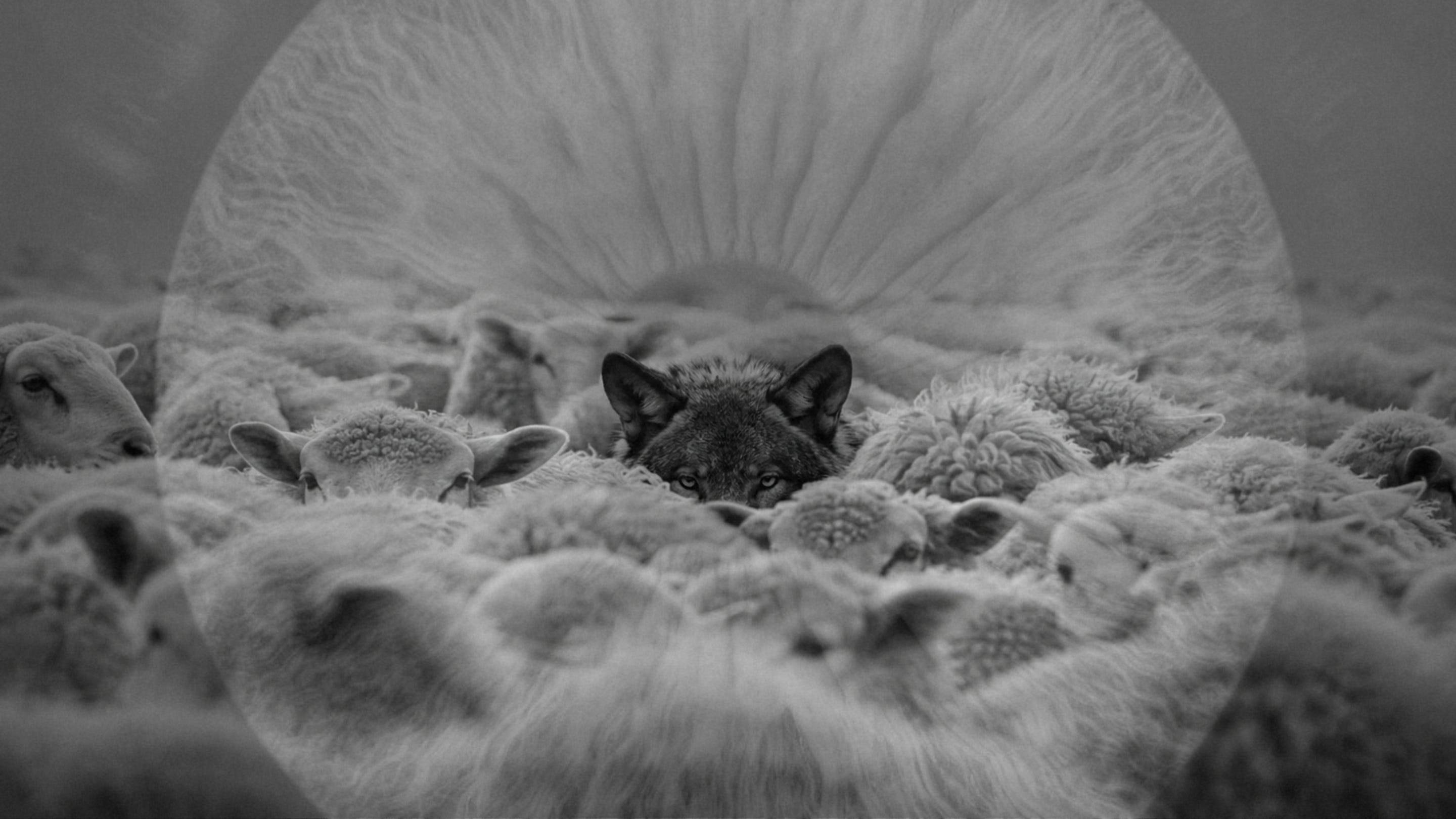
Miiyah Paavola grabbed a wet towel. That was the whole disaster plan.
A towel, an aluminum boat, five other people, three dogs, and a cat, pushing off into Collins Lake while a wall of fire came down on the Namaygoosisagagun First Nation, a community in northern Ontario with no road out. Just a rail line, the water, and whatever floats. From the second island, she looked back and watched the flames reach the shoreline where her life had been.
“If we had waited any longer, we would have been dead.”
Her home is gone. So are the tribal records, the regalia, the artifacts, the things one generation hides and protects and hands to the next, the physical memory of people who did approximately nothing to heat this planet, burned off the map in an afternoon.
The smoke from that fire, and from the thousand others like it, rode the wind south. In days, Duluth, Minnesota, a city that markets itself as a climate haven, posted an air quality index of 934. The scale files anything above 300 under “hazardous,” and Duluth’s previous all-time record was 159. So it didn’t break the record; it sextupled it. Detroit spent a morning as the most polluted major city on Earth, ahead of every megacity in Asia.
Into this scene walked the leadership of the free world.
A Michigan congressman posted a “FINAL WARNING TO CANADA” in the caps-lock of a man warning the sky about rain. An Ohio senator announced sanctions on Canadian officials for what he called an “atrocity.” And then the President himself didn’t want to be left out of the flammable accountability party and posted that the United States was being “unnecessarily invaded by filthy, polluted, and unhealthy air,” promised to add the incalculable cost to Canada’s tariffs, and even added that “maybe they should pay us some damages.”

The White House@WhiteHouse
"We are holding Canada responsible... the United States is being unnecessarily invaded by filthy, polluted, and unhealthy air, the quality of which is dangerous, and totally unacceptable!" - President Donald J. Trump 🇺🇸

7:51 PM · Jul 17, 2026 · 931K Views
4.99K Replies · 3.71K Reposts · 17.9K Likes
Damages. Accountability. Payment.
And here I part ways with every columnist currently dunking on the man, because I think he’s onto something huge. Smoke and dirty air crossed a border, harmed US citizens who never even saw the fire, and in any sane system someone up the chain should have to pay for that.
That isn’t just a rhetorical slip. It’s a real principle in environmental law — polluter pays — and lawyers have been trying for decades to hear the president of the most polluting country in history say something like it in plain English.
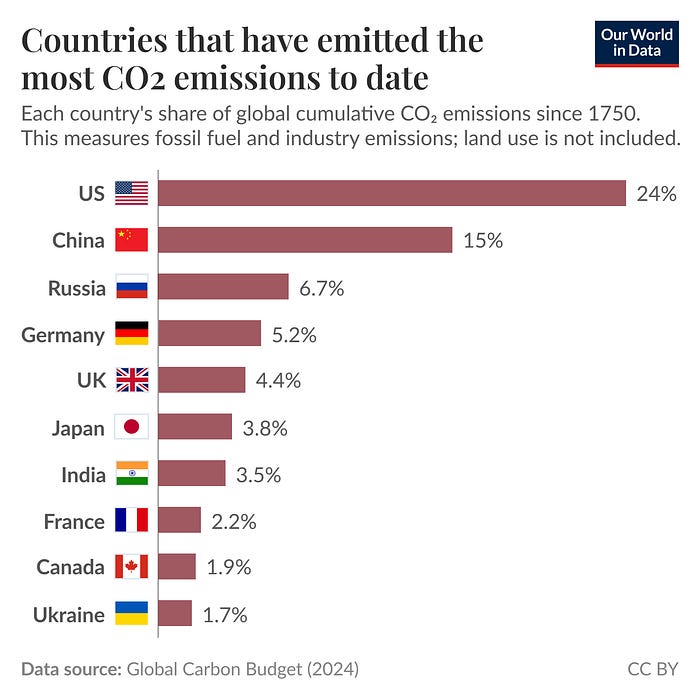
Source: OurWorldInData
He finally did. So let’s honor the moment. Let’s take his damages claim seriously, with the full seriousness a court would, doing three simple things:
show the harm,
prove what caused it, and
name who’s actually responsible.
Only then will we know who has to pay who.
When scientists tallied the health toll of the smoke from Canada’s 2023 fires, the same kind now being tariffed, they found it contributed to an estimated 33,000 premature US deaths.

Mike Hudema@MikeHudema
Wildfires in Canada this year burned over 15.3 million hectares (37.8 million acres) of land, nearly 10 times more than 2022 and roughly the size of New York state: buff.ly/3ZnPNAT 1,036 fires are still burning. This isn't normal. #ActOnClimate
4:27 PM · Sep 21, 2023 · 17.1K Views
59 Replies · 270 Reposts · 400 Likes
The acute deaths alone, the heart attacks and choked lungs on the worst smoke days, outnumbered the people killed on September 11th. This July’s sequel has already forced a First Nation onto boats, put ash-fall on Michigan, and pushed a dozen US cities past pollution records that had stood for decades.
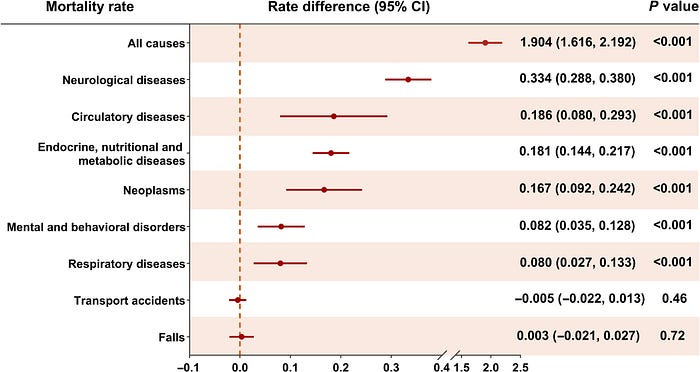
Absolute increase in mortality rate 100,000 persons per 0.1 μg/m3 increase in annual wildfire smoke PM2.5. (Source: Wildfire smoke PM2.5 and mortality rate in the contiguous United States)
So the President’s premise stands. The air is a weapon. The injury is enormous. Whoever caused this owes more money than any tariff schedule can hold.
Now, the loud opening argument meets the evidence.
The administration’s explanation is basically about housekeeping: Canada didn’t “tidy up.” The President says the country should have kept its forests cleaner, like an apartment where you forgot to sweep. It’s the same line he used during California’s 2020 fires: “you gotta clean your floors.” In this story, a megafire isn’t a complex disaster; it’s the result of skipped chores.
Sorry, Mr. President, but there’s the problem with the “Canada should’ve cleaned up its forests” theory: it doesn’t match how most of these fires actually start or where they burn.
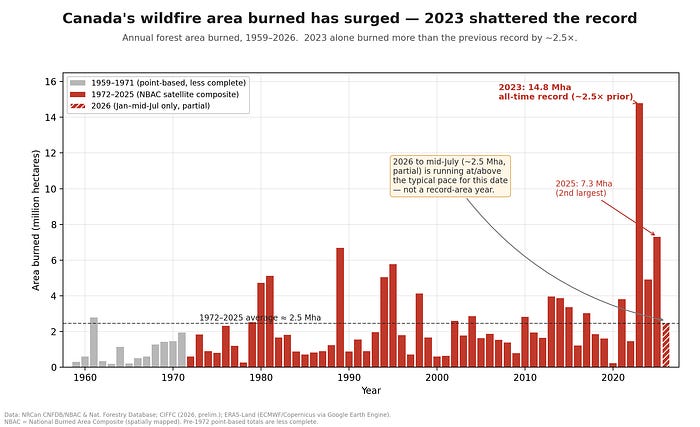
Annual forest area burned in Canada, 1959–2026. Grey bars show the point-based record (1959–1971); red bars the NBAC satellite composite (1972–2025); the hatched bar is 2026 through mid-July (Source: CIFFC)
Since 1990, about 71 percent of the land that’s burned in Canada was set off by lightning. In the record-smashing 2023 season, it was closer to 93 percent. Many of those fires begin hundreds of kilometers from the nearest road, places where the “infrastructure” is basically lakes and wilderness. And even if you wanted to manage the fuel like a neat-and-tidy yard, most of the area that burns isn’t the kind of forest anyone has ever actively managed. Over the last four decades, only about one-fifth of Canada’s burned area was in forests that were ever logged, thinned, or regularly fire-suppressed.
So blaming Canada for not “doing chores” is like blaming someone for not sweeping a house that no one has ever lived in.
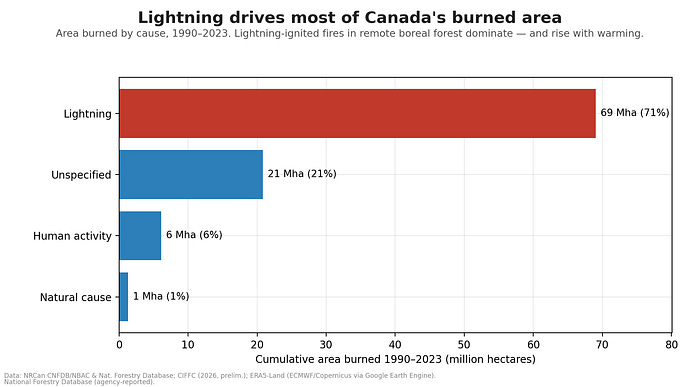
Cumulative area burned by ignition cause, 1990–2023 (Source: Climate Brink)
And the boreal isn’t California wearing a toque. The dry pine forests of the US West really did accumulate a dangerous fuel debt through a century of over-suppression, and thinning measurably helps there; if the President wanted to lecture the Sierra Nevada, he’d have half a case. But the boreal runs on a different physics. It burns rarely and totally, in crown fires that kill whole stands on a natural cycle of a century or more, and black spruce is practically engineered to burn to the ground and rise from its own ash. Three percent of the fires do 97 percent of the burning. This is a forest that waits decades and then detonates), and the detonation zone is on the order of three million square kilometers, roughly the size of India. Nobody rakes India.
The fire scientists who mapped Canada’s fuel situation said it plainly: treatments can’t scale to the boreal and wouldn’t stop a crown fire anyway.
So if it wasn’t Canada “forgetting to rake,” what was driving the blowtorch conditions? The record points to one big factor: heat.
Since the late 1950s, Canada’s fire season has gotten about 2.2°C (4°F) warmer. Far from just making things “a bit drier,” hotter air acts like a sponge, drinking moisture out of every needle and log it touches. And the relationship isn’t small: each additional degree of warming during fire season is linked to roughly 80% more area burned. Not 8%. Eighty.
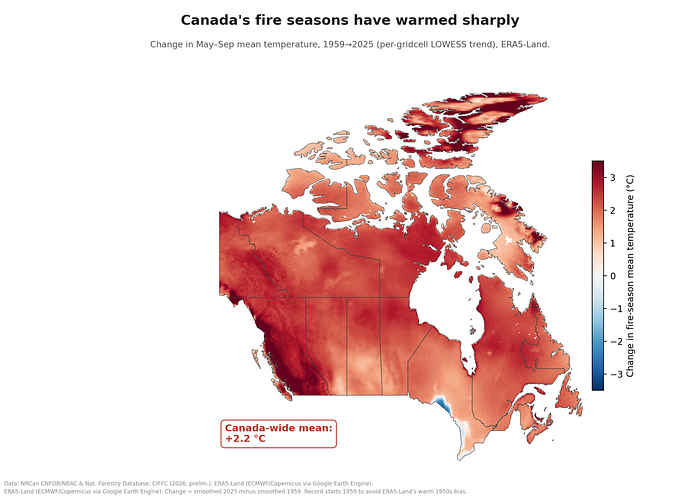
Change in fire-season (May–September) mean temperature, 1959 to 2025, computed as a per-gridcell LOWESS trend. Canada-wide mean change is +2.2C, exceeding +3C in parts of the high Arctic. Data: ERA5-Land (Source: ECMWF/Copernicus)
When attribution scientists studied the apocalyptic 2023 season, they found human-caused warming made the record burn two to five times more likely. And this month’s smoke disaster followed the same script. A historic high-pressure “heat dome” (the strongest ever measured over the north-central US and up to five times more likely in today’s warmed world) sat over an already-dry landscape, cranking temperatures to all-time highs on both sides of the border. Even Thunder Bay, right by Lake Superior, where you’d expect natural cooling, hit 39.5°C (103.1°F).
To be fair (since we’re doing the whole courtroom thing), no scientist is going to testify that climate change lit this exact fire. You can’t point to one blaze and say, “That was the moment the defendant struck the match.” But you can show how the defendant spent decades soaking the continent in accelerant.
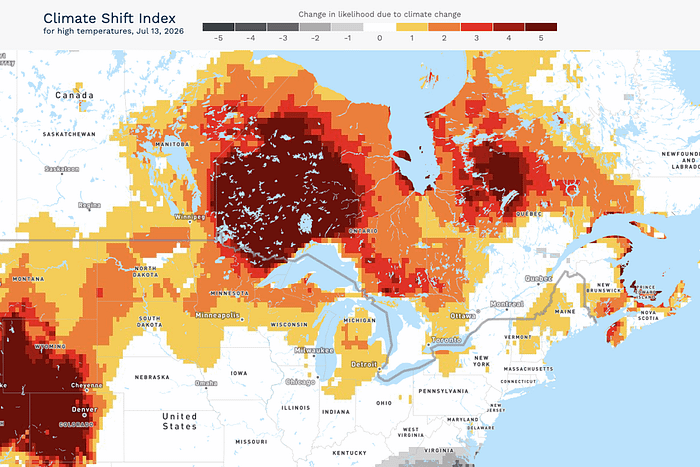
Climate Shift Index for Monday, July 13, 2026, showing the factor increase in high temperatures because of human-caused climate change (Source: Climate Central)
Which brings us to the only question left on the President’s “damages, accountability, and payment” form: who, exactly, gets named on the summons?
Smoke, it turns out, crossed the border in a bad month. Carbon dioxide crosses every border on Earth every single day, and it never shows up on an invoice, and if you could dye it the way we dye smoke orange, the largest single plume in the history of the sky rises from the United States, the biggest cumulative carbon emitter any civilization has produced.
The stuff humanity has already dumped up there now outweighs everything our species has ever built and every living thing on the planet, combined. So the heat drying Canada’s forests didn’t sneak in from nowhere. It’s the long-term result of burning oil, gas, and coal, fuel sold and burned in massive amounts, with the US doing more of it than anyone else.
And while Washington was busy drafting its complaint against Canadian air, US wildfires, feeding on a snowpack that mostly failed to show up this winter, were pushing their own smoke north, fouling the skies of British Columbia.

Kyle Brittain@BadWeatherKyle
Large amounts of wildfire smoke are moving from the northwestern US into western Canada this evening! What should we do? Try to stop it at the border? Should we tariff it? Should we sue?
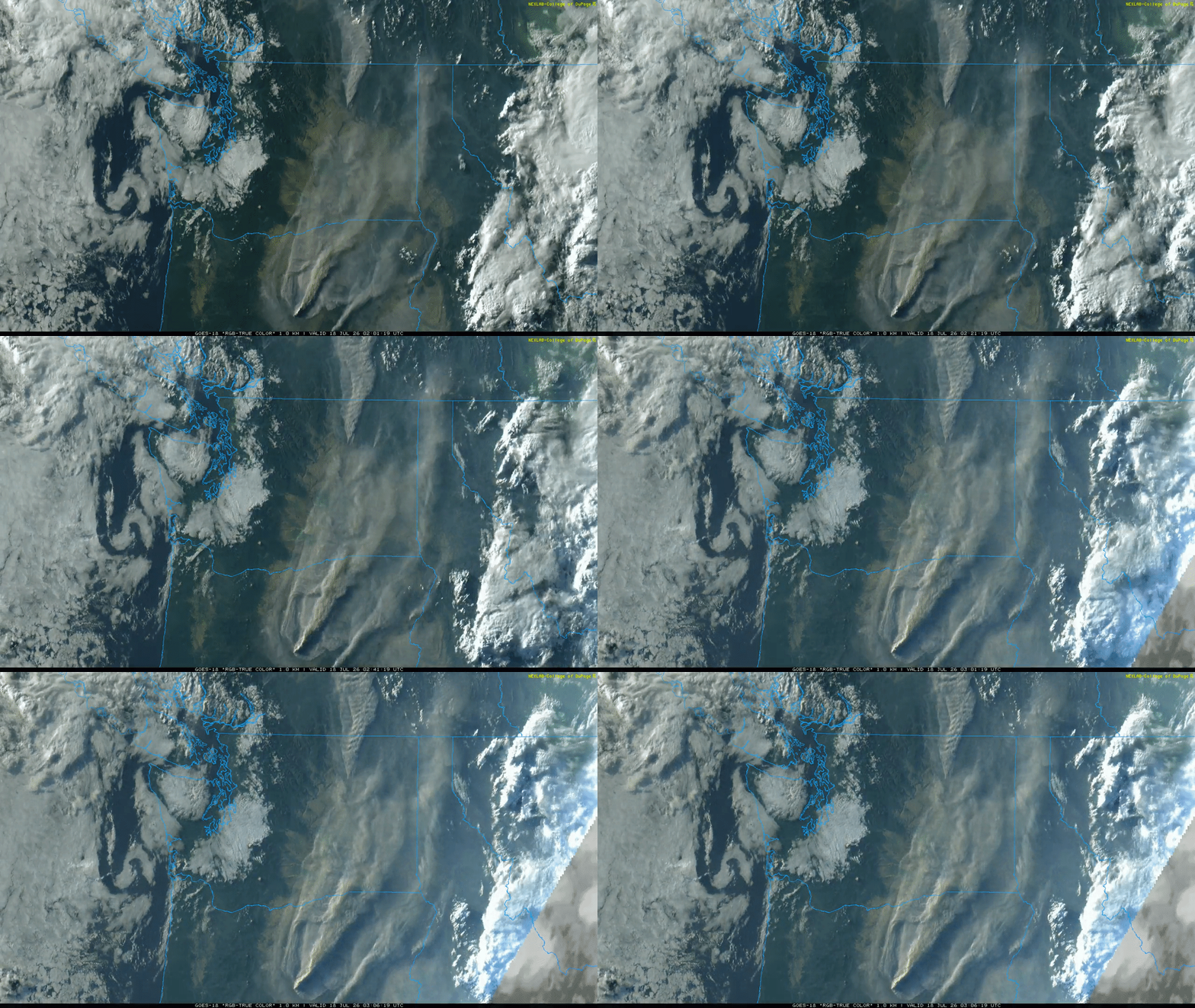
3:14 AM · Jul 18, 2026 · 129K Views
230 Replies · 828 Reposts · 2.66K Likes
The invaded is indeed invading, yet nobody in Ottawa is talking about slapping a tariff on US air. On the contrary, what Canada has historically proposed is help.
When Los Angeles burned in January 2025, Ontario had 150 firefighters ready for deployment and Quebec’s yellow water bombers were scooping the Pacific onto the Palisades, the same annual rescue they’ve flown for thirty years. And last week, while politicians were pricing Canadian smoke, a pilot from British Columbia named Nicholas Dale died fighting a fire on the Colorado-Utah border, defending the forests of the country that wants to bill his.
So the causation chain runs upstream, through the warming, to the carbon, to the largest historical emitter, whose current government is also, for the record, closing most of the research network that studies how fires work, a fifth of its fire-science PhDs already gone.
The President demanded a defendant for the smoke, but the paperwork keeps returning to his own address.
The doctrine the President just endorsed, that whoever fouls the air owes damages to whoever breathes it, is already the most feared idea in US courtrooms. Eleven states, the District of Columbia, and dozens of cities, counties, and tribal governments, together representing more than one in four US citizens, are currently suing the major oil companies on precisely that theory: they knew their product would cook the planet, lied about it for decades, and should pay for the wreckage.
This wreckage.
The Los Angeles wreckage that Quebec’s planes fought. The smoke that shattered Duluth’s records. The fire seasons growing 80 percent hungrier with each degree. And all the downstream crises that carbon pollution brings, starting with floods, droughts, heatwaves, sea level rise, and biodiversity loss, no matter if you still think that climate change is the largest con job ever.
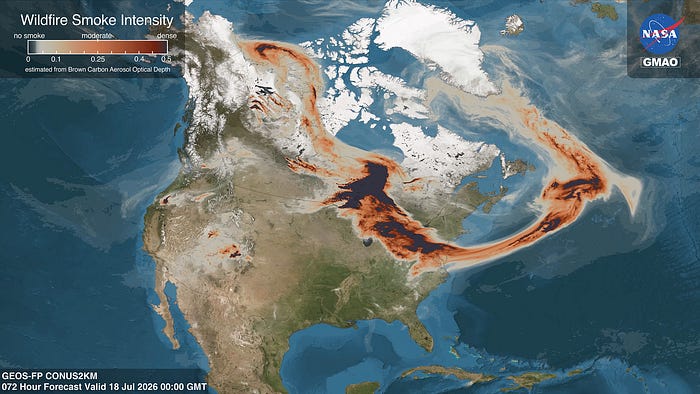
Long-range Transport of 2026 Canadian Wildfire Smoke into the United States (July 14–17, 2026) (Source: NASA)
And what has the President’s congregation been doing about that version of the damages claim, the one where there’s a clear chain of cause and effect, and specific companies can be named? They’ve been trying to shut it down.
In Republican-led statehouses, lawmakers have introduced or moved forward about fifteen bills in eleven states that would make it harder (or impossible) to sue oil and gas companies for climate-related harm. And in Congress, allies rolled out a bill called the Stop Climate Shakedowns Act, which is basically designed to make climate-damage payouts uncollectable — something the oil industry was openly grateful for, praising it in a joint press release like you’d thank someone for doing you a favor.
If Canada is the one getting billed for dirty air, suddenly it’s “accountability.” But when the bill is aimed at ExxonMobil, it’s dismissed as a “shakedown.” Nothing about the harm changes: same smoke, same health risks, same people breathing it in. Even the legal argument is basically identical. The only thing that changes is whose name is on the receipt.
The man didn’t discover the polluter-pays principle last Friday. His movement has known about it for years, feared it enough to legislate against it in eleven states, and now he’s waving it like a flag because, for one glorious news cycle, it seemed to point at somebody else.
And to be clear before the maple syrup gets too sweet: Canada isn’t exactly innocent in this story. While Toronto was sitting under a “dystopian haze,” the prime minister was out celebrating new tar-sands pipelines as “nation building.”
So no, the “liability-free” system for fossil fuels doesn’t only belong in the US. It was just perfected there.

LW World News@LW_WorldNews
🚨 #CANADA 🔴 CANADA BATTLES MASSIVE WILDFIRES Massive wildfires continue to spread across parts of Canada, with northwestern Ontario, including Thunder Bay, among the hardest-hit regions. Evacuations are underway in some areas as crews battle rapidly advancing flames.
11:17 PM · Jul 15, 2026 · 10.7K Views
5 Replies · 20 Reposts · 42 Likes
He’s right that the smoke is an invasion. He’s right that it kills. He’s right that the cost is enormous and that somebody upstream should pay damages. Every element of his claim is correct, and every element points the wrong way down the wind. The injury is Miiyah Paavola’s, and Duluth’s, and Nicholas Dale’s wife and sons, and all the helpless biodiversity caught in between.

But the causation runs through a warming atmosphere, not an unraked forest. And the defendant with the century of emissions, the buried research, and the fleet of lawyers writing immunity bills isn’t the country that keeps sending firefighters.
He said Canada should pay “damages.” And in a strange way, he and a woman in an aluminum boat on Collins Lake are saying the same thing: somebody should be held responsible.
They’re just reading different names off the summons.
Comments
Nothing yet. Say the first thing.
Sign in to join the conversation.