
I was on a first phone call with an originator who funds more than $100 million a year.
At the end of it, I told him:
“After all your expenses, your production would contribute about $80,000 a month to corporate. I get on a plane for $80,000 a month.”
The originator was quiet for a second and then asked:
“Wait. What do you mean?”
So I explained.
Even at thin margins, after the cost of supporting that volume, the production would contribute about $80,000 a month to the company. That’s a million dollars a year.
The originator eventually joined Princeton.
And the reason I am now writing this is that they joined because of the $80,000-a-month plane ride.
Which makes sense.
The originator knew the production and the comp. Asking for pricing and support was the familiar part.
He had just never calculated the seven figures that production created for the company.
Every lender promises better pricing, better comp, technology, service, or a smooth transition.
So by the time I get on the phone with an originator, I’m just another lender promising to be different.
So I don’t promise anything.
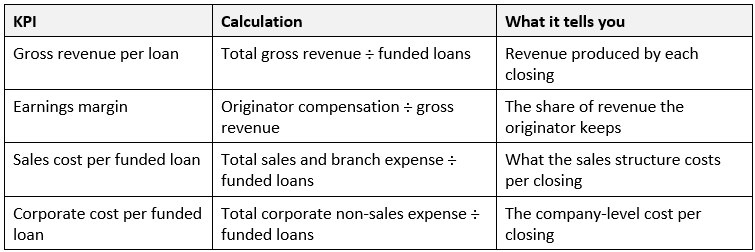
Instead, I talk about four numbers that let each originator reevaluate the economics for themselves.
And they always do because they show whether your current production could support better pricing, better pay, or both, and whether any company recruiting you can actually deliver what it promises.
I have talked about this in this newsletter before.
But Zeb Lowe at HousingWire and I walked through the full model of this in a webcast (you can watch it here), so I thought it worth repeating.
Originators are usually taught to treat pricing and pay as a tradeoff. You can either sharpen the rate or protect the paycheck. But the cost structure around you has more to do with both than you think. Because when you think about it, a more productive structure doesn’t erase the tradeoff. But it does leave more room for the borrower’s rate, your pay, and healthy company margin at once.
I know this because years ago I thought we were crushing it too. But then I sat through a presentation on the 21 KPIs every mortgage banker should track and realized that neither my originators nor I could track any of them, which made the comparison fairly quick. It took me about six months to build the visibility. And once I had it in front of me, I realized that we weren’t really crushing it at all.
Out of the 21 KPIs, I've come to realize that there are really only four that matter most.
Here they are:
BEFORE YOU READ THEM: Think of one funded loan as a small income statement. Gross revenue is the top line. Out of it come your pay, the sales costs around the loan, and the company’s corporate costs. Your earnings margin is your share of the top line.
This is not about volume. It’s about revenue.
The MBA’s 2025 numbers put average revenue at $12,920 per funded loan, on a $373,414 average loan. Eighty-four loans a year is $1,085,280 in gross revenue, more than roughly 96% of U.S. businesses. Only about 4% ever clear a million (Verne Harnish, Scaling Up).
This is your compensation per loan divided by the gross revenue on it. At MBA averages, about $3,777 of $12,920, a 29% margin. Every originator knows their comp plan. Far fewer know this number.
And it matters because a higher margin means the same compensation requires less gross revenue per loan, which leaves more room in the rate. Imagine two originators both paid 100 basis points. The one at a 44% margin can quote 6.00% and earn what the 29% originator only earns at 6.375%.
Five times the revenue rarely takes five times the cost, because much of a platform’s leadership, compliance, and technology is shared across production. High production should create better economics for the borrower, the originator, and the company. A large paycheck, on the other hand, can hide an even larger margin.
Much of the gap between platforms here comes from productivity. The operating system decides how many loans each person can carry, how much time is lost searching for information, and how often the same work gets touched twice. When it is weak, companies hire people to manage the handoffs the system creates. Which means that while the people behind them can be good, the work they do can still be unnecessary.
Take sales, for example:
Sales cost is the sales and branch expense to produce each closing. I’m talking about things like processing, support, sales management, marketing, payroll taxes, staffing. The cost is about $3,800 per funded loan at the MBA average, and closer to $2,000 on a productive platform.
Or look at corporate costs:
Corporate cost is total corporate non-sales expense divided by funded loans. These include compliance, accounting, corporate technology, reporting, and management. The cost is about $5,785 on average, but closer to $2,896 on a productive one.
Together, that is roughly $4,700 a loan between an average cost structure and a productive one.
A more productive system can lower that cost without lowering service, because the savings can come from wasted effort rather than from paying people less or thinning support.
But most originators and managers can’t see both layers because usually all a top producer can see is volume, comp, and the rate sheet, while all a branch manager can see is staffing, payroll, and branch profitability, which means that neither usually sees the full cost per loan, or which layer it sits in. Which means both can end up working on the wrong cost layer. Which also means they are accountable for economics they cannot fully see.
So to sum things up, here are the numbers you should always ask for:
Ask your current company.
Ask the next company recruiting you.
Ask me.
Seriously, hit reply.
I’ll try to answer as many as I can.
Or just watch the full HousingWire webcast, with the rate tables and the complete model.
Rich Weidel
CEO, Princeton Mortgage

Comments
Nothing yet. Say the first thing.
Sign in to join the conversation.