
Just last week I went to a concert in Bristol of a Balochi Benju Master, Usted Noor Bakhsh. He was 80 years old and performed an amazing array of Balochi folk songs on his instrument, called a Benju, a traditional instrument of Iran and Pakistan. It is keyboard-fitted zither and originally introduced to the region by Japanese sailors in the early 20th century and known as a taishogoto (or Noayga harp) and it was transformed into a more complete instrument by enlarging its body and adding metal keys. Usted Noor Bakhsh and others have taken this further by electrifying the instrument, giving it more volume and resonance.
The concert was great, and held in a newish venue in Bristol called The Jamjar. Bristol has evolved over the years into one of the musical hubs of the UK, with literally tons of world music and then the whole world of DJ inspired music. It has always been a Drum and Bass centre, with the likes of Tricky and Ronnie Size and many others. Bristol is also now a centre for those escaping London and hence parts of Bristol now resemble areas like Hackney in London. Prices have followed this exodus, a far cry from the days when I was hanging on the streets of St. Pauls and Montpelier as a young man. The crowd therefore was full of youngish, hipster looking folk but then also some British Sikhs and others of the Indian sub-continent.
If you look at a map, it is surprising to see how big Balochistan is and how strategic it is. Parts of it are not from India, with a relatively small sliver of Pakistan in between. The lovely Rajasthani city of Jaisalmer is not far away and Balochi people also live in large numbers in Eastern Iran and Southern Afghanistan. In fact it is a very strategic place even though it is largely arid and has a relatively low population. It has a large coastline, stretching from near Karachi in the east to the Iranian border and not far at all from the straits of Hormuz and the war between Iran and the U.S. There is a large deep water port there called Gwadar that the Chinese have been investing in for years as part of their belt and road initiative, linking the sea in the area with China.
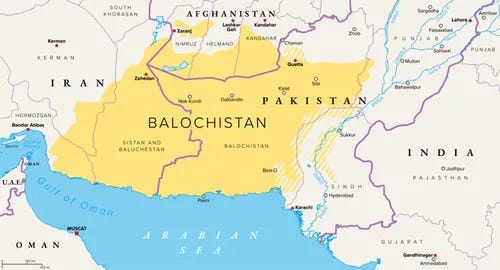
The language they speak, Balochi has more in common with Farsi in Iran than Urdu in Pakistan, though the mixing of words between the two is common. It constitutes about 45% of the land area of Pakistan but only about 5% of it is arable. It was integrated into Pakistan during the partition of India and Pakistan in 1947, although the referendum that took place perhaps had as many irregularities as a Presidential election in the U.S.A. The Gwadar region was in fact a colony of Oman for more than a hundred years, until 1958, when it was bought by Pakistan. Many Omanis remained and in 1970, four separate provinces were restored creating the larger Balochistan province. There has been an active separatist movement over the years, although it seems it is not as widely supported at it would need be, but then accusations have been asserted on Narendra Modi of India that he has been active in stirring things up.
Its relevance now is that being on the border of Iran, it is in the centre of the action of the war and how Pakistan is on one level trying to be a mediator and seem impartial in the war and yet is relying on American largesse to bail out its economy and give support to the newish military regime there, while former Prime Minister, and former professional cricket player, Imran Khan rots in prison. And then Pakistan is also trying to stay good friends with China as it relies a lot economically on China and China has a strategic interest in the region, especially building its belt and road initiative to reach the sea and to build pipelines through the region, linking Iran all the way to India and beyond. Pakistan has been accused of allowing the transfer of Chinese shoulder-fired air defense missiles to Iran through its country, no doubt giving concern to their American friends. But Pakistan has always played both sides, even more than India, but is much more vulnerable economically and politically. Modi, for all his apparent obedience to the U.S. agenda and his close relationship to Israel is a central part of BRICS and is currently Chair this year. That may not mean that much now, but still India has interests in keeping its oil supplies from Russia coming in and it can’t really afford to go full in with the U.S. either, especially now.
Balochistan is a very poor province in Pakistan, with only about 4-5% of Pakistans’s GDP and it also suffered serious damage in the Pakistani floods of 2022. However, it has unexplored natural resources and the investment in the port in Gwadar may bring significant income to the region. However, if the U.S. tries to maintain influence in the region and if it does maintain the fight in Iran, then this region will still be a center of strategic importance.
When I asked some friends where Balochistan was, no one really knew and whether it was a country or a province. Obviously it had to be in or near the “stans” but exactly where? It is fun to look at a map and see where it is and how it nestles there on the southeastern part of Iran and the Arabian Sea.
No posts
Comments
Nothing yet. Say the first thing.
Sign in to join the conversation.