
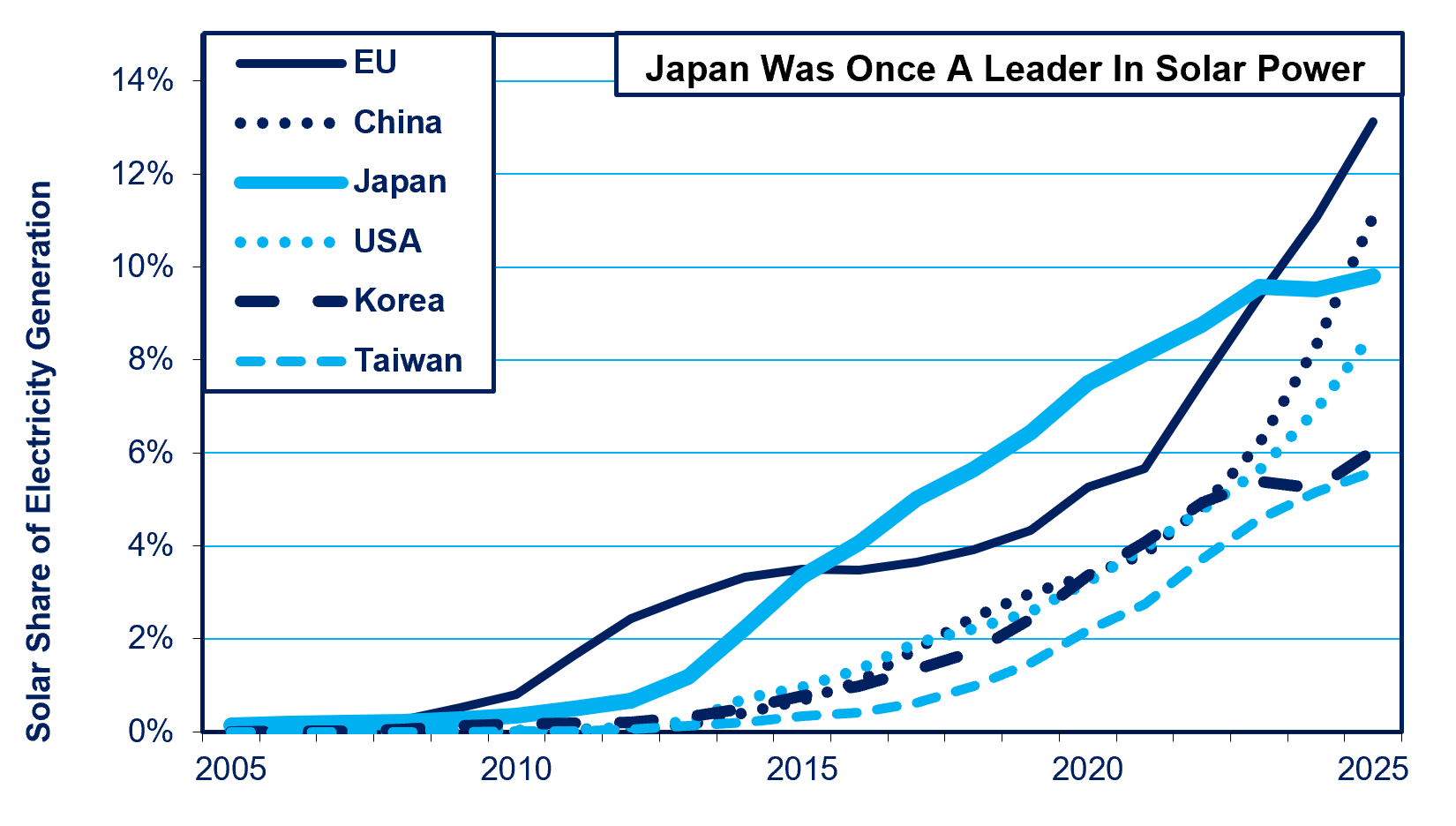
Source: https://ember-energy.org/data/electricity-data-explorer/
A decade ago, Japan was a global leader in solar power. Solar accounted for a higher share of electricity in Japan than in the US, the EU, or China. Today, it is becoming a laggard as solar growth flattens in Japan (see chart above), even as solar and wind soar elsewhere. Wind never took off in Japan because its geography is less suitable for onshore wind, and offshore wined, while abundant is still too expensive.
The situation is going to get worse since Prime Minister Sanae Takaichi tipped the scales against solar and toward even more fossil fuels. She succeeded in getting the Diet to cut off all subsidies for all utility-scale solar and all ground-based solar over 10 Kilowatts (KW) as of next April. At the same time, the government not only continues to provide mass subsidies to fossil fuels, far more than ever went to renewables, but even adds more subsidies to measures aimed at prolonging the use of coal and LNG. These include ammonia and hydrogen co-firing and carbon capture technology, neither of which make any economic sense. If the government allowed a level playing field between renewables and fossils market forces would lead renewables to grow much faster. Instead, the state has intervened against the market to prevent that outcome. For more details on Takaichi’s war on utility-scale solar, see my post here.
The irony is that Japan was a pioneer in solar energy and electric cars back in the 1970s. When the 1973-74 oil shock made oil both too expensive and too subject to political crises, Japan’s Ministry of Economy, Trade and Industry (METI) launched the “Sunshine Project” to promote solar energy and electric vehicles to improve energy security by reducing dependence on oil. Only much later did concerns about climate change come on the scene. For more on this history, see my previous post here.
Before examining Japan’s situation, let’s first look at the global picture for context.
Solar And Wind Soar Worldwide; Fossil Share Falling
Around the globe, the share of electricity generation coming from solar and wind is soaring at an incredibly rapid rate. Twenty years ago, their combined share was less than 1% of all electricity generation. As of last year, their share had multiplied to more than 19% (see chart below). This occurred at a time when total global electricity generation had increased by almost 70%. So, in terawatt-hours (TWH), electricity generated by solar and wind in 2025 is 40 times the level back in 2006.
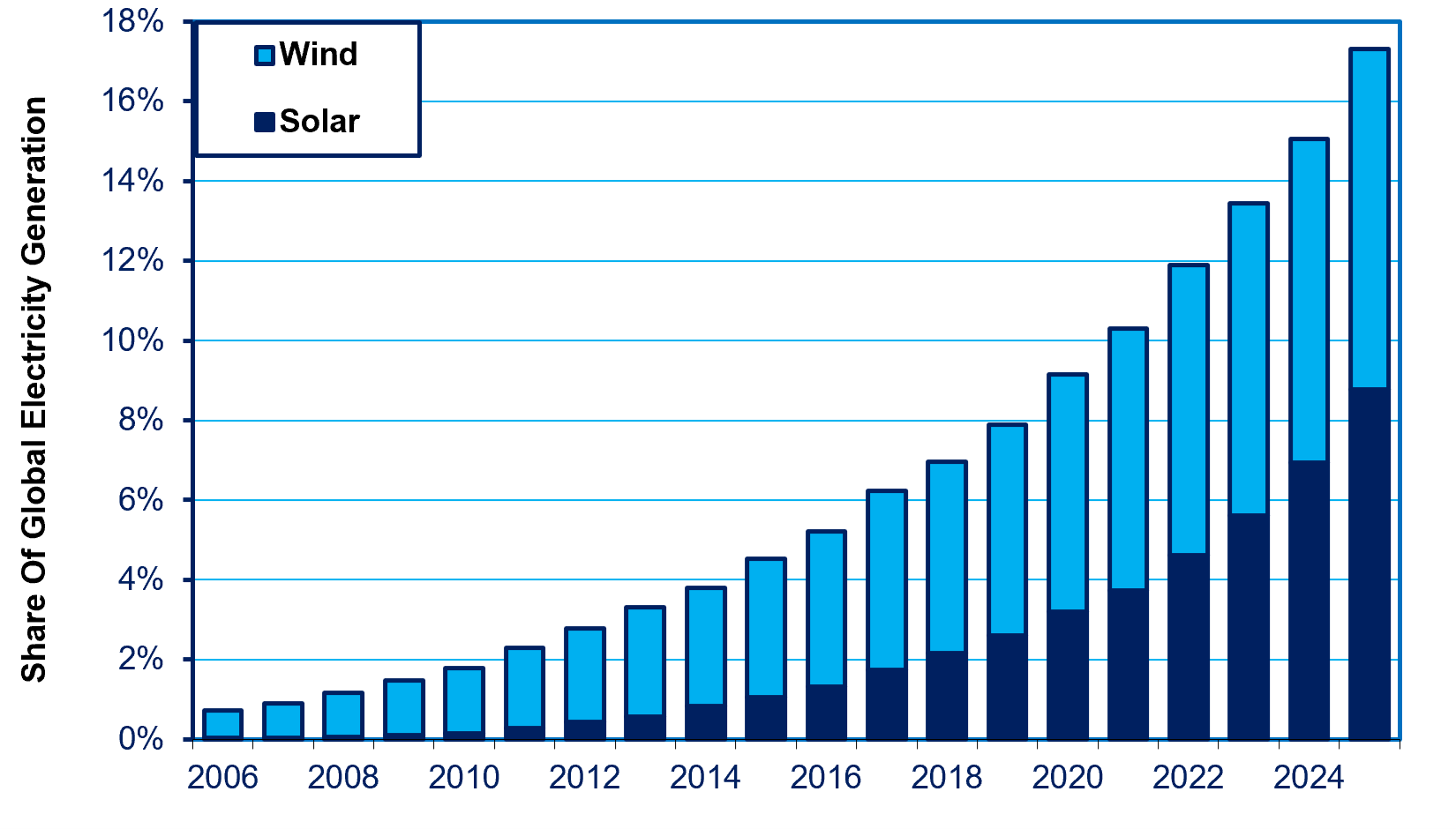
In the six years since 2019, solar power has increased by an average of 21% per year. If that rate continues, solar TWH will double every 3.5 years. Wind has increased by 11% a year since 2019. By contrast, total electricity increased by just 3% per year. That’s why the solar and wind share of electricity keeps increasing so rapidly.
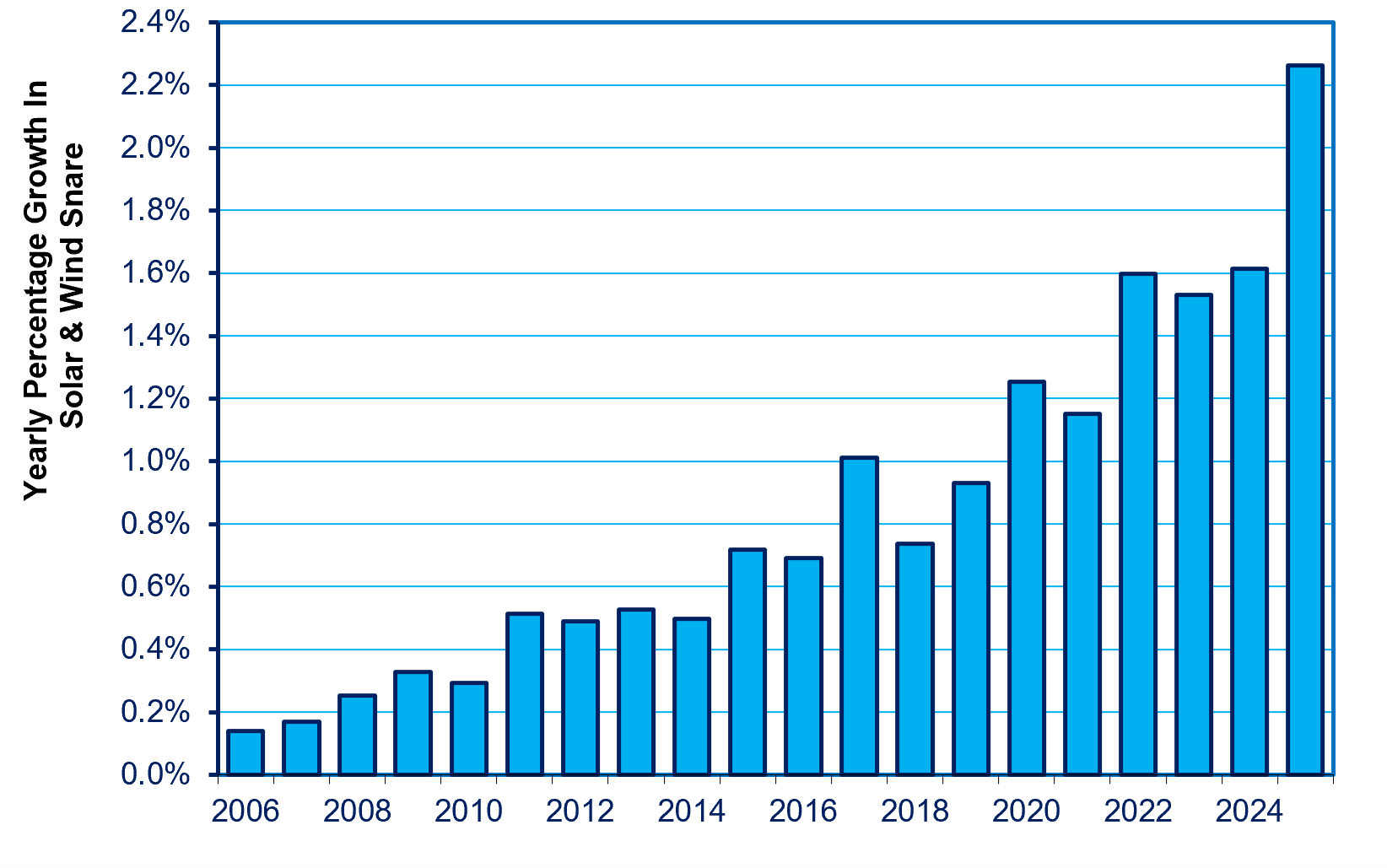
Even better, the yearly percentage increase has been accelerating. 2017 was the first year the wind/solar share of total electricity increased by more than 1 percentage point. Last year, the share increased by more than 2 percentage points (see chart below).
Conversely, ever since 2012, the fossil fuel share of electricity has decreased every year except one and appears to be declining faster than before (see chart below).
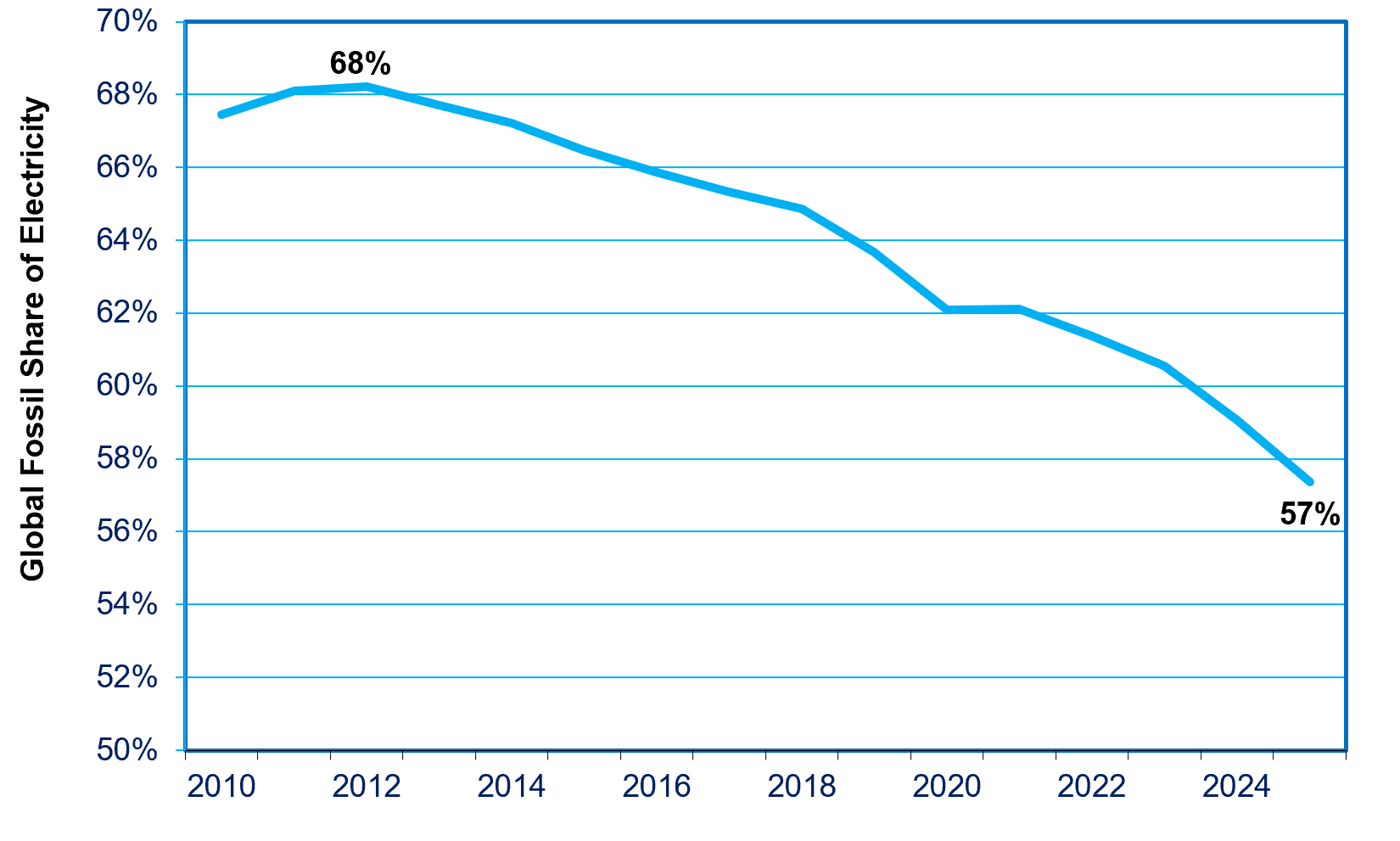
In 2025, for the first time other than in a recession or pandemic, fossil-based electricity generation (TWH) actually fell on a global basis. The drop was just 0.3%, but it’s a start. Conversely, total renewables (including hydro) increased by 9% and contributed more than the total increase in electricity since they more than made up for the reduction in fossil-based power.
The nuclear share, by the way, has plunged from 15% in 2006 to 9% last year.
Rapid Cost Cuts Help Poor and Middle-Income Countries Leapfrog Over Fossil Phase
One of the big fears in the past was that, as poor countries electrified, it would add a huge amount to global carbon emissions. But the plunging cost of renewables has made them far more affordable than anyone foresaw. Since 2010, the cost of megasolar has fallen by 89%, onshore wind by 71%, offshore wind by 63%As a result, IRENA reports that renewables are now the cheapest source of new electricity in most markets. In 2025, more than 90% of newly commissioned, utility-scale capacity delivered power at a lower cost than the cheapest, newly installed fossil-fuel-based alternative.” Moreover, the cost of battery storage has plunged by 93%, making it possible for renewables to become a viable source of baseload power even when the sun isn’t shining and the wind isn’t blowing.
As a result, in the past half-dozen years or so, an increasing number of poor countries have rapidly expanded renewables to leapfrog over coal, oil, and gas as they build new electric capacity. In 2025, the solar share of electricity generation surpassed 5% in 51 countries, with 60% of the entire global population. And in 29 countries, home to 30% of the world’s population, the solar share has surpassed 10% (see chart below).
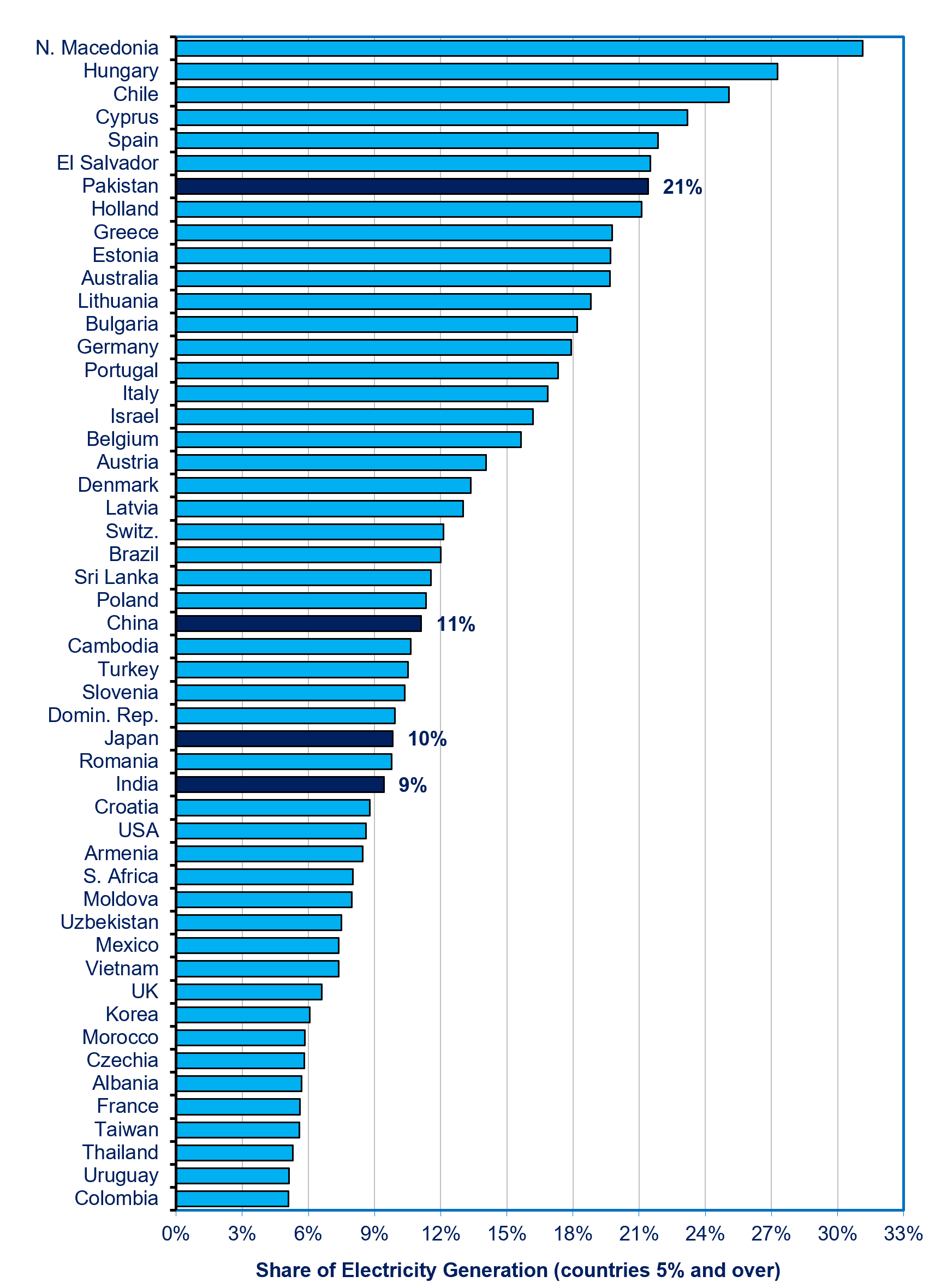
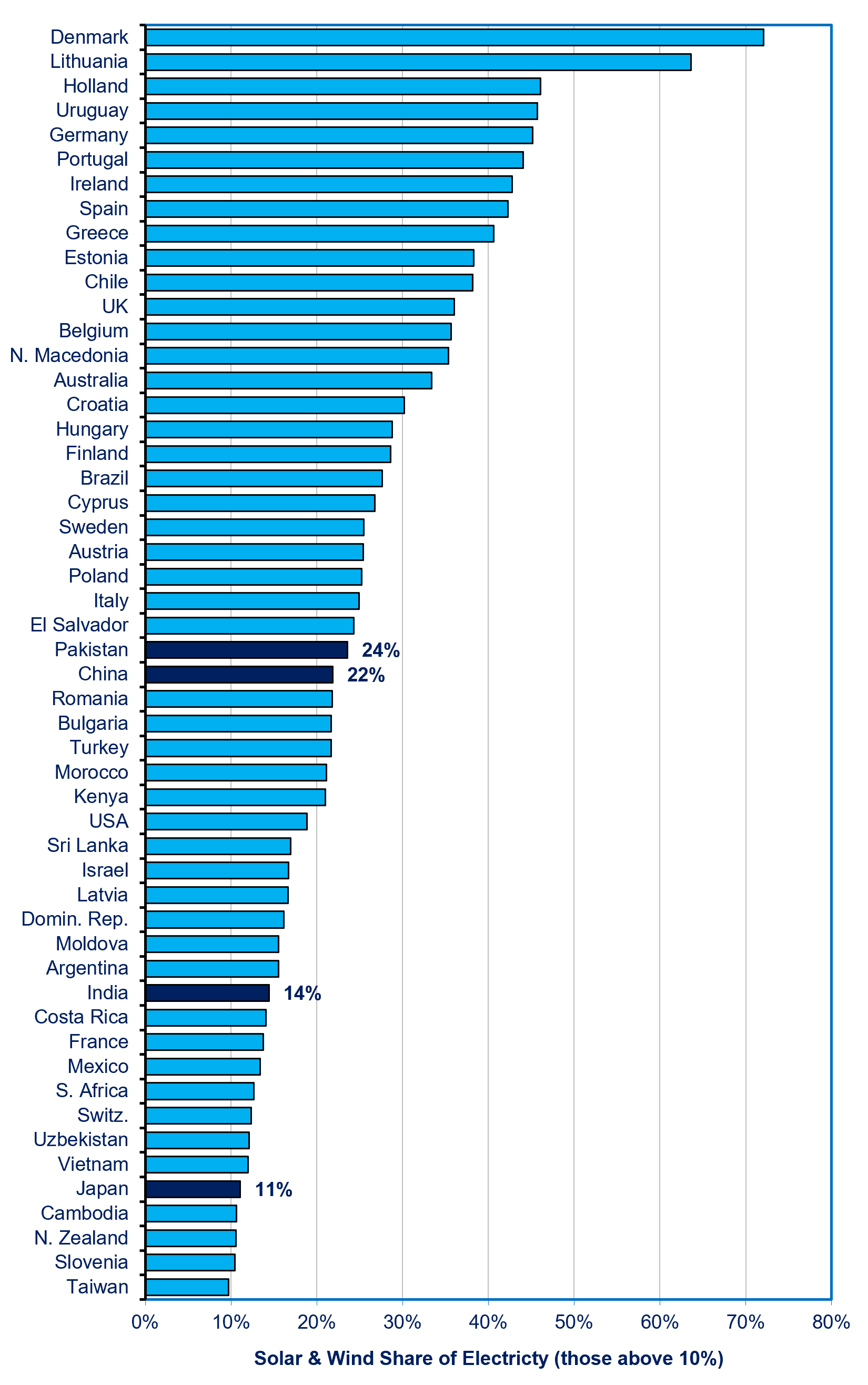
There are 52 countries where solar and wind combined supply more than 10% of electricity, and 32 countries where they supply more than 20%, which comprise 60% and 30% of the global population, respectively.
Consider India, a nation of 1.5 billion, comprising almost one in five people on the planet. From 2010 to 2025, its per capita GDP (in constant 2021 PPP dollars) doubled from $5,000 to $10,000. To accomplish this, India had to double its consumption of electricity. I remember taking a bus from New Delhi to the Taj Mahal a few decades ago. There was a lot of development, from farm irrigation to small manufacturing, where I could see the electric lines on the road. Where the electric lines ended, so did the modernization.
Had India not been able to use more renewables, the impact on emissions would have been horrendous. Fortunately, the Total Installed Cost of new Solar Photovoltaic Plants in India—with installation cost accounting for the vast majority of the lifetime cost—plunged by 92% from a prohibitive $6,100 per KW of capacity in 2010 to just $500 in 2025. The lifetime cost of onshore wind fell by half during the same period. As a result, India was able to increase its reliance on wind and solar from just 2% in 2010 to almost 15% last year. Add in other renewables, like hydroelectric, and the share grew from 15% to 24%. Conversely, coal’s share has dropped from a peak of 76% a decade ago to 70% in 2025 and, in 2025, declined slightly in absolute terms.
Then there’s the even poorer Pakistan, a nation of 260 million. Its real per capita GDP grew from $4,200 in 2010 to $5,600 by 2025. This growth was fueled by an 80% hike in electricity consumption. And to accomplish that, Pakistan increased the wind and solar share of electricity from 2% to 24%, a stunning achievement. Conversely, the power generated by fossil fuels tumbled 17% from 81 TWH a decade ago to 67 in 2025.
Other poor countries that have been able to dramatically increase their reliance on solar and wind due to plunging costs include Morocco, Moldova, Vietnam, Sri Lanka, Uzbekistan, Cambodia, Kenya, El Salvador, Armenia, and South Africa. Together with India and Pakistan, these countries constitute 25% of the world’s population.
By 2030, forecasts the International Energy Agency (IEA), solar and wind comprise 30% of all electricity generation globally. If we include hydro, renewables will reach 43%.
Japan Loses Its Lead: Illusions of Fossils and Nukes
Japan, unfortunately, is moving in the opposite direction. Growth in solar power has greatly slowed in the past few years, both in absolute terms (TWH) and as a share of electricity generation (see chart below).
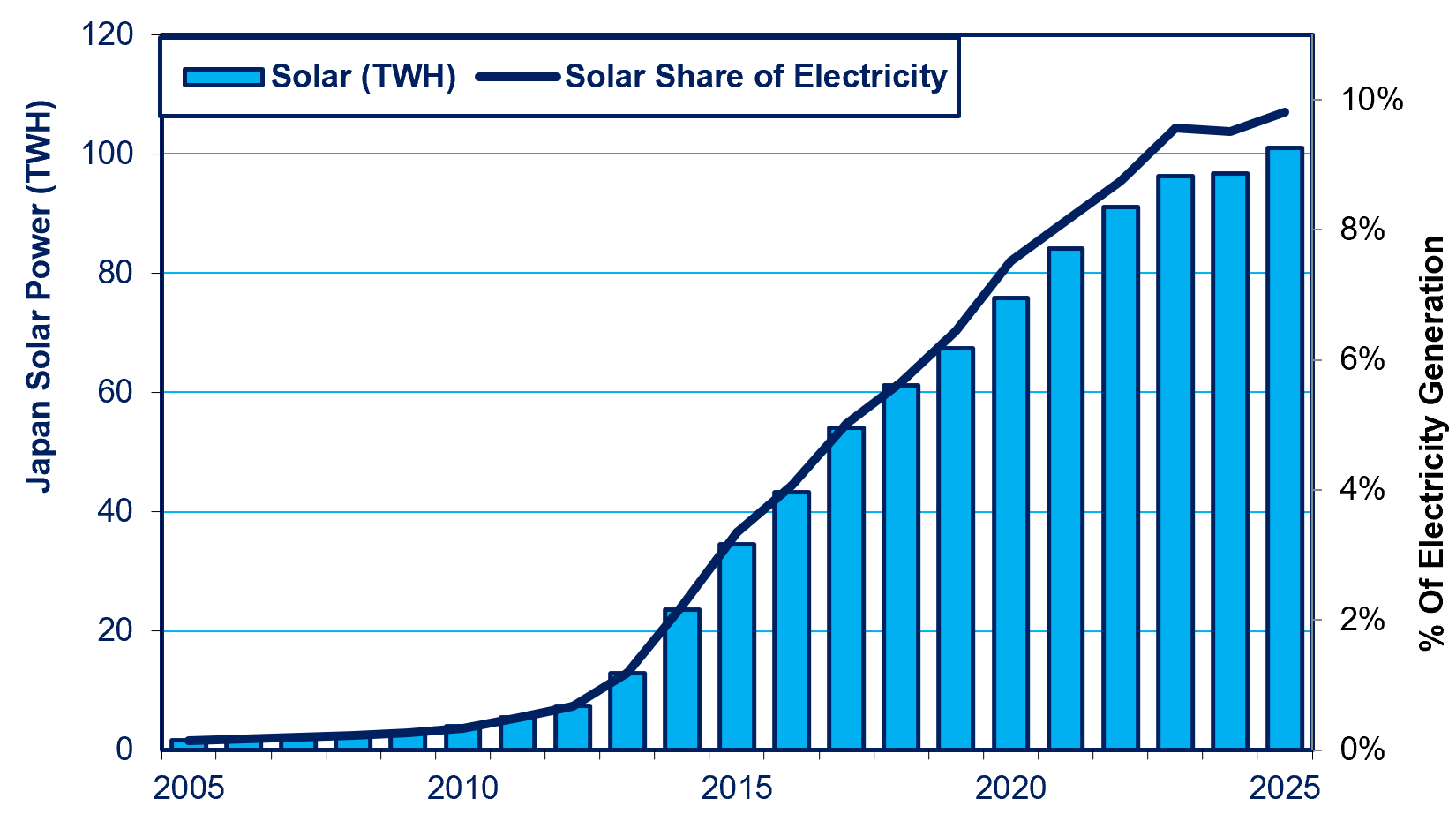
In the first years after the 2011 nuclear disaster, the subsidies put in place by the Democratic Party of Japan government—and maintained for a while by Liberal Democratic Party Prime Minister Shinzo Abe—led to a rapid rise in solar power. But a few years after Abe’s return to power, he cut back on the subsidies. The government wanted more solar power, but not so much as to threaten fossil-fuel and nuclear interests. The go-slow policy caused a steady deceleration. In early 2016, Japan added 12 gigawatts (GW) to the total capacity, but by this year, the yearly increment fell by two-thirds to less than 4 GW. In early 2017, the percentage increase in capacity was more than 20%. By this year, it was less than 4% (see chart below). Takaichi’s war on megasolar will slow growth even more.
Not only has Japan’s 2030 goal for emissions reduction been thrown away, but Japan is abandoning low-cost electricity for higher cost power. This belies Takaichi’s claim to be a pro-growth Prime Minister.
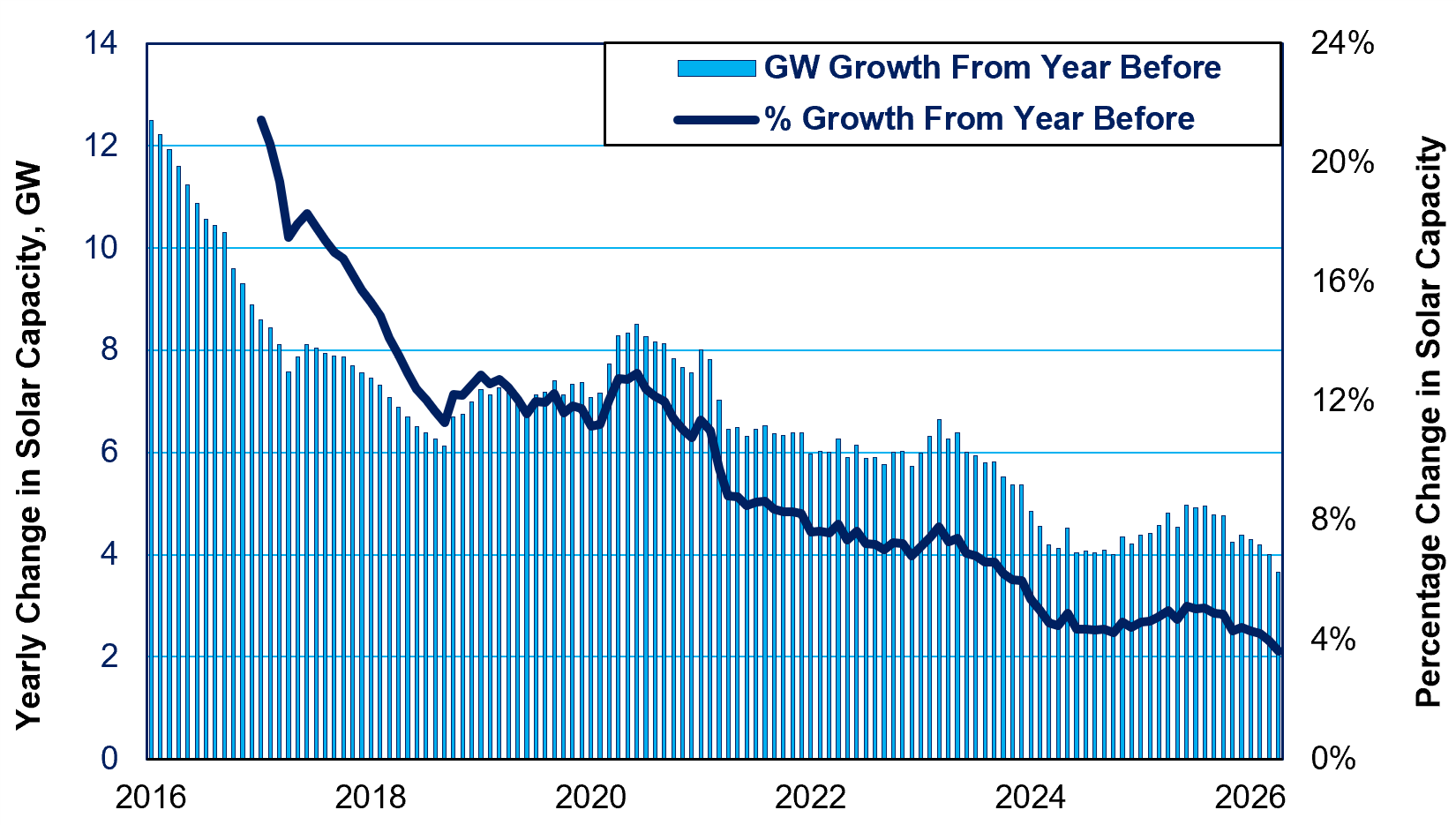
Source: https://ember-energy.org/data/wind-and-solar-capacity-data-explorer/
Myths and Reality On How Japan Turned From Leader to Laggard
Japan’s fossil lobby—fuel companies, utilities, makers of heavy machinery and autos, and METI—insists that this lag is not under Japan’s control. It is imposed by the combination of geographic conditions and the security threat of relying on China in the same way Europe relied on Russian gas. Flat land, they claim, is scarce, so many solar farms must be built on mountainsides, which not only raises costs but also triggers landslides that provoke public resistance.
This is sophistry, as I detailed in this post. The biggest obstacle to more solar power is land use laws that prevent even abandoned farmland from being used for nonfarm purposes. As of 2020, there was already enough abandoned farmland to generate 112 GW of renewable capacity, a volume equal to a third of Japan’s total electric capacity in that year. By 2030, says the Agriculture Ministry, abandoned plots could triple to 30% of all farmland, as the number of farmers halves. Building solar farms on flat land rather than on mountainsides is both cheaper and safer. When I raised this issue with a government official, he replied that farmland cannot be used because Japan lacks food self-sufficiency. But I don’t believe abandoned land produces any food. Taro Kono, a former contender for Prime Minister, has repeatedly complained that land-use laws impede renewables.
Takaichi claims solar is unsafe because it makes Japan dependent on China. That’s like saying that Japan should shut down its auto industry rather than import rare earths from China. Instead, Japan helped develop other sources of rare earths. India has become the world’s third-largest generator of solar power and a major producer and exporter of solar modules, yet it still relies on China for upstream components. So, why not partner with other rich countries to help India develop further? Initially, these panels might cost more, but that is less costly than sticking to coal and gas. Finally, there’s a big difference between relying on Russia for oil continually and making a one-time purchase from China. Besides, if Japan wants rooftop solar, as Takaichi does, Japan must get affordable panels from somewhere.
Support the Blog
Paid subscribers will be eligible for my new memos, an addition to these regular posts. Beyond that, if you feel you’ve gained insight from this blog, ever restacked it, if you ever subscribed to my previous publication, The Oriental Economist Report, and certainly, if you or your firm have gained insights that helped guide your investments, please support the blog with a subscription or by “buying me a cup of coffee.” You can buy a cup or two on a one-time basis, or once a year, or once a month.


No posts
Comments
Nothing yet. Say the first thing.
Sign in to join the conversation.