
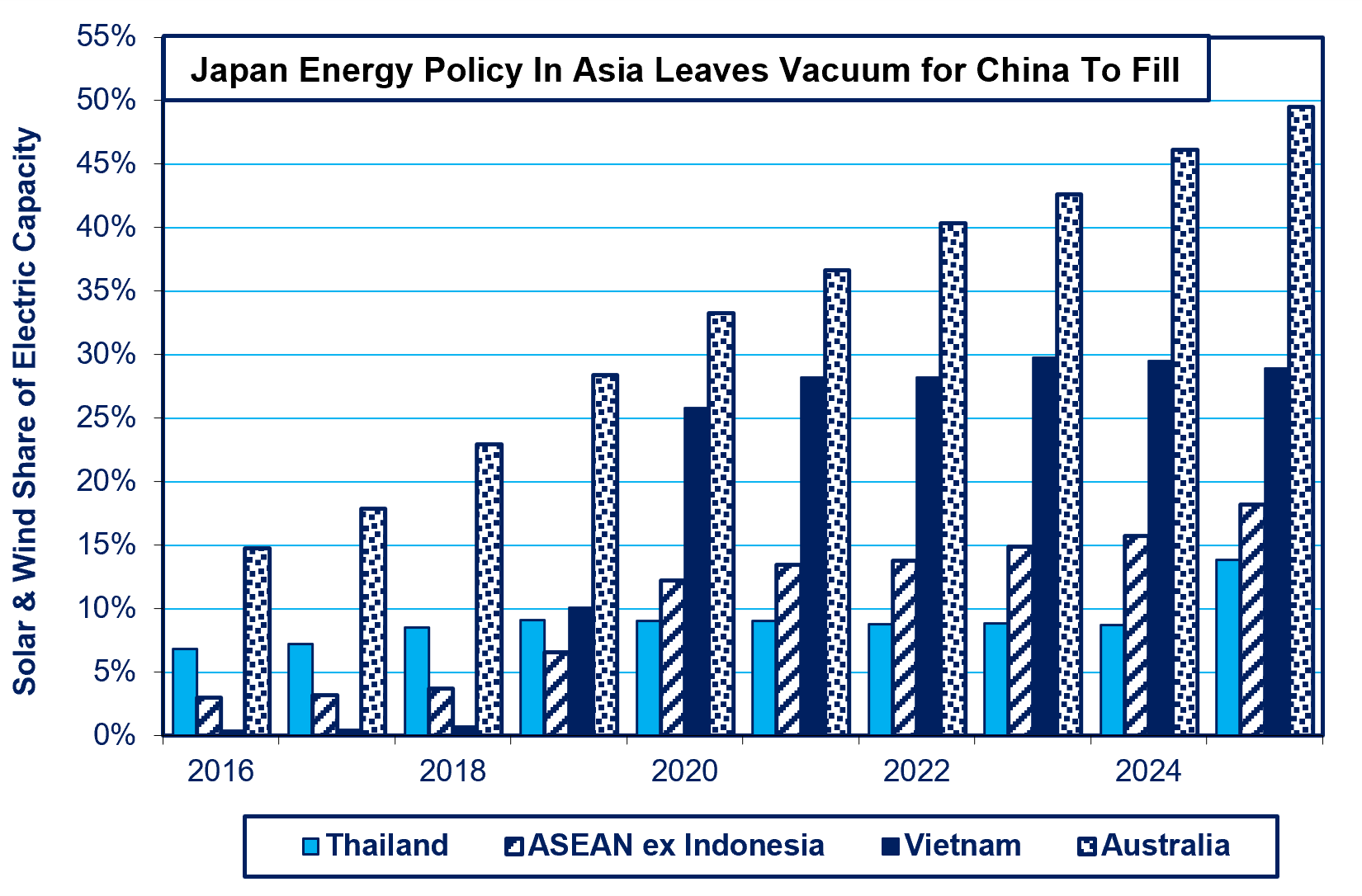
Source: https://ember-energy.org/data/electricity-data-explorer/?data=capacity&temporal_res=yearly
It is one of Japan’s most short-sighted policies: the attempt to keep Southeast Asian countries hooked on fossil fuels, especially natural gas. Unbelievably, it’s being done in the name of energy security at a time when events like the ongoing Hormuz blocking, not to mention plunging costs of solar and wind power, are luring countries into renewables.
In March, the first month of Trump’s war on Iran, China’s solar exports reached a record 68 gigawatts (GW), double the previous month. Fifty countries set records for Chinese solar imports, 60% of which were bought by Asian countries (see chart below).
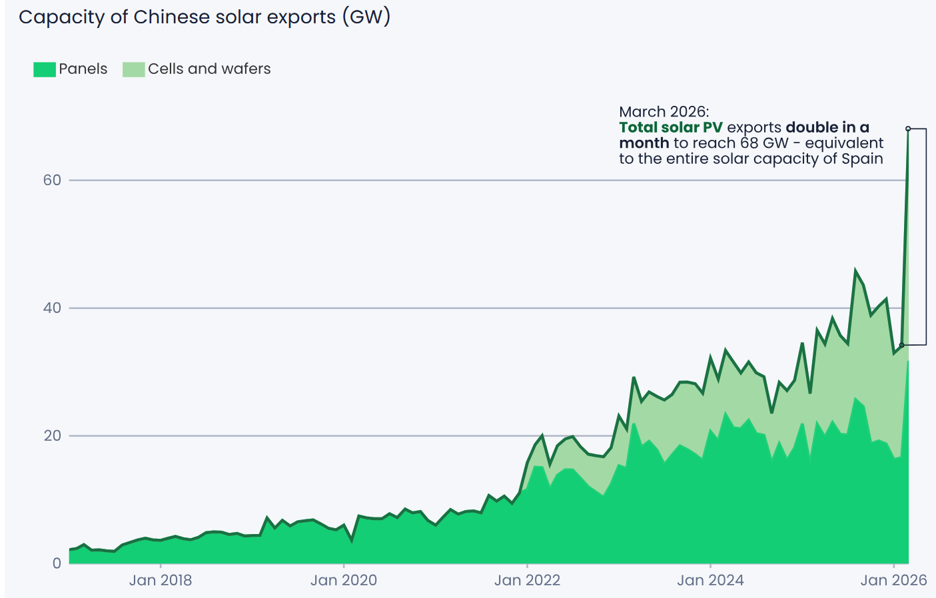
The reality is that, by trying to obstruct this shift and abstaining from exporting solar and wind technology, Japan has reduced security. It has created a vacuum that China has filled. Not even the ongoing Hormuz blockage has led policymakers to shed their blinders. Instead, Japan is only trying to diversify its sources of oil, coal, and LNG, and trying to increase the share of sources where it has direct control via its investment. In a long article criticizing the government’s stance, Nikkei quoted Japan’s ambassador for the promotion of the falsely named Asia Zero Emissions Community (AZEC) as saying, “AZEC’s fundamental aim is to break away from an exclusive focus on renewables.” By contrast, Korea has come up with a plan to triple renewable electricity.
I don’t have any problem with China helping emerging countries expand renewables. On the contrary, it’s the best option for both these countries’ prosperity and action on climate change. But I am opposed to countries being overly dependent on one source, especially one that has a history of using its dominance in certain products as a political cudgel, e.g., in the cases of Japan, Australia, and Lithuania.
Japan will have no more luck than King Canute in commanding the waves of renewables to stand still. Consider Vietnam, Thailand, and Indonesia, the recipients of 90% of Japan’s energy investments during 2000-2020, and members of the Japan-created AZEC. Vietnam raised the solar and wind share of electricity from virtually zero in 2018 to 28% last year while Thailand raised its share to 14% from less than 2% in 2012. Nine members of the Association of South East Asian Nations (ASEAN), except for Indonesia—the nine have a population of 400 million—have raised the solar and wind share to 18%. And Australia, another AZEC member, has raised it to half (see chart at the top).
While solar and wind supply just 1% of electricity at present, Indonesia has issued a plan to do so in the future. Huge price cuts in solar, wind, and batteries have now made renewable energy by far the least expensive electricity. In fact, recent national plans published by Indonesia, Malaysia, Singapore, Vietnam and Thailand would more than double ASEAN’s renewable capacity by 2030, according to the International Energy Agency. All renewables (including hydro, biofuels and geothermal) provided 32% of all electricity in ASEAN in 2025. In October 2025, ASEAN agreed to raise this to 45% by 2030.
In the absence of enough other players, these nations are turning to China, not only as a source of solar inputs but also for factories on their soil. China has invested heavily in Southeast Asian production hubs, often as a way of bypassing US tariffs (see chart below).
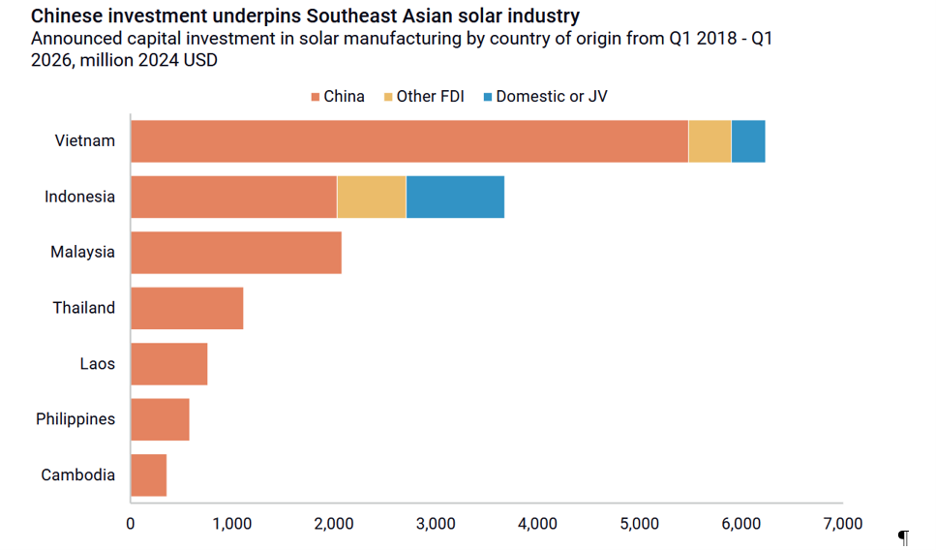
Source: https://rhg.com/research/solar-manufacturing-in-asia-at-a-crossroads/
EU, UK, and Pre-Trump USA Create Positive Alternative
In contrast to Japan, the US, UK, and EU established the Just Energy Transition Partnerships (JETP) in 2021 to help developing countries. Both decommissioning of coal plants and building of renewables are part of the package. Donald Trump pulled out soon after his return to power in 2025, and Japan was never a member.
So far, JETP has committed about $50 billion in public and private money, beginning with South Africa, Senegal, Indonesia and Vietnam. A 2022 commitment of $20 billion to Indonesia represents the largest JETP package to date. Last year, it announced a $15 billion pledge for Vietnam.
JETP is not without its problems, but its efforts can reduce over-reliance on China. Other countries, like India, are also making big efforts to become global solar suppliers, and those efforts should be helped.
A Game-Changing Economic Milestone Makes Japan’s Attempt Even More Futile
I’ll never forget it. Michael Caine was telling Johnny Carson that his father was so poor, he could never afford to buy a radio; instead, he rented one. And, over the years, he paid far more in rentals than it would have cost if only he’d been able to save that much. “Poor people cannot afford cheap goods,” Caine explained.
He could have been talking about solar energy. Until now. Over their lifetime, solar and wind are far cheaper than coal and oil. As early as 2021, in countries with half the world’s population, it was already cheaper to build and operate new solar and wind power plants than to operate existing coal and oil plants. But that’s over the lifetime of the plants. However, like Caine’s radio, the upfront cost of building solar and wind plants, and the accompanying battery storage, was prohibitive for poor countries. That’s no longer the case. It now costs less to build a new solar or wind plant than a new gas or coal plant. When one includes the necessary battery storage, that will be the case by 2030 (see chart below).
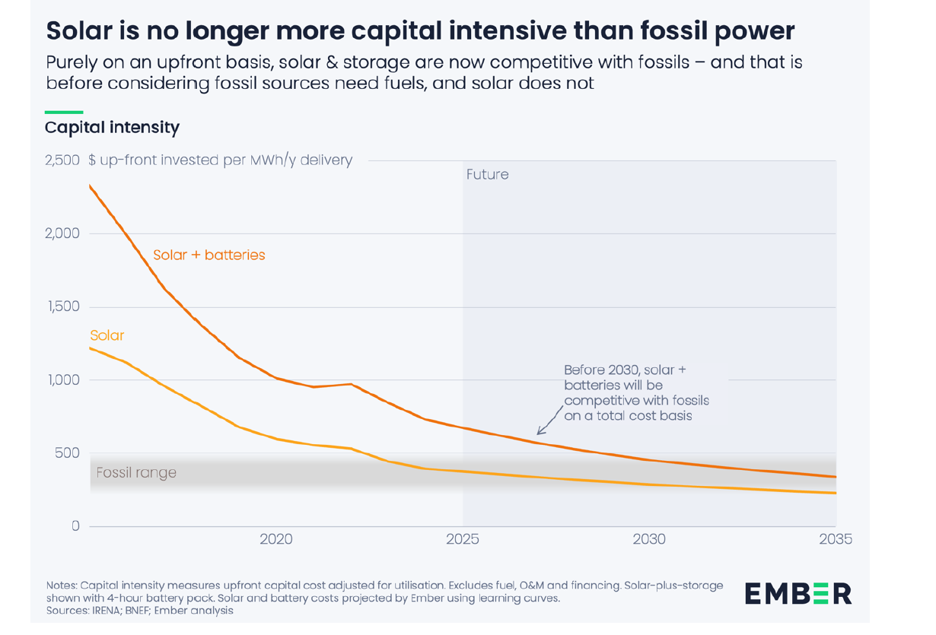
Source: https://ember-energy.org/app/uploads/2026/04/The-electric-fast-track-for-emerging-markets-PDF-1.pdf
Once the upfront costs are paid, no one must pay the sun to shine or the wind to blow. The only financial burden is marginal maintenance and repair costs. Nor can wars blockade the sun as they block oil and gas.
For countries that need to expand overall electric capacity, solar and wind are no-brainers. And ASEAN needs to expand its overall electricity capacity fivefold to equal the current per capita level in the OECD. No wonder that countries are increasingly turning to solar and wind for new capacity (see chart below).
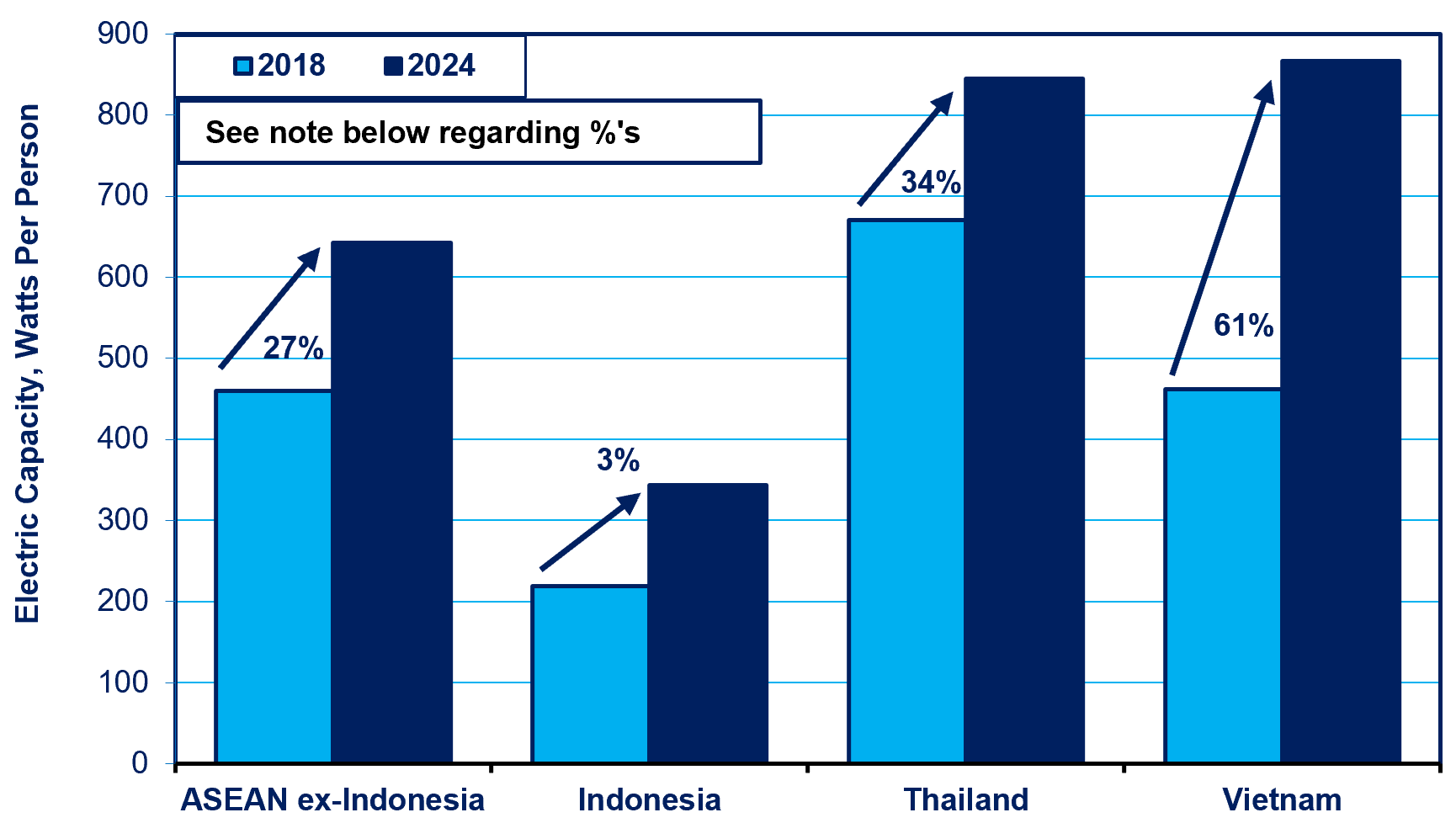
Source: https://ember-energy.org/data/electricity-data-explorer/?data=capacity&temporal_res=yearly Note: The percentage label shows the portion of the total increase in per capita electricity that comes from solar and wind, e.g., 61% in Vietnam
So far, Indonesia has remained the exception. Not only is its per capita electric capacity very low and growing slowly, but the portion coming from solar and wind is just 1%. The plunge in upfront costs and the use of battery capacity changes all that. EMBER compares the situation to the difference between the cost of providing everyone with landlines vs. cell phones. There’s a huge cost to construct physical wires to everyone, especially those who live tens or hundreds of miles from a grid, or who live on one of Indonesia’s 17,000 islands. On the other hand, just as it is far less costly to put cell phone towers throughout the land, it costs so much less to build localized solar or wind facilities complete with battery storage in areas too far from the grid.
Fortunately, ASEAN is blessed with around 20 terawatts of solar and wind potential, 55 times its current total electric capacity.
Tokyo: “Natural Gas For Decades To Come”
Japan has exhibited an ideological adherence to fossil fuels, one impervious to any contrary evidence.
Until a few years ago, Japan was one of the biggest financiers and builders of coal-fired electric power plants in developing countries. When international and domestic opposition grew too hot, Japan switched to natural gas under the rubric of fighting carbon emissions by sponsoring a “coal to gas” transition.
In 2023, in a marvel of false advertising, Tokyo created the Asia Zero Emissions Community (AZEC). Of the 150 Memoranda of Understanding (MOUs) signed with ASEAN nations from AZEC’s inception until mid-2025, 35% supported fossil fuel technologies, while only 7% focused explicitly on wind and solar. Sending billions or tens of billions on a fossil fuel plant locks a country into that fuel for decades. More mentioned solar and wind in new MOUs signed in October 2025, but that doesn’t tell us how this translates into investment dollars, since only one MOU has actually been implemented so far.
What we do know is that, during 2000-2020, of Japan’s $67 billion investment in electricity projects in ASEAN—90% of that in Indonesia, Thailand, and Vietnam—only 4% was devoted to solar, wind, geothermal, and other renewables. Half consisted of fossil projects (see chart below).
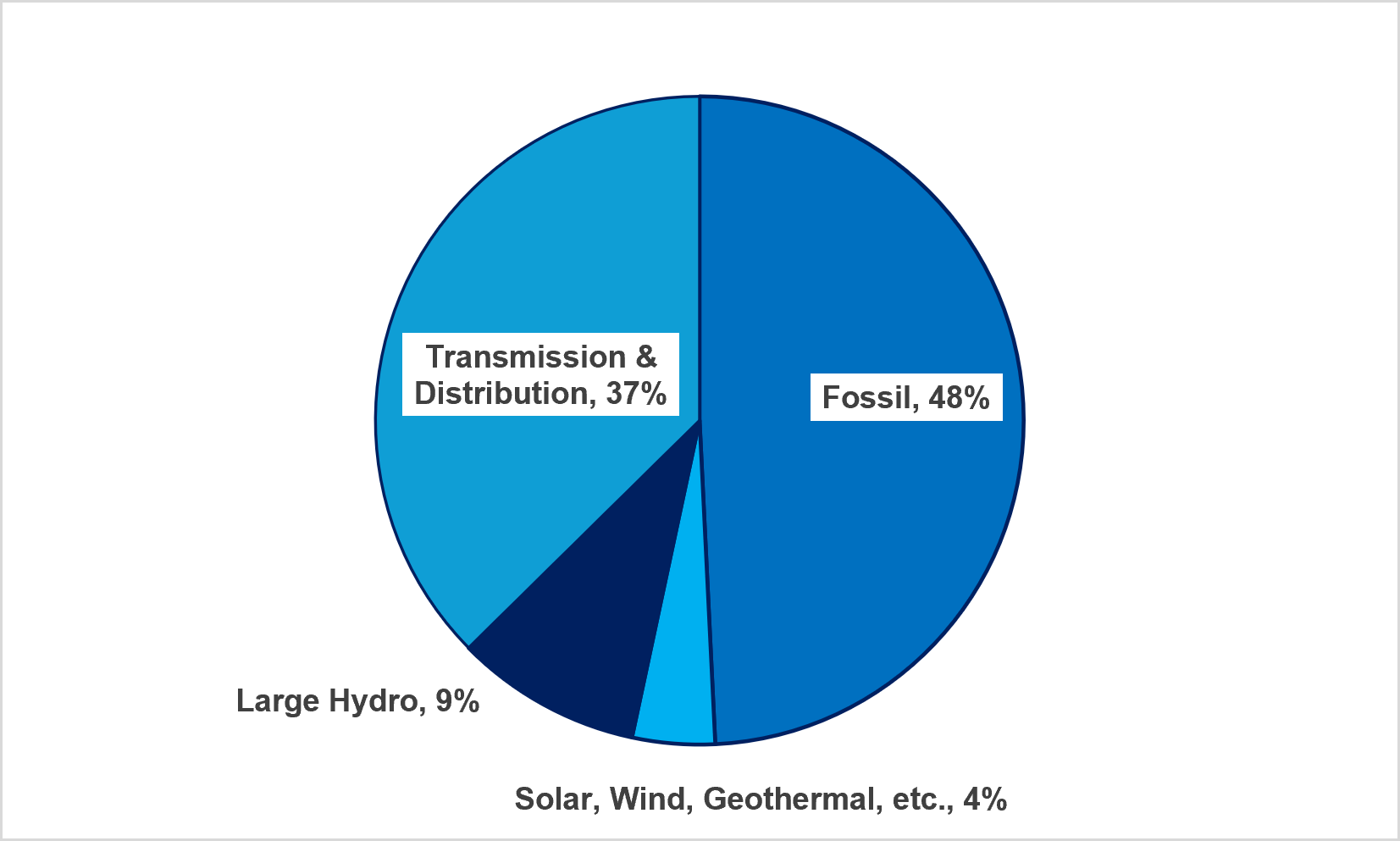
Source: www.azectracker.org/#w-tabs-0-data-w-pane-0
At a 2025 conference of LNG producers and consumers from 30 countries, Minister of Economy, Trade and Industry (METI) Yoji Auto declared, “We believe that natural gas and LNG will continue to be an important energy source even after carbon neutrality. Japan’s natural gas emissions are low… and decarbonization is possible by utilizing CCS (carbon dioxide capture and storage) and hydrogen.” He referred to LNG as a “driver of clean economic growth” even though it’s a major source of carbon emissions.
Hence, a big part of the AZEC MOUs is investment in measures aimed at prolonging fossil use such as co-firing with ammonia and hydrogen as well as CCS. But “green hydrogen” takes two megawatts of electricity to produce for every megawatt it yields when used in co-firing. The situation is similar with ammonia. COS costs far more than renewables. This is what I mean by imperviousness to evidence.
Why?
Some people argue that Japan is pursuing this policy mainly because it boosts the exports and profits of its own heavy machinery and natural gas companies. But it’s not that simple. The state and fossil-allied companies form an ideological community. In stone-killing-two-birds fashion, the same policy can boost company sales and help the state pursue what METI sees as its interests.
For example, a recent report by IEEFA pointed out that Japan’s overseas fossil fuel investment strategy focuses on increasing its “fossil fuel self-development ratio”, i.e. the share of imported oil and gas from Japanese-owned upstream assets. Japan aims to raise this ratio from 37% in 2023 to over 50% by 2030 and 60% by 2040. Consequently, between 2013 and 2023, Japanese public financial institutions invested $93 billion in overseas oil and gas projects, despite having previously committed to end fossil-fuel financing by the end of 2022. At the 2023 Group of Seven meeting, Tokyo extracted permission to invest in new gas-burning power plants at home and abroad if they replace coal.
In addition, Japanese policymakers argue that promoting solar in other countries just strengthens China’s influence. Tatsuo Terazawa, a former Vice Minister of METI for International Affairs who now chairs the METI-affiliated Institute for Energy Economics Japan (IEEJ), wrote in 2023, “Decarbonization’s push for solar, wind power, batteries, and BEVs strengthens China’s dominance in the supply chain...It would take decades before we can stop using fossil fuels.”
In the face of that fear and China’s low prices for solar products, Japan’s market share in solar inputs fell from 25% or so in 2013 to less than 1% today. Its share in storage batteries fell from 27% to 5%.
I had hoped that the Hormuz crisis would provoke at least some significant change but talks with people in Tokyo have dashed that hope. Even companies that favor more renewables have kept a low profile so far. Hopefully, reality will eventually make an impact, but it could be quite a long time.
Support the Blog
Paid subscribers will be eligible for my new memos, an addition to these regular posts. Beyond that, if you feel you’ve gained insight from this blog, ever restacked it, if you ever subscribed to my previous publication, The Oriental Economist Report, and certainly, if you or your firm have gained insights that helped guide your investments, please support the blog with a subscription or by “buying me a cup of coffee.” You can buy a cup or two on a one-time basis, or once a year, or once a month.
No posts
Comments
Nothing yet. Say the first thing.
Sign in to join the conversation.