
Life in the USA is not normal. It feels pointless and trivial to be talking about small looks at the fascinating natural world when the country is being dismantled. But these posts will continue, as a statement of resistance. I hope you continue to enjoy and learn from them. Stand Up For Science!
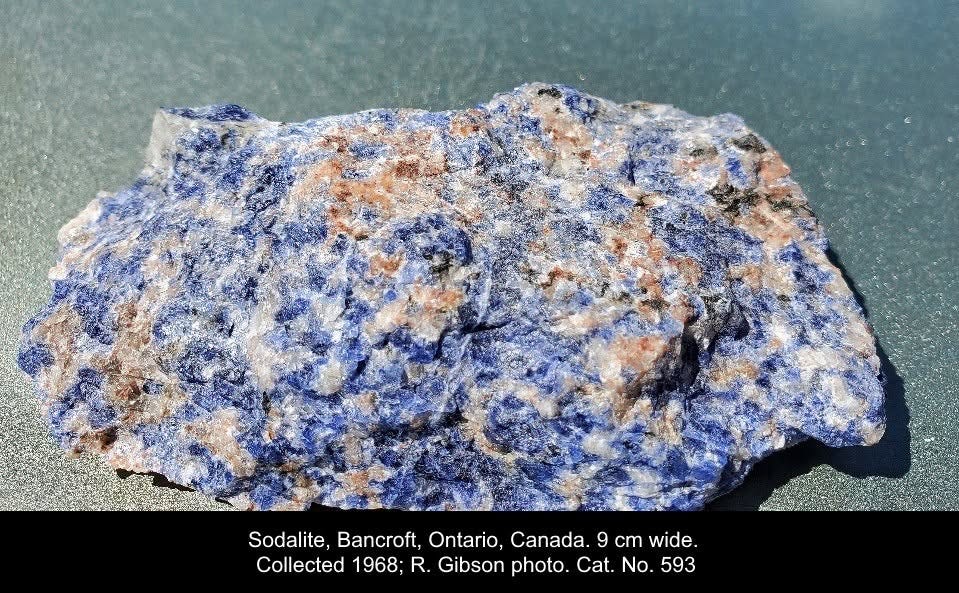
Sodalite is a sodium aluminosilicate with chlorine, Na4(Si3Al3)O12Cl. Although it can show many colors, from transparent and white to black, it is famously blue in many occurrences. This piece is from Bancroft, Ontario, where it is associated with alkaline (sodium- and potassium-rich) intrusive rocks that formed about 1.1 billion years ago when a long narrow band of continental material was colliding with the ancient core of North America (the Superior Craton) as the Grenville Orogeny.
Sodalite is usually classified as a feldspathoid, which means it is quite like feldspar, but it formed in a setting where there was less silica than is needed to make true feldspars. Quartz, pure silicon dioxide, rarely occurs with feldspathoids because of that silica-poor environment.
The rocks at Bancroft are famous for strange minerals because of this relatively unusual alkaline and low-silica setting.
At a molecular level, the structure of sodalite is cage-like, so it can incorporate various extraneous ions. Sulfur in those cages is probably the origin of the blue color, but other possibilities have been suggested.

I collected this on a field trip from Flint (Michigan) Junior College in April 1968. I’m pretty sure it is from the Princess Sodalite Quarry. “In 1901 the Duke and Duchess of Cornwall (later King George V and Queen Mary, grandparents of Queen Elizabeth II) were presented with a piece of this sodalite; they found it so attractive that some was quarried for Marlborough House in London.” (Grice, 1989, Famous Mineral Localities of Canada: Fitzhenry & Whiteside, Markham Ontario, 190 p.)
The rock is technically nepheline syenite, and the white parts of the specimen in the photo are probably nepheline. The yellow-orange bits are probably cancrinite, another feldspathoid.
Sodalite’s name is just a reflection of its essential sodium content, and sodium the element was named by Humphrey Davy in 1808 from its presence in soda in well-known salts such as sodium bicarbonate (baking soda). “Soda” is ultimately from an Arabic word for a plant from which soda was obtained by burning to generate sodium carbonate, used in making soaps and glass.
Soda ash (sodium carbonate) helped spark the fledgling glass industry in Jamestown, Virginia, and their first exports back to England (in 1608) included “soap ashes,” i.e., soda ash from burned plants.
We’ve seen sodalite in the form called Yooperlite in this previous post.
Comments
Nothing yet. Say the first thing.
Sign in to join the conversation.