
Fitness trackers have become ubiquitous. It has gotten to the point where I’m sure many would not even contemplate a run if they could not track their pace in some way, shape or form. For some, sleep quality is no longer inferred from their ease of waking or morning alertness, but from bluetoothing their wearable’s data to a phone or laptop. While wearables can absolutely have their benefits1, there are some genuine drawbacks. The most salient of these is over-analysis, where the data begins to overrule how you feel.2 This reliance on data can negatively impact intuition and give a false impression that true vitality can be gauged by a collections of numbers. Recovery and sleep scores can become sources of anxiety, perpetuating a feedback loop that fails to serve health. This is without even considering the potential sizes of the error bars associated with the metrics provided by these wearable devices.
However, there are a variety of techniques that can be extremely effective in providing clear, physiological feedback without the use of tech and the ubiquitous LEDs and subtle EMFs associated with them. Most of these are zero-cost and take very little time and practise to understand how they relate to your state. They are based on logic and intuition, which, over a long period of time, work to serve your our sense of vitality and your instincts.
A control pause is one of the simplest and most effective way to quantify CO2 tolerance — a measure associated with heart rate variability (HRV). CO2 tolerance is effectively always diminished in individuals with nervous system dysregulation. In my work as a pulmonary scientist, I worked with countless patients who’s CO2 tolerance was so poor that even minor exertion would make them exhausted.
A control pause is measured by breathing calmly while seated. After a normal exhalation, hold your breath and count until you get the first jolt in your upper chest, prompting you to breathe. At this small jolt, stop timing and resume breathing; you should be able to commence breathing normally, if you gasp for air, you have held too long. This is best performed first thing in the morning before getting up as you should be rested and without any sympathetic drive.
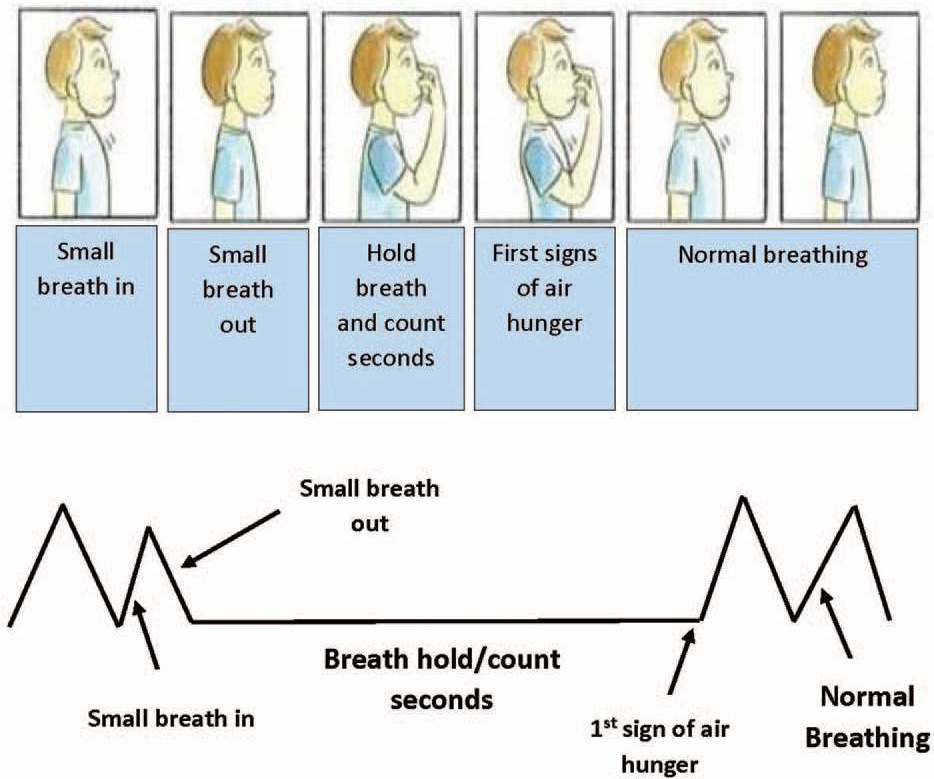
Generally, an acceptable control pause is >20 seconds, below which generally denotes suboptimal CO2 tolerance and a decreased tolerance to sympathetic tone. I have worked with patients at the hospital who could not manage a 5 second control pause. Similar to the HRV rating on a wearable device, in my opinion, control pause serves a similar (yet not identical) purpose — to indicate one’s current nervous system state.
One of the most under appreciated measures of health and vitality is blood pressure (BP). The issue with this metric is that it is effectively never measured correctly. BP should be measured manually3 in a relaxed environment where the patient has been given 5 minutes to sit quietly without any immediate stressors. Rarely are patient’s BP measured in this manner. BPs around 110/70mmHg are likely close to optimal ranges. However, these are likely to fluctuate from moment-to-moment, making the trend over weeks and months much more relevant to quantifying health than single readings.
Stable, normal BP is a sign that the body is capable of adjusting appropriately to the various stressors it is being faced with. In the absence of any salient stress, you should be able to achieve a normal BP measurement. Like all modern ailments, chronically high BP is typically due to a combination of many factors, including poor sleep, circadian disruption, inadequate sunlight exposure, psychological stress, dehydration, poor breathing habits, refined foods, exposure to synthetic chemicals and chronic inactivity. Cumulatively, these common exposures can manifest as high BP, increasing risk of heart attack and stroke.
However, low blood pressure is also a significant concern — one that similarly points our nervous systems dysregulation. Low BP is connected with the body’s inability to meet changing requirements. Exposure to contrast therapy or high-intensity exercise in those with low BP can often cause light-headedness as it exacerbates the low blood pressure.
Interestingly, a key way to use blood pressure measurements as a proxy for HRV is to measure both the left and the right arm. To my knowledge, individuals with dysautonomia commonly exhibit significant variations between the left and right arm, signifying poor adaptive capacity between sympathetic and parasympathetic activation.
Comments
Nothing yet. Say the first thing.
Sign in to join the conversation.