
There are many brilliant stories out there that people stay away from because they’re too complex or confusing for them to get into. I’ve posted beginner’s guides for a few of these stories, including Malazan Book of the Fallen, JoJo’s Bizarre Adventure, the Fate franchise, and some others. This post isn’t really a beginner’s guide, because The Wheel of Time isn’t really that complex or difficult to understand.
It’s just really fucking big.
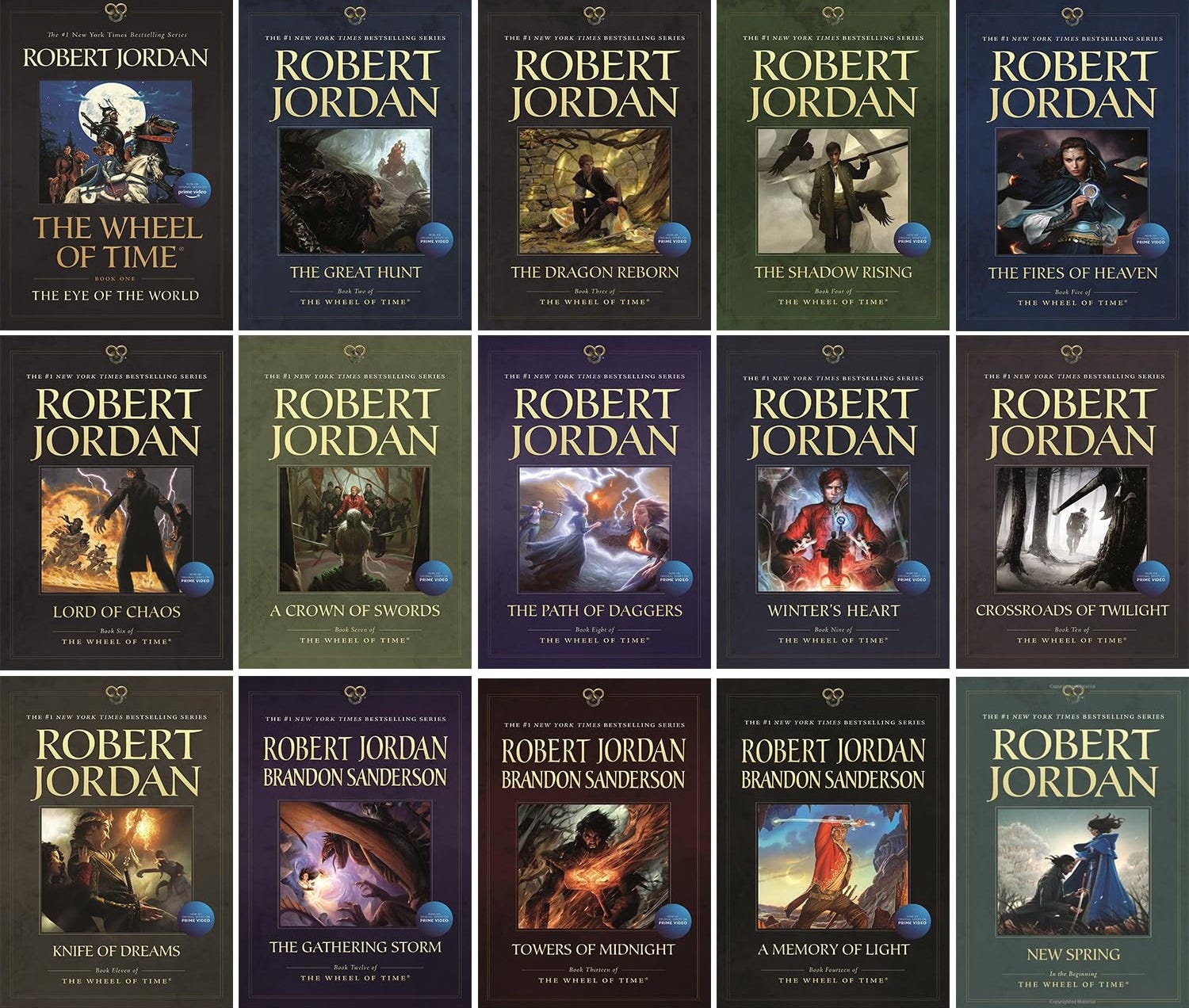
The Wheel of Time, a popular high fantasy book series, was created by Vietnam veteran and Conan writer James Oliver Rigney Jr. under the pen name Robert Jordan. Jordan wrote 11 books and a prequel novella between 1990 and his untimely death in 2007. The series was completed by Brandon Sanderson, who wrote 3 more books, finally completing the series in 2013. Amazon adapted the books into a television series a few years ago, which was widely criticized by the fanbase and got cancelled after three seasons. I haven’t seen the show, and this post doesn’t concern it. I’m only talking about the books here.
I can see why The Wheel of Time might be intimidating to a new reader. It’s probably the biggest fantasy book series ever written, with 14 books of about 800 pages on average. It has over 100 POVs and over 2000 named characters. With more books being published than ever before, and people having less and less time to read, you might be wondering whether picking up this series is worth it.
Honestly, I can’t answer that question for you. It was worth it for me — The Wheel of Time was my favorite fantasy series for a good three years until I got into Malazan in 2025. You might feel differently. The purpose of this post isn’t to convince you to read the series; it’s to lay out its strengths and flaws in a structured manner, and hopefully help you in making an informed decision.
The Wheel of Time turns, and ages come and pass, leaving memories that become legend. Legend fades to myth, and even myth is long forgotten when the Age that gave it birth comes again. In one Age, called the Third Age by some, an Age yet to come, an Age long past, a wind rose in the Mountains of Mist. The wind was not the beginning. There are neither beginnings nor endings to the turning of the Wheel of Time. But it was a beginning.
— first paragraph of The Eye of the World
The Wheel of Time is set in a cyclical high fantasy world (unnamed by Jordan but dubbed Randland by the fanbase) where a cosmic force of evil known as the Dark One is locked in an endless war with various reincarnations of a warrior known as the Dragon. Its main magic system is the One Power, an ability that only a select few can channel.
3000 years before the events of the series, the Dragon Lews Therin Telamon sealed the Dark One inside the mountain of Shayol Ghul. However, the Dark One tainted the One Power, driving every male channeler, including Lews Therin, insane. In the present day, female channelers form an order called the Aes Sedai, while male channelers are hunted and killed or driven insane by their powers.
The first book, The Eye of the World, begins with Aes Sedai Moiraine Damodred taking three teenage boys — Rand al’Thor, Matrim Cauthon, and Perrin Aybara — from the remote region of the Two Rivers, believing one of them to be the Dragon Reborn. They are accompanied by Moiraine’s Warder Lan Mandragoran, travelling gleeman Thom Merrilin, and young female channelers Egwene al’Vere and Nynaeve al’Meara. After Rand awakens his channeling abilities, Moiraine believes him to be the Dragon Reborn and tries to train him for the role while his new abilities begin to drive him insane.
This was the era where Robert Jordan was still finding his feet. Like a lot of fantasy books released at the time, The Eye of the World, The Great Hunt, and The Dragon Reborn all bear heavy influences from Tolkien and The Lord of the Rings. While they are fairly derivative, down to the names of the two deuteragonists, and nowhere near Jordan’s best works, they’re still fun to read.
To me, The Shadow Rising, The Fires of Heaven, and Lord of Chaos were Jordan at the height of his abilities. These are the books where he breaks away from Tolkien and finally hits his stride. Characters are fleshed out, the world and its cultures are expanded upon, and in general everything about The Wheel of Time that makes it great takes shape in these three books.
These books probably shouldn’t exist. But they do, and you can’t skip them, because they contain important plot stuff. Earlier books had largely self-contained arcs with huge climactic endings. In contrast, A Crown of Swords, The Path of Daggers, Winter’s Heart, and Crossroads of Twilight mainly consist of plotlines that drag on for several books. They end underwhelmingly or on cliffhangers, with so many subplots focusing on minor characters that the main story slows to a crawl. I will argue that Winter’s Heart is very good, but the other three are a huge step down in quality.
Knife of Dreams was Robert Jordan’s final book before his death from cardiac amyloidosis in 2007. It was a major turning point of the series and a huge step up from the previous books. This book sped up the main plot, satisfactorily resolved many of the long-running subplots of the slog, and delivered some massive payoffs to the main characters, setting the stage for the much-anticipated Last Battle. Jordan, knowing that he wouldn’t live to complete the series, left extensive notes on how he planned it to end in the hope that another writer would be able to wrap it up successfully.
Brandon Sanderson, then an up-and-coming author rather than the industry giant he is today, was chosen to finish the series after writing an eulogy to Jordan on his blog1. This might be a hot take, but I think The Gathering Storm, Towers of Midnight, and A Memory of Light are Sanderson’s best works. While some aspects of the books feel distinctly Sanderson, he does a fairly good job of adapting Jordan’s style and a very good job of wrapping up plotlines and character arcs in a satisfying manner. While I still wish we got Jordan’s version of the ending, I was extremely satisfied with the way Sanderson ended the series.
Something that makes The Wheel of Time feel unique is the way it blends different mythological and philosophical systems into a single cohesive cosmology. While drawing from many of the same Norse, Germanic and Anglo-Saxon mythologies as The Lord of the Rings, the series also incorporates Eastern concepts of cosmic balance and cycles of reincarnation. The eponymous Wheel of Time is based on Hindu and Buddhist ideas of the eternal return, wherein history repeats across vast periods. The series also uses a Taoist duality of complementary, opposing forces — embodied by the gendered halves of the magic system — and a Zoroastrian struggle between a benevolent Creator and an imprisoned evil entity.
This cosmological foundation allowed Jordan to pull off one of the most elaborate plots in fantasy history. The central plotline — the preparation of the world for the Last Battle — is introduced in the first book and maintained with a remarkable thematic consistency across millions of words. The story uses foreshadowing, dreams, and prophetic statements that pay off multiple books after their initial introduction. This creates a rewarding experience for the reader, where rereads reveal layers of story that are invisible during a first read.
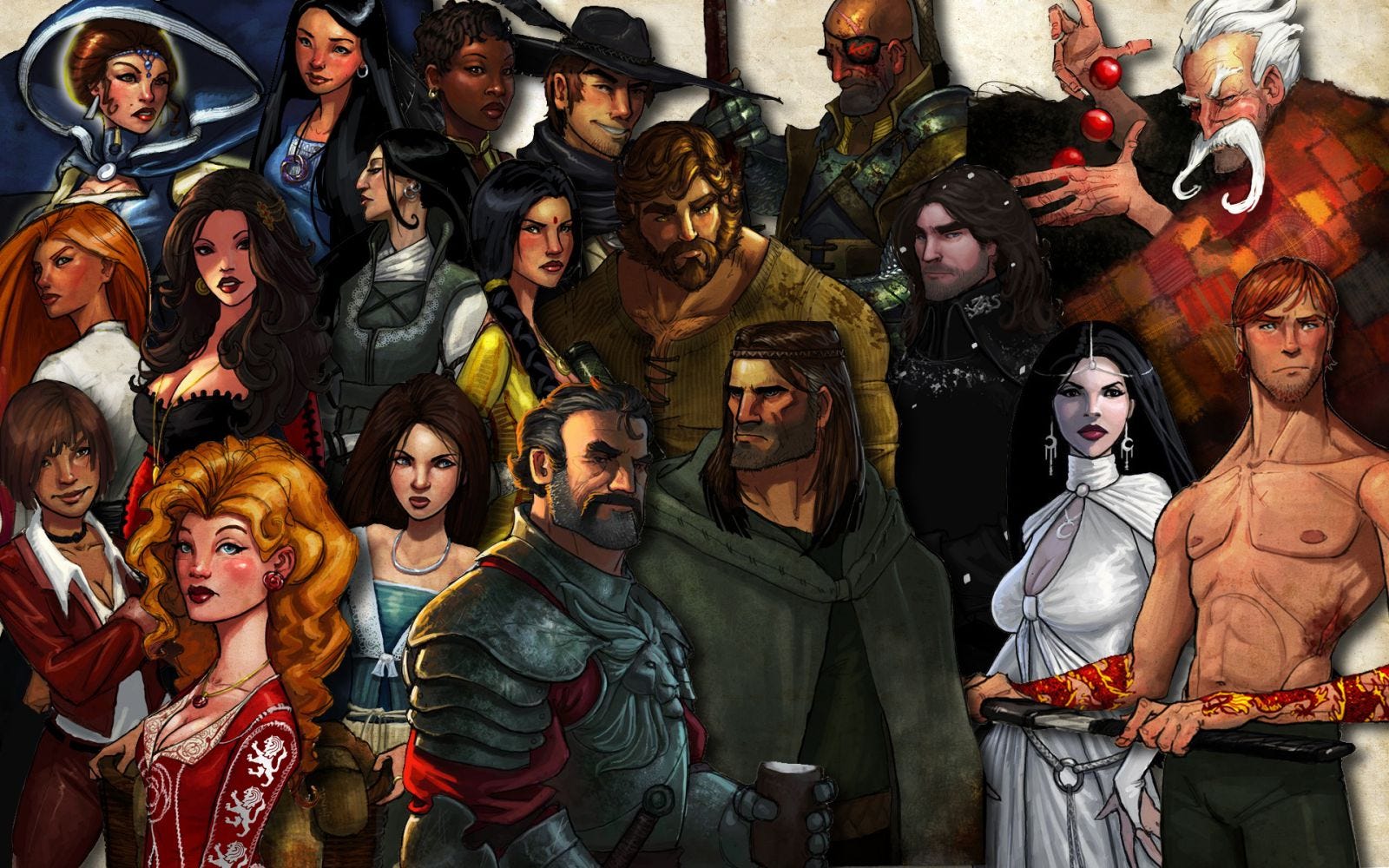
What makes the characters of The Wheel of Time truly great is not that they’re idealized paragons of heroic fantasy, but that they’re deeply flawed and realistic human beings. Jordan wrote the entire series in the third-person limited perspective. There is no omniscient narrator explaining the objective truth. Instead, every chapter is filtered through the cultural biases, personal insecurities, gendered prejudices, and limited knowledge of the POV character. This creates dramatic irony; characters constantly misinterpret each other's actions, leading to the interpersonal friction and political distrust that drives the plot.
In The Wheel of Time, what a character thinks, what they say, and what they actually do are often three completely different things. Characters frequently lie to themselves to protect their egos or mask their trauma, requiring the reader to pay close attention to their physical actions rather than just their internal monologues.
Unlike classical fantasy heroes who effortlessly shoulder the mantle of destiny, Jordan’s protagonists are deeply traumatized by the call to adventure. They suffer from anxiety, PTSD, paranoia, and, in the case of male channelers, progressive, magic-induced insanity. They resist their destinies, make catastrophic mistakes, and cling desperately to the memory of their simple, rural lives.
Because the series is over four million words long, character development is incredibly gradual. A character’s transformation from a naive village youth to a hard-bitten political ruler or battlefield commander takes place over thousands of pages, making their ultimate growth feel completely earned.
Here’s a brief overview the five main characters:
Rand al’Thor is a unique exploration of the “Chosen One” trope. Revealed to be the Dragon Reborn, Rand is prophesied to save the world from the Dark One, but destroy civilization in the process. Rand’s journey is defined by the terrifying mental burden of his destiny and the creeping madness of saidin. Through him, Jordan gave us a depiction of insanity and trauma treated with harrowing realism.
Mat Cauthon is the series’ most spectacularly untrustworthy narrator. In his internal monologue, he’s a self-serving rogue who actively runs from responsibilities and insists he’s “no bloody hero”. Yet, his physical actions are consistently, selflessly heroic. Cursed and blessed with supernatural luck and the memories of hundreds of dead military commanders, Mat is thrust into leadership. He goes from a gambling scoundrel to the brilliant leader of a mercenary group and, ultimately, the supreme commander of the armies of the Light, all while desperately trying to pretend he is just a simple cardplayer.
Perrin Aybara is a massive, quiet blacksmith’s apprentice with a dangerous bond with wolves. Because of his strength and connection to the wolves, Perrin is terrified of losing control and hurting those he loves. His arc is represented by his choice of weapons: the axe (animalistic violence and bloodlust) vs the hammer (creation and civilization). Unlike Rand, who rules by right of destiny and conquest, or Egwene, who pursues institutional power, Perrin is a leader because his people demand it.
Egwene al’Vere goes from an innkeeper’s daughter to one of the most powerful women in the world. Her strength lies in her adaptability; she absorbs the teachings of the Aes Sedai, the grueling discipline of the Aiel Wise Ones, and the secrets of the dream world. Egwene serves as the direct institutional counterpoint to Rand’s chaotic, destructive messianism, showcasing an unbreakable iron will. She refuses to bend under physical torture, using moral authority and intellectual superiority to unite a fractured sisterhood and lead the defense of civilization.
Nynaeve al’Meara begins as a young Village Wisdom who had to become fiercely abrasive to force older villagers to take her authority seriously. Furthermore, her channeling is restricted by a mental block: she can only channel when she’s angry. This creates a tragic positive reinforcement loop where Nynaeve is conditioned to seek out anger because it’s the only way she can access her power to save lives. Beneath her prickly, braid-tugging, and argumentative exterior, Nynaeve is one of the most genuinely kind characters in the series. Unlike other Aes Sedai, Nynaeve refuses to accept the cold calculus of war, her entire motivation being simply to protect the people she loves.
Robert Jordan didn’t just build a world; he created living, breathing cultures. He systematically detailed every society down to its specific currency, attitudes toward magic, local slang, and textile choices.
Jordan structured societies by testing how geography forces humans to adapt. For instance, a desert society must build its entire honor structure around the extreme scarcity of water. He never relied on generic exposition dumps; instead, cultures are explored through the eyes of characters. A house or clothing style is described in completely different terms depending on whether the viewpoint character is an Andoran farmer, a Cairhienin noble, or an Aiel warrior.
Some of the major cultures in Randland include:
The Aiel: The Aiel are fierce, honor-bound desert warriors living in the inhospitable Aiel Waste (probably based on the Fremen from Dune). Their society is entirely structured around a rigid, complex system of honor and obligation known as Ji’e’toh.
The Seanchan: An aggressive imperial superpower from across the ocean, the Seanchan feature a hyper-rigid, caste-based feudal empire ruled by absolute monarchs. They use exotic, engineered beasts for warfare and force women who can channel into slavery.
The Borderlands: Situated at the northernmost edge of the world, these nations exist as a shield against the existential threat of the Shadow-corrupted Blight. They are at constant war against the armies of the Dark One, and as such their culture is defined by martial discipline and duty.
Cairhien: A highly stratified, metropolitan nation where status is everything. The entire society is obsessed with Daes Dae’mar (the Great Game), an endless web of political maneuvering and social climbing.
The Wheel of Time’s main magic system, the One Power, represents a watershed moment in the transition toward hard magic in fantasy literature. Derived from the True Source, the power is strictly divided along binary gender lines: saidar for women and saidin for men. Jordan established precise rules and limitations for both halves of the power. The series also has a secondary soft magic system, where certain people can access and control the world of dreams, but Jordan generally uses this system well without it feeling like plot convenience.
Jordan also allows us to see the material consequences the magic system has on the world. Because male channelers are cursed with madness due to the ancient taint on saidin, the political order of Randland is defined by matriarchal hegemony and the fear and systemic extermination of men who can channel. The female Aes Sedai use their access to the One Power to operate as political arbiters and advisors to monarchs, weaving a complex web of global influence.
While the series begins as a standard quest story heavily influenced by The Lord of the Rings, it rapidly evolves into a deconstruction of the Chosen One trope. Rand’s mental state is heavily explored. Rand is a teenager wielding a power that he doesn’t understand and can’t control, one that is vilified and feared by his people and is slowly driving him insane. On top of that comes his destiny to save the world — a world that alternates between fearing him, trying to control him, and demanding that he die so that they may live. Jordan didn’t shy away from the effect this had on him.
Jordan explored the isolation and mental load that came with Rand’s messianic burden. His character arc is defined by a descent into paranoia and emotional withdrawal, exacerbated by the progressive madness of saidin and his hallucinations of his past life. The story treats his mental health with a level of realism and weight that was rare in epic fantasy at the time.
The benevolent, wise mentor is another fantasy staple that Jordan systematically dismantled. In classic narratives, the mentor provides a safe haven of wisdom and absolute truth. In The Wheel of Time, the primary mentor figure, Moiraine Damodred, is viewed by characters and the reader with mistrust rather than reverence.
From the first book, the young protagonists quickly realize they are not being nurtured, but are instead being used as pawns in a high-stakes, centuries-old chess match with the world at stake. Moiraine openly admits that she would rather see them dead than fall into the hands of the enemy, and she’s one of the better mentor figures in the series. While she’s focused on the greater good, she still cares about her charges. The other Aes Sedai are either more focused on gaining political power than fighting the Dark One, or they are hamstrung by their own arrogance and biases.
This reflects a broader deconstruction of fantasy geopolitics. In traditional epic fantasy, the threat of an existential evil naturally unites humanity. Jordan rejected this romanticism in favor of geopolitical realism. As the Last Battle approaches, the people of the world don’t unite; instead, nations double down on petty civil wars, merchants hoard grain for profit, and aristocratic factions vie for thrones. Jordan demonstrated that institutional inertia and human stubbornness and self-interest are much more potent forces than any unifying moral imperative, making the political struggle to unite humanity far more difficult than the eventual battle against evil itself.
I already wrote about this when discussing the series’ different eras. The term was coined during the original publication, when readers had to wait years between the releases of books 7 through 10. However, the underlying issues remain present in the text to confound new readers. These are the books where Jordan began introducing new plotlines without resolving old ones. The slog’s narrative focus shifts from the main fight against the Dark Ones to various semi-unrelated and increasingly uninteresting subplots, including a succession crisis, the rescue of kidnapped characters, and the political machinations and schisms of the Aes Sedai.
The Wheel of Time falls into this weird niche where it was progressive for the time it was written in, but would probably get cancelled on Twitter if it came out today. It takes place in a largely matriarchal world where interesting, flawed female characters hold both institutional and magical power, and are just as likely to abuse that power as men would be in that position. However, Jordan wrote gender division with a rigid essentialism that is deeply ingrained into both the magic system and the behavior of the characters.
The magic system dictates that men must control saidin by fighting and conquering it, while women must control saidar by surrendering and submitting to it. This binary split extends to Jordan’s depiction of both genders. Women frequently view men as stubborn, foolish, and hot-headed children who must be subtly guided or outright manipulated for their own good, while men view women as frustratingly secretive, overly complicated, and prone to changing their minds without reason.
This is generally played for laughs; a running gag in the series is that men and women will complain about how much the other gossips... all the while gossiping themselves. For me, it got irritating really quick when characters couldn’t go five pages without commenting about how annoying and/or stupid the other gender is.
One of the later books also contains a plotline where a male main character gets held at knifepoint and raped by a female character, who then forces him into a relationship. The whole thing is played for laughs, and the story seems to gloss over the whole thing by later showing that the male character is into it. And… yeah. 😬
This one might just be a personal thing. It ties somewhat into my previous point, but I just couldn’t get invested into the major romances of The Wheel of Time. There’s a popular romance that most of the fanbase absolutely loves (I can’t tell you what it is without spoiling, but you’ll figure it out from the first book itself) that I just don’t care about. I like the characters individually, I just don’t care about them getting together.
The main characters’ romance arcs are even worse to me. Out of Rand’s three major love interests, I dislike one’s interactions with him and another’s entire character. Mat jumps from one toxic relationship to the next, and Perrin stays in a single toxic relationship for the entire series. Off the top of my head, I can’t think of a single romance in the series I truly cared about.
Robert Jordan’s style of prose is florid, slow-paced, and highly descriptive. He had a tendency to spend extensive paragraphs — and sometimes full pages — detailing clothing, scenery, architecture, and other minutiae. Sometimes, it works well. Often, it doesn’t. This is mostly the case with character descriptions. To convey characters’ internal states, Jordan relied on a very limited set of physical gestures — most notoriously, female characters constantly tugging their braids or smoothing their skirts. A significant chunk of the series’ word count probably went into these descriptions, which unnecessarily slowed down the pacing of the books and the series as a whole.
I know, I know, every series needs some degree of plot armor for the story to work, but most don’t use them this egregiously. The Wheel of Time’s plot armor is literally baked into its magic system. Rand, Mat and Perrin are all ta’veren, people important to the Pattern of Ages. This causes highly improbable and even absurd events to happen around them, such as extraordinary luck, spontaneous alliances, and uncanny coincidences that align with the ta'veren's goals. This can often make their achievements feel contrived, a matter of plot convenience rather than their own efforts. Mat largely avoids this, but Rand and Perrin often fall victim to it.
Another major aspect where the series’ plot convenience shows through is with how comedically incompetent its villains are. The Forsaken are thirteen powerful channelers from the Age of Legends, built up as terrifying semi-mythical figures. However, the story largely depicts them as cartoonishly arrogant, underwhelming, and ineffectual. Because they view the people of the Third Age as primitive, they routinely underestimate the protagonists and learn nothing from getting their asses handed to them.
It doesn’t help that the Forsaken spend more time plotting against each other than they do against the good guys. On the rare occasions when they have the drop on our protagonists, they’re either immediately betrayed or hamstrung by their own narcissism and inability to cooperate. While this infighting is realistic for characters driven purely by greed and ambition, it significantly reduces their effectiveness as a threat and their ability to be genuinely frightening to the readers.
I think Daniel Greene put it best when describing what makes The Wheel of Time worth reading:
The Wheel of Time is the pinnacle evolution of the classic fantasy genre, and manages to blend the strengths of said classic fantasy genre while simultaneously ushering in a new age for fantasy by raising the bar of what fantasy could have been and setting the trends for what we consider the modern fantasy genre today.
I think The Wheel of Time has a little of something everyone can enjoy. It’s got big epic wars. It’s got classic good vs evil. It’s got moral complexity and grayness too. It’s got intense magical duels. It’s got sex and political intrigue. It’s got talking animal companions. At the same time, it’s got a lot of flaws, and even without them, it’s not for everyone. If you’re mainly interested in rapid plot progression, streamlined narratives, or polished, modern prose, the series’ flaws will likely outweigh its virtues.
So, yeah. Decide for yourself.
Comments
Nothing yet. Say the first thing.
Sign in to join the conversation.