
This one hurt to write. Naruto is one of my favorite anime of all time. I know engagement with the series is at a low point right now, what with the sequel anime being on hiatus (and also terrible) and there not being any new material to talk about. Still, Naruto is big enough to have retained a large and dedicated fanbase, one that I have been a part of since I was 14 and am probably about to royally piss off. Whenever I’ve returned to the series over the past year or so, something about it left me unsatisfied. I couldn’t put a finger on what it was for a long time, until I finally realized what was bothering me so much: Naruto is terrible at writing political conflict.
A lot of you will probably say that it’s not that deep or that I have unrealistic expectations. Naruto isn’t Game of Thrones. It’s a coming-of-age battle shonen anime, not a political drama. I shouldn’t condemn it or expect it to be something that it isn’t.
I heavily disagree with this line of thought, because Naruto is very political. Not in the sense that “all art is implicitly political”, but in the sense that Masashi Kishimoto explicitly tried to weave his politics into his story. My issue lies with Kishimoto’s proposed solutions to the political problems he’s introduced being wildly unrealistic, and that actively taking away from my enjoyment of the story. I know, I know; nothing about Naruto is even remotely realistic. This still irritated me. If you don’t want to read me complain, feel free to click off.
Some of you will probably also hit me with the good old “anime isn’t political”. There’s this widespread idea that international fans are somehow shoving their politics into anime, because obviously the Japanese have no politics of their own! After all, Japan is just an island full of magical girls and katanas, and it’s not like katanas were ever used in wars, they’re just cool swords! I can’t believe someone could watch anime like One Piece and Attack on Titan, or Ghibli films like Grave of the Fireflies, and actually believe that they have political themes! Truly, these soyjaks will not rest until they’ve pushed their woke transgender agenda into every media imaginable!
This is sarcasm, in case you couldn’t tell.
The first few arcs of Naruto, while still uplifting battle shonen bildungsroman, took place in a surprisingly dark and gritty world. Kishimoto used the early arcs to show that Naruto’s geopolitical system was built on a mercenary economy, state-sanctioned child soldiers, and the systemic marginalization and exploitation of its minorities.
And then Kishimoto spent most of Naruto: Shippuden desperately backtracking, trying to blame everything wrong with the ninja world in general and the Hidden Leaf Village in particular on a handful of bad actors, and trying to posit assimilation within the current system as the only moral path. As a result, the series’ messaging made a baffling transition into chest-thumping nationalism and glorification of sacrifice for the sake of the state.
I don’t know if Kishimoto’s philosophy changed as he grew older and more famous, or if some higher-ups in the industry didn’t like his original ideas taken to their logical conclusion, but the end result is undeniable and a large part of why I was so disappointed with how the series ended.
The conflict between the Hidden Leaf and the Uchiha clan is one of the story’s most glaring failures when it comes to writing politics. The story establishes in great detail how the Uchiha were marginalized by the village. The Second Hokage placed the Uchiha in charge of the military police force, a political maneuver designed to exclude them from governance while breeding resentment between the clan and the general civilian population. Years later, Danzo Shimura and the village elders blamed the clan for the Nine-Tails attack that killed the Fourth Hokage, forcing the clan into a walled-off compound and essentially segregating them from the rest of the village. The clan was subjected to constant surveillance by the Anbu, stripping them of both political agency and civil liberties.
The Uchiha’s planned coup d’état was a natural response to the marginalization they faced. However, rather than addressing it as a failure of Konoha’s government, the story shifts the blame onto the Uchiha themselves. It does this through the concept of the “Curse of Hatred”— a pseudoscientific theory coined by the Second Hokage which claims that the Uchiha are genetically predisposed to madness and violence due to the Sharingan.
]This switch to biological determinism reframes a political struggle over civil rights as a genetic defect. By establishing the Uchiha as biologically dangerous, the narrative justifies their oppression. By claiming that their fight for rights would cause another Great Ninja War, it justifies their genocide.
Itachi Uchiha, who slaughtered his entire clan (including children and non-combatants) on the orders of Konoha’s elders, is consistently framed by the narrative as a tragic, self-sacrificing hero. Prominent historical figures that the audience is supposed to like and agree with, including the resurrected Hokage and Naruto himself, praise Itachi’s actions as the pinnacle of patriotism. Even Itachi’s own parents are lobotomized by Kishimoto and spend their last moments praising Itachi for his selfless service towards the village that oppressed their family.
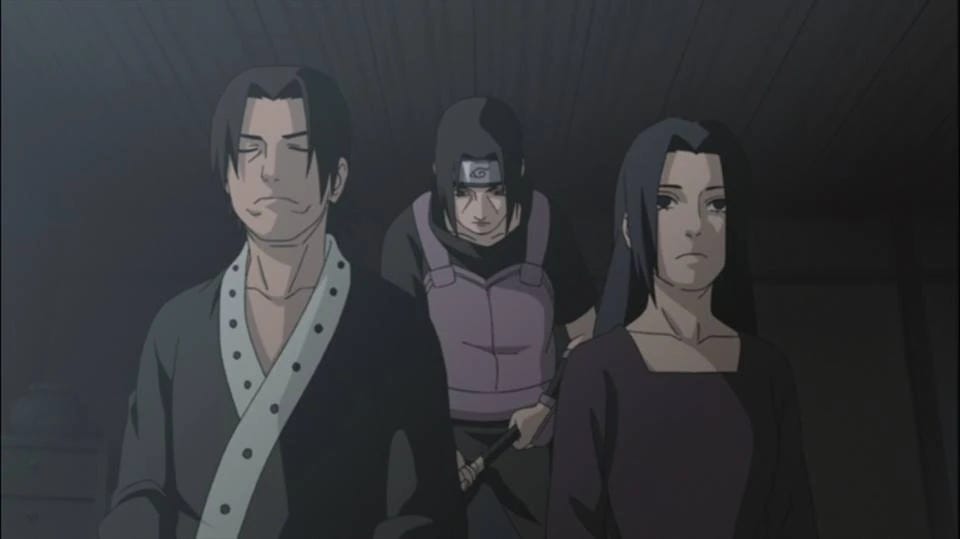
The “Will of Fire” is a recurring theme of the series and the philosophy that the ninja of Konoha are supposed to live by. It states that the entire village is like a large family unit and every Konoha shinobi with the Will of Fire loves, believes, cherishes, and fights to protect the village, as previous generations had done before them. A lot of fans were swept up in the grandeur of the idea without realizing how manipulative it really was. In practice, the leaders of Konoha use this ideology to demand unquestioning obedience from their (often child) soldiers. The series unintentionally posits the Will of Fire as the absolute submission of the individual to the state, with them justifying any atrocity, including ethnic cleansing, in the name of Konoha’s security and “the greater good”.
With the story praising the Will of Fire as a moral and righteous path to follow, it also silences the Uchiha victims entirely. While the later arcs of Shippuden heavily abuse resurrection to bring back characters like the dead Hokage and Itachi, the victims of his massacre are never resurrected to tell their side of the story. The surviving conspirators of the genocide — the Leaf Village elders — remain in power throughout the series, and the story never tries to punish them or even address their role in the massacre.
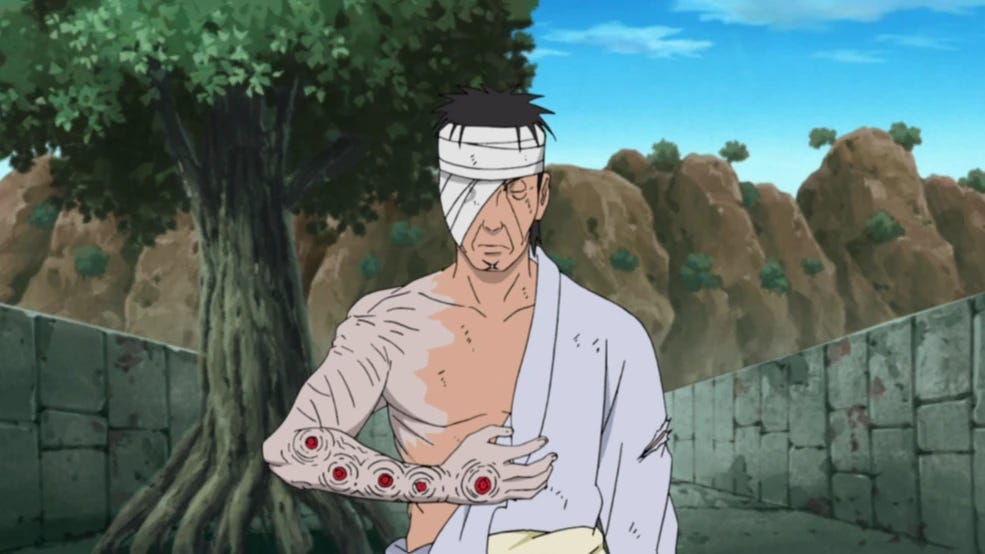
Like most Naruto fans, I hate Danzo Shimura, but probably not for the reasons you’re thinking of. To me, Danzo’s entire characterization feels like narrative cowardice stemming from Kishimoto’s desire to exonerate the Hidden Leaf Village. Let me explain:
The four past Hokage, despite being the leaders of Konoha and in theory responsible for all its crimes, are nevertheless framed as good people. Hashirama and Minato are charismatic goofballs much like Naruto himself. I’ve written before about my issues with Hiruzen’s characterization. Even Tobirama, whose inability to bury his grudge with the Uchiha sowed the seeds for their eventual massacre, is never really criticized by the story or its characters, his discrimination framed as brutal pragmatism at best and justifiable hatred at worst. In order to not hold the Hokage responsible for Konoha’s problems, Kishimoto needed a scapegoat. To that effect, he created Danzo Shimura.
Danzo reminds me of American cop shows trying to handle issues of police corruption and racism. Stay with me, it’ll make sense in a second. Generally, these shows do this by depicting one or more corrupt/racist officers who are taken down by our righteous police heroes at the end of their arcs. Essentially, these stories try to paint problems within the police force as a matter of a few bad apples rather than a system designed to protect them and keep them in power. Danzo is basically the same thing: a strawman that Kishimoto somehow made personally responsible for everything wrong with the Leaf Village.
The Uchiha massacre was a proof of Konoha’s corruption and a result of its failure to trust the Uchiha and grant them the rights they deserved? Nope, Danzo orchestrated the entire thing to get his hands on the Sharingan! Naruto’s treatment as a child reveals Konoha’s willingness to use an orphaned child as a weapon of mass destruction while simultaneously ostracizing him? Nope, Danzo leaked that Naruto was the Nine-Tails host, so it’s his fault! (Don’t think about how the villagers actively chose to treat Naruto the way they did! Just look at how happy Naruto is when they actually treat him like a person!) Why address the fact that the village forces child soldiers to fight to the death as a display of military power when you can show that Danzo treats his own private child soldier militia even worse?
Danzo is essentially a get-out-of-jail-free card, a way for Kishimoto to pin all the blame on a single bad apple he could then kill off to avoid having to address the wider systemic issues in the world he created. Except it doesn’t really work, because a) Konoha’s problems existed long before Danzo was born and b) everything Danzo did, he did with the implicit consent of the Third Hokage and the village elders. At best, Danzo is just a symptom of the Hidden Leaf’s wider problems. Kishimoto tried to pass him off as the root cause, and a large part of the audience didn’t really question it.
Kishimoto’s solution to Konoha’s problems is similarly individualistic: making Tsunade/Kakashi/Naruto Hokage, where it’s implicitly assumed that they’re fixing all of Konoha’s problems offscreen even though we never see them addressing said problems. Because you see, there’s nothing actually wrong with the system, we just need to put the good guys in charge! Just ignore that the people previously in charge were supposedly good guys, and all the present problems were caused under their regimes!
The main mechanism of conflict resolution in Naruto is popularly known as “Talk no Jutsu”— Naruto’s ability to convert enemies to his cause by sharing his personal experiences of trauma and offering unconditional empathy. While these talks work on a personal and emotional level, they fail completely as tools of political resolution because they translate historical grievances into the psychological crises of a handful of villains.
This failure is most evident in the Pain Arc. The arc’s antagonist, Nagato shows Naruto the problems within the geopolitical system that Konoha is complicit in. He explains that the prosperity of the Five Great Nations is directly built on the exploitation of smaller, peripheral countries like Amegakure, which are used as battlegrounds for their proxy wars.
When pressed for a logical alternative to Nagato’s (admittedly unhinged) solution, Naruto admits that he has no answer. He simply demands that Nagato abandon his plans and “believe in him” because he will find an answer in the future. Amazingly, Nagato — a hardened, decades-long international terrorist who has witnessed his family, friends, and country destroyed by Konoha’s imperialist policies — unilaterally surrenders his life’s work on blind faith in a teenager.
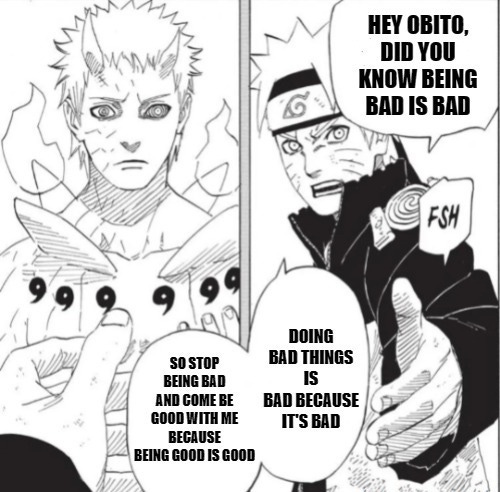
Nagato then uses a deus ex machina to resurrect every civilian and ninja killed during his invasion of the Leaf Village. To me, this felt like a cop-out. By erasing the physical consequences of Nagato’s assault, the story ensures that Naruto and the Hidden Leaf never have to confront the costs of their foreign policy. It avoids the difficult ethical question of how a state should reconcile with the victims of its imperialism and violence. Instead, the victim sacrifices himself to resurrect his oppressors, and the status quo of the Leaf Village is restored without a single policy change or concession to Amegakure.
In the aftermath of the Pain’s Assault arc, Naruto goes from social outcast to village hero overnight. On one hand, the village’s validation is everything he’s ever wanted. On the other hand, a part of him is naturally resentful at the people who treated him like a monster his entire childhood only to suck up to him the moment he became popular. Naruto has an entire arc about confronting his inner darkness and letting go of his hatred towards the people who ostracized him.
And you know what, good for him! I think Kishimoto had a point about how holding on to hatred is self-destructive and can hurt the good causes you’re trying to fight for. My problem isn’t that Naruto forgave the people of Konoha. My problem is that those people never acknowledged that the way they treated Naruto was wrong or ever expressed any remorse. Sure, Iruka and Naruto’s friends in the Konoha 11 did show some remorse, but there’s no indicator that the ordinary citizens of Konoha would treat another kid in Naruto’s situation any better than they treated him.
This ties into Naruto’s wider trend of glorifying conformity to the state. Characters like Itachi and Kakashi, who sacrificed everything for Konoha even though they were marginalized and mistreated by the village, are glorified by the story and characters. Naruto is the same. His entire reason for becoming Hokage was to seek validation from the people who hated him. And they do start to love him — once he becomes useful to them. The audience is supposed to see this as a triumphant moment. Somehow, I can no longer see it that way.
This trend towards conformity also heavily affects the dynamic between Naruto and Sasuke. Most of their interactions in Shippuden are Naruto demanding/begging Sasuke to come back to Konoha. This doesn’t really change when Sasuke learns the truth about his family. It absolutely baffles me how Sasuke can tell Naruto “the village you serve oppressed my people for years and forced my 13-year-old brother to murder my whole family when they tried to fight back” and Naruto will respond with “come back anyway”. And Sasuke’s arc somehow ends with him coming back, forgiving Konoha for killing his family, and trying to reform it (meanwhile, all the people he hurt unconditionally forgive him, which is a whole other can of worms).
This ties into how the story doesn’t allow any character to leave their village and still remain good guys. Any characters who oppose Konoha, no matter how justified they are immediately get lobotomized by Kishimoto and turned into gleeful war criminals. While they point out flaws in the systems, their solutions are too unhinged for the viewer to even attempt to believe that they want to end the cycle of war. Sasuke’s plan was to take over the world and rule as a dictator. Obito’s plan was to trap everyone in the world in a genjutsu and drain their chakra. Nagato’s plan was to make the Great Nations understand the horrors of war by essentially using weapons of mass destruction on all of them once.
This framing feels disingenuous, as Kishimoto uses it to create a false dichotomy: either you support Konoha, and fight for it despite all its flaws and everything it has done to you, personally, or you are evil. There’s nothing wrong with Naruto wanting to reform the system from the inside, which is implied in the end but never really shown. The problem is that Kishimoto doesn’t allow for a gray area. Anyone who decides that they don’t want to work for Konoha, that they want to openly oppose its oppressive policies or just walk away from it entirely, gets a character assassination and begins kicking puppies.
Conversely, any villain who gets the Talk no Jutsu treatment and rejoins Konoha is instantly forgiven. Orochimaru spent years performing human experimentation and kidnapping and murdering children. Sasuke tried to kidnap Killer Bee, repeatedly tried to kill his supposed friends, and tried to take over the world at the end of the series. Both were forgiven instantly once they rejoined Konoha and were given no consequences for their actions. This reinforces the framing that anyone who sides with the state is automatically good and anyone who sides against it is automatically evil.
Sasuke’s final thoughts in the series epilogue seem to be Kishimoto’s final thesis:
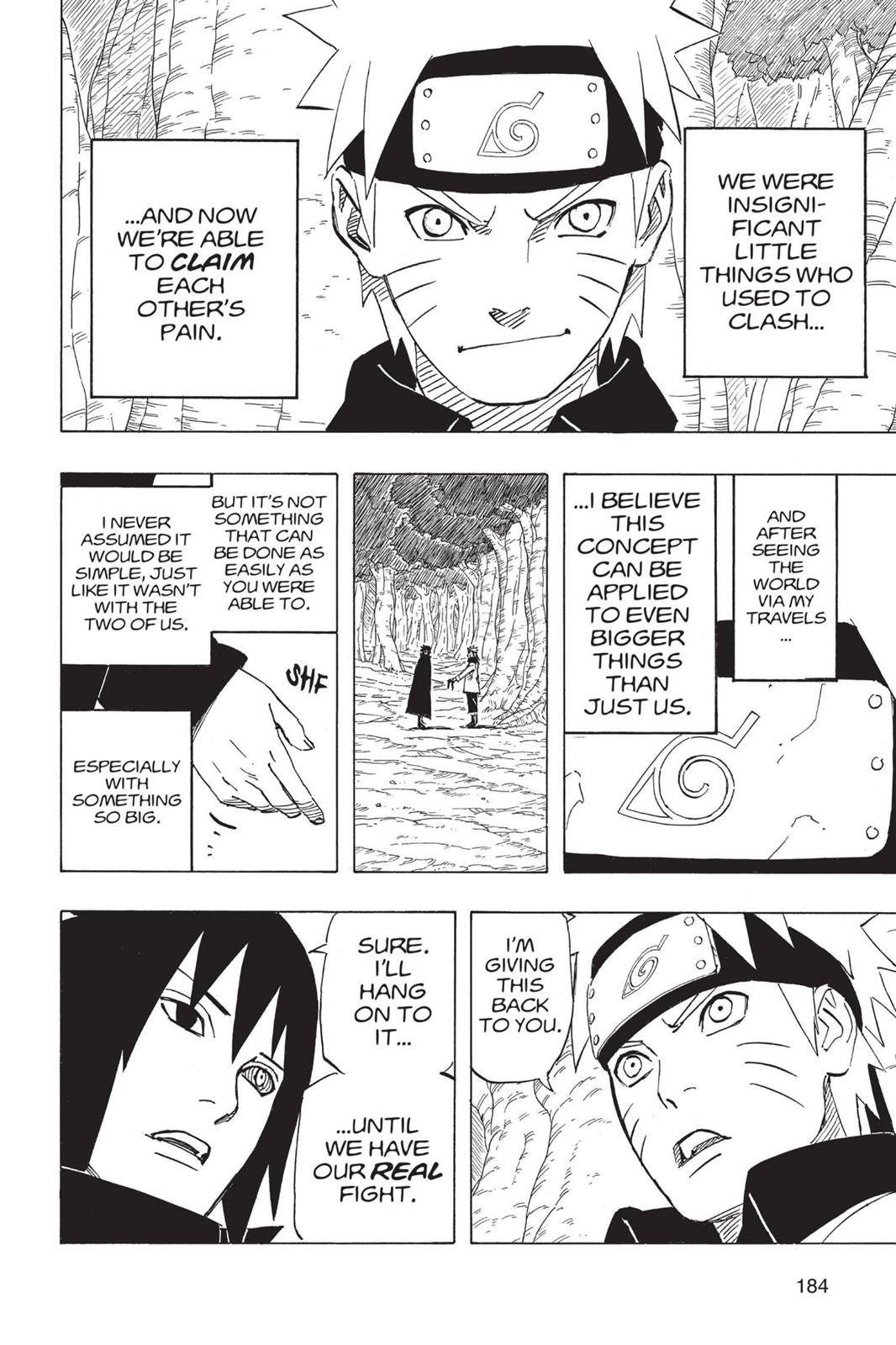
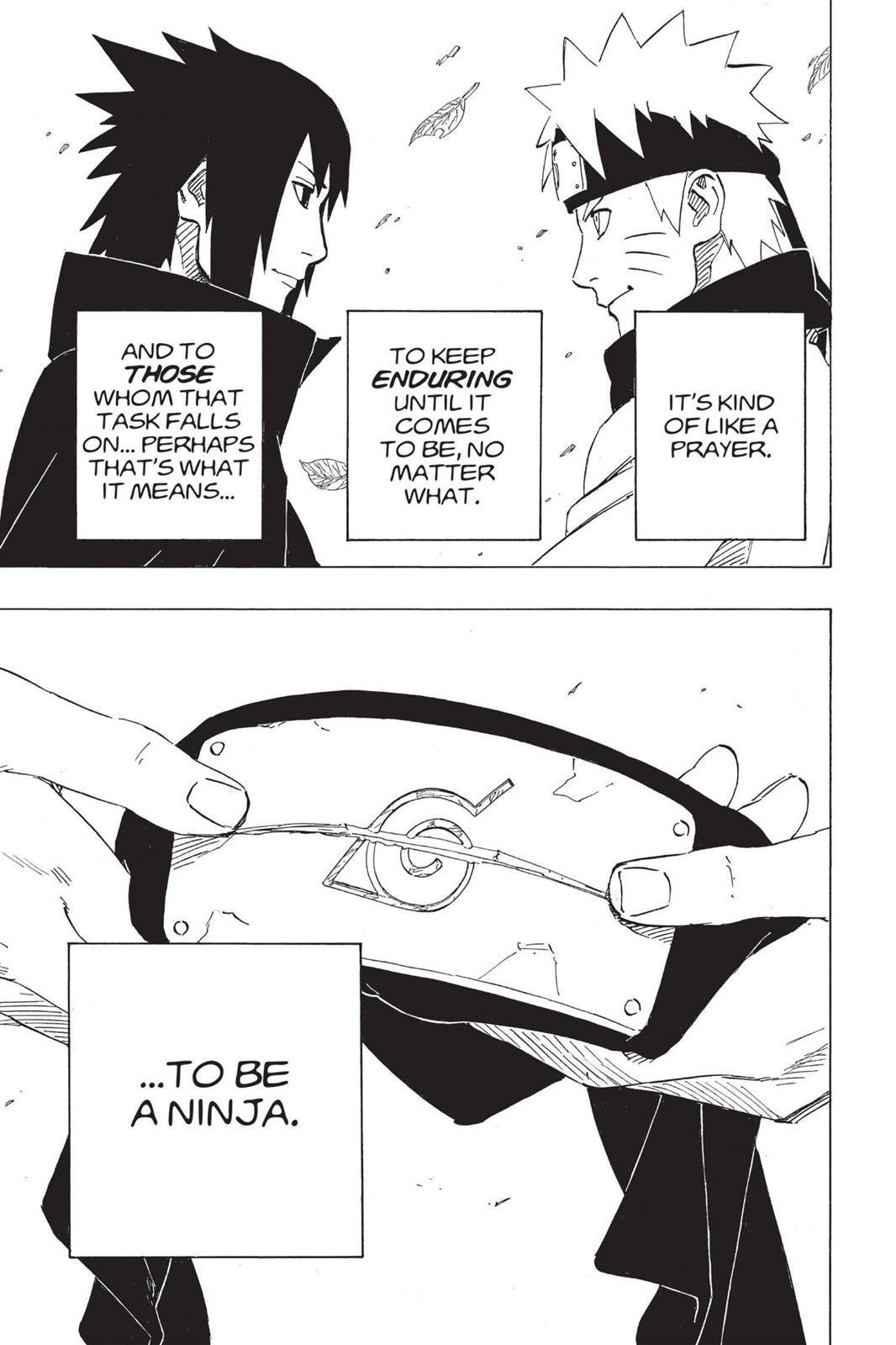
Sasuke’s basically saying that meaningful connections, like the one between him and Naruto, can bring peace and understanding. He believes that the same concept can be applied to establishing peace between the nations. He acknowledges that change from within the system takes time and effort, and they need the fortitude to endure until the ninja world finally changes.
Personally, I don’t think it’s fair to tell victims of systemic oppression that they need to “endure” while they wait for culture to slowly catch up and stop oppressing them. Telling people who are being actively exploited as second-class citizens, child soldiers, and human weapons, that they must patiently wait for a slow cultural shift is nothing but a defense of the status quo. When the narrative frames endurance as the ultimate virtue, it places the moral burden entirely on the victims to tolerate their suffering.
Furthermore, the peace Naruto builds as Hokage relies entirely on his own benevolence and godlike power. Naruto’s new era is similar to the system established by Hashirama Senju, who used his power to act as a deterrent to global conflict. When Hashirama died, the system collapsed into decades of war because the underlying institutions — the mercenary economies and reliance on child soldiers — were never restructured. By focusing on reaching the hearts of individual Kage rather than building transparent, democratic, and demilitarized international institutions, Naruto simply repeats the mistakes of his predecessors.
Ultimately, the argument that Naruto is successful at telling a story about gradual cultural change fails because the narrative consistently protects the oppressors and punishes the victims. Naruto vilifies any character who demands immediate, radical change. Conversely, redemption is only granted to those who assimilate back into the state. The Leaf village elders who actively orchestrated and authorized the Uchiha genocide remain in power, completely unpunished and unaddressed, throughout the entire run of Shippuden and into Boruto. People like Tobirama and Hiruzen, who oversaw the system that marginalized the Uchiha and actively enabled Danzo’s atrocities, are glorified as patriotic heroes. To me, Kishimoto’s refusal to hold these figures responsible for their actions feels emblematic of his wider refusal to hold the state accountable.
Naruto’s greatest strength, in my opinion, is its ability to appeal to emotions. There’s something universal in this story about a young social outcast finding people who love and respect him. It’s what makes people root for Naruto. It’s also what keeps many of them from recognizing the series’ flaws.
And Naruto does have flaws. The story introduces all these complex political plotlines only to try and resolve them with spiritual platitudes and individualized character arcs. By defining virtue as the willingness of the oppressed to patiently endure their exploitation until things one day get better, Naruto only presents a defense of the status quo, with no concrete path toward meaningful change; proving that for all its complex geopolitics and worldbuilding, the series is incapable of writing genuine political resolution.
Comments
Nothing yet. Say the first thing.
Sign in to join the conversation.