
When digital imaging disrupted the photographic film market in the late 1990s and early 2000s, Fujifilm Group recognized that its core business was in structural decline. The company responded with a comprehensive transformation, cutting costs in legacy businesses while reinvesting in new growth areas, including healthcare and medical imaging.
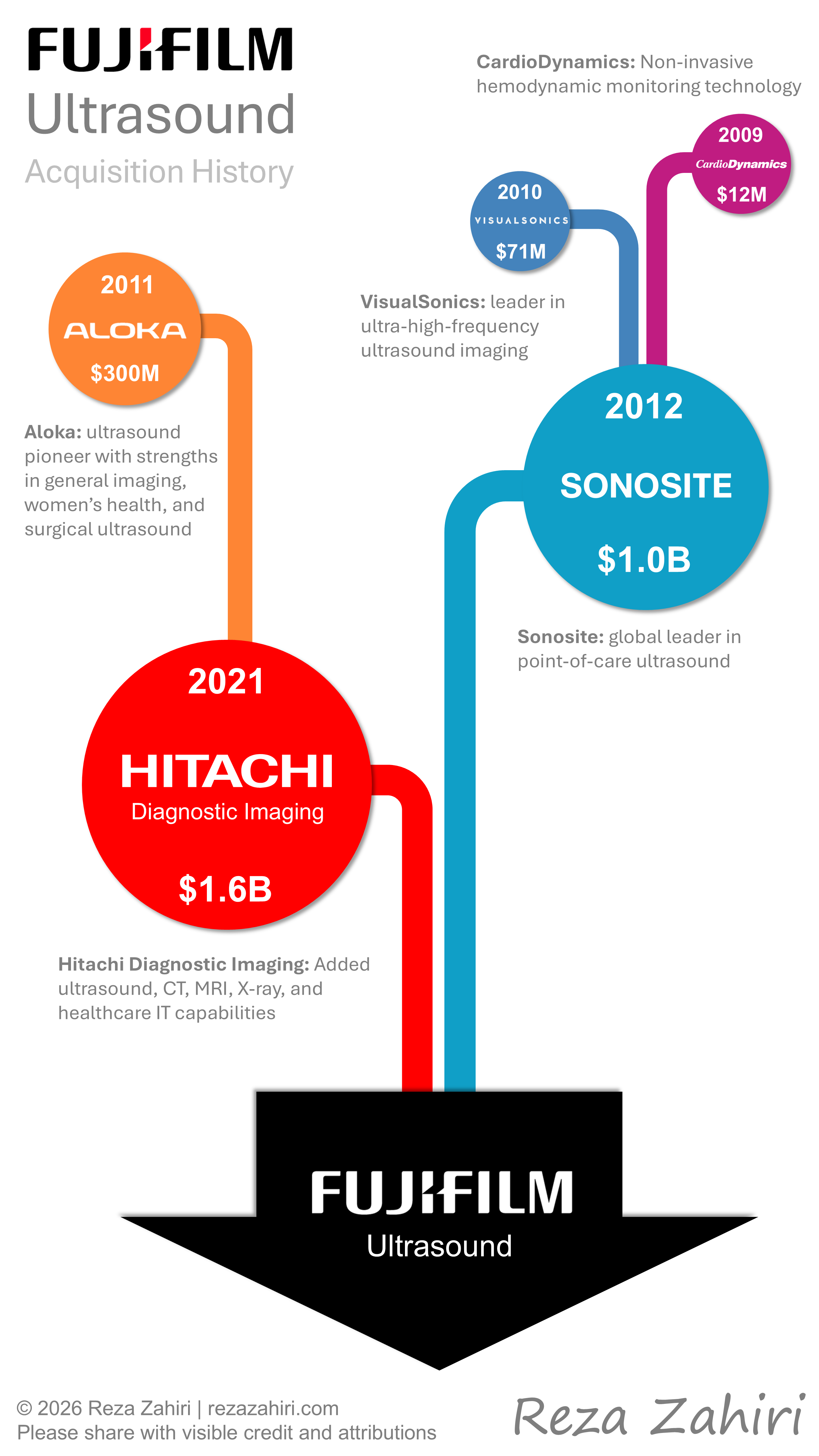
FUJIFILM acquired SonoSite for approximately $1.0B, establishing a major position in point-of-care ultrasound. SonoSite had already expanded its capabilities through acquisitions, including CardioDynamics, which added non-invasive hemodynamic monitoring, and VisualSonics for $71M, which added ultra-high-frequency preclinical ultrasound imaging. Today, FUJIFILM Sonosite, Inc. has over 5% of global ultrasound market share.
FUJIFILM pursued an even larger expansion opportunity in 2016 when it competed to acquire Toshiba Medical Systems, one of the world’s major medical imaging companies. Ultimately, Canon won the bidding and acquired Toshiba Medical for ¥665B, roughly US$6B.
In 2011, Hitachi acquired Aloka for approximately $300M, combining Hitachi Medical’s imaging portfolio with Aloka’s long-standing ultrasound capabilities, particularly in general imaging, women’s health, and surgical ultrasound. A decade later, FUJIFILM acquired Hitachi’s Diagnostic Imaging business for ¥179B, approximately $1.6B. The transaction significantly broadened FUJIFILM’s medical imaging portfolio across ultrasound, CT, MRI, X-ray, and healthcare IT, while also bringing the Aloka ultrasound heritage into the company.
FUJIFILM’s position in ultrasound was not created organically or through a single acquisition. It was assembled over more than a decade through a series of targeted acquisitions. The result is a diverse portfolio spanning point-of-care, general imaging, women’s health, surgical applications, and ultra-high-frequency imaging. Today, FUJIFILM holds more than 10% of the global ultrasound equipment market, placing it among the industry’s three largest players. The lesson is bigger than ultrasound. A company that made photographic films for 70 years became a top-tier medical imaging player not through one bold bet, but through patient and disciplined M&A.
No posts
Comments
Nothing yet. Say the first thing.
Sign in to join the conversation.