
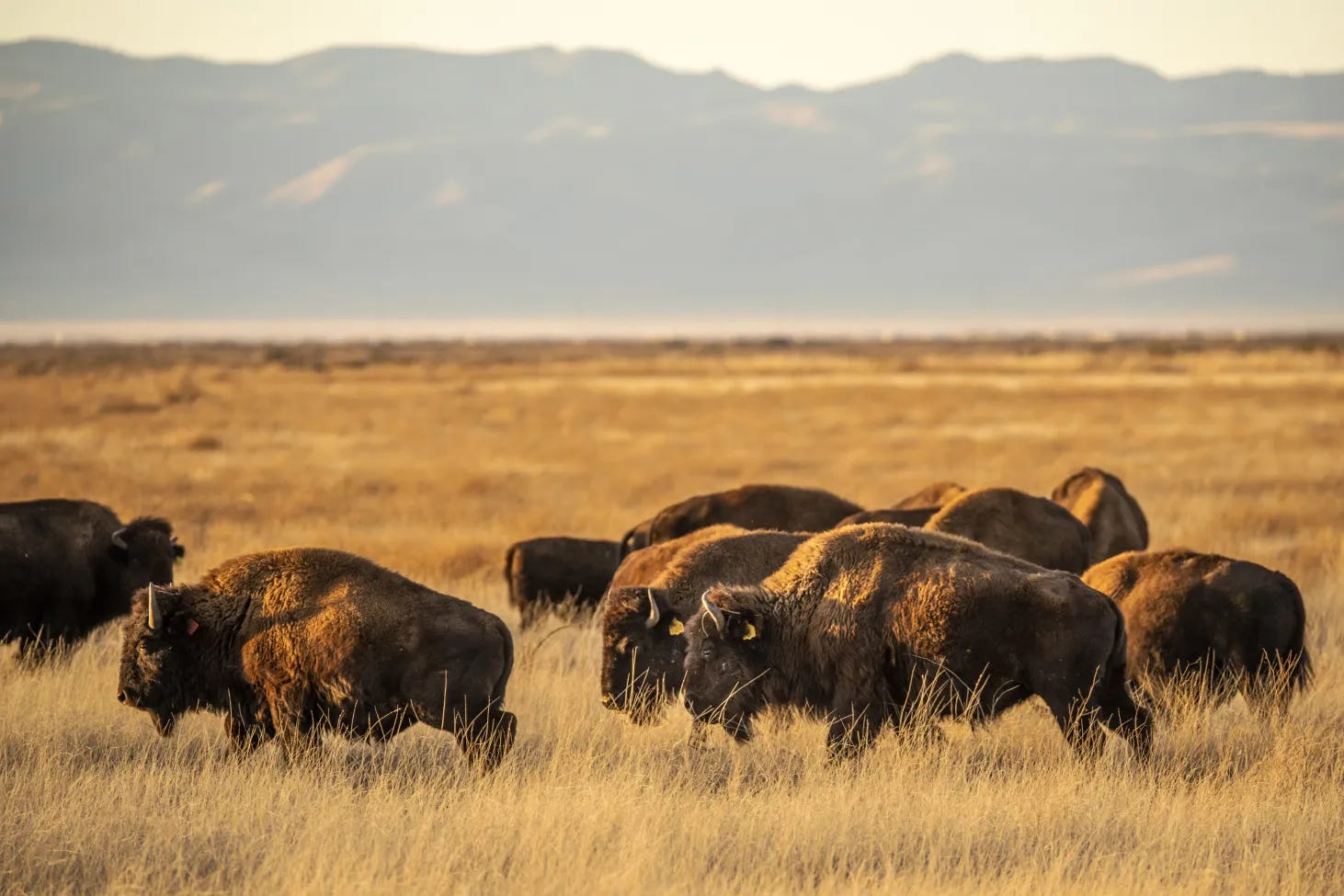
As little as one hundred a fifty years ago, an estimated 60 million American bison roamed the wild lands of North America in huge herds. Then the whole Manifest Destiny wave rolled across those lands and White Man found one insidious and deadly way after another to get Native tribes out of the way. There were slaughters and massacres, countless lies and countless treaties, and those invariably broken by the new arrivals to the continent before the ink was dry.

Likely the most insidious act of all was the conscious decision to slaughter all bison, because these represented for many American Indians their way of life, it was culture and tradition, it was spiritual practice - and of course it was an essential source of food and clothing and even tools. What happened then, is clearly defined as “a form of biocide in service of genocide, part of and the campaign to ethnically cleanse American Indians from the land.”
It is well documented that the US Army actively promoted and sanctioned mass slaughter of bison herds - by taking away the buffalo from American Indians, they could be pressured to give up their ways and move to reservations. General Sherman (whose middle name Tecumseh is that of a American Indian chief) said that the best way to compel natives to settle down to civilized life, was “to send ten regiments of soldiers to the plains, with orders to shoot buffaloes until they become too scarce to support the redskins.”
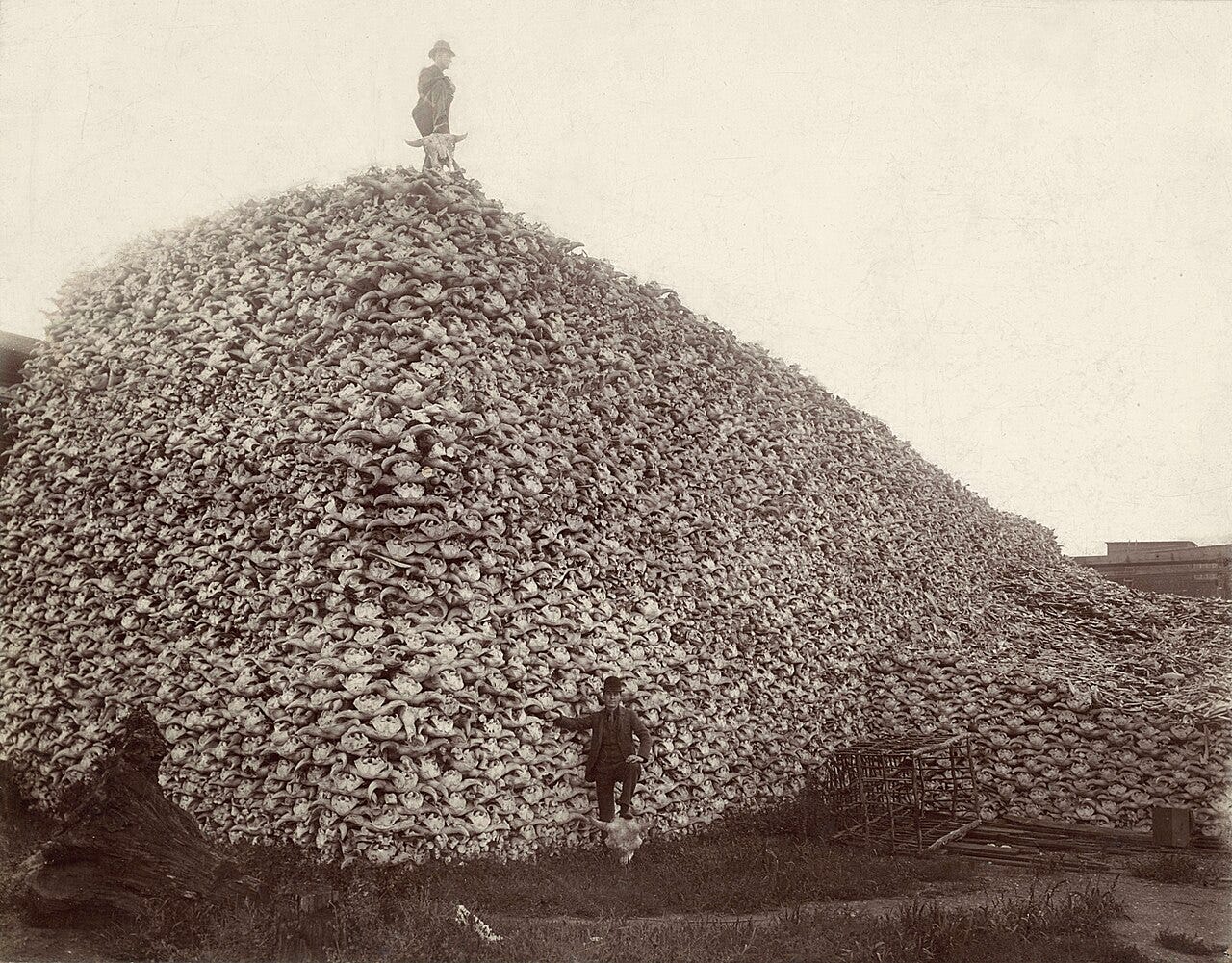
Just a few decades after European settlers, hunters, traders and the US Army had mass-slaughtered the American bison, there were only about 100 of them left. Today that number has risen to about 500’000 again again … but a) that’s peanuts compared to 60’000’000 that once were and b) most of those 500’000 are not free-roaming - they are farmed animals, they are livestock. Only about 30’000 can be considered free-roaming.
Now, just for a moment, imagine what that once-upon-a-time abundance meant for the land. Bison are first-rate ecosystem engineers, providing outsized impact and benefits for both flora and fauna with all they do by simply roaming free. All of those ecosystem services have been lost. For this majestic species to deliver impact at a large scale once more, bison cannot be conserved and protected - they have to be truly freed to grow their numbers back to abundance. That, of course, can only happen if the American bison becomes a truly protected species that is allowed to freely roam.
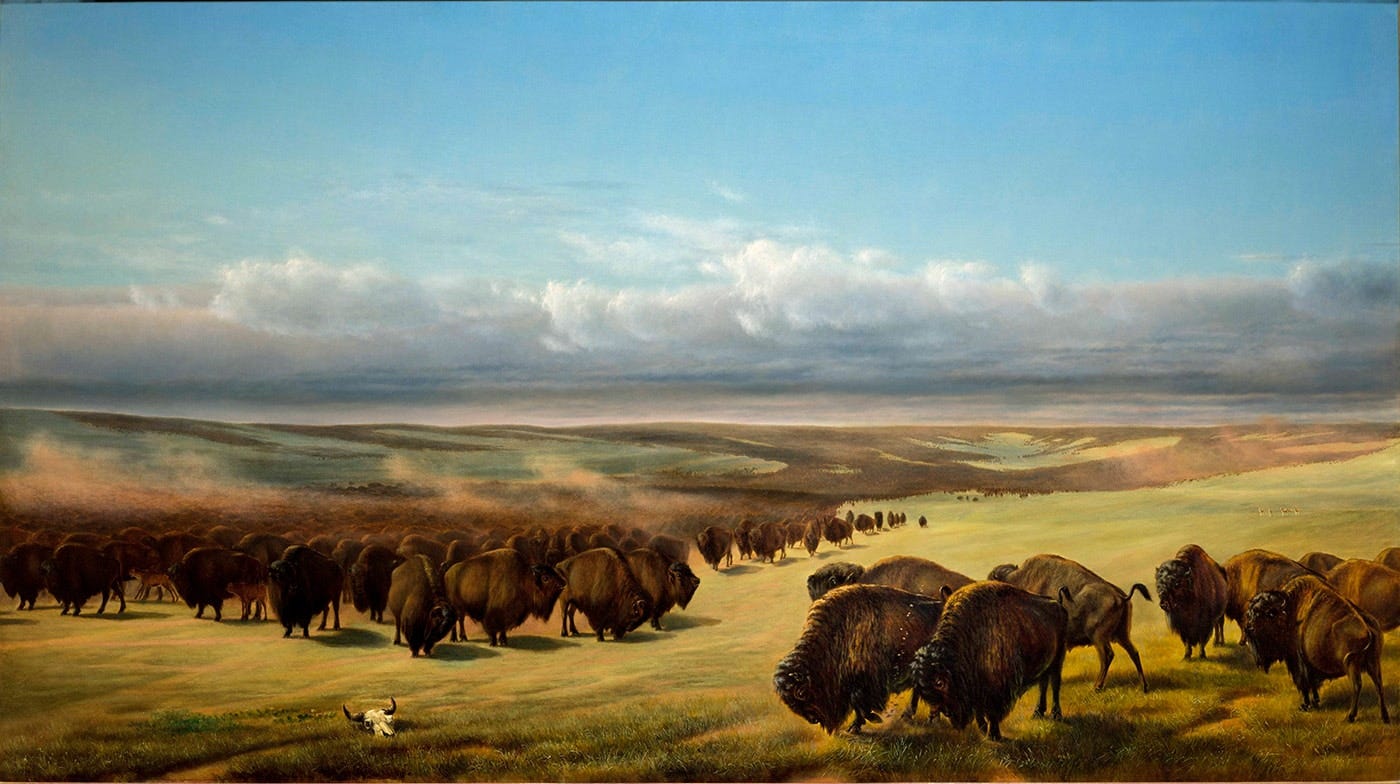
Most of us cannot even begin to imagine what it must have been like in Northern America before the Manifest Destiny monster tore through the lands from the east to the west. The closest is likely the annual Great Wildebeest Migration.

Fiction often opens a window that lets us see, let’s us imagine. American author Zane Grey was known for writing Wild West adventure stories.
In the ‘The Trail Driver’ I came across a few passages that really give a great sense of the immense and respect-commanding majesty of vast bison herds. In the story, the protagonists are tasked with taking a few thousand cattle on the Chisholm Trail from San Antonio to Dodge. Along the way, of course, they are greeted by all sorts of trouble.
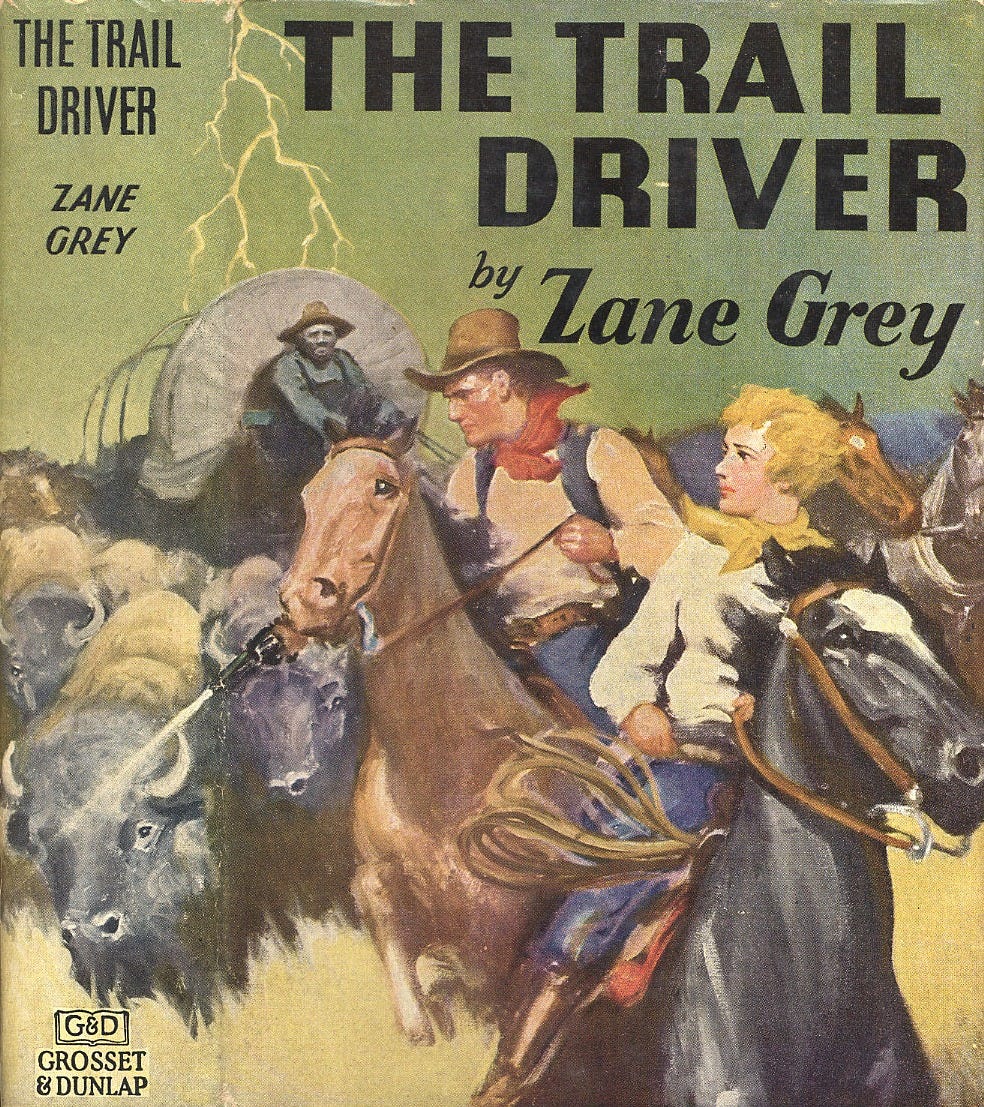
The worst fear for these cattle drivers was a run-in with a buffalo herd stampede. It would kill countless cattle and drive the rest of them far and wide. And so this novel, of course, leads up to that greatest of fears. Here a few snippets as tension rises:
“This day the range land grew wilder and rougher, making travel slow. Buffalo showed in every swale and hollow; wolves and coyotes trotted the ridge tops too numerous to count. Their presence in any force attested to the proximity of the buffalo herd. That night these prairie beasts made the welkin ring with their mourns and yelps. The coyotes boldly ventured right into camp, and sometimes sat on their haunches, circling the camp fire, and yelped until driven away.”
“Across the river, on the high bluff, a huge buffalo bull came out to stand gazing, silhouetted black against the sky, magnificently wild in aspect, and symbolic of that nature dominant for the hour.”
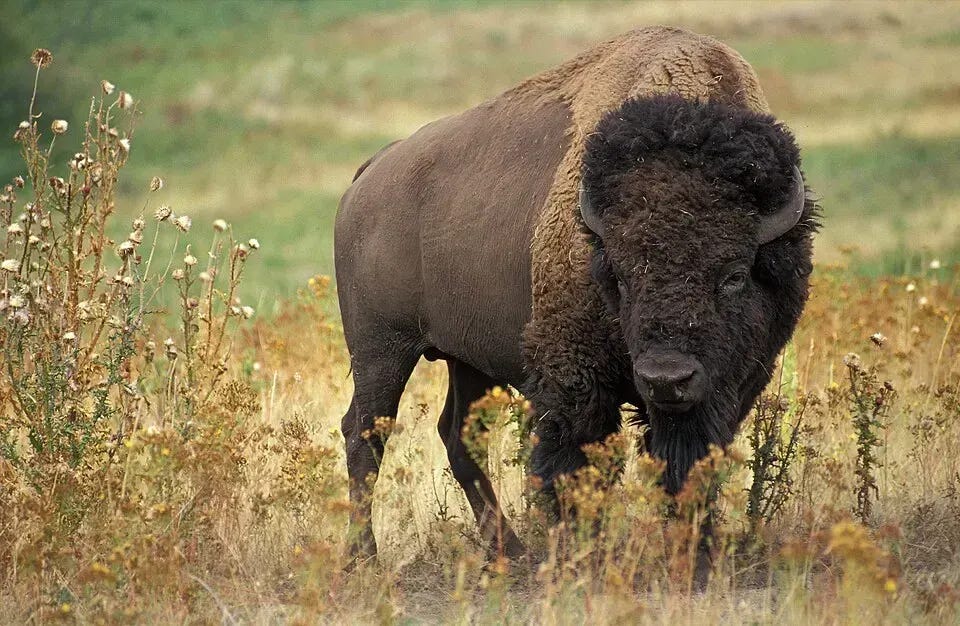
“The day was sultry and brooded storm. Bands of buffalo grazed on all sides, attended by droves of wolves and coyotes and flocks of birds.”
“Buffalo increased in numbers on all sides, still distant, but gradually closing up gray gaps in their line. That black line extended north as far as eye could see. The fact became evident that Brite’s outfit was driving into the vast herd, leisurely grazing along. The situation grew hourly more nerve-racking.”
“All night the guards sang and rode to keep the herd bedded down. Morning disclosed the endless stream of buffalo closer.”
“That fourth day, when they were off again, buffalo once more made their appearance. Soldiers from Fort Cobb, a post forty miles off the trail to the east, informed Brite that they had been turned back by the enormous, impenetrable mass of buffalo some miles westward.”
“All day Brite’s herd had shaggy monsters for company, short lines, long thin strings, bunches and groups, hundreds and twos and fours of buffalo, leisurely grazing along, contented and indifferent.”
“That day a long, black, thick line of buffalo crossed behind Brite’s herd, and turning north crept along parallel with it. This line had no break. Behind and to the west the black wave, like a tide of broken lava, rolling imperceptibly, slowly augmented and encroached upon the cattle herd. How insignificant and puny that herd of six thousand long-horns now! It was but a drop in the bucket of the Great Plains.”
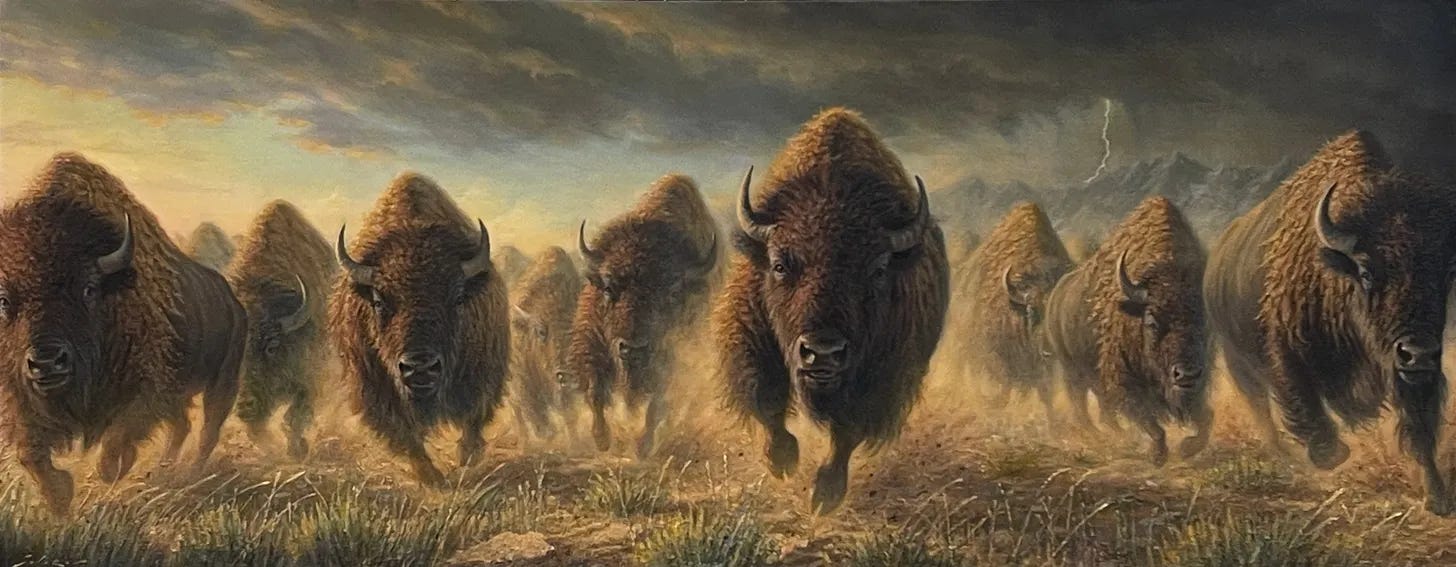
As it says in the above paragraphs, endless herds of wild buffalo, “contented and indifferent” - but they were an incredible force of nature and, if unleashed for whatever reason, it was best to be nowhere near.
“So they drove on and the buffalo closed in black all around them. Herd, remuda and riders occupied the center of a green island surrounded by rugged, unbroken waves. This island was a couple of miles long by about the same in width, almost a circle. It kept that way for hours of suspense to the drivers.”
“About noon there came a change. Something quickened the buffalo. Brite felt it, saw it, but could give no solution. Buffalo were beyond understanding.”
“Brite looked behind him. The buffalo were a mile in the rear, ambling along, no longer nipping the grass. The shaggy line bobbed almost imperceptibly.”
“On each flank the buffalo had markedly changed in aspect. Where before they had wagged along, now they bobbed. Far ahead the forward mass had not yet caught this acceleration. From behind, the low roar gradually increased.”
“The buffalo had broken into a lope. An instant later that low roar perished in an engulfing sound that would have struck terror to the stoutest heart. The gap between the rear of the herd and the oncoming buffalo began rapidly to close. Louder grew the roar. On each side of the cattle, far ahead, the buffalo closed in, so that the shape of a great triangle was maintained. It would be impossible for the cattle to mix with the buffalo. An impenetrable, shaggy wall moved on all sides.”
“Above the steady roar of hoofs all around swelled a sound that swallowed it—the deafening thunder of the stampede in the rear. It had started the herd into action. But now its momentum forced the buffalo ahead again to break their pace. Like a wave rolling onward in the sea it caught up with the cattle, passed through the buffalo on each flank and raced forward to the leaders.”
“Brite’s distended eyes saw a vast sea of black ahead, a sweeping tide, like a flood of fur covering the whole prairie. No doubt it was the same on each side of him and for miles behind. Even in that harrowing moment he was staggered by the magnificence of the spectacle.”
“The hellish stampede went on—a catastrophe which perhaps a gopher had started.”
Thanks for reading The Rewilder Weekly! This post is public so feel free to share it.

As mentioned - the annihilation of 60’000’000 American bison will forever remain in human history as one of our species’ most efficiently executed (literally) ecocides. Let that record stand, and may our vest remain forever stained as a reminder.
When you hear that, from just 100, the numbers of American bison have risen to 20-30’000 (free-roaming) today, that may sound heartening. But remember, these are ecosystem engineers and for them to be able to do their job, they need to be there in abundance.
Yellowstone National Park holds about 5’000 bison - but most conservation herds are isolated and roam in small numbers, the majority in numbers 500 and less. See here for the numbers.
I’m a big fan of what the Olsen Bison Rewilding Project is doing in Canada. They have about 5’000 free-roaming bison on lands in Alberta and Monitoba and what began in the early nineties, really shows how bison help transform the land back to much healthier states. But again, it’s the numbers that make the real difference. Quantity delivers quality.
In a recent article, Suzanne Asha Stone looks at the Big Grass Fire and its underlying cause. Where once vast numbers of bison had roamed, starting in the 1860s large cattle and sheep herds were kept in numbers - these were not roaming as bison did, they behave differently and consume differently. Over the course of decades the fertile lands were reduced to grasses that catch and carry fire quickly - because of a grazing regime with cattle and sheep that’s entirely unnatural.
All of this really leaves me with two wishes - one is to see species abundance return. Thousands of bison is a heck of a lot better than none - but I want to see hundreds of thousands, I want to see millions of individuals. We just all experience those sights with awe and humility.
The others is for us to not just accept that this abundance requires coexistence compromises from us, but to embrace them in the knowledge that, if nature thrives, we thrive. If nature’s healthy, we’re healthy. Nature is our very foundation, without a solid foundation, everything crumbles and falls … and that very much includes our species.
Let’s not just return species and protect them in small numbers - let’s strive for species abundance - especially so with ecosystem engineers like bison.
Cheers,


Glad you’re here, reading the Rewilder Weekly. Share the stories, write your own (and let me know about it), engage with others. Let’s continue to reach out, inspire and activate ever more people around the world. The rewilding movement is growing, and with all of us pitching in, it’ll grow a great deal more!
Eager for more rewilding insights?
get inspired by the lives, decisions, challenges, beliefs and hopes of passionate rewilders with the Meet the Rewilders portraits;
connect with these organizations - sign up for newsletters and support them in any way you can;
join these events - conferences, online seminars, rewilding days and weeks to immerse yourself and learn from the experts;
read these books - a selection from Foreman to Macdonald, and from Tree to Daltun, Hetherington and Bowser;
listen to these podcasts - it’s inevitably inspiring when the likes of Peter Cairns, James Shooter, Ben Goldsmith and Brooke Mitchell talk to the pros in the field;
and check out these resources - explore the principles, ways of funding, research publications and personal ways to start rewilding.
And, of course, connect with and follow the many passionately engaged rewilders. Let’s keep growing the movement! 🦬🌳🐺🌞🌍
Go ahead, do it! 😊 I love comments and you can ask me anything (literally). You can also let me know about projects you come across, article you think I should share - and feel free to throw in tough questions, too - spice of life!
Oh, and please do click the ❤️ (like) button, too. The more ❤️, the more these posts rise in Substack’s algorithm - which means more and more people will discover rewilding, will learn about it, will engage around it, and hopefully will become active rewilders before long. Thanks!
Thanks for reading The Rewilder Weekly! This post is public so feel free to share it.
Comments
Nothing yet. Say the first thing.
Sign in to join the conversation.