
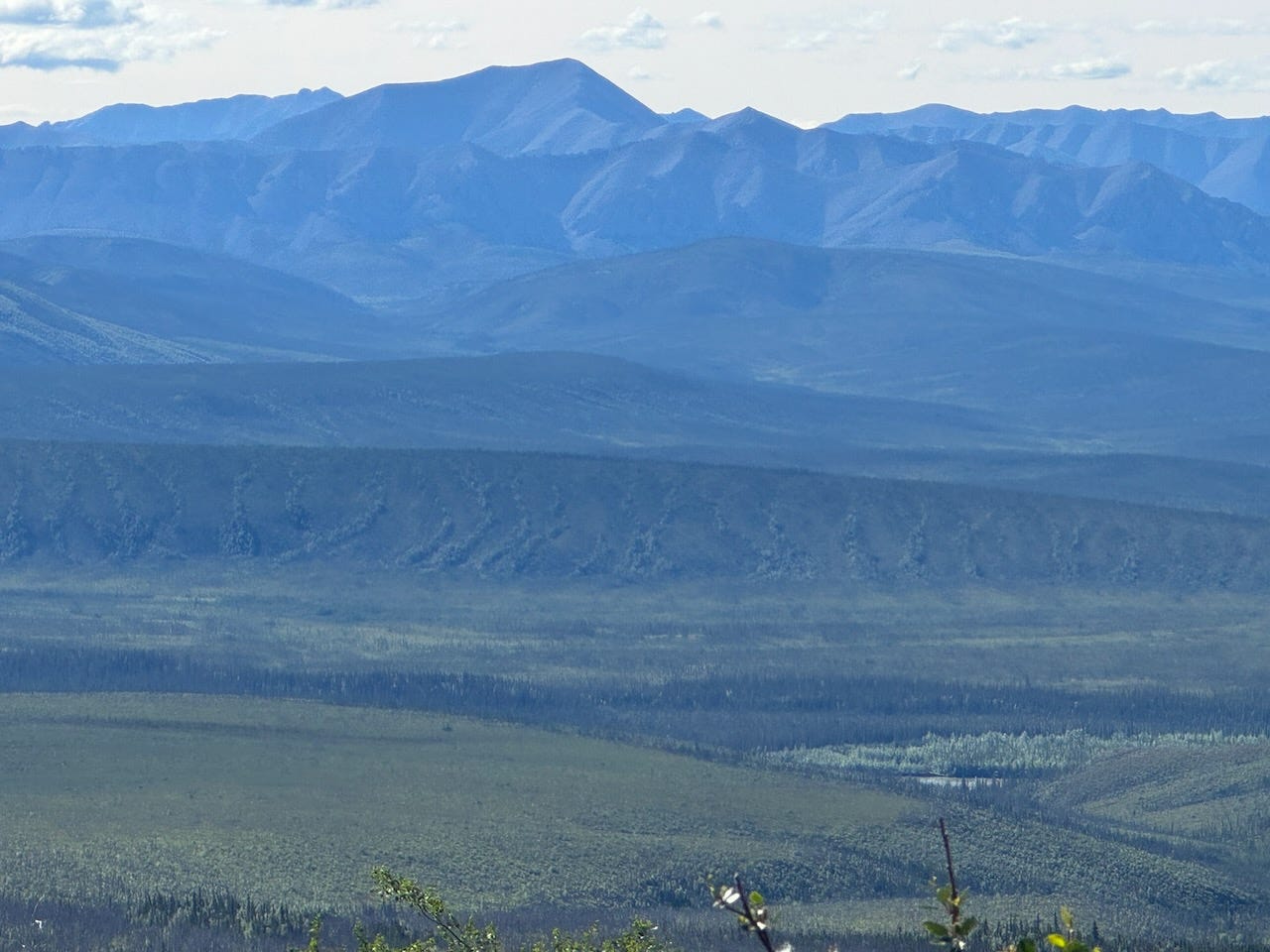
To understand the people and cultures in the area we are currently visiting, it helps to know a bit of what scientists have discovered about prehistoric times in this region. During periods of glaciation, the massive amounts of the Earth’s water stored in ice mean that sea levels drop. In the relatively shallow straits between what is now Russia and Alaska, sea levels dropped by more than 150 feet, leaving a land bridge that was over 600 miles wide. I had read about this land bridge and its role in the migration of plants, animals, and humans, but did not understand that there was another key factor in this region. That was that the region around the land bridge in Asia and North America was, for the most part, free from ice. The massive glaciers moved much farther south in other regions, spreading across the land, but there was a large area that escaped glaciation. Scientists have given the name Beringia to this area. Because it was a refuge from the massive sheets of ice that covered much of the north, it was a refuge for plants, animals, and humans.
One of the contemporary effects of this ancient history is that the indigenous peoples of the region have ancient histories, going back tens of thousands of years. For most of that time, the people were pre-literate, and histories were not recorded in writing. The stories of ancient times are remembered through oral songs and stories.
It is a privilege to be a guest in these places where the stories of the people go back so far. However, European settlers, when they came to this area, did not understand or appreciate the ancient cultures they encountered. They sought to convert the indigenous people to European ways. As recently as the 1950s, residential schools, funded by the government and run by churches, sought to separate indigenous children from their language and cultural practices. Despite this abuse, indigenous languages, stories, songs, and dances have survived and are being revived and restored in recent decades. Numerous cultural centers have been established that welcome guests and educate us about the indigenous cultures.
We entered the Yukon in the southeast corner, near Watson Lake, and traveled northwest to Dawson City, then northeast to the border of the Northwest Territories before going north to the Arctic. We did not take the most direct route, following the unpaved Campbell Highway instead of the Alaska and Klondike highways. We’ve covered over 1,200 miles of unpaved roads on our journey so far. This has allowed us to traverse lands with ancient histories and cultures. Among the First Nations regions that we have traversed are the lands of the Ross River Dea Council, the Carcross/Tagish First Nation, the Little Salmon Carmacks First Nation, the Selkirk First Nation, the Tr’ondëk Hwëch’in, the First Nation of Na-cho Nyak Dun, and the Vuntut Gwitchin First Nation. These nations have distinct dialects and oral histories, but they have known and traded with each other for millennia. They have also traded with other nations stretching across Alaska to the Pacific, northward to the Arctic Ocean, and southward as far as the southwestern states.
A journey across others’ home territories does not give us a full understanding of their cultures. We are obtaining just a sample of the stories of those people, but we have tried to visit as many cultural centers as practical for our trip and will continue to do so as we enter Alaska.
For most of the history of this region, travel has been on rivers, and we have crossed and traveled alongside two of the major rivers, the Mackenzie and the Yukon. These are some of the largest rivers in the world and provided access for human travelers over wide areas. The roads we have driven follow ancient routes, many of which follow animal migration paths.
This land has been layered with the rich history of human migration. Europeans explored the area, and posts were established to trade with the indigenous people. Guns, household goods, and other items were traded for furs sought after for the European fashion industry. Felted beaver fur hats were in high demand and resulted in the near extinction of European beavers. Beaver pelts demanded a high enough price to warrant shipping halfway around the globe to meet the desires of people living in European cities. Fur traders often were stationed in remote locations for several years during which they lived among the indigenous people.
Because it was accessible by steamship during the gold rush days, Dawson City absorbed 30,000 people in a single year when the lure of riches drew people north. The miners spread over the land, following rivers and streams in search of wealth.
The intersection of the many different people and cultures that came to this region with the indigenous population has resulted in a significant number of people whose genetic heritage is mixed. Officially recognized as a distinct indigenous people by the government of Canada, Métis have their own cultural history and practices.
We have the honor of being guests in this land for a little while. Tomorrow we will cross into Alaska for a few weeks of exploration and learning. We are grateful for the hard work and dedication that has produced cultural centers where we can learn more about the peoples of the areas we are visiting. It has been a grand adventure so far and promises to continue to be a rich time of learning. This is a big land with expansive vistas, huge rivers and mountains, and though we will see much, there is much that we will not see. This is true of the people we meet as well. We will encounter only a small sampling of the rich cultural heritage of these places.
With humility in the face of such greatness, we continue to travel and learn.
No posts
Comments
Nothing yet. Say the first thing.
Sign in to join the conversation.