
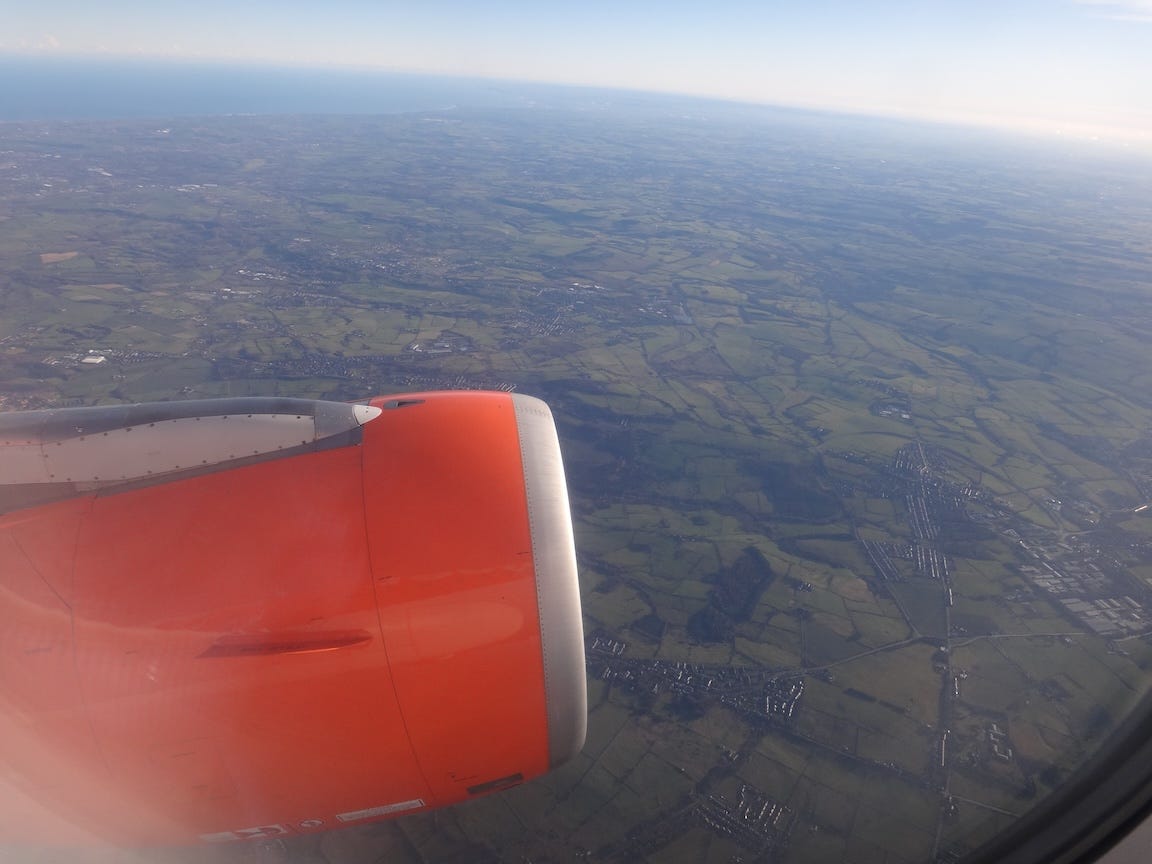
The UK’s largest orange-branded airline easyJet may be taken over by American asset managers Apollo.
According to Squeezy’s website Apollo has four plans for the airline:
1. Continuing the ongoing fleet modernisation and up-gauging strategy
2. Enhancing the airline’s ancillary and loyalty offerings
3. Scaling the easyJet Holidays business into a structurally differentiated earnings stream
4. Identifying and retaining key staff, recognizing the important contribution of easyJet’s employees to the company’s past and future success
Advertisement:

Airline Revenue Economics is on holiday. During August there will be one article a week rather than the usual three. Returning on Wed-2-Sep.
All sound sensible. Airbus A320neo and A321neo in the order book are set to offer between 186 and 235 seats, against 156 to 186 seats per plane currently. That will help easyJet capture growth in western Europe’s congested air traffic market.
Enhancing ancillary, loyalty and holidays into money spinners is a tried and tested route for European airlines. easyJet is already quite good at giving passengers what they want, with retailing and not just airline specialists on the management team. But there is no reason to think that they cannot do better.
Viewing the airline’s team as a strategic asset that makes the airline work rather than just a cost centre is also good news. Nominated regulatory post holders aside, airline knowledge is easily lost.
As well as thinking about what the airline might do under new management, it is also interesting to think about things they should not do. Today’s article explores three of these.
easyJet should not join an alliance or enter codeshares
easyJet’s success has been powered by simplicity across three domains. Extensive agreements with other airlines would remove this simplicity, increasing cost and degrading passenger experience. So easyJet should not join an alliance or enter codeshares.
First up is Information Technology.
Price up a flight on BA of Lufty’s website and you can almost hear cogs turning and steam being vented as the engine tries to cough up a price. Meanwhile on easyJet.com the flights and prices appear almost instantly.
Airline websites rely on back-end IT to find flights and figure out the correct fare. Supporting this IT is a large network of interline and special prorate agreements, fare databases and accounting rules.
When more than one airline is involved, things get complex fast. The marginal benefits from joining an alliance or entering codeshares will make easyJet’s IT more clunky. I doubt that is a price worth paying.
The next domain where easyJet has engineered simplicity is in network design. Their network is characterised by direct flights between a wide range of airports, not a hub and spoke system.
Their three London operating bases at Gatwick, Stansted and Luton for example do not integrate with mainline airlines or regional connections. They serve Scotland but not England.
Networks at these three airports are set up for point to point itineraries. easyJet.com will happily sell a connection, but it is clearly marketed as such.
easyJet’s network structure is not as optimised from a cost perspective as hub and spoke is. They are unable to take advantage of economies of scale in maintenance or airport services.
But they help passengers get where they want to go. Aside from direct flights, they also offer a choice of connecting points, giving consumers more options than with mainline European carriers.
For example, if I want to go from Newcastle to Athens on Thu-10-Sep the airline will sell me connections via Paris, Prague, Bristol, Malaga and Majorca. None go through London or Amsterdam, the usual connecting points for Newcastle-originating passengers.
Some are convenient – a Bristol connection involves 9h20 total travel time and arrives on the same day it left. Others are not – Prague’s connection involves an overnight stop and the total travel time is 18h45.
The purpose of joining an alliance or entering a codeshare is to give consumers more choice. easyJet arguably already achieves this thanks to their network design.
The third domain where easyJet has turned simplicity into a growth strategy is Loyalty. Rather than creating a complex programme of miles and points they operate easyJet Plus. The programme offers benefits at the airport like priority bag drop and speedy boarding, and benefits on the plane too including free-of-charge front row and exit seats.
easyJet already partners with Emirates. I used Skywards miles that would otherwise have been orphaned a few years ago to jet between Barcelona and Newcastle.
A Virgin Atlantic partnership in the same vein would complement the existing Emirates relationship nicely. From the perspective of easyJet’s core west European customers, Emirates would take care of the “east” and Virgin Atlantic the “west”. Both easyJet and Virgin Atlantic are lifestyle brands.
easyJet could also build a lounge at one or more of its major airports. Air travellers go wild for lounge access and such a product could support a more expensive membership tier for easyJet Plus.
Lounges are not exactly cheap, but they align with easyJet’s “low cost” brand in the sense that it is cheaper to supply a premium “club”-type experience on the ground than it is in the air. A lounge would also support easyJet as a lifestyle brand, which was nicely encapsulated in the “Generation easyJet” ad campaign before COVID.
Once again, easyJet would not need to actually incur the costs of entering an alliance or using codeshares for their passengers to enjoy these benefits.
easyJet should not launch Business Class
Business Class in Europe follows the moveable curtain model. Airlines with two cabins set three, four, five or more rows where middle seats are blocked. Sometimes a table occupies the middle seat, sometimes not.
This model with convertible Economy seats offers advantages over wider but fixed “premium” seats for both airlines and passengers.
Whilst not as ostensibly comfortable, they are likely to be more plentiful and easy for passengers to buy. They also offer comfier connections to longhaul flat beds, supporting revenue for the airline’s highest cost products.
The economics of these seats explain why easyJet does not need them. There is no longhaul network to support.
easyJet Plus offers ground benefits by membership scheme rather than by cabin. It offers free seat selection for the most desirable seats on the planes.
The only thing missing is the blocked middle seat, and even that can be done in practice. Buy a seat under the name OBJ Edward OBJ Smith, plonk that down next to your actual seat and badda-bing-badda-boom, you have Euro-Biz easyJet style.
Launching Business Class would add more complexity to easyJet’s model. Check-in systems would need to handle the new cabin. Upgrades or downgrades might be needed. Fancy catering would require extensive contracting and expensive performance monitoring.
easyJet is better off sticking with one cabin under the new owners.
easyJet should not chase corporate or volume incentive deals
It may be tempting for the new owners of easyJet to go after business travellers. easyJet is already well regarded in the business market. Problems could materialise if a desire for high corporate traffic goes too far.
easyJet’s value proposition is offering good value fares for everyone. If under Apollo’s ownership the airline were to chase volume deals, they might start offering discounts to do so.
Revenue Management could then be distorted in some ways. They might be under pressure to push up the public fares to compensate, making it harder for ordinary travellers to get the best deals. Or they might distort network and inventory availability decisions to favour the corporate traveller to the detriment of the core customer base.
easyJet should continue to offer “business” fare products like flexibility and priority check-in or boarding services. They should continue to target business travellers.
But they should not forget that a company enjoying a discount for a seat they would have purchased anyway is diluting rather than supporting revenue. Where incremental sales are achieved, if these are low value easyJet might have been better off chasing the premium leisure market.
Conclusion
easyJet’s success has been built on simplicity. Simple IT, simple networks, simple Loyalty and a simple consumer value proposition: affordable air travel for everyone.
Under new ownership the airline should avoid losing what made it great in the first place.
They should not seek to enter codeshares or alliances as this would complicate IT, distribution and the network.
They should not introduce Business Class as this would complicate the onboard product.
And they should not chase the corporate volume market as this would complicate revenue management as undermine the airline’s value proposition.
Do that, and as long as the airline is not asset stripped or loaded with debt it should be happily tootling around Europe for decades to come.
Comments
Nothing yet. Say the first thing.
Sign in to join the conversation.