
There were some interesting facts about travel agents published in The Economist last week. The dismal science’s favourite newspaper (not magazine!) reported:
1. The travel trade association ABTA reckon around a third of British travellers book through a human
2. Membership of the American Society of Travel Advisers has risen from 190,000 in 2024 to 310,000 today
3. Social media platform LinkedIn thinks the role is one of America’s fastest growing jobs.
My own news feed presented interesting news last week too. Groovy-funky Virgin Atlantic is getting in on the action and opening a travel shop at Battersea Power Station for Holidays bookings. They are currently hiring a Retail Store Manager and you can apply here before 27-Aug.
Thinking about these stories in the light of trends like Modern Airline Retailing and agentic commerce made me wonder if airlines can ever really hope to replicate travel agent services. I don’t think they can without building bricks and mortar shops. And surprisingly, Modern Airline Retailing may be an incentive for them to do this.
Read on to find out why…
Advertisement:

Airline Revenue Economics is on holiday. During August there will be one article a week rather than the usual three. Returning on Wed-2-Sep.
Why do consumers still use travel agents?
A British high street travel agent these days is in some ways unchanged from the ones I remember back in the 80s and 90s.
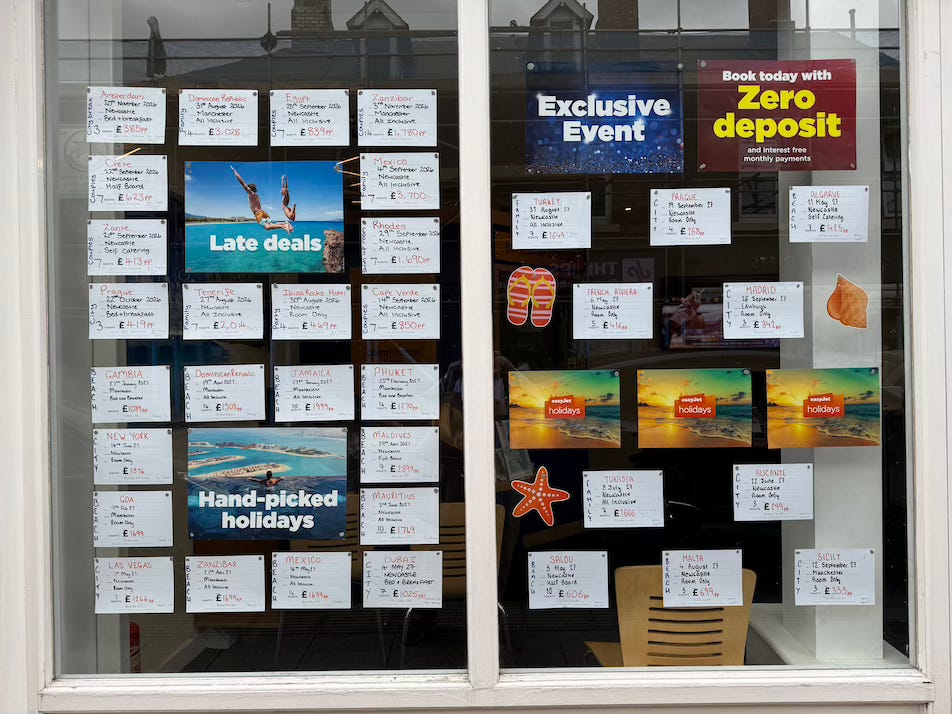
Handwritten signs in the window (pictured) still promise sun, sea and sand. Glossy brochures show skyscrapers, mountains and the occasional cruise ship.
In some markets airlines like Emirates have shifted the mix of destinations further east from the traditional Turkey, Med and Caribbean. As far as many travellers are concerned, sandy beaches and sunshine in the Indian Ocean are good substitutes for a Caribbean island.
In one other respect though travel agents have changed a great deal.
Back in the 80s and 90s there was no doubt good money to be made on holidays. But a large amount of a shop’s footfall would have been from domestic train tickets, ferries and the occasional short-haul flight. All those are now booked online.
Thanks to mobile technology consumers are now used to buying with their device. And thanks to Revenue Management fares are often cheaper than they used to be in real terms. That makes it less risky for consumers to buy their own tickets than it used to be, so a travel agent is less often required.
But whole trips are much more complex than air, ocean or rail fares alone. They require hotels, transfers, guides, activities and more. Travel agents add value to holiday bookers in three ways.
First they offers consumers their experience and judgement. Experienced agents understand the holidays they are selling. Many will have been on similar trips at some point.
Sitting in front of travellers helps them discuss taste and preferences, and personally assess which packages might resonate best with each customer. Over time, consumers and their travel agents can build good relationships. That helps the agent sell the next holiday too.
Agents also offer travellers reassurance that if something goes wrong it will be put right.
Airline counters can be a great help at the airport, but in times of disruption queues may be long. Meanwhile phone lines are not always answered quickly. Cruise community lore suggests that ship operators are even harder to deal with than airlines when things go wrong. A travel agent can take care of that heavy lifting.
Finally, agents can often offer customers specific expertise that is not easily available through online engines, even those powered by AI. Examples include travel for allergy sufferers or tourists who want to travel with their pets.
Why do business travellers still use travel agents?
Booking through agents also comes with advantages for business travellers.
Business travel is sometimes booked at the last minute. Airlines and banks are wary of last-minute transactions booked on credit cards due to fraud risk and may not always allow such bookings to be completed, even if a website will show a price.
With agents airlines accept bookings right up until departure as they know they should get paid. Using agents can make it easier for business travellers to get the flights they need.
The second benefit of using agents comes from fares targeting business travellers sometimes (but not always) being more expensive than those sold to consumers.
Revenue managers know the travel patterns which characterise business travel. They implement Saturday night stay rules or inventory management strategies to charge these passengers more, even if flights are not otherwise busy.
Putting pricey tickets on personal credit cards is unlikely to be attractive for many employees. Many employees may not have enough personal credit to carry long-distance First and Business Class purchases.
And although some may relish the opportunity to earn miles and points, others will baulk at carrying the risk of an employer taking a long time to reimburse.
Meanwhile agents simply sign contracts with companies and issue invoices for the travel purchased accordingly.
Compliance is the third way in which businesses use agents to handle their travel.
If a company’s travel policy is First Class flights and five star hotels they do not need a policy. Any such business traveller can count themselves lucky. Most must navigate a complex web of rules, combining seniority, flight time and destination profile with cabin class, baggage allowance, seat selection and more.
Travel rules are complex. That makes them costly for buying firms to implement and manage. A travel agent’s processes and systems may be better suited to buying in-policy travel than a businesses own administrators.
Might airline travel shops be due a resurgence?
London’s Piccadilly thoroughfare was well populated with airlines 20 years ago. Sadly most are now gone.
Air France was there. Korean Air still is. Iran Air had an enormous shop – presumably they took out a long lease before the revolution.
Thai Airways was nearby. So was Uzbekistan Airways – your favourite airline revenue economist popped in to buy a ticket, was told “cash only” and went to book online instead…
British Airways closed their Piccadilly shop and others in 2006. A FlyerTalk thread at the time said:
The proposed changes will affect around 300 staff who work in the 17 high street travel shops, corporate travel agency Worldlink, based at Heathrow, and its back office support areas. A further 100 staff currently work in the Belfast call centre.
‘It is clear that an increasing number of our customers want to book and organise their travel plans with BA via the internet,’ said commercial director Martin George.
‘This is a travel industry wide trend and we have to ensure that our business reflects this.’
Mr George was right. At the time consumers were switching to online booking. BA did not need their shops anymore.
Yet as I mentioned earlier, Virgin Atlantic is now opening a Holidays shop at Battersea Power Station. Their website describes it as “standalone” suggesting there will not be any more.
There are reasons to believe that travel shops could have a new role for airlines, even BA and airlines like easyJet who never had a Piccadilly presence..
These airlines are among many who are investing in their holidays products. Any hotel commission earned is pure margin for the retailing airline. BA offers bonus tier points and Avios currency to holidays bookers.
The business case for a travel shop targeting Holidays customers rather than just selling flights is based on the high margin nature of these products. I wonder if we will see BA and easyJet open new shops just for holidays.
Holidays shops could help boost core airline revenue too.
They can show customers the benefits of upgrading to higher cabins. Think amenity kits and champagne glasses in display cases rather than model flat bed seats, which would be expensive to keep clean and in good working order.
As brand ambassadors travel shops will be excellent centres for the airline to have occasional exhibitions to inspire people to come in. Think uniforms, model planes and posters. Today’s intrigued passer by could become tomorrow’s customer.
The Virgin Atlantic travel shop will also be an excellent venue for the airline’s own corporate hospitality. The area around the shop is covered in pricey apartments inhabited by long-haul travel buyers.
If I were Virgin Atlantic I would invite local residents in from time to time for a glass of fizz and a canape.
What does this mean for Modern Airline Retailing?
Modern Airline Retailing is supposed to turn airlines into general purpose travel retailers. There are many high margin and high revenue market segments where it is hard to see the new schemas substituting for traditional travel agents.
However Modern Airline Retailing is helping airlines see the benefit of investing in just the type of holidays products which can best be supported by face to face retailing in a bricks and mortar shop.
It would be ironic if the trend towards digital Modern Airline Retailing actually ended up encouraging airlines to reopen the travel shops they closed a long time ago, only with a holidays rather than general purpose set up. I hope that is what happens.
Comments
Nothing yet. Say the first thing.
Sign in to join the conversation.