
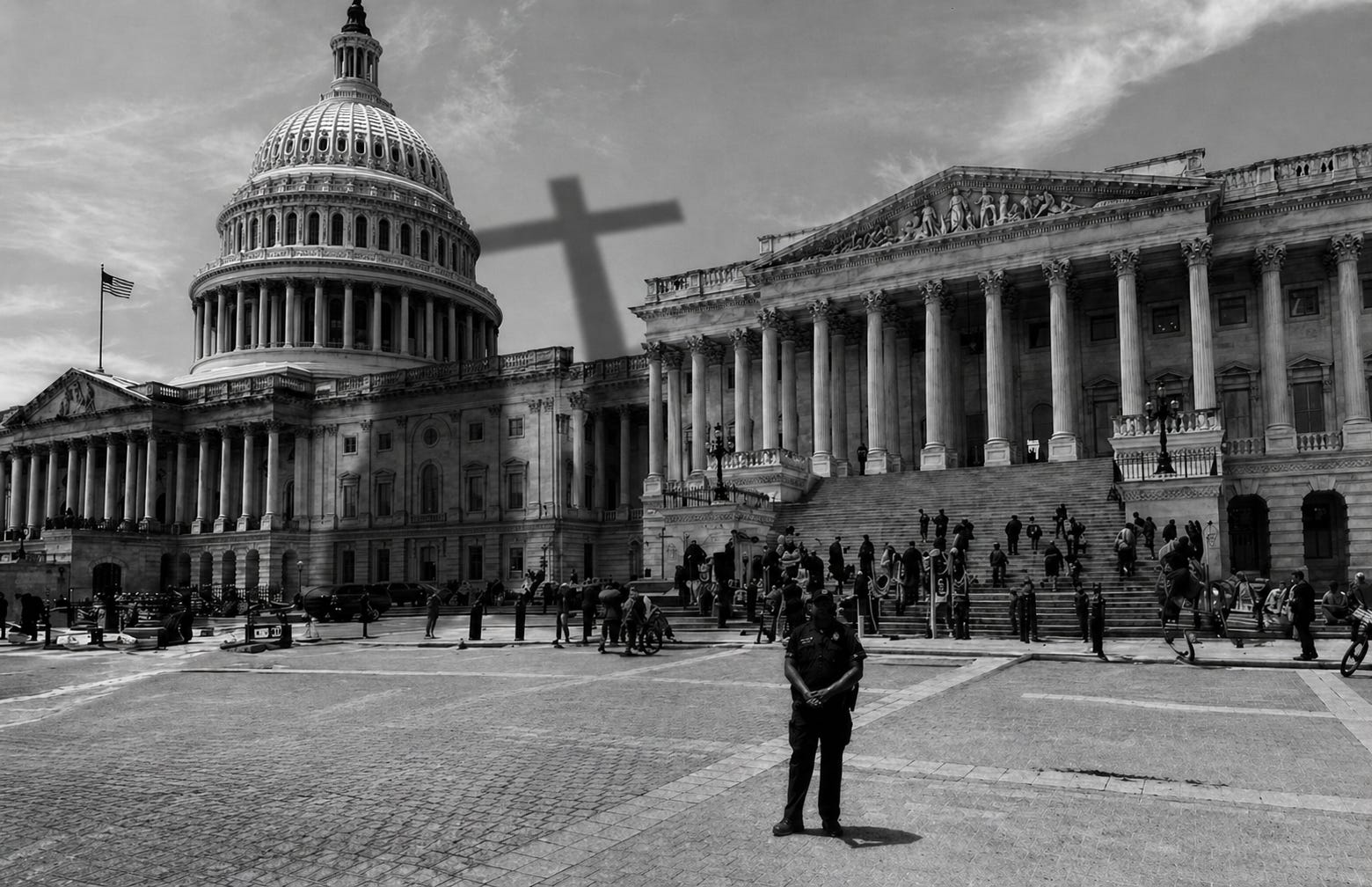
On April 30, the Trump administration’s Task Force to Eradicate Anti-Christian Bias released a report claiming that the Biden administration systematically targeted Christians across the federal government. The report, produced by a seventeen-agency task force led by the Department of Justice, presents itself as an investigation into religious liberty. But it is better understood as a political document designed to advance a story: that Christians in America are under siege.
That story matters because it is one of the core narratives animating Christian nationalism.
This is also a familiar move in authoritarian politics: cultivating a sense of victimhood among people who still hold significant power, then using that grievance to justify attacks on pluralism, civil rights, and democratic institutions.
Christian nationalism is not only about theology or patriotism. It is also about perceived threat. Its power depends on convincing Christians that they are losing “their” country, that pluralism is oppression, and that any effort to protect the rights of others is really an attack on them.
That is why this report should not be dismissed as just another culture-war document. It is a government-backed effort to reinforce one of the most politically potent falsehoods in American life: that Christians are victims of a hostile secular state.
To be clear, Christians, like people of any faith, can experience discrimination. Religious liberty is a core democratic principle, and no one should be targeted by the government because of their faith. No church, synagogue, mosque, temple, or faith-based organization should be punished because of its religious identity.
But that is not the same thing as saying that Christians, as a group, are marginalized in the United States.
They are not.
Christians remain the overwhelming religious majority in this country. Christian language saturates American politics. Christian institutions command enormous cultural, financial, and political influence. Christians serve at every level of government, sit on the Supreme Court, lead major corporations, run state legislatures, shape school boards, fund national advocacy organizations, and influence both major political parties.
This is the truth that must be said plainly:
Christianity is not powerless in America.
That does not mean every Christian gets their preferred policy outcome. It does not mean every conservative Christian claim wins in court. It does not mean every federal agency will treat one theological view of abortion, sexuality, gender, family, or public health as binding on the whole country.
But losing a policy fight in a pluralistic democracy is not persecution.
Sharing power is not oppression. Equal protection for LGBTQ+ people is not anti-Christian bias. Reproductive freedom is not a government attack on the church. Public health rules are not religious discrimination simply because some Christians object to them.
The report collapses these distinctions. It takes routine law enforcement, regulatory decisions, civil rights enforcement, public health policy, and disagreements over the meaning of religious liberty and reframes them as evidence that Christians are being targeted. It selectively presents facts, omits context, relies on anecdotal testimony, and treats political disagreement as religious discrimination. The result is not an impartial inquiry. It is advocacy dressed up as investigation.
The political effect is powerful.
If people can be convinced that Christians are persecuted, then almost any assertion of Christian power can be recast as self-defense.
Efforts to restrict abortion become protection for Christian conscience. Efforts to roll back LGBTQ+ rights become resistance to anti-Christian coercion. Efforts to privilege conservative Christian organizations in public policy become “neutrality.” Efforts to purge dissenting voices from government become a defense of the faithful. And when Christian leaders promote violence or authoritarianism, criticism of them can be recast as hostility to Christianity itself — even as extremism or terrorism.
This is how a majority begins to speak the language of victimhood while exercising the power of dominance.
It is also why Christians committed to democracy need a more prophetic public witness: compassionate enough to understand the fear beneath the persecution story, and clear enough to say that losing cultural dominance is not the same as being oppressed.
Many Christians are experiencing real dislocation as the country becomes more religiously diverse, less deferential to institutional Christianity, and less willing to let one strand of conservative theology define public morality for everyone. That fear should not be mocked. But neither should it be manipulated.
A pluralistic democracy will sometimes disappoint every religious community. That is not a failure of religious freedom. It is the condition that makes religious freedom possible.
The First Amendment protects free exercise and prohibits establishment. Those commitments belong together. Religious liberty means the government may not punish people for their faith. It also means the government may not privilege one faith, one sect, or one theological interpretation as the authorized moral voice of the nation.
The Trump administration’s report blurs that line. Its implicit argument is that certain Christian positions on abortion, sexuality, gender, and family should shape federal enforcement priorities.
But whose Christian positions?
The Christian tradition is not monolithic. There are Christians who support reproductive freedom as a matter of conscience. Christians who affirm LGBTQ+ people as beloved children of God. Christians who believe public health measures can be expressions of love of neighbor. Christians who understand pluralism not as a threat to faith, but as a safeguard for it.
The administration’s report does not speak for Christianity. It speaks for a political project that uses Christianity as a marker of national belonging and treats challenges to conservative Christian power as attacks on faith itself.
That should concern all of us. It should concern religious minorities whose real experiences of discrimination are often drowned out by the louder claims of politically powerful Christians. It should concern LGBTQ+ people and women whose rights are repeatedly cast as threats to religious freedom. It should concern secular Americans who are told, implicitly or explicitly, that they are less fully American because they do not share the preferred faith of those in power.
And it should concern Christians most of all.
Christianity does not need the machinery of the state to defend itself. The gospel does not become more powerful when backed by federal agencies. The church does not become more faithful when it is used as a constituency in an authoritarian political project.
History teaches us that when Christianity is fused with state power, the faith itself is distorted. The language of persecution becomes a tool for domination. The cross becomes a flag. The neighbor becomes an enemy. The vulnerable become scapegoats.
This is why the persecution story must be challenged directly. Not cruelly. Not dismissively. But truthfully.
Christians are not being asked to disappear from public life. We are being asked to share public life with others.
Christians are not being denied religious freedom when the government refuses to impose our theology on everyone else.
Christians are not oppressed because LGBTQ+ people have rights, women have agency, public schools serve religiously diverse students, or federal agencies enforce civil rights laws.
The question is not whether Christians are allowed to bring our values into public life. Of course we are. The question is whether we can do so in a way that honors pluralism and the dignity and freedom of all. Democracy requires us to argue, persuade, listen, and sometimes lose. It does not give any religious group the right to impose its minority theological view on everyone else.
That is the religious freedom worth defending.
Real religious freedom protects conscience without turning theology into state policy. It safeguards worship without licensing discrimination. It honors faith without making Christianity a test of American belonging. It protects Christians, Jews, Muslims, Hindus, Sikhs, Buddhists, atheists, agnostics, and every person whose conscience deserves respect.
The Trump administration’s report asks us to believe that Christians are victims because they no longer automatically control the moral terms of public life. But what is changing is not the freedom of Christians to practice our faith. What is changing is the willingness of many Americans to accept one narrow form of Christianity as the default identity of the nation.
That is not anti-Christian bias. That is democracy.
And in this moment, Christians have a choice. We can cling to a false persecution story that turns neighbors into threats and pluralism into an enemy. Or we can bear witness to a better story — one in which faith does not need domination to be strong, Christianity does not need privilege to be faithful, and religious liberty is protected precisely because no one tradition controls the state.
Our faith does not need a throne.
It calls us to love our neighbor, defend the vulnerable, tell the truth, and seek the common good.
That is the Christian witness this moment requires.
How to talk with those who are concerned
Research suggests that when speaking with people who are vulnerable to Christian nationalist ideas, start by addressing the persecution narrative directly rather than begin with an abstract argument for pluralism. Remind Christians that we are not a persecuted minority in the United States, where Christians continue to hold significant cultural, political, and institutional power.
After reassuring them about Christians’ safety and freedom, discuss the ethics of Christian love which may then lead toward greater tolerance.
For more, read Ruth Braunstein’s Substack, Democracy Is Hard.
No posts
Comments
Nothing yet. Say the first thing.
Sign in to join the conversation.