
Wednesday stories (8 pm UK time) are by Sally Prag. Sunday stories (at the same time) feature the work of a range of writers. With the gradual evolution of the JPF, I am keeping all regular posts free but will be introducing a new column for paying subscribers called Book Talk — all about books relevant to Jewish life and literature. Watch this space! For now, if you would like to support me with a one-time donation, click here.
SUBSCRIBE TODAY! The JPF isn’t here for polite debates or academic footnotes — we’re dismantling antisemitism one idiot, one coward, one apologist at a time.
I’m currently reading the award-winning novel, The Weight of Ink by Rachel Kadish, a historical fiction exploring Jewish life in London in the 1600s through documents and books discovered at the beginning of this century. Within the story we also see both the contemporary and historical world through the eyes of the historians studying these documents.
I’m only halfway through so far, but for me, the prevailing theme is one of neverending struggle, the fight to survive, or simply to be accepted, appreciated, and allowed to live, contrasted with the world that everyone else in British society seems to occupy, where for many, such struggle is remote, even unknown. The contrast between peace and endless war, even when the war is internal or merely veiled by the illusion of peace.
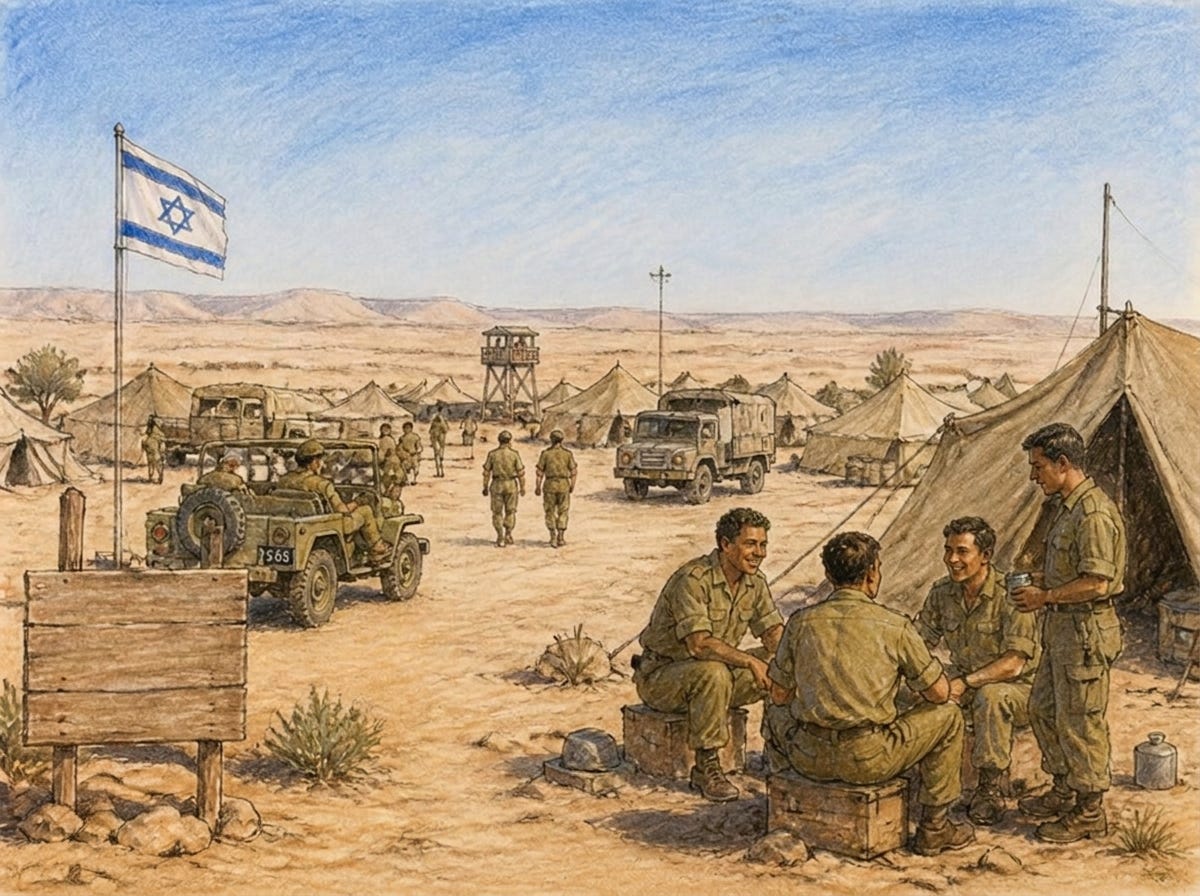
While the non-Jewish protagonist, Helen, an aging academic and expert in Hebrew and Jewish studies, is casting her mind back to her younger years during which she volunteered in Israel and became enamoured by the history of the Jews, these words, spoken by an Israeli soldier in the desert in 1954 to a group of foreign volunteers, jumped out at me:
Dror pointed to the east, into the dusky hills. In a low voice, switching languages and scanning their faces to make sure he was understood, he continued. “Over there, that line of dark rock: Jordan.” He swiveled, pointing south, then west. “There, Saudi Arabia. There, Egypt. Drive a half day to the north: Lebanon, Syria.” He turned back, surveying the group. “There’s been war on this spot where you’re standing. There will be more.”
With his tight black curls, high forehead, and handsome, angular face, he looked to Helen like something out of an illustrated Old Testament — noble and severe.
“We’re a small base,” he said, “but everything is on our shoulders. If you spend your six months here, you’ll understand what that means. If you came for a vacation, go home.”
It made me think of my dad. Born right in the middle of the second world war, his memories don’t stretch to wartime. He remembers the ongoing rationing, and the time he was convinced his older brothers and sisters were trying to poison him by telling him this firm, yellow, curved thing was a banana, when he’d only known bananas to be brown, dried and shrivelled. He’d never seen a fresh banana before.
He emerged into his childhood at a time when Britain had collectively experienced the most frightening time in recent history, and survived. Hitler was gone, Nazi Germany defeated, and Britain now braced itself for lasting peace.
No more war, was the refrain from Britain. Never again, the refrain from Jews globally, including my dad’s parents and their fellow British Jews. Never again would the world allow genocide. Never again would the Jews have to live as subjects of another’s murderous regime.
For the people of Britain, the focus was on peace, but for the Jews who now inhabited the fledgling Jewish state, the focus was on survival.
My paternal grandfather quietly understood this, but spared the youngest of his six children — my father — the mental strain of this understanding. Quietly, my grandfather Abraham contributed every penny he could spare from his humble shop profits to provide for the Zionist cause and help to put food on the table for the hundreds of thousands of Jewish refugees from both the east and the west, who had been stripped of their wealth, their dignity, and many of their family members, arriving with nothing but the clothes on their backs.
My dad, meanwhile, enjoyed his British childhood, freer than that of the generation before him, with the promise of peace forevermore stretching ahead. Sure, life was still frugal for all Brits, especially that of large households like my father’s. It was his generation who became the flowerchildren of the sixties, where peace and love reigned, and rock ’n’ roll was the new religion. He rebelled against the old notion of religions yet never stopped being proud of his family’s Jewish heritage.
And that was what led him to become a volunteer in Israel in 1967 following the Six Day War. He spent two months on a kibbutz and was then due to fly home to resume his work for Nestle, a job he hated. The night before leaving, he arranged to meet up with an old friend of his mother’s family from Dublin, where she was born. His name was Chaim Hertzog and he was, at the time, a general in the army. The Jewish world was very small.
At that meeting, Chaim offered my dad a volunteering opportunity in the army. The choice between remaining in Israel and returning to his horrible Nestle job was a no-brainer. For the following six months, my dad was collecting up weapons abandoned by the Egyptians in the Sinai, being chased by armed Arab militias, and firing weapons he had no training in. Living life on the edge in Israel was the adrenalin kick he craved, but he also began to understand what that really meant when four members of his 25-strong group of foreign volunteers were killed in confrontations with Egyptian militia members.
Still, he remained in Israel for longer when the government offered him and his group the opportunity to stay and attend Tel Aviv University for a year. Which was where he met my mother, was married within a year, and living in an apartment in Ramat Gan.
It’s only now I realise that the naivety that was ingrained in him from the belief that lasting peace inevitably follows war never quite left him. In 1973, by now a father to a young baby daughter, he suddenly realised that he was living in a place that could not bask in such luxury as lasting peace, and he announced to my mother that he wanted them to relocate to the UK, where he could raise his children with more certainty that they would survive beyond childhood.
And so it was that in the week my sister turned one year old, they left Israel. Within days of their departure, Israel was attacked — on Yom Kippur. My mother, born into a land where running away from the inevitable wars unleashed by hostile neighbours was not an option, was suddenly given an exit option not afforded to her family who remained.
But my dad, experiencing the responsibility of parenthood for the first time, realised that this was no vacation. The fun of adrenalin had run its course. It was time to go home and return to the lasting peace he was promised as a post-war child.
I don’t blame my dad for making that decision. I mean, if you were to take away all the context and simply offer someone the choice between war and peace, who wouldn’t opt for peace? But one can’t overlook the element of denial when you do bring context into it.
My dad had a luxury even his own parents weren’t able to enjoy. Recently he said to me that he never considered the fear my grandmother must have had to live with, knowing what would happen to all of them if Hitler succeeded in invading Britain. It seems that it took the horrific events of October 7th 2023 and all that Jews worldwide have faced since then for him to begin to consider it.
I find myself pondering on all of this as I stare at the chaos in the world right now. The denial that mass immigration can pose a threat to existing civilisations. The ease with which smuggling gangs have been able to line their own pockets as they flood Britain and Europe with everyone from hopeful and desperate men, women and children to those with more insidious designs on foreign lands and their populations.
Meanwhile, peace isn’t all it pretends to be.
The narrative war has been at play since well before the outbreak of the second world war. When the UN partition vote took place in 1947, all that really happened was that it changed course. It laid a new foundation upon which it has built now for decades.
We Jews have felt the brunt of the narrative and information wars for a good while now, but the real impact on the West has yet to be realised. It’s not looking good. And yet, many are still able to disappear into the illusion that we have peace in our little corners of the Western world.
Now, when I think about the defensive wars that Israel has had to fight repeatedly since its inception, I realise our global fight that appeared to end in 1945 here in Britain has never really ended. It just relocated for most of the last 80 years. There has never been true peace because, despite some lasting peace agreements being signed, many parts of Arab society never gave up their plans to annihilate the Jewish state.
Back in 1947–9 Arab society and the numerous neighbouring states to Israel fought each other with their multitude of opposing goals surrounding Palestine. In 1947 many Palestinian Arabs just wanted to live. Many communities within towns and villages defied their leaders by selling goods to Jews and warning them of planned Arab attacks. Ramallah was predominantly Christian and set up defenses against the threatened invasion of the Muslim population. King Abdullah of Jordan had designs to be the ruler of all of Palestine, to incorporate it into Transjordan, while other Arab League member states fought to prevent such a rise of the Hashemite dynasty. The Arab League did everything it could to stop the Hitler-endorsed lunatic Haj Amin al-Husseini from causing more chaos and evacuations from Palestine.
It was due to this multitude of opposition within Arab society that they were so weak against Jewish unity, despite the Yishuv being at a huge disadvantage in weapons and manpower. Yet while none of them ever achieved any of their respective goals, they refused to ever stop fighting. Today we see how far it has come, how the Islamist greed has simply grown as they have seen the far wider fertile ground to be conquered, ie., the West. The Muslim Brotherhood, along with Islamic Republic that colonised Iran in 1979, created this vision long ago. The huge influx of illegal migrants into Europe, once seen as simply a refugee crisis, and Europe proving that it is the model of peaceful unity and inclusion, repeatedly denied that this influx was a problem.
We’re still fooling ourselves now. We still believe we are acting for the best of everyone, that giving asylum to a constant flow of illegal migrants is an act of peace, that our societies are not under attack, despite the huge quantity of evidence to prove otherwise. Besides the massive housing crisis for ordinary British citizens, there’s a whole host of violent threat we are faced with. The huge rape and grooming gang crisis. Terrorist attacks undertaken by recently naturalised citizens. Charities funding Islamist terror factions.
In Spain, the major controversy of the migrant crisis in Cuenta and the domino effect that is likely to have throughout Europe.
Left wing “progressive” politics has proven it isn’t looking for peace. We need to take note.
And yet, Britain and Europe still act as if they aren’t under attack. Lasting peace — that’s what was promised after WWII. And they will uphold the illusion until the very last.
In 1973 I can see how easy it was to believe the wars weren’t coming for the West. My dad genuinely believed leaving Israel would guarantee his children a life of peace.
But that peace was never designed to last, only delay the onslaught that Israel has been busily fending against since 1947. My dad didn’t prevent war for us, only delay it until it finally caught up with us.
Israel wanted peace more than anything else in the world. But the luxury of pretending there was peace is not something she has ever been blessed with.
Thanks for reading! Don’t forget to subscribe and if this resonated with you, feel free to restack/share/give it some love. Please also consider joining with a paid subscription or a one-time donation to enable me to keep bringing this content to the platform.
Comments
Nothing yet. Say the first thing.
Sign in to join the conversation.