
Today’s piece is by Dov Schulman was first published on his excellent Substack, TEL: Exploring Jewish Histories in Cityscapes. Please go, read, and follow/subscribe to receive his work straight to your inbox.
Wednesday stories (8 pm UK time) are by Sally Prag. Sunday stories (at the same time) feature the work of a range of writers. With the gradual evolution of the JPF, I am keeping all regular posts free but will be introducing a new column for paying subscribers called Book Talk — all about books relevant to Jewish life and literature. Watch this space! For now, if you would like to support me with a one-time donation, click here.
SUBSCRIBE TODAY! The JPF isn’t here for polite debates or academic footnotes — we’re dismantling antisemitism one idiot, one coward, one apologist at a time.
When Julian Casablancas, frontman of the Strokes, appeared on Kareem Rahma’s Subway Takes earlier this year and singled out “American Zionists” as the organizing villains of his worldview, he was doing something specific. By collapsing Jews, American Jews, and Zionists into a single legible villain, and elevating the Gaza war and the Palestinian cause as the moral center of a breezy conversation about things he doesn’t like, Casablancas was trafficking in symbols.
Symbols are signals, and one of the most powerful signals of cultural currency is cool. Casablancas, the Übermensch of early aughts New York hip, is himself — as a sort of embodiment of a white, wealthy elite performing its own dispossession — a symbol of aspirational cool. New York, as epicenter of aspirational cool, is sending more signals.
New York Magazine’s recent “Habibi City” issue, a celebration of SWANA (Southwest Asia and North Africa) culture in the city of Mayor Zohran Mamdani, is the latest and most visible expression of how that signal is being minted and spent. SWANA is a category capacious enough to unite Palestinians, Yemenis, and Iranians on a single cover: peoples vastly different in language, religion, ethnicity, and historical experience, whose governments are often actively working against each other’s interests, united here by the shared utility of the symbol.
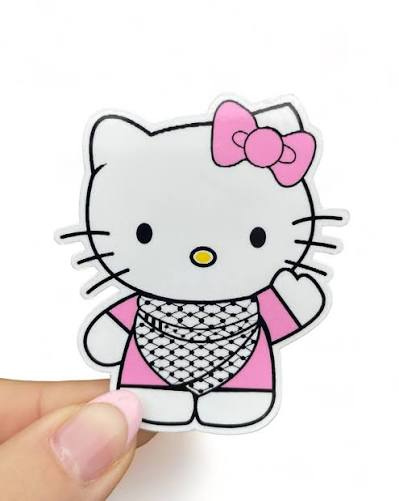
In her 1995 essay “Cuties in Japan,” the scholar Sharon Kinsella described a culture that arose in post-war Japan among young people who refused to become adults. These are people who dressed themselves as innocent babes, who rejected authority by becoming small and embracing an aesthetic of kawaii, read as “sweet, adorable, innocent, pure, simple, genuine, gentle, vulnerable, weak and inexperienced.”
A country bombed into submission processed its trauma by becoming adorable, childlike, and by reorienting itself culturally, aesthetically, and emotionally toward the aggressor. Hello, kitty.
Is something similar happening to the United States, to the West since 9/11?
September 11th was the first in a cascading series of attacks on the West by a confederated effort of politically and theologically driven Islamists. If 9/11 was the most visible and perhaps most shocking-and-awing, what has followed has nary missed a beat: the Madrid train bombings of 2004, the London Underground attacks of 2005, the Charlie Hebdo massacre, the Eagles of Death Metal at Paris’ Bataclan on a Friday night in November 2015, the truck on the Promenade des Anglais in Nice on Bastille Day 2016. Coupled with compounding crises of slow economic erosion, COVID, and a politics of schlock, is it surprising that the West has barely had time to register, let alone process, the trauma of these attacks?
In Trauma and Recovery, the psychologist Judith Herman argues that psychological trauma cannot be understood outside its social and political context. Herman notes that unprocessed trauma produces seemingly paradoxical needs to both speak about what happened and the need to deny or distance from it. When applied at the collective level, Herman calls this “intermittent amnesia,” a cultural cycle of rediscovery and repression that prevents any genuine reckoning from taking hold. We know not what we see.
Could it be that the West, in its own unprocessed grief, is finding its kawaii moment now, reorienting, culturally, aesthetically, emotionally, toward the aggressor, drawing itself closer to the source of the threat as a way of managing what it cannot face directly?
To be clear, the aggressor is not Arab culture. It is not SWANA. It is not the millions of people whose food, music, language, and history are being celebrated in the pages of a magazine. The aggressor is a specific political and theological project that uses terror and violence as an act of spectacle and oppression. This distinction matters because it is precisely the nuance that gets lost when a magazine cover collapses diverse civilizations into a single aesthetic symbol of cool.
Contrary to what was said at the time, irony didn’t die on 9/11. The fact of collapsing Palestinians, Yemenis, and Iranians into a block on the cover of a magazine proves that.
The Arab world, the SWANA world, is vast, internally divided, ancient, and multifaceted in ways that a single magazine cover cannot begin to contain. It is a condescending use of soft power — the cultural tastemakers doing to SWANA peoples exactly what Casablancas did to Jews: flattening them into symbolic currency. The people become the symbol. The symbol serves the needs of the people doing the collapsing.
Jews are anciently familiar with this device.
The symbolic energy of the victimized Jew has been spent. The Holocaust survivor, the refugee, the eternal minority no longer serves the story the West needs to tell about itself. Given the relative post-war successes of the diasporic and Israeli world, the larger culture is now making new meaning to form the symbol now required: the Jew as oppressor, obstacle to justice, the Zionist as white-settler-colonialist. (The backlash to “Habibi City” of course being the disappearance of the vast and large Mizrahi community, neither white nor settler, but, yes, Jewish.) Into that vacancy pours the excess, erotic energy of a culture that has not processed its grief and needs somewhere to put it.
This is insulting to everyone.
In a recent article, Florida International University professor of religious studies, Iqbal Akhtar, writes:
“The Jewish-Muslim relationship has become one of the central testing grounds for whether deep religious and cultural difference can be held without violence, and its collapse feeds a wider crisis of pluralism now visible across the democratic world. When this relationship breaks, it does not break in isolation. It confirms a story many people already want to believe: that difference is dangerous, that the only stable society is a homogeneous one, that the neighbor who is raised differently is a threat to be managed rather than a person to be known.”
Neither the SWANA world nor the Jewish world should accept the role being assigned to them. Both are being used as symbols in a proxy war for making meaning. Both deserve to be known as what they actually are: ancient, complex, internally divided peoples with legitimate claims on dignity, autonomy, and particularity.
Two symbols, dancing to someone else’s choreography, ought to refuse the invitation. And maybe, in refusing it together, find a shared song.
Habibi, be mine.
Thanks for reading! Don’t forget to subscribe and if this resonated with you, feel free to restack/share/give it some love.
Comments
Nothing yet. Say the first thing.
Sign in to join the conversation.