

Today’s article is by Ann Isabelle and was previously published in Ruach, our sister publication on Medium.
Wednesday stories (8 pm UK time) are by Sally Prag. Sunday stories (at the same time) feature the work of a range of writers. With the gradual evolution of the JPF, I am keeping all regular posts free but will be introducing a new column for paying subscribers called Book Talk — all about books relevant to Jewish life and literature. Watch this space! For now, if you would like to support me with a one-time donation, click here.
SUBSCRIBE TODAY! The JPF isn’t here for polite debates or academic footnotes — we’re dismantling antisemitism one idiot, one coward, one apologist at a time.
Different societies build different worlds, and if you want to understand what a society actually believed and not what it said it believed just look at what it built. Imperial hierarchy lives in Versailles, where proximity to the king determined your worth: which rooms you slept in, which doors you could open, how far you were from power. Soviet design ideology lives in the Khrushchyovka: five-story blocks, identical floor plans, same ceiling height, same window, stamped from Riga to Vladivostok. Enforced sameness was the architecture of enforced equality. The kibbutz made the same move as the Khrushchyovka and it actually meant it.
The first kibbutz, Degania Alef, was established in 1910 near the Kinneret. The founders were Jewish pioneers from Eastern Europe, shaped by socialist ideals, and they were building something with no real precedent: a collective settlement based on shared ownership, shared labor, and the systematic dismantling of private life. They were not just farming land. They were constructing a theory of human nature in brick and soil.
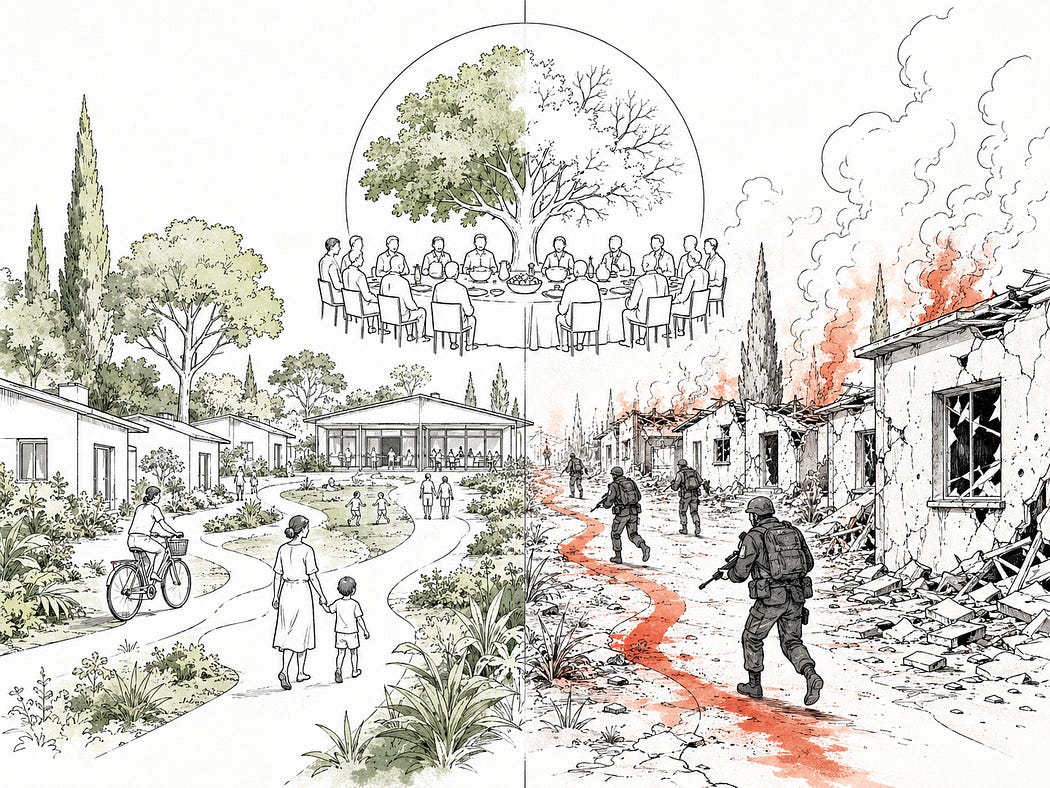
The architecture followed the ideology with unusual precision. There were no fences inside the kibbutz. The idea of a private perimeter was itself a kind of bourgeois thinking to be rejected. Dwelling units were reduced to the minimum: a sleeping room for a couple, without a kitchen or living room, because meals were eaten communally in the dining hall and children were raised together in a children’s house. Individual homes were scattered across open, landscaped green space, connected by a web of pedestrian and bicycle paths. The communal dining hall and cultural buildings sat at the center, physically and symbolically. Architecture and landscape merged into what kibbutz architect Samuel Bickels called “an all-day garden”; a space designed to keep people in constant, informal contact with each other.
This was not an accident. Architects who grew up inside the kibbutz movement absorbed its values (frugality, equality, the rejection of private property) and those values found their way directly into design decisions. The kibbutz master plan developed by Richard Kaufman in 1926 drew on European Garden City models but pushed further: no private streets, no locked gates, no spatial hierarchies that would let one family signal status over another. The built environment was engineered to make equality feel natural, because it would be, literally, the shape of daily life.
It worked, for a long time, at the level it was supposed to work. People lived more communally because the space gave them no alternative. The architecture produced the behavior the ideology prescribed.
What no one fully reckoned with was that openness is a posture. And postures can be read.
October 7, 2023.
Kibbutz Nir Oz had roughly 400 residents. More than 100 Hamas terrorists entered the community in the early morning hours. When they left, they took with them approximately 80 people, a quarter of the entire population. Those seized ranged in age from nine months to 85 years. Nir Oz accounted for roughly a third of all hostages taken that day.
Kibbutz Be’eri lost 101 civilians and 31 security personnel from a community of about 1,000. Residents who survived named one stretch of ruined homes “death row.” Each house the terrorists entered, they killed everyone inside.
The kibbutz had no perimeter worth the name. The pedestrian paths that made daily life feel open and connected also meant that once attackers were inside, they moved freely. The dispersed layout of small residential buildings, so elegant as an expression of egalitarian values, became a problem of coverage and response time. There were no natural chokepoints, no spatial features that slowed an attacker or concentrated defense. The architecture of trust had no contingency for betrayal at this scale.
A 2025 academic study on kibbutz security put it plainly: the October 7 attacks exposed critical vulnerabilities in the spatial design of Israeli kibbutzim, where openness and communal planning had become security liabilities. The buildings didn’t fail, they did exactly what they were designed to do and was the problem.
There is a version of this story that frames it as naivety; the peace-loving leftists who refused to acknowledge the danger on their doorstep. That reading is cheap and mostly wrong. The kibbutzim near Gaza were not unaware of the threat. They had security protocols, armed response teams, safe rooms in every home. Several kibbutz members had spent years advocating for coexistence with their Gazan neighbors, driving patients across the border for medical treatment, building relationships across the fence line. They were not naive about the conflict. They had made a choice, and the choice had a spatial expression: they would live openly, they would face the border without armor, because to do otherwise was to concede something essential about who they were.
That is a different thing from naivety. It is ideology held at cost. The original kibbutz founders enclosed their settlements in defensive courtyards, the chatzer, during the Ottoman era and early British Mandate period. When the security situation improved, they opened up. The move from enclosure to openness was a deliberate political act, a declaration that they had arrived, that the experiment was working, that they could afford to stop building walls. Over a century later, the communities that paid the highest price on October 7 were the ones that had most completely internalized that declaration.
What happens now is a genuine design problem with no clean answer. Researchers and architects working on post-October 7 reconstruction have proposed fortified perimeters, controlled access points, decentralized community hubs, and upgraded safe rooms. These all are reasonable interventions. They are also, in a direct sense, a retreat from the argument the kibbutz has been making for a hundred years.
You cannot have a fortified perimeter and an all-day garden. You cannot have controlled access and the spatial logic of radical equality. Every wall built around a kibbutz is a concession, not to Hamas, but to the original founders, the ones who built courtyards because they had to, before the movement was confident enough to open up.
Kibbutz Be’eri voted in late 2025 to demolish most of the homes destroyed on October 7. The vote was 196 to 146. There were people who voted against demolition, who wanted to keep the ruins, live with them, build around them. The Heritage Minister considered designating some structures as national heritage sites, over the community’s own wishes. Even the question of what to do with the destroyed buildings became a fight about what the kibbutz is for: memory or future, testimony or continuity.
Nir Oz voted to rebuild on the same land. Young adults from the Hashomer Hatzair youth movement have moved in while construction begins, living in temporary housing, partly as what one of them called “defense by presence.” The newest settlers are also, in some sense, the oldest kind: pioneers moving to a dangerous border because the ideological argument demands it, because the alternative is to admit the experiment failed.
Architecture encodes belief. When the belief changes, the buildings change with it. Or they don’t, and the gap between what the space says and what its inhabitants need becomes visible, sometimes brutally. The kibbutz spent a century building a spatial argument for openness, equality, and the rejection of enclosure. That argument was not wrong. It produced real communities, real solidarity, real lives that most people living in cities would find difficult to imagine.
What October 7 revealed was not that the argument was false. It revealed that arguments have costs, and that the people who bear the costs are not always the ones who made the argument. The families in those dispersed little houses, connected by bicycle paths through the garden, were living inside someone else’s theory about how human beings should inhabit the world. The theory was beautiful. The buildings were beautiful. The people who built them were serious and brave.
None of that is armor.
Kibbutz spatial design and the “all-day garden” concept https://urbannext.net/architecture-of-collective-living/
Samuel Bickels and the kibbutz as modernist landscape: https://www.researchgate.net/publication/260638583_An_all-day_garden-the_kibbutz_as_a_modernist_landscape
Post-October 7 security vulnerabilities in kibbutz architecture: https://www.tandfonline.com/doi/full/10.1080/13537121.2025.2575380
Kibbutz design culture and ideology — From Vision to Realization: https://www.tandfonline.com/doi/full/10.1080/2159032X.2023.2283941
Privatization trends, 2025 data: https://www.berghahnjournals.com/view/journals/israel-studies-review/41/1/isr410101.xml
Nir Oz hostage scale and community layout: https://www.timesofisrael.com/kibbutz-nir-oz-overrun-on-october-7-embodies-hamass-hostage-taking-strategy/
Nir Oz IDF response timeline and attack details — 40 minutes too late: https://www.ynetnews.com/article/hkan00ib3jx
Be’eri demolition vote and heritage designation dispute: https://www.timesofisrael.com/minister-may-preserve-beeri-homes-gutted-on-oct-7-despite-kibbutz-vote-for-demolition/
Border kibbutzim rebuilding and new settlers: https://www.jta.org/2025/10/05/israel/2-years-after-oct-7-shattered-them-israels-border-kibbutzes-are-drawing-new-dreamers
Gaza envelope reconstruction on the ground: https://www.jpost.com/israel-news/article-880638
Thanks for reading! Don’t forget to subscribe and if this resonated with you, feel free to restack/share/give it some love. Please also consider joining with a paid subscription or a one-time donation to enable me to keep bringing this content to the platform.
Comments
Nothing yet. Say the first thing.
Sign in to join the conversation.