
1
Earlier this year, on the fediverse, @electron_greg posted a short portable Basic program and started collecting timings for various retro machines. But his account is now gone! Fortunately, the computer museum NAM-IP has reconstructed the results, here.
Just in case it’s again lost, here are some quotes:
This is a repost of benchmark of BASIC on various micro proposed by Electron Greg earlier in 2026 but which looks not reachable any more. So we don’t loose that interesting information !
BASIC code is based on the SPIGOT algorithm implementing a continuous base change, see this PDF by Valentin Albillo
SPIGOT – Producing Digits of π one at a timeQuite generic BASIC code (but may require some tuning)
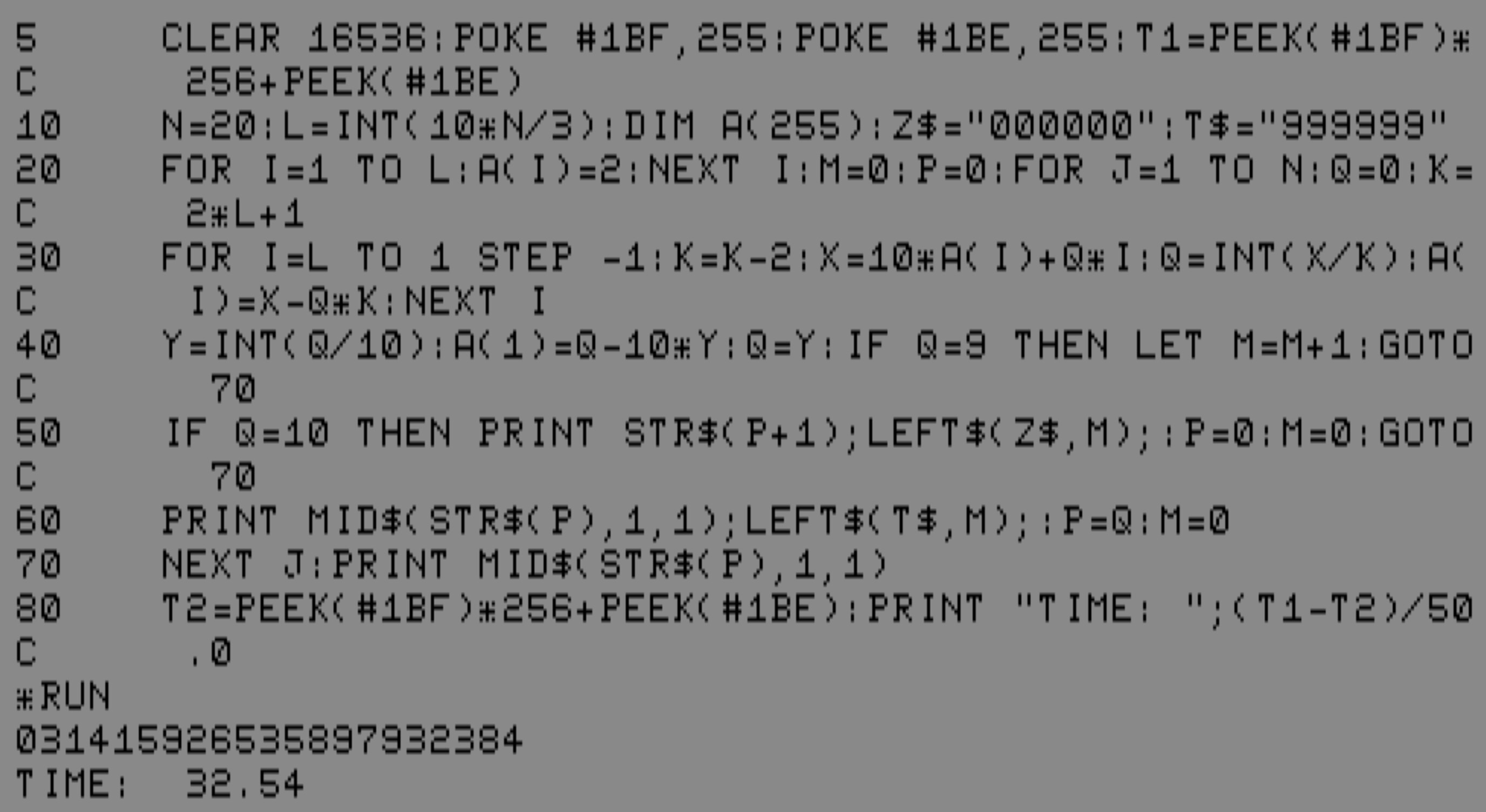
1 N=20: L=INT(10*N/3): DIM A(255): Z$="000000":T$="999999"
2 FOR I=1 TO L: A(I)=2: NEXT I: M=0: P=0: FOR J=1 TO N: Q=0: K=2*L+1
3 FOR I=L TO 1 STEP -1: K=K-2: X=10*A(I)+Q*I: Q=INT(X/K): A(I)=X-Q*K: NEXT I
4 Y =INT(Q/10): A(1)=Q-10*Y: Q=Y: IF Q=9 THEN LET M=M+1: GOTO 7
5 IF Q=10 THEN PRINT STR$(P+1);LEFT$(Z$,M);: P=0: M=0: GOTO 7
6 PRINT STR$(P);LEFT$(T$,M);: P=Q: M=0
7 NEXT J:PRINT STR$(P)
Ranking by increasing time to compute, number without credit are by Greg
RC2014 : 14 (thank you JonV)
BBCMicro : 19
AmstradCPC : 22 (thank you Devlin)
AmstradPCW : 23 (thank you Pete)
AcornElectron : 25
C128 : 27 (fast mode - thank you Jonas H)
LuxorABC80 : 29 (thank you Erik)
SharpMZ700 : 32 (thank you Tim Holyoake)
DAI: 33 (by NAM-IP)
VIC20 : 36
AcornAtom : 37
AppleII : 38 (thank you Jeroen)
TRS80CoCo : 42 (thank you Chip)
Atari800 : 42 (thank you Mark Elliott)
CBMPET : 43
C64 : 43
Dragon32 : 44
SharpMZ80K : 45 (thank you Tim Holyoake)
C16 : 46
Altair8800 : 52
MSX : 53 (thank you Pixel Purrito)
C128 : 56 (default “mode”)
ZX80 : 57
ZXSpectrum : 68 (thank you Adam)
SharpPC1500A : 167 (thank you Karttu)
SharpPC1245 : 405 (thank you Karttu)Our contribution for our Belgian DAI computing 20 PI digits in about 33s
There are also traces of various replies to the original thread, lying around in a detached state…
Here’s one from Tim Holyoake (psychotimmy) which includes an alternative, a primes benchmark.
Here’s an algorithmic clarification from Jeroen Wiert Pluimers, which links to a post of mine where I note
It’s nice to observe that this pi spigot algorithm dates from 1991 - later than most of these micros. Introduced by Rabinowitz as 14 lines of Fortran, and four years later explained in a paper with Wagon.
By 1994 Dik Winter had written his 133-character C version, according to this Usenet thread.
Somewhere nearby, I noted that the point of the basic Basic benchmark was to benchmark various Basics. It wasn’t an invitation to improve the coding or the algorithm or to make something faster but not so portable. But I linked to the Stardot thread “Calculating digits of Pi in Basic” and said:
The best BBC Basic effort I could come up with is towards the end of that thread, producing the requested 20 digits in 2.07 seconds.
I also chose to have a look at how fast a very BBC Basic version of the original algorithm could run on a Beeb. I did that here:
For what it’s worth (very little!) here’s that 8.11 second version in (very) BBC Basic:
0 T%=TIME
1 N%=20: L%=10*N%/3: DIM A%(255): Z$="000000":T$="999999"
2 FORI%=1TOL%:A%(I%)=2:NEXT: M%=0:P%=0:FORJ%=1TON%:Q%=0:K%=2*L%+1
3 FORI%=L%TO1STEP-1:K%=K%-2:X%=A%(I%)*&A+I%*Q%:Q%=X%DIVK%:A%(I%)=X%-K%*Q%:NEXT:Y%=Q%DIV&A:A%(1)=Q%-Y%*&A:Q%=Y%:IFQ%<9PRINT;P%LEFT$(T$,M%);:P%=Q%:M%=0:NEXTELSEIFQ%=9M%=M%+1:NEXTELSEPRINT;P%+1LEFT$(Z$,M%);:P%=0:M%=0:NEXT
4 PRINT;P%:PRINT (TIME-T%)/100;" seconds"
3 Likes
drogon 2
Hm.
If I run the original in my own SBC running BBC Basic4 at 16Mhz then it gives me a time of 1.3 seconds, or an equivalent of 10.4 seconds at the Beebs usual 2Mhz via a simple multiply by 8.
The 2nd “very BBC Basic” one takes 7.36 seconds. (or 0.92 * 8)
I’m not sure I can translate it into my own TinyBasic… Although I have a different Spigot version which I’m really not sure where I got it from, however it 's not as slow as I thought it might be taking 4.48 seconds to calculate 20 digits on my 16Mhz 65C02…, so ~36 seconds on a 2Mhz Beeb if I were ever to run it there.
  0 REM Pi - Spigot
  140 PR "Pi - Spigot"
  150 PR "How many digits (<= 1000)? "; : INPUT N
  180 IF (N>1000) OR (N<1) PR "Try again...": GOTO 150
  190 REM Storage is modest at about 1/3 N,
  196 REM ... however we max. out at 10*N, so about 3000 digits
  200 L=(10*N/3)+16 : E=0
  220 !&A0=0:REM Zero timer
  240 A = TOP : REM Start of free RAM
  250 M=0 : P=0
  270 REM
  280 FOR J=1 TO L :!(A+J+J)=2 : NEXT J
  310 REM
  320 FOR J=1 TO N
  330   Q=0
  340   FOR K=1 TO L
  345     I=L+1-K : X=10*!(A+I+I)+Q*I
  355     T=2*I-1 : Q=X/T
  370     !(A+I+I)=X-T*Q
  380   NEXT K
  385   T=Q/10 : !(A+2)=Q-10*T : Q=T
  410   IF Q=9 THEN M=M+1: GOTO 610
  420   IF Q<>10 THEN GOTO 540
  430   REM Q==10
  440   D=P+1 : GOSUB 670
  450   IF M<=0 GOTO 500
  460   FOR K=1 TO M
  470     D=0: GOSUB 670
  480   NEXT K
  490   REM
  500   P=0 : M=0
  520   GOTO 610
  530   REM Q<>10
  540   D=P: GOSUB 670
  550   P=Q
  560   IF M=0 THEN GOTO 610
  570   FOR K=1 TO M
  580     D=9 : GOSUB 670
  590   NEXT K
  600   M=0
  610 NEXT J
  620 REM
  621 PR P-10*(P/10)
  630 REM
  635 PR "Time: ", !&A0, "centi-seconds"
  640 END
  650 REM
  660 REM Output
  670 IF E THEN PR D-10*(D/10);: RETURN
  680 IF D=0 THEN RETURN
  691 PR D-10*(D/10),".";
  700 E=1
  710 RETURN
The run:
>RUN
Pi - Spigot
How many digits (<= 1000)? ?20
3.1415926535897932384
Time: 448centi-seconds
-Gordon
EdS 3
That’s rather good then, compared to the listed 19 seconds.
The C64 and VIC20 have nearly identical BASICs and nearly identical effective clock speeds. Why the significant time difference between them? I can’t imagine the badlines stealing that many cycles …
EdS 5
AIUI there’s a bigger disparity in PAL machines, perhaps that’s it?
Comments
Nothing yet. Say the first thing.
Sign in to join the conversation.