
1
I’m familiar with the C64 and have a little idea of its features and limitations, but I found this demo, and the full explanation of why it is impressive and how it was done, very good indeed.
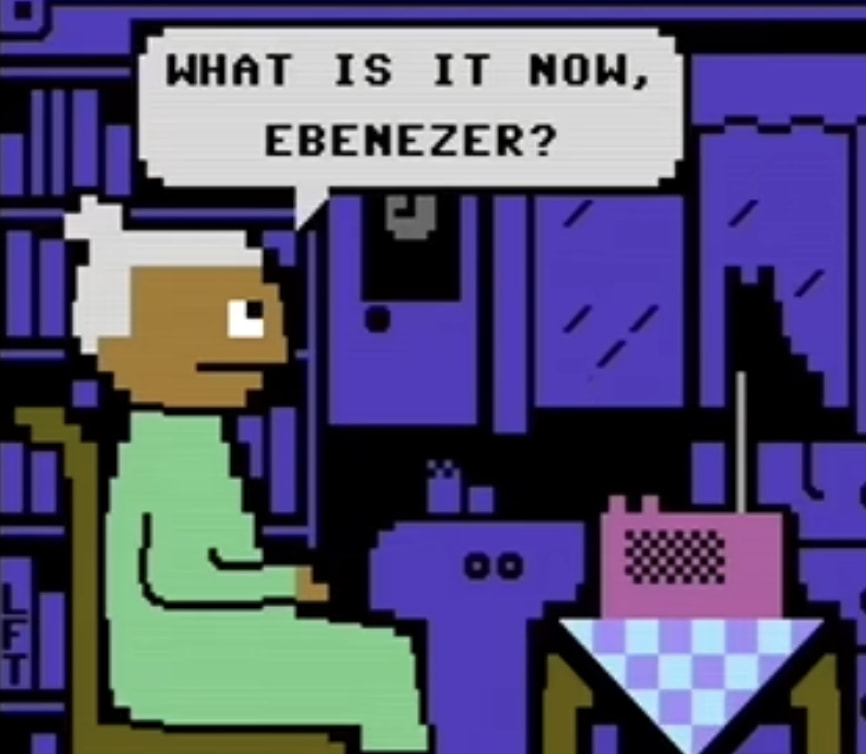
Rodents in the Attic (Small C64 demo) (4 mins)
The demo is short, and funny. There’s a skill in plotting such a thing, and executing it, beyond the technicalities.
C64 Demo Effects Explained: Rodents in the Attic (17 mins)
via Linus Akesson’s blog here.
Thumbnail:
9 Likes
Interesting. Thanks! But it was obvious, that sprites are involved. But it’s a bit more complicated.
There are many demos, showing stuff that seems impossible. And most using the boarders.
scruss 3
That’s what makes me a little sad about retro demos: they no longer look cool in their own right. There has to be an explanation of what’s all going on at once and why that’s cool on the particular hardware.
The demo that did blow me away recently was Dmitry_Milk’s We Are Vocoders on the ZX Spectrum. It seems it packs a multi-channel sound engine and possibly Votrax speech chip emulation in 12½K of code, on a machine with no sound chip and crude PWM audio direct from the CPU.
3 Likes
EdS 4
That certainly is impressive! These demos are highly constrained - for me, the ideal is that they have an immediate aesthetic appeal, that they appear impressive to those who know something of the constraints they operate within (the more we know, the more impressed we are), and that there’s an accessible explanation of how it’s done and why.
Dmitri adds a little in the comments to that video:
No AY-chip, Covox or other sound facilities used, only 1-bit beeper.
Sound is generated exclusively by Z80 processor using pulse width modulation at 16.2 kHz.
…
It’s better to use models that are not affected by I/O contention.
…
idea of mixing looped waveforms (5 resampled channels in my case + 1 non-resampled).
…
Speech is synthesized from [allophones]. In fact, nothing new has been added to engine compared to previous demos. It’s the same logic, as for all tonal instruments in this demo - switching 1-period waveforms on-the-fly, while note is still sounding, preserving phase of waveforms. At all, there are 23 256-byte subphoneme waveforms, along with other 34 256-byte waveforms for instruments, that are well-packed.
…
12.5KB - yes, it is compressed, decompressed size is 36KB
Bushy555 5
Dmitry’s previous demo release “Beeperdrive” was released at Diehard’s demo comp Winter 2026. He included the source, and I managed to port it over to the VZ200 / Laser200 only last night using a 18 resistor ladder circuit DAC sitting on the printer port. The VZ/Laser uses a piezo speaker which does not respond to a lot of auido unlike the ZX’s full cone speaker. Sounds wonderful, and at the release of this first demo six months ago, it also did the rounds and was kind of mindblowing, being an unpacked 28kb for 3 minutes of 1-bit music. (no speech)
Beeperdrive : ZX Spectrum Beeper Music Beeperdrive by Dmitry_Milk.
I ported the same above to the Microbee and worked fine though with a lot of noise. This Beeperdrive should play fine on any Z80 computer with simple output port/latch changes. ie, the likes of the Lynx, Sam Coupe, TRS80 model 3+4, NEC PC8001, Amstrad, Sharp MZ700/800, Laser 500, Aquarius.
Just now need to find the source code for this newer ‘We are Vocoders’ release - if he has released it.
1 Like
IsaacKuo 6
Yeah, this is how the C64 demo scene has been for some decades.
Well … not all of it. There’s still a lot of PETSCII demo sceners who obviously can’t “innovate” with technical trickery. It’s a pretty pure expression of artistic skill and aesthetics.
But there are other forms of artistic expression that have just fallen out of interest. Simply drawing stuff out of graphics primitives on a bitmap, for example. You never see a simple demo like Swinth, or the Kaleidoscope 1 effect in The Print Shop.
Hmm … maybe I should single handedly bring 'em back …
1 Like
IsaacKuo 7
But it’s worth remembering, that even this fancy ghost byte effect demo still ALSO features classic PETSCII art and animation.
Comments
Nothing yet. Say the first thing.
Sign in to join the conversation.