
Hey there,Welcome to another round of The Advantage Hit 📨 - where we spill inbox secrets that drive real conversions!
Most Klaviyo accounts have four segments that feel like a system.
Engaged.
Unengaged.
Repeat customers.
VIPs.
Maybe “newsletter subscribers” if someone was feeling organized.
Those labels are useful. They are not enough.
Because the money in segmentation is rarely in broad audience labels. It is in customer moments:
the first-time buyer who should be making order two this week
the VIP who stopped buying right before the normal refill window
the subscriber whose next charge is coming and should not see a site wide coupon.
If those moments are not saved as segments, your account cannot act on them.
The customer exists. The revenue moment exists. The segment does not.
That is Segment Debt.
Every missing segment creates a missing decision: no flow branch, no exclusion, no reporting view, no campaign path.
A lot of Klaviyo accounts are segmented for sending, not for retention.
That means the account can answer basic broadcast questions.
Who opened recently? Who has not opened recently? Who has purchased before? Who spent the most?
Useful.
But retention work needs a sharper question.
Who is most likely to place order two if we reach them now?
Who bought the starter product but never moved to the replenishable product?
Who only buys when a discount is attached?
Who should be protected from the July promo because they bought yesterday or have a subscription charge coming next week?
Those are customer moments. If they are not saved, named, and used, the account behaves as if they are invisible.
This is why segmentation leaks rarely look broken in the dashboard. The missing segment does not show up as a red warning.
It shows up as a campaign that has to work too hard because the account cannot separate the people inside it.
When we audit a Klaviyo account, we are not impressed by a long segment library on its own. We want to know whether the segments map to decisions that actually change revenue, margin, or customer experience.
Five we look for early:
1. Hero-product non-buyers
Recently engaged people who have never bought the product the brand is built around.
This segment usually needs education, proof, use cases, and a clean first-purchase path. If it does not exist, the best prospects get treated like generic newsletter traffic.
2. First-order buyers in the second-purchase window
Customers who placed exactly one order, are past delivery, and have not placed order two by the point where a second order should be plausible.
This is not the same as a winback segment. The relationship is still warm. The job is to make the second purchase feel obvious before the customer drifts.
3. Two-time buyers stuck before order three
Customers who bought twice and then stopped before the habit formed.
This group often gets lumped into “repeat customers,” which hides the actual moment. A second purchase proves intent. The third purchase is where the brand starts becoming a default.
4. Lapsing VIPs
High-value customers who are no longer behaving like high-value customers.
They should not get the same generic code as the whole list. They usually need status, access, service, replenishment timing, or a reason to feel recognized.
5. Recent buyers to protect from discounts
Customers who bought in the last 7, 14, or 30 days, or customers with an active subscription charge coming soon.
This is one of the most ignored segments in promo calendars. Without it, the brand pays to discount orders that were already going to happen, then trains the best customers to wait.
That is the sneaky part.
Most teams hear “missing segment” and think it means a campaign opportunity.
Sometimes it does. But just as often, the value is in what the segment prevents.
A recent-buyer segment prevents margin leaks.
A suppression-risk segment protects deliverability.
A discount-trained segment keeps the promo calendar from feeding the exact behavior it is trying to escape.
A first-order buyer segment makes reporting cleaner because you can see whether the second-purchase system is actually working.
Segmentation is not just targeting. It is decision control.
If the account does not know who should receive, who should be suppressed, who should be branched, and who should be measured separately, every send gets a little broader than it should be.
Broad sends are easy to ship. They are expensive to keep relying on.
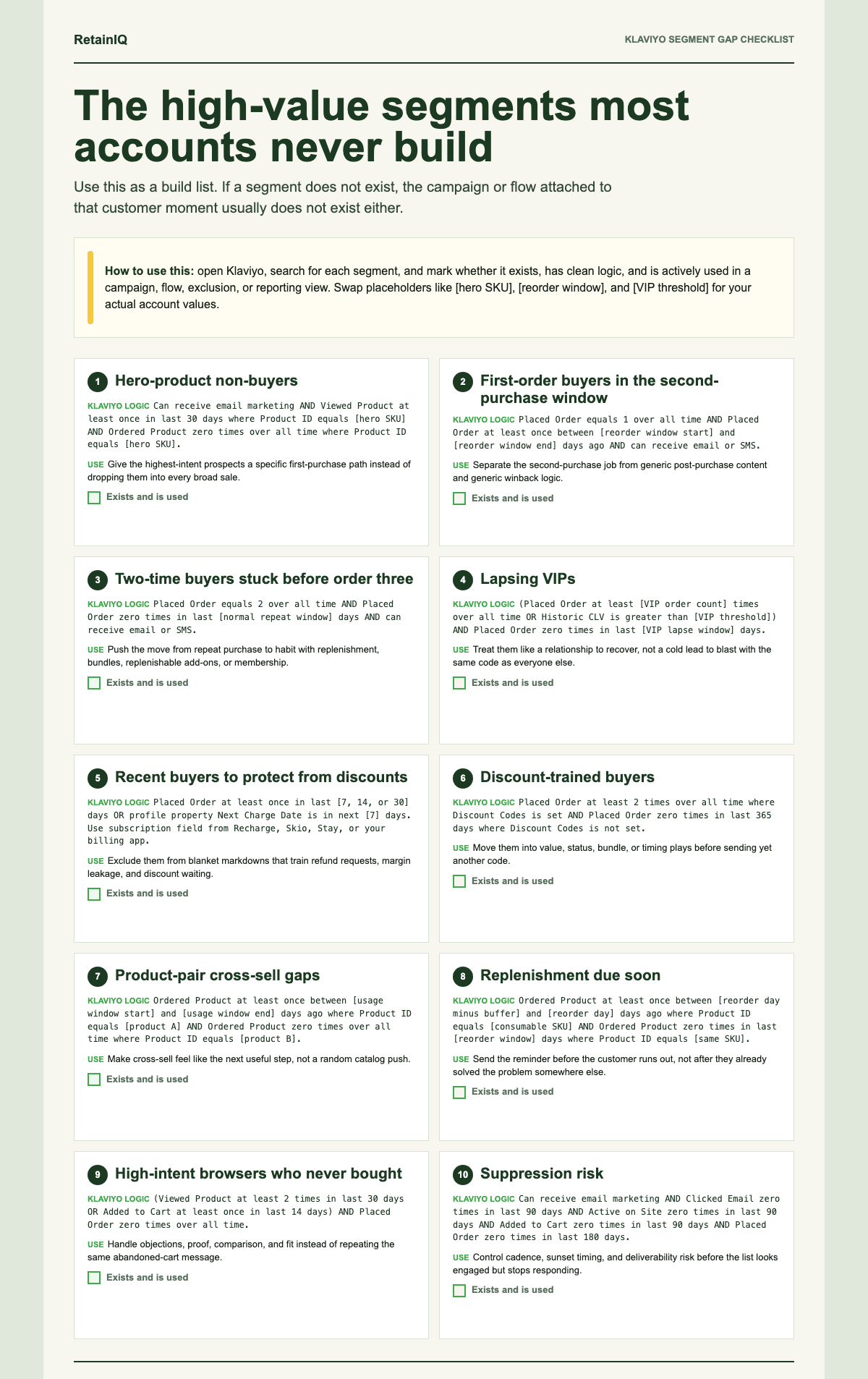
Before you call a segment useful, run three checks.
Does it describe a customer moment, not just a broad label?
Does it change a decision in the account?
Is it actively used in a campaign, flow, exclusion, or reporting view?
If the answer to any of those is no, the segment may exist, but it is not doing much work.
The dangerous version is when the segment does not exist at all. That means nobody is seeing the moment. Nobody is suppressing the wrong send. Nobody is triggering the right message. Nobody is measuring the cohort separately.
The revenue does not look lost.
It never got named.
Want us to map the segment debt in your account?
If you want to know which of these segments exist in your Klaviyo account, which ones are broken, and which customer moments are missing completely, that is exactly what we look at in a free retention audit.
We read the account structure, flow logic, segment library, exclusions, and promo rules. Then we show you where the system is holding and where it is treating valuable customer moments like generic list traffic.
No deck. No pitch. Just a clear read on the account and the gaps worth fixing first.
The RetainIQ Team
Klaviyo Gold Master Partner
P.S. Segment Debt is dangerous because nothing appears broken. The account simply never built the view that would expose the leak. If you want us to find those missing views, start with the audit.
Enjoyed the read? Share it with your email obsessed peers.
Comments
Nothing yet. Say the first thing.
Sign in to join the conversation.