
Hey there,Welcome to another round of The Advantage Hit 📨 - where we spill inbox secrets that drive real conversions!
The first order has gotten a lot more expensive since the start of this year.
That is the simplest way to describe the state of D2C halfway through 2026.
Paid acquisition is less forgiving. Meta is less predictable. Google is crowded. Creator traffic is spiky. Discounts are doing more conversion work than most brands want to admit.
For a lot of teams, the first purchase no longer feels like the win. It feels like the cost of entry.
That changes the job of email.
Email can no longer just be the channel that “drives 30% of revenue.” That number is useful, but it does not answer the bigger question:
Did email make this customer easier to keep than they were to acquire?
That is the mid-year retention check.
Most brands have the basics now.
Welcome flow. Cart abandonment. Browse abandonment. Post-purchase. Winback.
But having the basics does not mean the lifecycle is doing enough work.
A post-purchase flow can be live and still fail to move first-time buyers into order two.
A winback flow can report revenue and still recover customers too late, with too much margin given away.
A campaign can create a spike and still teach the list to wait for the next code.
This is The Payback Gap.
It is the space between what acquisition spent to win the customer and what email is built to earn back after the first order.
The bigger that gap gets, the more growth depends on buying the same customer again.
The brands doing this well are not treating Klaviyo like a campaign calendar.
They are using it as the system that decides what happens after acquisition.
That means the account should know:
Who bought for the first time during a sale
Who is inside the second-purchase window
Who has a subscription charge coming soon
Who just bought and should be protected from the next discount
Who used to buy on rhythm and is starting to lapse
Which cohorts are getting more valuable over time
That is not more email.
It is better lifecycle control.
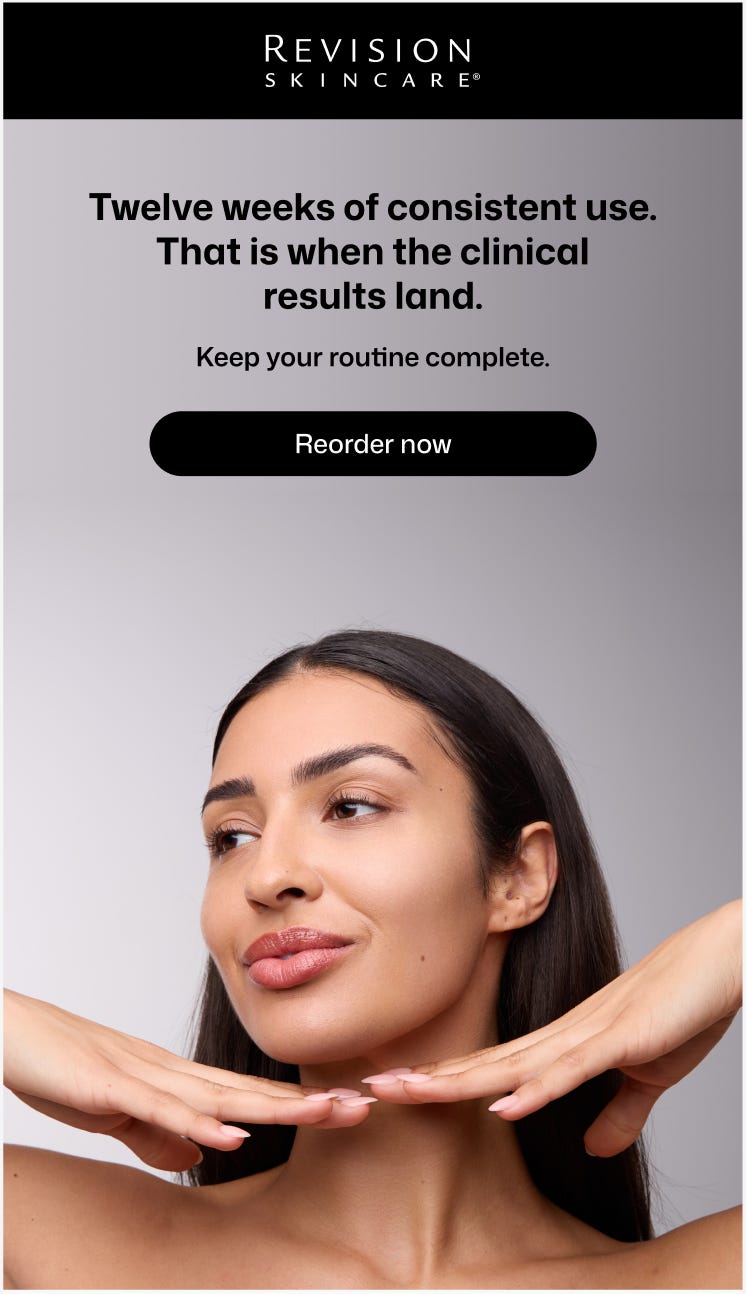
This Revision Skincare email is a good example of what that means.
The move is not the design. It is the reason.
“Twelve weeks of consistent use” gives the reorder a timeline.
“Clinical results” ties the next purchase to the outcome the customer already wants.
“Keep your routine complete” reframes buying again as staying on track, not being sold to.
No coupon. No fake urgency. No generic “running low?” reminder.
Just the product usage rhythm translated into a reorder moment.
That is the craft most accounts miss. The email is not asking, “how do we get another order?”
It is asking, “when does the customer need to keep going, and what reason makes that feel obvious?“
When acquisition gets expensive, email has to do more than send campaigns. It has to protect the moments where a customer is still warm, still reachable, and still able to become profitable.
The question is not “is email working?”
That is too vague.
The better question is:
Is email making acquisition easier to afford?
To answer that, we would look at four things:
First-to-second purchase: how many new customers reach order two, how quickly, and does that change by acquisition source or discount use?
Margin protection: who is being excluded from discounts because they were already likely to buy?
Lifecycle coverage: which high-value customer moments exist as segments, branches, or flows, and which ones are still invisible?
Cohort movement: are customers becoming more valuable over time, or is email mostly catching revenue that would have happened anyway?
That is the retention work that matters now.
Not because email suddenly became more important.
Because acquisition became less forgiving.
When the first order gets more expensive, the system after the first order has to get smarter.
If you want a second set of eyes on whether your Klaviyo account is doing that job, we can take a look.
We will show you where email is helping acquisition pay back, where it is mostly reporting revenue, and which lifecycle gaps are making growth more expensive than it needs to be.
Talk through your account with us
The RetainIQ Team
Klaviyo Gold Master Partner
P.S. The strongest retention programs we see in 2026 are not sending more. They are accounting for the customer moments that make acquisition pay back. If your account cannot see those moments, it cannot protect them
Enjoyed the read? Share it with your email obsessed peers.
Comments
Nothing yet. Say the first thing.
Sign in to join the conversation.