
More than three decades ago, West Yorkshire began feasibility work on a tram system. The tram has still not been built.
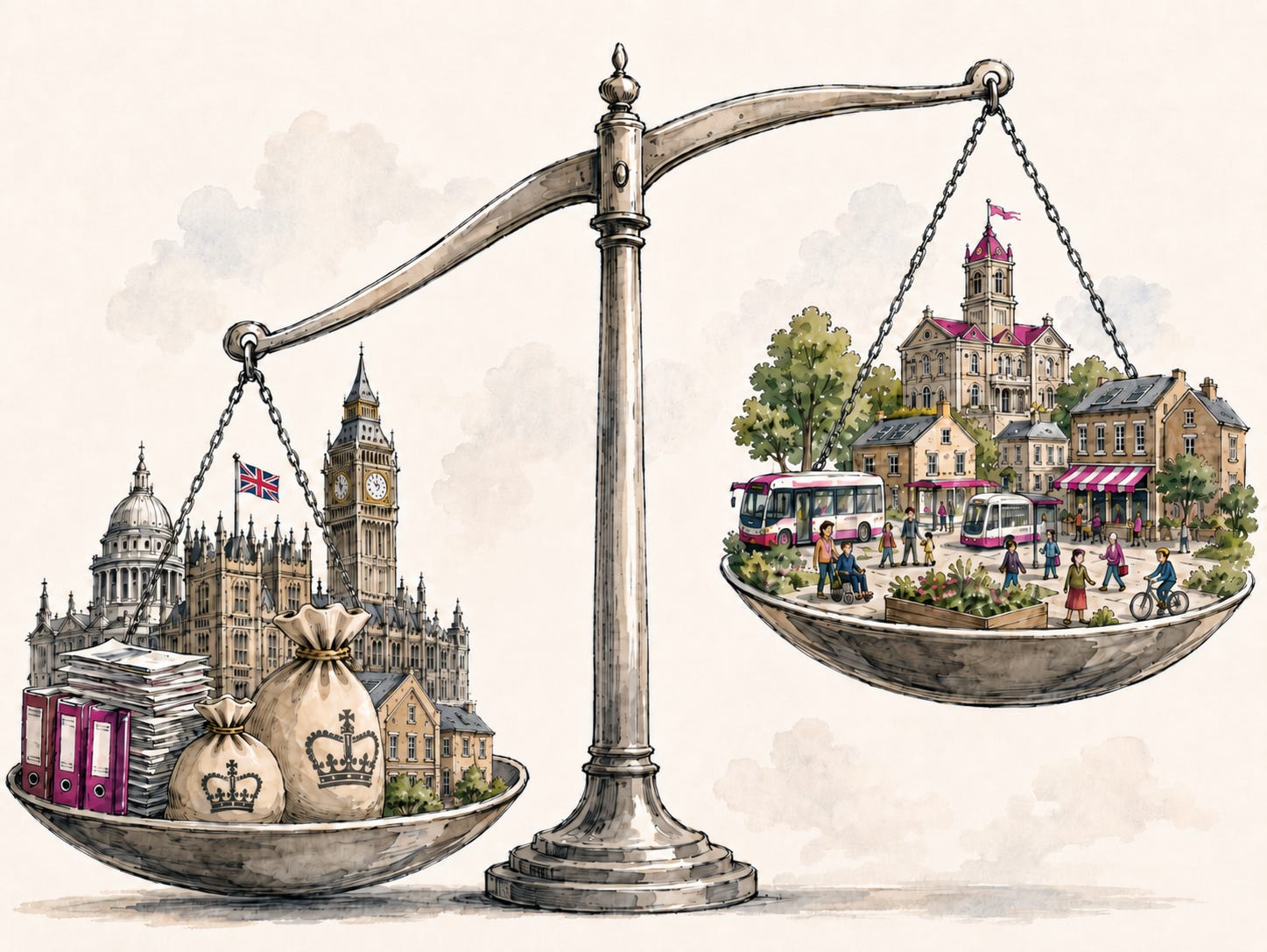
That sentence could almost be used as a potted history of the English governance model. Decisions taken within a locality rarely survive the long journey through Whitehall approval, sign-off, and resourcing. There is no alternative to deep dependency upon the permission and funding that emanates from central government.
Local government once possessed a much greater capacity to shape local economies and invest for the future. In late Victorian England, the Manchester Corporation could finance the construction of the Manchester Ship Canal through municipal borrowing. At the turn of the twentieth century, 61 local authorities owned tram networks.
But the quest for devolution across England now is not an exercise in nostalgia. An enormous opportunity now exists to make radical progress and put a lasting stop to the dominance of Whitehall. The revolution has been under way for some years. And with the opportunity comes the very real risk that the revolution will be left incomplete: a transfer of accountability without a commensurate increase in regional or local power.
This means that the next phase of devolution must be much more radical than the last. Fiscal devolution should give strategic authorities a direct stake in the growth they generate, underpinned by an equalisation system that prevents places from being trapped by their starting conditions. Regional institutions should have a stronger hand in directing public investment, shaping development vehicles and attracting capital. Their chief executives should take direct responsibility for devolved funding, rather than Whitehall permanent secretaries remaining nominally accountable for decisions they no longer make.
The paper we publish today, Devolution revolution, sets out ten priorities for a Government with significant interest in achieving a more decentralised State. This would extend the power of strategic authorities beyond an ambition for growth and into the realms of public service reform and place-shaping. Employment support, skills, health, policing and other institutions should operate across coherent geographies. Mayors should be able to align funding, data and commissioning around shared outcomes, and intervene where fragmented public service markets are failing residents and taxpayers alike.
In practical terms, that means much more than handing mayors extra funding. The report calls for stronger institutional capacity in strategic authorities, a new accountability model in which their chief executives take direct responsibility for devolved spending, and an England-wide settlement that does not leave large parts of the country permanently outside the system. And it makes the case for strategic authorities to become the organising layer for public service reform, bringing employment support, skills, health and other services into closer alignment, using shared data and commissioning power to tackle fragmented markets, and pushing Whitehall towards a presumption that major public bodies should operate across the same geographical boundaries.
This is an undertaking larger than any tramway: the creation of a new tier of governance, growing from a patchwork of strategic institutions to a lasting transformation of the way England relates to the State.
Devolution revolution, co-authored with Jack Shaw, is available to read now.
No posts
Comments
Nothing yet. Say the first thing.
Sign in to join the conversation.