
Quote of the week:
“Yet the thing I will always take away with me, the most humbling aspect of this job, is the front row seat you get to witness the greatest things of this country in action. To see, every day, immeasurable acts of resolve, grit, decency and compassion.”
Sir Keir Starmer’s final speech as Prime Minister.
This week, the UK got a new Prime Minister – its seventh in a decade. He is, he says, committed to “the remaking of the British state”. It’s a good line: our strapline here at Re:State is “bold ideas to remake the State”. We’ve long argued that the culture, structure, and operation of the British State hold the country back, and that fundamental reform is needed to improve its functioning and deliver better outcomes. So, the diagnosis and sense of urgency from the new PM is encouraging.
What to make, though, of the specific changes to the machinery of government announced this week? First, Burnham has moved to strengthen the machine supporting the Prime Minister. There is a widespread and longstanding consensus that Prime Ministers have been poorly served by a small and underpowered No 10 team.
Burnham is addressing this through a new Office of the Prime Minister and Cabinet (OPMC), bringing in the bits of the Cabinet Office that directly support the PM, No 10, and the new No 10 North, along with an AI taskforce and new executive agency focused on key administrative functions.
While strengthening the operation supporting the PM is positive, there is a risk that this becomes a rebranding exercise, relabelling the bits of the Cabinet Office that served the PM already and returning AI responsibility to the centre, where it sat until only two years ago.
To make a difference, these structural changes to the core of the executive must disrupt the way Whitehall operates and lead to new ways of doing things. On this front, it is the innovation of No 10 North that appears the most promising.
It is imperative, however, that this new institution does not simply become an outpost or regional branch of a No 10 that otherwise doesn’t change much. This would miss the opportunity for it to be an engine of devolution and regional growth, unpicking the siloes that structure Whitehall.
Earlier this week, we set out our blueprint for a transformative No 10 North, arguing it must avoid becoming purely symbolic, too small, duplicative, or another layer of complexity.
Instead, it should be structured around four core units (devolution; subnational investment and growth; system democratisation; local public services innovation). Teams from other parts of Whitehall should be brought in to staff it, so that existing capabilities are combined in productive new ways and new capacity and capabilities are built.
Ultimately, it should be about strengthening the ability of the Prime Minister to deliver his cover mission of spreading power, resources and decisions to subnational governments and economies. The sign of its success will be if some of its initial functions, particularly those driving decentralisation, become less necessary as its mission progresses.
The early signs are promising. It appears that local economic growth and devolution strategy is being moved into No 10 North from the Ministry of Housing, Communities and Local Government, along with local economic growth policy from the Treasury and the Test, Learn and Grow Unit from the Cabinet Office.
Burnham is also reviving the Gordon Brown-era National Economic Council, which he will chair for the first time today, bringing together senior ministers and regional mayors to drive forward devolution and regional economic policy.
This kind of ongoing collaboration with local leaders will be vital to the success of these plans – structured coordination can help sustain a sense of shared direction and strategy. But it will not always be the case that everyone is singing from the same hymn sheet. One of the real tests will be when a devolved leader seeks to take a different path.
Read of the week
This week’s recommended read is from Chris Curtis MP. The former parliamentary Chair of the Labour Growth Group is writing about, yes, growth. He covers the extent of the UK’s recent economic stagnation compared to other countries. His explanation is an institutional one: the British state is both too centralised and too complex and fragmented. Have a read for his suggestions as to what we should be doing differently.
Have a great weekend!
Alex
Senior Researcher

It’s been a very busy week here at Re:State!
On Tuesday, our ‘Plan for Government’ programme published Building No 10 North, which was covered by Politico’s London Playbook newsletter and BBC News. Also on Tuesday, our Director of Policy and Research and lead author of the report, Dr Simon Kaye, published a Substack outlining our plans, and later joined Laura McGhie on BBC Radio 5 Live to discuss the report and recommendations for how Downing Street’s new northern base should operate.
On Wednesday, Chief Executive, Charlotte Pickles, was quoted in The Times about the Government’s next steps for No 10 North. Building No 10 North was covered by Civil Service World, Manchester Evening News, and Left Foot Forward.
On Wednesday also, Senior Researcher, Alice Semark, wrote an op-ed for LocalGov, arguing that more funding from Westminster alone will not fix adult social care, and that councils need to rethink their approach to commissioning, building on findings from our recent report, Care to stay.
On Thursday, our ‘Plan for Government’ programme published another report, A Mid-Career Fast Stream. Report author and Re:State Director of Strategy, Joe Hill, wrote about why the scheme is needed on our Substack.
Coverage continued for Building No 10 North on Thursday. Simon was quoted in a BBC News article on why it’s important that No 10 North is big enough to outlast Burnham’s administration.
On Friday, Charlotte joined BBC News to discuss how No 10 North should be organised, and its potential to drive genuine devolution and fundamentally reshape how the country is governed. She also made the case for it on Talk TV.
Similarly on Friday afternoon, Simon appeared on Times Radio to discuss No 10 North.
And Simon commented on the breakup of Homes England in an article in The i Paper, and Building No 10 North was picked up again by Politico’s London Playbook newsletter.

This week, our ‘Plan for Government’ programme published two new papers.
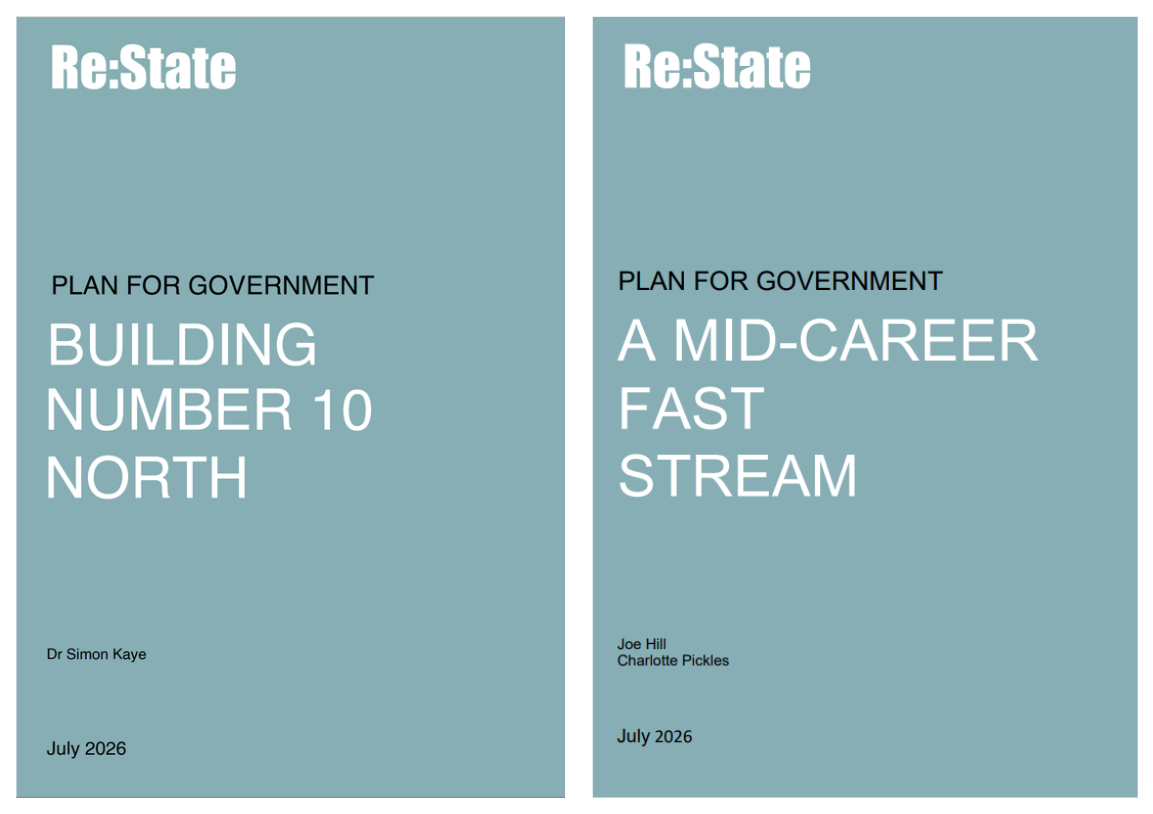
On Tuesday, we published Building No 10 North. The new Prime Minister has promised to “take power back from Westminster and Whitehall and give it to the place where you live”. At the heart of those plans is No 10 North, promised to become the “nerve centre of a rewired Britain”. But a new postcode will not, by itself, create a new model of government. No 10 North must be designed as more than a relocated government office. This paper provides a blueprint for building that institution.
On Thursday, we published A Mid-Career Fast Stream. The challenges facing the public sector are daunting, but for many people that’s why they want to work in government. Civil service roles come with the chance to make a real difference to people’s lives, and some of the best and most exciting jobs in the country are in Whitehall. But for a country whose leaders so often say that they want “the best and the brightest” to come and work in government, the government doesn’t make it easy for them to do so. This paper outlines how A Mid-Career Fast Stream would work – as a two-year programme for 50 successful candidates, supported by senior civil service mentors and a world-class development offer, to progress them rapidly to the standard of being promoted to Deputy Director-level on completion. It includes a job advert and curriculum design which can be directly implemented by the Cabinet Office.
No posts
Comments
Nothing yet. Say the first thing.
Sign in to join the conversation.