
I’ve been writing here on Substack since mid-March 2025, or for just over a year. This post is to let you know what the heck is going through my head as I process the lessons of that first sun circuit and, yes, decide to continue to do this.
In many ways, writing on Substack has turned out better than I expected. In other ways, a bit less so. The lessons learned have been substantial and will, I think, help me greatly in producing strong content going forward.
This Substack, ReportEarth, was my attempt to start writing again after leaving the Washington Post in the summer of 2024 and taking an academic turn, accepting a professor of practice and practitioner fellow appointment at the University of Virginia Environmental Institute.
I didn’t quite know how to do this. I wasn’t sure of my new writerly identity, and my detached newspaper voice was hard to kick. I went through an initial phase of forcing myself to post weekly pieces here, but they often felt like echoes of what I’d done at the paper when working on similar timelines.
That wasn’t me any more.
On the other hand, I also wrote some things I would never have written for the Post, and they were often the most successful posts. These tended to be reflections on the state and nature of climate communications and journalism, drawing on data but also content from my lectures (especially data visualizations), and my general thinking about these things. They were a blend of data journalism and more academic thinking.
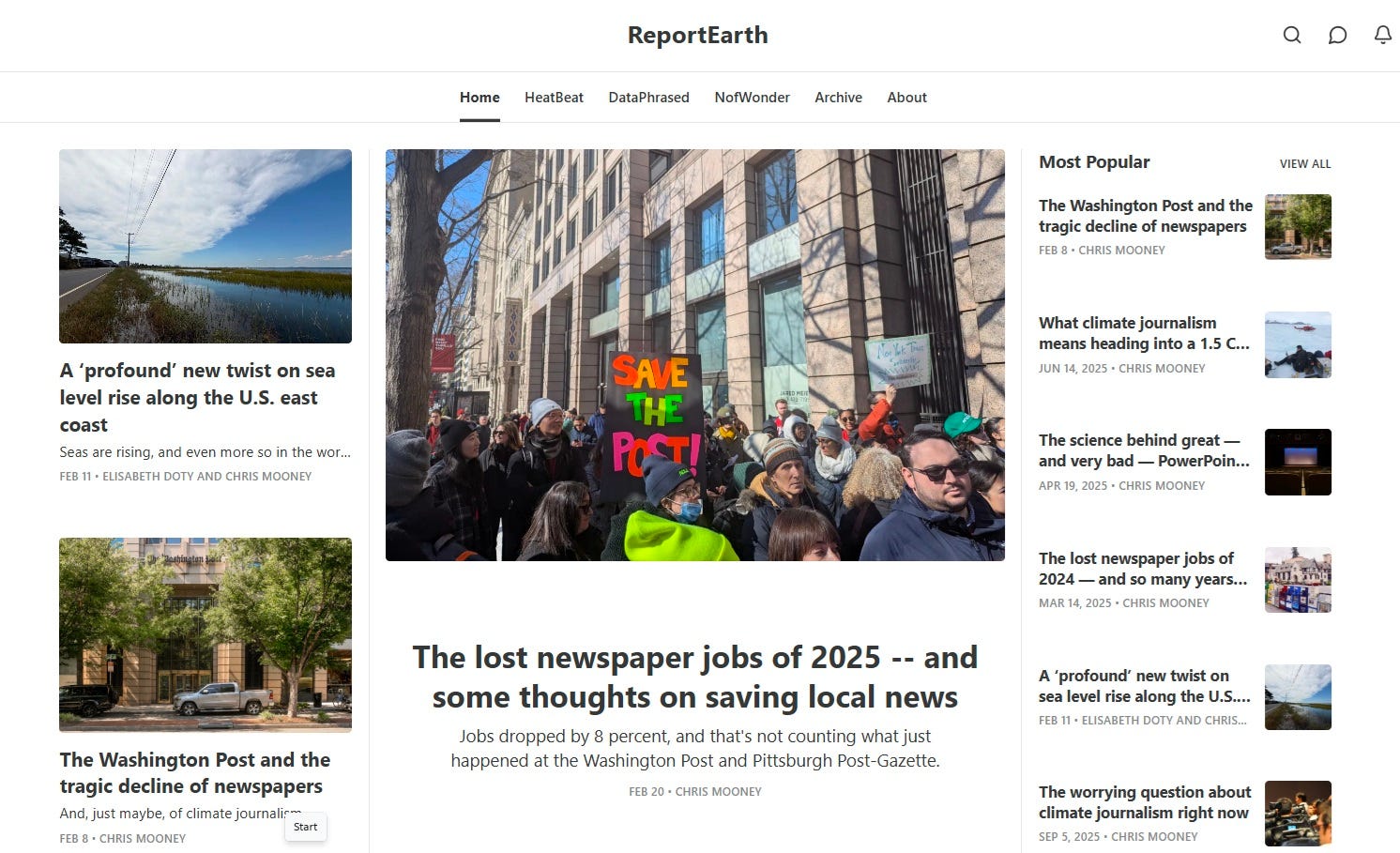
My most successful story was this one, with about double the readership of the average piece here:
If you look at the other stories I consider my most successful, they tend to be similar. Like this one, which was one of the earlier stories to raise alarms about declining climate change coverage in the U.S. media:
And most recently this one, which as of now is my second most read story and, like the other two above, one of my top drivers of subscriptions to ReportEarth:
So what am I learning from all of this?
Substack seems to be a great place for me to try out new ideas, comment on the fields of climate journalism and science journalism, and explore interesting datasets. While I originally thought of this as a place where I would be posting about weekly, I’m not sure any longer if that will be the case. The writing wasn’t always clicking, and sometimes, life just got in the way. (This is my first post in about a month, which kind of proves the point.)
In addition, last year I wrote a few stories for CNN, and my most in depth climate reporting work has thus been appearing there, though I’m flagging it here as well. Substack, then, seems likely to remain a vital outlet for me to share ideas, data explorations, and more experimental writings that don’t quite fit anywhere else.
It’s also the place where I can write the way I want to. I can include all the nuances when I unpack a dataset. I can take an extra week to factcheck, think, and solicit outside responses for added perspective, a process that makes me feel more confident I’ve been thorough.
I can write long.
Editors, bless them, would never let me get away with these transgressions. But here, they can’t touch me! Seriously: As I have written right here, I value editors greatly, and I’d surely have more readers here if I had a good editor. But I also enjoy just being myself, and Substack lets me do that.
In the process, I’ve sent out 25 newsletters (averaging a newsletter around every two weeks in the first year), and published 38 graphics. Throughout this, I have garnered a little over 1450 subscribers so far. Thanks to all of you!
I am not charging anything for content at this time, which seems appropriate for a somewhat experimental Substack like this one (and helps lessen the pressure about posting every week). Nonetheless, even though you didn’t have to, some of you have pledged to pay for my work. Thank you!!! While I have not turned on payments, your generosity has inspired me to think about what else I may be able to do here that might really make a difference, and how that might be supported. It’s a great series of conversations I’m having with myself, and you’ll be the first to know where those end up.
The good thing is, subscribers and article readership are heading in the right direction: Slowly but steadily upwards. You have probably come across some of the many grating “how to make a lot of money on Substack” posts out there. Here’s my version: How to grow slowly and not make any money on Substack. What do you think of its viral potential?
I do have to hand it to the site: This is like blogging again, but far better designed. The most impressive aspect of the model is just how well built the site is when it comes to design, functionality, aids with using social media and headline testing, and so on. It is easy and altogether pleasant to write here, and sharing your work is almost effortless.
One striking thing, as I’ve returned to regular writing in the last year or so, is where my work resonates most, and where it does not. While I am getting some meaningful engagement on Substack, what really works is reposting graphics from my Substack pieces with a bit of commentary on Facebook, where I have an author account. These have often gotten very large viewership and engagement. Here’s an example of a graphic of mine that was very widely shared on Facebook:
Alongside Substack network effects, Facebook is driving the most outside readership to this Substack. On occasion, Bluesky and LinkedIn will step up and be big drivers, but not close to what Facebook is doing.
A key part of the model I’m developing is to have a suite of regularly updated graphics that I’ll share regularly (usually, monthly). In some sense, these graphics are just as central to what I’m producing here as the written posts themselves.
I’ve published 38 graphics so far in my Substack posts. Each one requires its own careful analysis, fact checking and so on. They all live here, at my Chart Archive, and this page is being updated all the time, even when newsletters are not being sent out. You may want to bookmark it. Because it was never sent out as a newsletter, it has a lower readership than my other posts; but in spite of that, it has a pretty a good record of converting subscribers.
The vast majority of the charts were created with Datawrapper, an extremely handy tool and one I teach students to use. I suspect I’ll continue to use it in most cases going forward, principally because Datawrapper charts adjust depending on whether the viewer is using mobile, desktop, or email. That’s hugely valuable in online publishing.
However, I’ve also recently published a first graphic created in R, which allows me to customize some things that Datawrapper (seemingly) can’t, though it sacrifices this responsiveness. Still, there may be more of these coming. We’ll see:
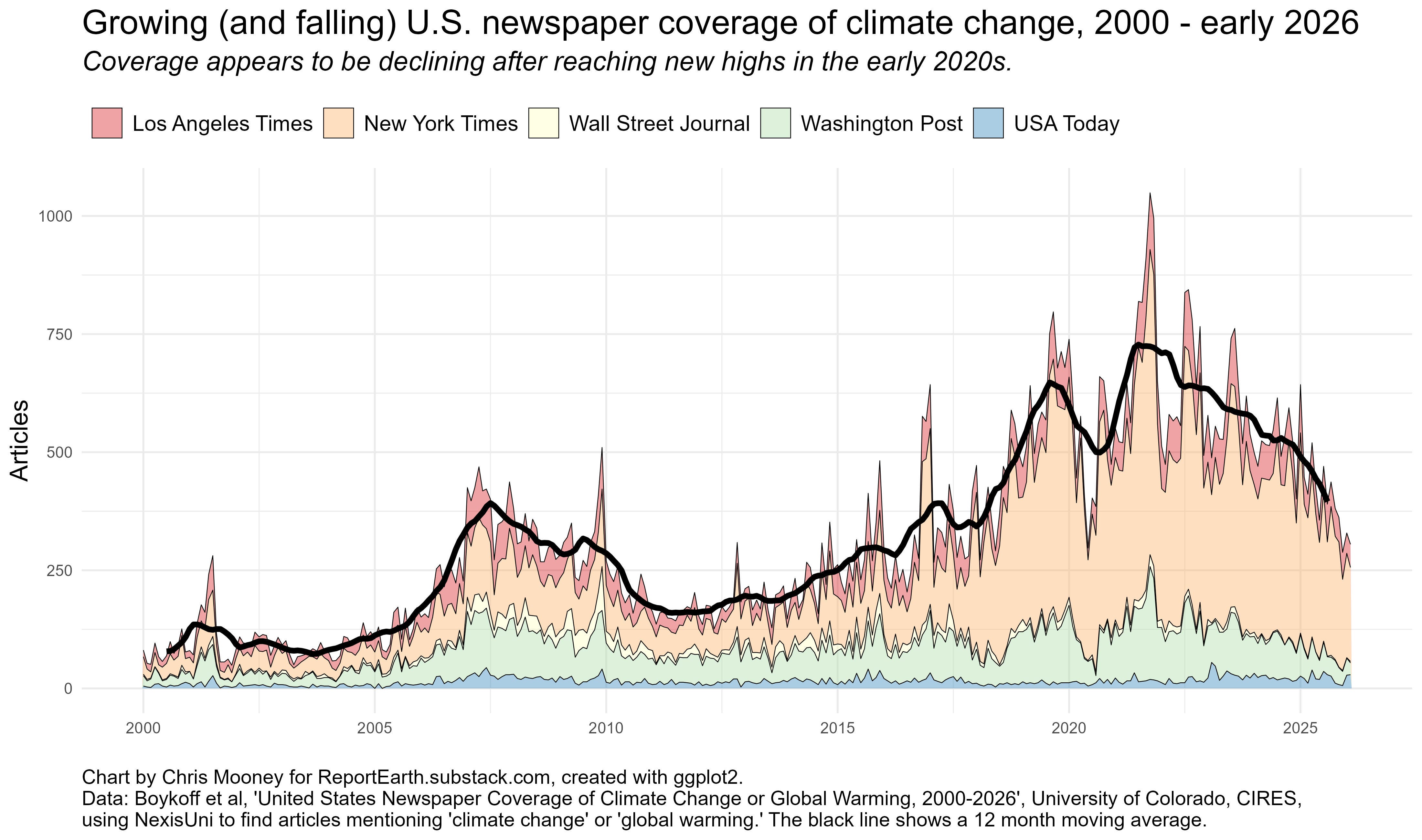
Even over the year I’ve been writing here, we’re seeing a transformation of the media and communications arena. Newspaper jobs and the coverage of climate change continue to shrink. Meanwhile, there’s AI-produced content all over social media, and I suspect on Substack as well. It is starting to filter even into our remaining newspapers. In this context it is more important than ever that journalism show it produces something distinct, valuable, and not replicable by robots.
This is something I plan to write about in much more detail. But for now, I can pledge to you that I do not use generative AI in my writing.
I am certainly open to ways that AI can improve journalism. I think it may be especially useful at the story-finding stage, and can clearly also contribute to the research conducted by data journalists like myself, just as it contributes to science. But, contra some recent newsroom moves, I do not feel comfortable with AI doing journalistic writing directly. My concerns include, but are not limited to, issues such as model hallucinations, bias, copyright, and potential plagiarism. In sum, journalistic originality and accountability alike are at stake here.
It is also worth noting that journalists could fare better when it comes to being trusted by the public, and I don’t see how including AI directly in writing itself will help. Indeed, it is perhaps the diciest of the many possible uses mentioned above.
Consider this survey of the public on AI, and AI in journalism, by the Minnesota Journalism Center and the Poynter Institute. The overall gist is that, of possible journalistic uses of AI, the public trusts the least the ways that news organizations may be using it in “writing the text of news stories,” and strongly feel any such use should be disclosed to readers.
In any event, my pieces here will continue to feature something current AI cannot do: Reporting. In other words, going directly to human sources with questions — including, in the data journalism context, to verify with experts that I’m getting the data right in its display or presentation or, perhaps most important, its interpretation. Through this approach, I can pledge to you I’ll continue to provide my own insights on datasets, their meaning, and the state of the world as they reveal it.
Pretty soon, I’ll be doing all of this in a new role: In August I’m joining the University of Tennessee, Knoxville as the Julia G. and Alfred G. Hill Chair of Excellence in Science, Technology and Medical Writing. Teaching journalism will be at the center of what I do. My recent publication of a story led by UVA graduate student Elisabeth Doty here is a hint of that future, and also something I hope to do more of.
So, if you like all of this stuff, stick with me — or even tell others about me!
Comments
Nothing yet. Say the first thing.
Sign in to join the conversation.