
i think we often mistake simplicity with ease. i protest even to the way the two words are used interchangeably, cheapened to imitatory synonyms of one another. it’s why tiktokers lecturing about building a capsule wardrobe list off the same three sezane pieces as proof of the kinds of clothes you should ‘invest’ in; in their cosplay of the elegant, they’ve forgotten that it is earnest effort and curation that lends itself to refinement.
just because it is easy for you to understand the codes of a thing does not mean it will be easy for you to replicate said codes; this thesis is proved true anytime you watch a video of k-pop idol trying to rap (there are exceptions, obviously, (shoutout to the BTS rapline, han and changbin of SKZ, zico, that little blonde boy from P1 Harmony etc) but there are not nearly enough for me to rescind my shade.)
we see evidence that the motions have been gone through- the hair is in wonky braids, the stage lights reflect off diamond encrusted teeth, we’re sat at the expected 88 bpm- and yet all we are left staring at is an underwhelming counterfeit. the hubris of those who think they can get away with trying to sell us utter dross has always astounded me but not as much as those of us audience members who, like rats starved in a swiss lab, resort to coprophagy to keep ourselves sustained.
in short: i know we’re in a rom-com drought darlings, but please stop gaslighting yourselves into settling for the unstimulating saxaro streamers are trying to pass off as the next great romance film. and yes, this was prompted by a forced viewing of the abhorrently bog-standard people we meet on vacation. picked from a growing gaggle of rom-com novels penned by emily henry (like every author propelled to booktok fame, she pushes out one of these tropey little novels every year or so), people we meet on vacation was hoped by fans of henry to be the flame that reignited something of a rom-com renaissance for the horny and optimistic.
what they found instead was a two hour dairy fest that mocks the genre it was meant to help resuscitate.
characterization as thin as sushi nori hangs over our lead character’s heads. she is the vivacious travel writer (we know this because she keeps telling us that she is a vivacious travel writer, and because she does other quirky girl things like making use of condiments at breakfast and skinny dipping; you just can’t take her silly ass anywhere!)
he is a frowny charisma vacuum of a male lead, wooden. those loyal to the book will say it is a choice informed by alex’s awkwardness and introversion; blyth pulling perpetual shart face is not an anchored character choice. it’s him phoning it in because he knows how unremarkable the whole thing is. the film proports to capture the pairs enemies/friends to lovers arc through continual summer break flashbacks that are meant to illustrate growing intimacy between the two. all you are left with is the sense that someone asked ChatGPT to summarize when harry met sally and then cobbled together a conde nast traveler variant where jameela jamil is your unreasonably supportive editor in chief.
all of this would have been forgivable if the chemistry- that elusive thing that has hoodwinked us so many times before into ignoring even gaping plot holes– had been there. instead, we are left with a film so frigid and unerotic it harkens to the dryness you’d expect of a john oliver monologue on the prison industrial complex. it is a frustration i last felt years ago sat in a dark cinema waiting for anyone but you to finish playing. eugenics barbie had not yet unmasked herself as the sort of venomous pathetic you’d ascribe to a kardashian, but her attempts at selling us a 25 million dollar dhar mann video and pass it off as the genuine article irked.
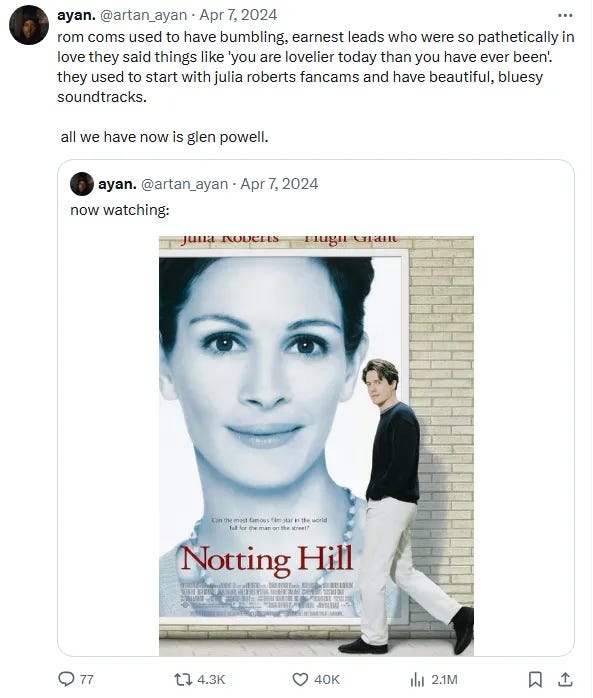
i will never be the kind of writer who shits on the horny romance novel or the bridgerton binge; i enjoy them too much. nor will i ever be someone who thinks that all art should be educational. i will, though, cite that refusal to take storeis that revolve around love seriously is robbing us off something precious, something we should guard.
i haven’t seen heated rivalry yet, but part of the reason why i know my viewing of it will be a question of when and not if is for the simple fact that a.) it has the Camille Charriere seal of approval and b.) it seems everyone involved in its creation took it seriously. i’ve seen little clips here and there of beautifully lit scenes (God how lovely is it to be able to see texture and real bodies marked by life lit WELL and not as though the whole thing was filmed in a dentist practice) that hint to a gravitas i am presently surprised by.

if we can’t take love of all things seriously, what can we?
anyone but you refuses to treat love with any sort of honesty, or depth. it makes the same mistake those who confuse simplicity (person a and person b meet, fall in love, overcome an obstacle to live happily ever after) with the thing being easy.
it is the michael rapaport of romantic comedies; insidious and deformed in its shallowness. so clear are its intentions to cash in on of the backs of an audience starved that it offends. proof that merely shoving two conventipnally attractive white people into sexually suggestive situations does not a romance make, anyone but you wants to see how little respect you have for yourself and the genre.
have you ever hated something enough to start doing research? i was booting up google scholar searching for reasons as to why a genre so warm and human could have been reduced to youtube reel fodder before my uber home had even arrived. so offensive was this film to me, it led to a distinction awarded masters thesis denouncing the entire thing. my argument was simple: the romantic comedy had been killed off for two reasons.
the first was a stubborn refusal to center beyond the whiteness sweeney knew hollywood and the like got tight in the crotch thinking about. the second was that the people involved in making these films simply were not taking them seriously. melancholy was a key ingredient in those older films; that tragi-comic mix brought us films like sleepless in seattle (i rewatched it recently; that woman should have been in JAIL; club chalamet levels of delusion), a film that begins with a shot of sam and his son jonah stood in front of his late wife’s grave. immediately, the tone is set. this will be a story that deals with more than just the playful attraction we grant center stage now. sleepless is a very funny film (meg ryan’s goffiness is at times the most compelling part about the entire thing) but that just means that when our widower gets his happily ever after again, it feels all the more poignant.
there’s always meant to be an emotional buy in, a reason to root for these people despite their neuroses and flaws. it requires a patience we perhaps no longer possess. the shallowness of these scripts mirrors in one way the shallow detachment the digital dating age has brought upon us. people become disposable with a single swipe of the thumb; someone’s hopes, desires, fears, a whole contained history dismissed because what if the next person is hotter? i knew we were cooked when people were getting on the internet to call when harry met sally unwatchable because billy crystal was chopped. if i typed out what i wanted to do to that tweeter they’d put me on some sort of terror watch list.
the detachedness the hyper-modernity of the digital age has encouraged has meant playing an unending game of charades in the attempts of guessing at the kind of person no one could ever swipe left on. that burying of the messy self has existed as long as people have, but the performance that would usually stop when we are alone becomes more difficult to when we have a phone to perform for within our reach at all times. every generation has a story of following the time’s social codes in a bid to chase that shapeless plume we call ‘cool’; our generation’s contains a sort of self-policing that rejects veering into the public sphere in a new way. try hard remains as scathing now as an insult as it did in the 90s or the 80s. and yet, the way our elders talk of romance is marked with a distinct ardor; chasing down buses to get phone numbers, waiting outside record shops to catch a glimpse of a crush, hours spent making mixtapes. we would call the yearners of yesteryear performative love bombers if we ever encountered them now.
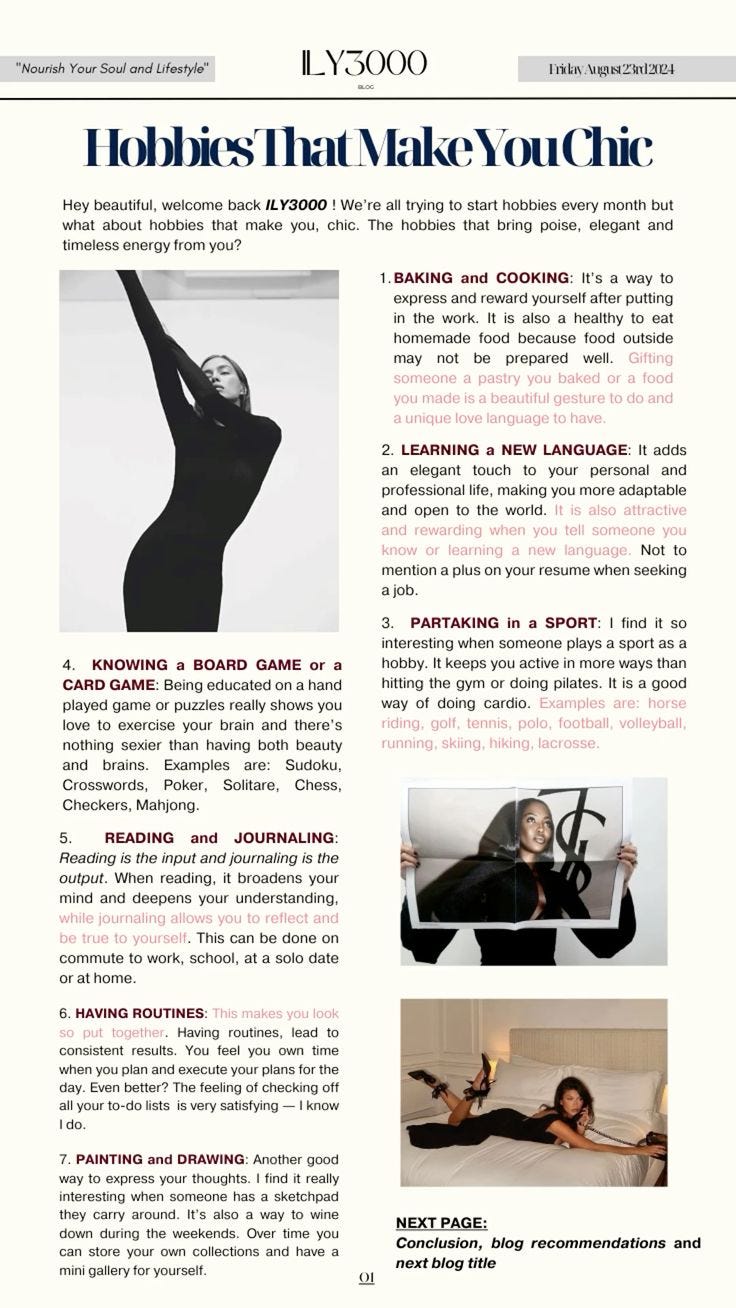
effortlessness is a virtue. look at the way chicness has become the reach for descriptor for all that is aspirational. girls sat in front of cameras list off things that clearly require trying: polyglotism, playing an instrument, having a go to makeup look (something you can only do if you spend hours experimenting, knowing what works for your face and skin etc), travelling, owning item x or y that requires an income, that requires literal labor to be purchased. the romantic comedy is the counter opposite of the chic removedness we worship. it is the turning of two people inside out. it requires shedding that defensive shell dating app hopping has forced upon us; if you don’t care, you won’t feel hurt when that person you thought was the one suddenly ghosts you. the consequence is a chunk of your own humanity.
this gameification of dating combined with the 2010s wave of white feminism (this distinction is important because we are seeing the consequences of this wave’s exclusion manifest in very real ways: the orientalist critiques of iranian women for, the rise of gender essentialism and transphobia etc) that asked questions of the family unit- a unit encouraged by the classic romantic comedy- meant an audience and industry that seemed out of step. writers like tamar jeffers mcdonald insist that these films are pieces of political work that “both reflect and contest the anxieties, assumptions and desires of the specific times and agencies making them.” in short, part of what killed the romantic comedy was a refusal to engage critically with their politics. the carelessness they were treated with trickled down even into our role as viewers.
there is an urge to not take these films seriously, partially because of their popularity with women in particular (rom-coms and chick flicks are often used almost interchangeably as terms since the two sub-genres usually deal with the lives of women, including their love lives) but that willful ignorance of their politics helps to inoculate them against close interrogation - and they need to be interrogated. i am a nora ephron stan down (i sincerely believe that she was one of our greatest filmmakers period, and if we took women’s pleasure half as seriously as we did dudebro dramas, she would be remembered as such) but being a brit meant that i grew up particularly attached to the work of richard curtis.
bluesy, almost gloomy films filled with flawed, gentile women and bumbling, eager men with hearts of gold falling in love, living happily ever after. cobblestone streets, witty banter and ardent love confessions. four weddings and a funeral, about time, notting hill, love actually: i wanted to be buried in one of these pictures. to study these films though is to be confronted by a representation of englishness that is stifling in its exclusion. curtis’ movies reflect the image of what britan looks like to him and his wealthy friends- a prosperous, sophisticated, cosy world that has been cordoned off by the chattering classes that couldn’t be more different to the version of this country we grew up with.
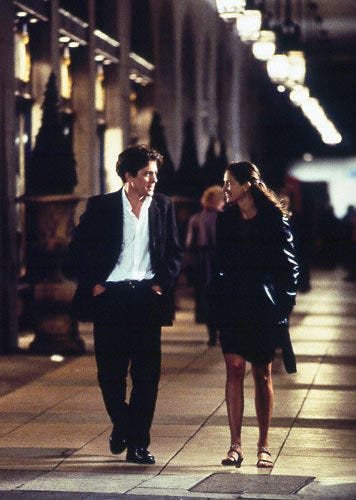
we write what we know, and the version of england that curtis knows is one that revolves entirely around wealthy white brits where everyone else is an afterthought (it’s the same selectivism that emerald fennell suffers from); he was head boy at harrow, went on to study at oxford. his male leads are often self-insert fantasies that centre and present similar characters and recurring themes; affable white english men who are charming precisely because of their posh backgrounds. in many ways, these rom-coms romanticised the exclusion of black and brown characters because to someone like curtis, whiteness is the default. if the romantic comedy is a fantasy land that captures our inner most desires, the desire being communicated here is a world in which the posh and unmelanated fall in love at first sight in antique bookshops in notting hill while the rest of us simply do not exist.
if we aren’t being entirely excluded from the romantic narrative, then we are expected to play the supporting characters who like prop furniture splash some colour onto the screen. in anyone but you, the plot revolves around a wedding- one that happens to be taking place between a lesbian couple, with one of the brides being black. these characters have no personality or purpose beyond being tokens pushing the plot forward for our main white couple. if you held a gun to my head, i could not tell you a single distinguishable feature of either character beyond their identities. that is the point.
the message being translated to audiences through these films is that black and brown people are not worthy of being at the centre, not worthy of being seen as objects of desire, of romanticizing. the same goes for the heteronormativity of these pictures. imagine me and you, the wedding banquet, fire island, crush, red white and royal blue, a nice indian boy are all rarities which further asks questions of whose love stories are marked culturally legitimate. there is a xenophobia present in our idealization of a ‘traditional’ family unit in romance. it shrouds a conservatism you wouldn’t otherwise be comfortable associating with media otherwise marketed as radical in its empowerment of women. if that empowerment is dependent on the exclusion of so many, can it be called empowerment at all?
it has also meant that in terms of story there hasn’t been any real variety in things like setting or what counts as conflict because they all take place in the same socio-economic contexts.
thinking beyond the white protagonists that we are usually subjected to allowed for screenwriters adele lim and peter chiarelli to have access to diversity in setting, story beats and characterisation. the antagonistic force (if you can even really call her that) in crazy rich asians isn’t the male lead’s stupidity or non-commitment but nick’s overprotective mother eleanor sung-young whose distaste for his ‘westernised’ girlfriend forces the couple’s break-up. diversity in character allows for diversity in story too, giving audiences a fresh take on a genre whose tropes are beyond recognisable. if we think of the few films that have managed to capture an audience post the mid-tens slump like rye lane, always be my maybe, to all the boys i loved before they all renew expected tropes with their diversification and the humanness they commit to the centre of the piece. a whole world of romantic possibility exists out there, and we are ignoring it. some of the most attractive stars of our time have voiced their eagerness to star in one, and so far no one is biting.
we have the likes of dev patel, manny jacinto and daniel kaluuya sitting around without a rom-com under their belt. if the world were fair and this were the nineties, we would lock david jonsson in the same romance basement they kept mcconaghy and grant in.
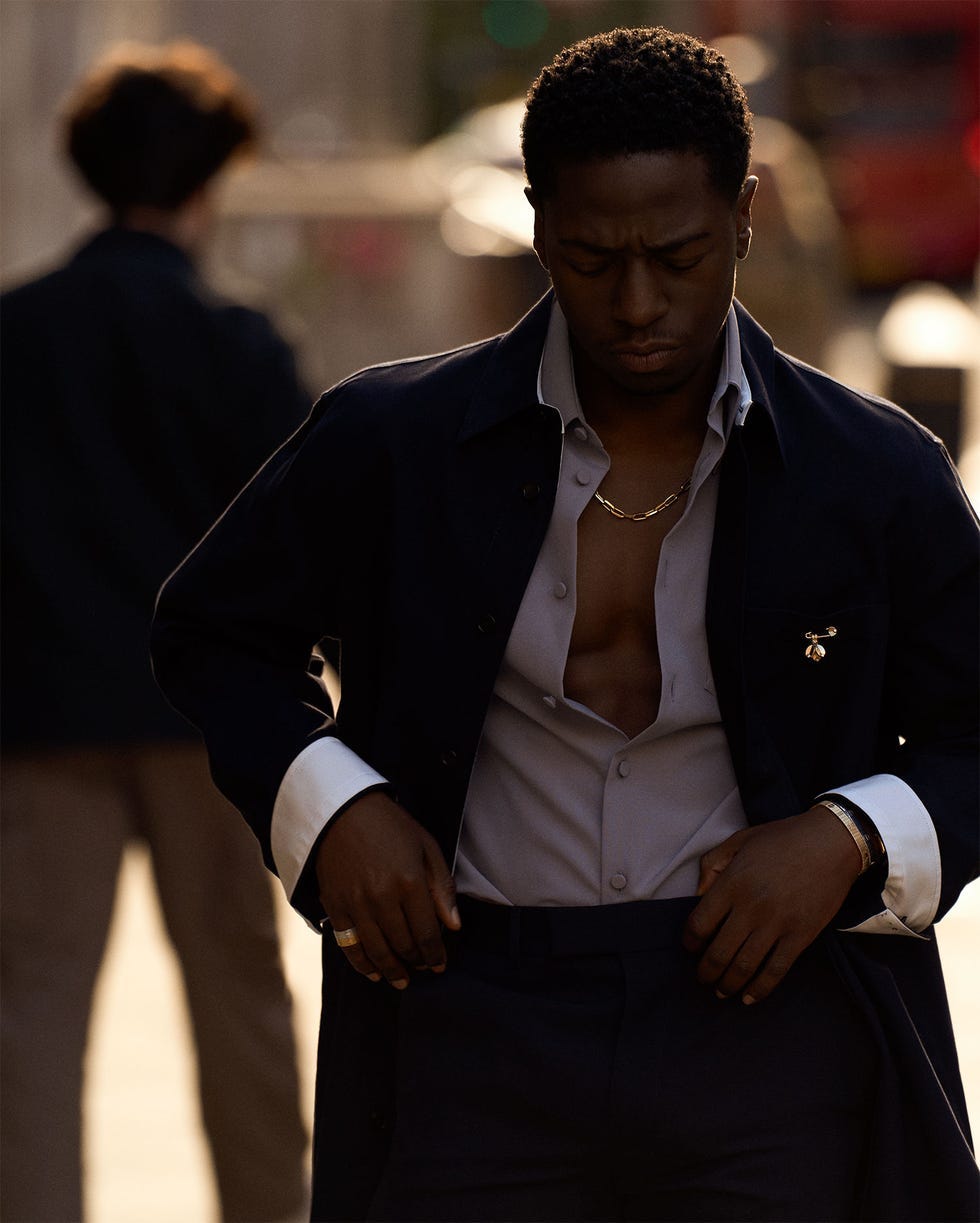
we haven’t gotten our crazy rich asians sequel in part because adele lim wasn’t paid fairly for her work on the first film. it’s almost shakespearean in its irony. we fight the same battles behind the scenes as we do onscreen.
this white fear of not being at the center, of being replaced that dominates our politics also dominates our culture, and it’s had the dullest consequences. if you don’t believe me, go watch people we meet on vacation.
thank you for reading angels, and a happy belated valentines to you all! i am currently rewriting part two of the taylor piece (a broken laptop and a shitty USB has meant it needed a COMPLETE rewrite; if i think about it too long i'll find a really tall building to leap off) so she is coming i promise. that blonditalist won't get off scot free. also: i've missed you all. i hope 26 has treated you with warmth and kindness. i'll see you soon (my interview with cherien dabis drops on thursday inshallah.) as ever, all my love.
aa x
No posts
Comments
Nothing yet. Say the first thing.
Sign in to join the conversation.