

In order to understand what happened to my son, you have to understand what happened to his grandfather.
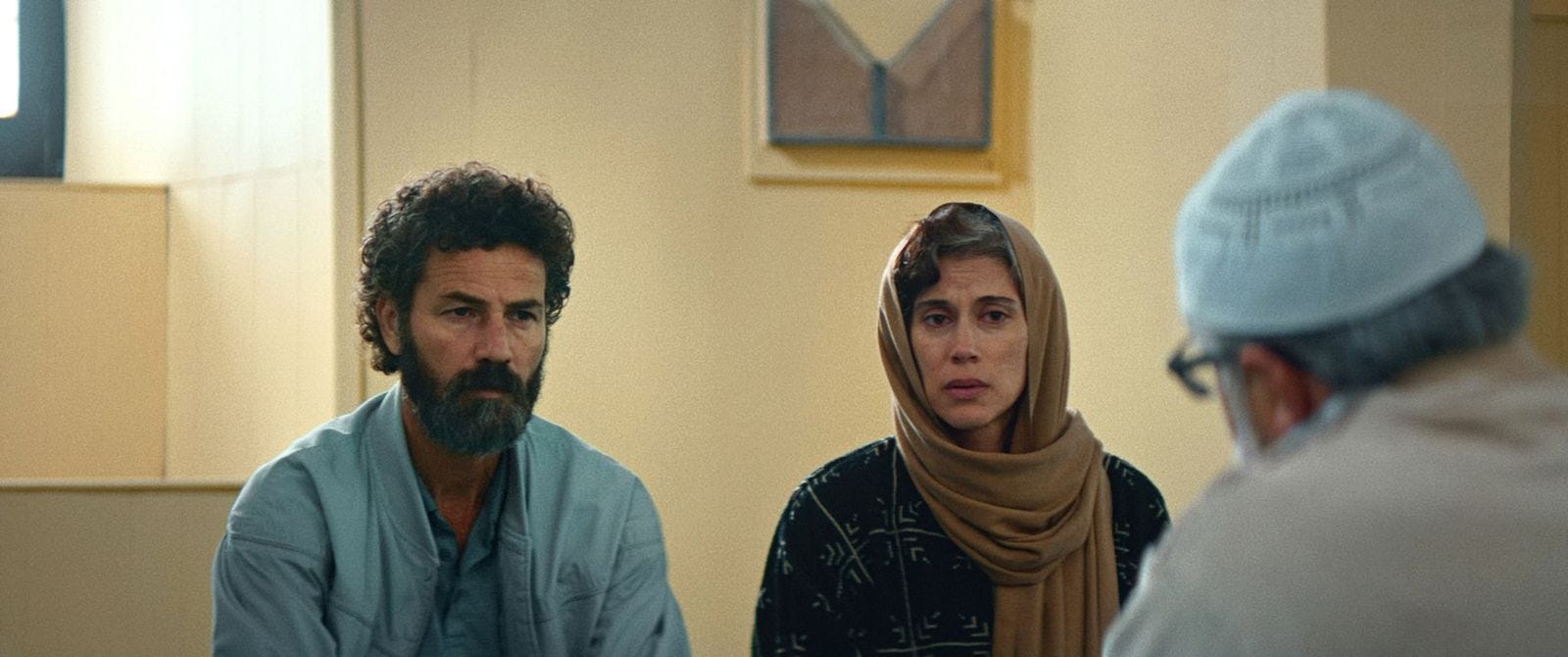
This is the first line of Cherien Dabis’ All That’s Left of You. What follows it is a two and a half hour film portrait of a Palestinian family trying to live a dignified life even as every thinkable system surrounding them makes it impossible to. It is by turns hopeful and evidence of a great, harboured hurt, a wound passed down from generation to generation. Like a pin, it pierces with its unyielding honesty. It seeks to contextualise the continued Nakba, the displacement that marks the lives of so many Palestinians, while also capturing those brief moments of respite and joy they attempt to hold onto. All That’s Left of You is evidence of her people’s lives and at a point of such undisguised censorship and record-burning, that makes it an invaluable work.
Growing up Palestinian in small-town Ohio meant Dabis never had the luxury of ignorance. She was in high school when the Secret Service turned up seeking to question her older sister for supposedly threatening to kill the President. At the height of the Gulf War, her father, a doctor, was made a target, losing patients as America sent its troops to Iraq. Every point of her life is marked by a reminder of her otherness. It is only natural that she now refuses to shuck her identity in order to better sell her work, even as our gatekeepers vie for a piece of her perspective in a bid to perfume their institutions with the impression of progress.
We meet over Zoom for our conversation, she in New York, me in Leicester. Dabis is exactly as I expected, elegant, and warm: a simple black turtleneck and a messy bun evoke images of the artist, interrupted. She has been on an impossible press run, meaning this would have been one of a hundred interviews she has had to parse. It shows in the deftness with which she talks of the work, of herself; her answers are considered but never censored. It takes a good question for her hands to make an appearance, gesturing in order to capture enormity or feeling; a familiar one to evoke a slight hunching of the brows as she tries to find a new way to phrase her reply.
For the next half hour, we share a conversation that touches on Palestine, her time in Ramallah following October 7th, why writing the All That’s Left of You script felt spiritual, and the quest to find community in an industry intent on its own ignorance.
ARTAN: I want to go back to the beginning. You were eight when you went back to Palestine for the first time. What do you remember of that trip?
DABIS: My main memory is of the actual trip there. My family were travelling from Jordan to the West Bank. I was eight, like you said. We were held at the border by Israeli soldiers for twelve hours. That wait is my main memory. The soldiers interrogated my parents over and over, picking through the contents of our suitcases. And then they ordered all of us to be strip-searched, including my baby sisters who were three years old and one.
[Cherian relays this story with an ease that betrays how common it is to her and her people; it is blasé only in so far as it being unremarkable to her. This too is an indictment of Israel.]
My dad was of course so upset and he confronted the soldiers, trying to talk some sense into them, trying to understand why they were holding us. I remember thinking they were going to kill my dad in front of us. When we finally, finally made it through and were on our way to my dad’s village, I remember thinking oh this is what everyone is talking about. This is what it means to be Palestinian. We are really hated. And I couldn’t understand why. My eight-year-old brain couldn’t comprehend it. I was like they don’t know who we are.
ARTAN: Because a child doesn’t understand hate.
DABIS: Exactly. I was like they don’t know who we really are. They misunderstand us.
ARTAN: Fragmentation is a core theme in your work: it crops up in Amreeka, it’s obviously a huge part All That’s Left of You- even your work on Mo. How did you start to write that way? Did it come from your relationship with all these places you call home or from a something more hidden?
DABIS: I think it comes from a desire to explore my own identity and the identity crisis I felt growing up. As a kid, I literally thought of my as a bridge. I had one foot in the US and one foot in the Arab and I was always trying to bring those two sides together. It didn’t make sense, these two identities of mine when I was a kid. I was born and raised in the US, I grew up really going back and forth to Jordan and Palestine. I picked up a camera from a really young age as an attempt to bring the two sides closer. I would show my American friend’s what life was like in Jordan and Palestine and vice versa. My identity is why I became a filmmaker. It was a desire to tell authentic stories about who we are because I saw how much Arabs, Muslims and Palestinians were especially dangerously misrepresented and dehumanised.
ARTAN: Is All That’s Left of You part of that reclamation?
DABIS: Absolutely. This film in many ways is about how as Palestinians our identities are formed by what is happening back home. How the different generations have different reactions to what’s happening, and different reactions to each other. Our identities form in relationship to one another and sometimes in opposition to each other. I observed a lot of that in my own family and wanted to make a film about that intergenerational trauma and how we deal with the grief of the ongoing Nakba in Palestine.
ARTAN: People talk about love being a motivator for a creative career, but I do genuinely believe that it is spite that made me a writer. It was watching Captain Phillips in primary school that sowed that seed for me; I’m Somali and even then as a child, I was startled by how animalising it was. Is there a film like that for you, one you’re writing or directing in opposition to?
DABIS: I understand that feeling entirely. There are so many I don’t even know where to start. One of them was a film called True Lies. Have you seen this film?! The one with Arnold Schwarzenegger?
ARTAN: I have!
[True Lies follows Schwarzenegger, a US Government agent who is tasked with locating some atomic warheads and stopping the bad guys-kaffiyeh-clad Arab terrorists- from blowing up innocents. When director James Cameron was confronted by a journalist for his lazy depiction, he quipped: I just needed some convenient villains. It could [have been] anybody. I could have picked Irish terrorists.]
DABIS: There were so many insanely, insanely caricature-y movies of Arabs as terrorists and that was one of the films where I was like are you kidding me? Every single time I saw it, I would just get so angry. Hollywood is culpable, even in creating I think a more violent world. As creatives, we need to be incredibly careful about what we put out into the world. We are putting ideas in people’s heads; we are putting images in people’s heads. That’s a great responsibility. I take that very seriously and I don’t think that Hollywood in general has. This industry has stereotyped so many ethnic groups. God, I don’t even know how to articulate what that makes me feel.
ARTAN: There’s something I’m curious to ask but I don’t know if I’ll be able to shape it elegantly into a question.
DABIS: Ask it anyway.
ARTAN: As a filmmaker, regardless of your valid criticism of the industry, you’re forced to engage with it because of how white-centric, Anglo-centric the film industry still is. What is it like to negotiate that relationship while also having to watch the imperialist genocide denialism that infects Hollywood? I’m only observing all of this and even to me, it feels like such a burden.
DABIS: It’s such a great question, and I appreciate you for asking it the way you did. I cannot tell you how often I’m like I’m going to have to retire. I just don’t know that I can deal with this anymore. It feels like such a weight, such a heavy weight that I just really want to put down. Does that make sense?
ARTAN: Of course it does.
DABIS: You said burden, and it’s the perfect word. Because there’s really such a cognitive dissonance. There are many moments where it feels like it’s not a negotiation I want to be having. Luckily I’ve never had to compromise because I’ve found funding outside the system, and that’s what really keeps me going. That and meeting allies, people who are so aligned and believe deeply in what I’m doing and what filmmakers like myself are doing so that sense of community. But there are so many times where I’m like I should stop. Maybe I should just write a novel. This might be it for me. The challenges of making this film topped with the impossibility of finding major distribution in the United States was a really confounding moment for me.
ARTAN: In what way?
DABIS: It just felt so thankless. So unbelievably thankless. That you can work so hard and make something that is so clearly moving people’s hearts- the audience reactions have been so profound- and yet still, nothing.
ARTAN: This question of whether it’s ever possible to write against the system while in it has been so relevant, even among us critics. I think the release of The Voice of Hind Rajab brought that question to the forefront again in an almost unavoidable way. One side felt it was opportunistic, convenient even to have the film come out in the midst of the genocide, a kind of image-laundering exercise by Hollywood. The other argues it’s a necessary piece that bares testimony to Hind’s life and the truth of Palestinian reality that’s being denied. Where do you fall? Are we being unnecessarily cynical?
[The Voice of Hind Rajab is an Oscar nominated docudrama directed by Tunisian filmmaker Kaouther Ben Hania. It reconstructs the murder of the five-year-old girl who was killed in 2024 by the IOF alongside six family members and the two paramedics who tried to come to her rescue. The film features the real audio recording of her voice as she pleas for help. Just yesterday, she rejected an award at the Cinema for Peace Gala in Berlin after former Israeli general Noam Tibon was also awarded.]
DABIS: It’s really hard for me to say. I know Kaouther and I know her intention and her heart are in the right place. And so whatever I think of the film for me is really colored by her. By my knowledge of who she is and the fact that she’s a really good person who sincerely wants to uplfift the ovoice of this little girl. I understand the criticism, but I really stand behind Kaouther as a filmmaker and I’m a fan of hers. Is that too wayward an answer?
ARTAN: No. I think it’s human and nuanced.
DABIS: I just think intention matters. The reason why a filmmaker makes a piece of work is absolutely vital to our understanding of it. When we put the work out into the world, it no longer belongs to us. Our intention gets lost in the interpretation of the many and that’s okay. There is no one movie. There are a million versions of it because every person has their own version. Once that happens as a filmmaker, it becomes scary. Sometimes your intention gets lost and you read a review and you’ll go guys no this wasn’t what I meant!
ARTAN: Is this the part of the interview where I apologise slash defend my colleagues and I?
DABIS: [laughs] No I get it completely! It comes with the job but sometimes you just hope everyone will get it. And when that doesn’t happen, you hope the majority will atleast.
ARTAN: You and your crew were in Ramallah when Israel began it’s retaliatory bombardment of Palestinians post-October 7th. What do you recall of that moment.
DABIS: We landed in Palestine in May of 2023 to begin pre-production. I worked with a massive Palestinian crew on the ground. We found all of our locations; we had a massive warehouse of carefully curated props from all of the different time periods, we’d begun construction on our locations. Everything was ready. And then October 7 happened, and we had to stop immediately. I had foreign crew who had just arrived in Palestine the week before, and very soon after the events of October 7 they decided that they wanted to leave and go home. Wes tarted evacuating on the ninth. e went to Cyprus, and we thought we’d shoot that part of the movie first, and we were always hoping to return to Palestine.
ARTAN: You were living your film even as you made it.
DABIS: I think that was the hardest part. We were making a movie about what was happening, and it was happening right then even to us so it was just really emotional. Our life and art kind of merged, you’re right.
ARTAN: I can’t watch anything without being compulsive about the script, and one of the things I can’t imagine with a multi-generation expansive piece like All That’s Left of You is how you go about drafting it without drowning. What did day one working on the script look like?
DABIS: I went about writing this film in a very different way to my previous films. Before, I just had an idea and intuited my way through the first draft. I’m a very character driven writer, so I’m always obsessing over what choices these people would make and then that’s usually where the plot comes from. With this film, I knew it was much bigger than anything I had ever made. I knew I had multiple generations and therefore many more characters that I needed to follow. I knew structurally it was going to be different. I really wanted to develop them all before I sat down to write. I spent five years sitting with these characters.
I bought a notebook and filled it with backstory’s. I immersed myself in our history and chose my time periods. I figured out the entire thing out before drafting. I would daydream and see what else came to me. Because I know I’m a control freak, I don’t go towards that control. What I’m looking for in my process is inspiration and I want to balance control with openess. I read books, I let dialogue come to. It would come to me while I was on the treadmill or in the shower. I didn’t even know what scene I would include them in. By the time I sat to write, it just flowed out of me. I don’t know if I’ll write every script like that. Different ideas require different processes but this was so intuitive. It honestly felt like I was being guided by the ancestors.
ARTAN: That’s beautiful.
DABIS: Isn’t it?
Every guest of the newsletter is asked for their recommendations, the art that has inspired or asked questions of them they hope more people would pay attention to. Here are Cherian’s:
The work of Hala Alyan, Palestinian-American writer and poet: Her poetry is just so beautiful and full of truth. She’s the kind of writer who gets to the heart of something. I’ve been reading her most recent book I’ll Tell You When I’m Home. You can follow Hala on Instagram.
Kokuho (2025), directed by Lee Sang-il: It’s just absolutely stunning, from the cinematography, to the production design I haven’t been able to stop thinking about it. It’s really about the art of Kabuki, the classical form of theatre in Japan. The story is epic, it’s also multi-generational. It’s heart-breaking and it’s a window into a world so few of us know anything about. I was so thoroughly impressed by it. The film, shortlisted for Best International Feature, is nominated for a Best Hair and Makeup Oscar at this year’s ceremony.
No posts
Comments
Nothing yet. Say the first thing.
Sign in to join the conversation.